
Wristwatches · Wristwatch
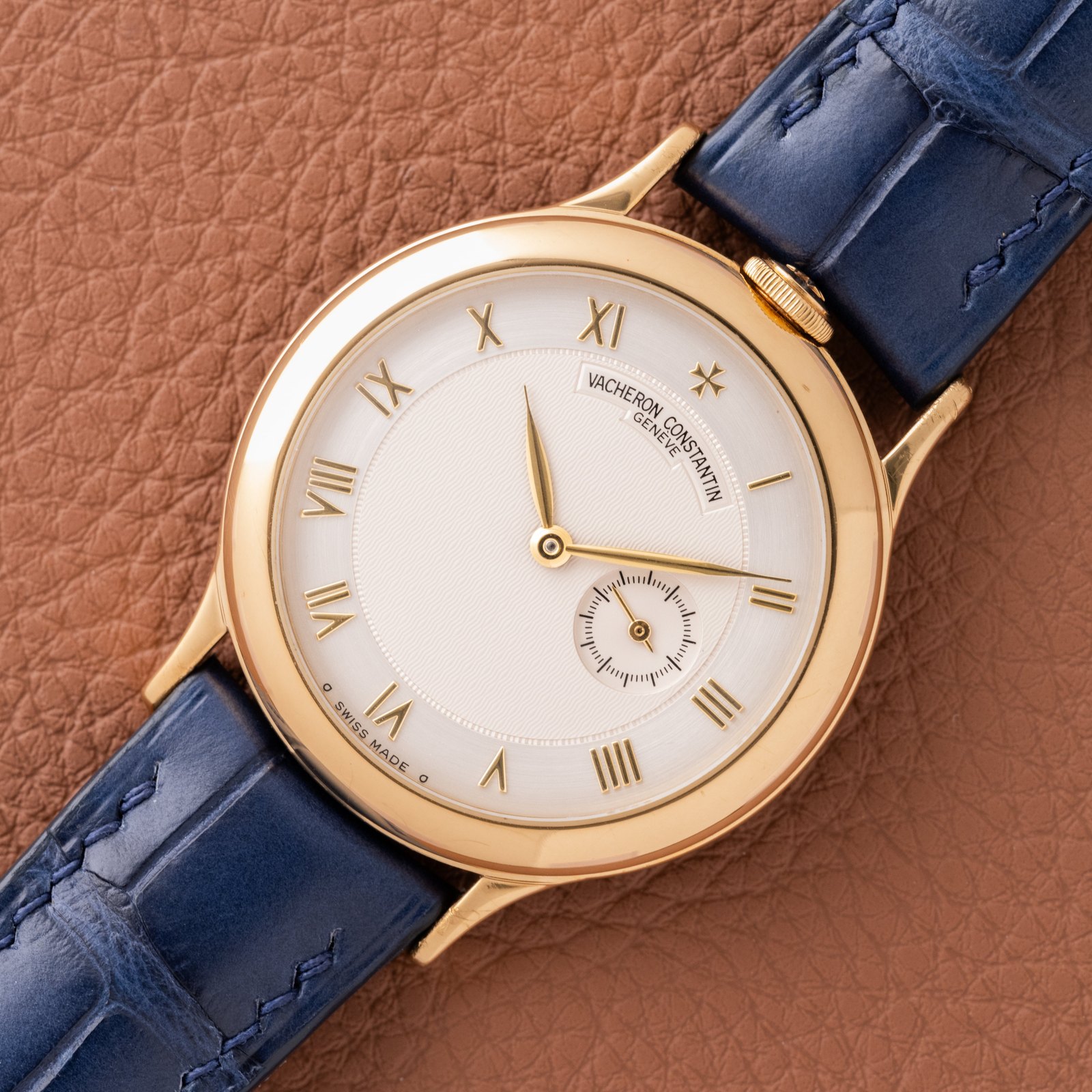
Vacheron Constantin Top Winder (Ref. 92012), 1990s
- Maker / attribution
- Vacheron Constantin (maker)
- Date
- 1990s
- Historical period
- Mechanical Renaissance (1990 – 2010)
- Country of origin
- Switzerland
- Object type
- Wristwatch
- Dimensions
- Case 35 mm
- Stock no.
- Product 8688081174711
- Credit line
- Dealer listing, Huntington Company (product 8688081174711)
- Catalogue title (original)
- 1990s Vacheron Constantin Top Winder (Ref. 92012) (English)
View the source record (dealer listing) ↗ (opens another website in a new tab)Suggest a correction
Record summary
Catalogued by Huntington Company (dealer) (stock number Product 8688081174711), this is a wristwatch by Vacheron Constantin, made in Switzerland, dated 1990s. The Atlas places it in the Mechanical Renaissance period (1990 – 2010) of its Wristwatches collection. Recorded dimensions: Case 35 mm. The record is illustrated with 6 photographs.
Assembled from the source record's structured fields. Dates and attributions are given as the source states them; where a field is missing the Atlas leaves it blank rather than estimating.
Catalogue description
Dealer description — Huntington Company
History and Significance For over 270 years, Vacheron Constantin has quietly represented the pinnacle of traditional Swiss watchmaking. While many collectors immediately gravitate toward the maison's complicated perpetual calendars or ultra-thin masterpieces, the brand has long excelled at something arguably more difficult: creating simple time-only watches with proportions and finishing so refined that they never go out of style. The Top Winder collection embodies that philosophy beautifully. Produced during the 1990s, these watches arrived during an era when larger, more complicated sports watches were beginning to dominate the market. Vacheron Constantin instead remained committed to timeless elegance, producing understated dress watches that relied on craftsmanship rather than excess. The result is a watch that feels just as sophisticated today as it did three decades ago. Reference 92012 perfectly captures this understated approach. The warm yellow gold case measures a balanced 35mm, while the silver guilloché dial is framed by applied Roman numerals and complemented by a small seconds display that adds just enough visual interest without disturbing the clean symmetry. It is the kind of watch that rewards careful observation, revealing thoughtful details each time it is worn. Writer’s Thoughts Every so often, a watch comes through the office that reminds us why originality matters. Before looking at the dial or movement, the crisp lines of the case immediately caught our attention. This Top Winder has avoided the polishing wheel, allowing its elegant proportions to remain exactly as Vacheron Constantin intended. Reference 92012 is already a difficult watch to find in honest condition, but pairing an untouched case with a flawless original dial makes this example especially appealing. While the blue leather strap is a tasteful later replacement, we're pleased that it still retains its original solid gold Vacheron Constantin buckle, an accessory that is often separated from the watch over the years. We appreciate dress watches that have been preserved rather than restored, and this one represents exactly that philosophy. Our Promise Every watch is thoroughly vetted, carefully described with complete transparency, and guaranteed authentic. Each piece is offered in honest condition, ensuring collectors receive a timepiece that reflects both originality and integrity. Specifications Brand: Vacheron Constantin Model: Top Winder Year: Circa 1990s Case Material: 18K Yellow Gold Case Size: 35mm Dial: Silver guilloché with applied Roman numerals Movement: Automatic Strap/Bracelet: Blue leather strap Buckle/Clasp: Original 18K yellow gold Vacheron Constantin buckle Contents: Watch only Condition Case: Unpolished yellow gold case with crisp factory lines and only light signs of honest wear. Dial: Original dial in excellent condition with no visible aging or imperfections. Hands: Original hands in excellent condition. Crystal: Clean with light signs of use consistent with age. Strap/Bracelet: Generic blue leather strap showing light wear. Buckle/Clasp: Original solid gold Vacheron Constantin buckle in excellent condition.
Historical context
Mechanical Renaissance (1990 – 2010)
Mechanical watches return as cultural objects; independent watchmaking flourishes.
Mechanical watches returned as cultural and luxury objects. Complications, tourbillons and new materials proliferated; independent watchmakers such as George Daniels, F.P. Journe and Philippe Dufour revived artisanal watchmaking; collecting vintage watches became a major field.
Read the period in the timelineMore wristwatches from this periodEarlier: Quartz Revolution
Atlas type guide
Wristwatches
Bracelet watches were worn by women from the early nineteenth century — Breguet made one for Caroline Murat, Queen of Naples, in 1810–12 — but the wristwatch only became a man's instrument with military use and aviation in the early twentieth century. Between the World Wars it overtook the pocket watch; the 1920s and 1930s brought rectangular Art Deco cases, water-resistant cases and the first automatic winding systems.
After 1945 the wristwatch became a carrier of identity — dress watches, sports and dive watches, chronographs, calendars — produced by Swiss, American, Japanese, German, Soviet and Chinese industries. The quartz revolution after 1969 and the mechanical renaissance since the 1990s, including the rise of independent watchmakers, complete the story.
What to look for
- The reference number (between the lugs or inside the case back) and serial number, the starting point for dating.
- The calibre: its maker and number are often stamped under the dial or on the bridge.
- Originality of dial, hands and crown — refinished ('redial') dials are common.
- Case material marks: 18K/750, 14K/585, stainless steel, gold-filled, plated.
Dating clues
- Wire-lug cases: before c. 1925.
- Water-resistant screw-down cases: from 1926.
- Quartz movements: from 1969; sapphire crystals widespread after c. 1980.
General guidance written by the Atlas editors about this kind of object. It is not a statement about this particular piece; for that, rely on the source record above and on physical examination.
Related records
Pocket Watches · c. 1896
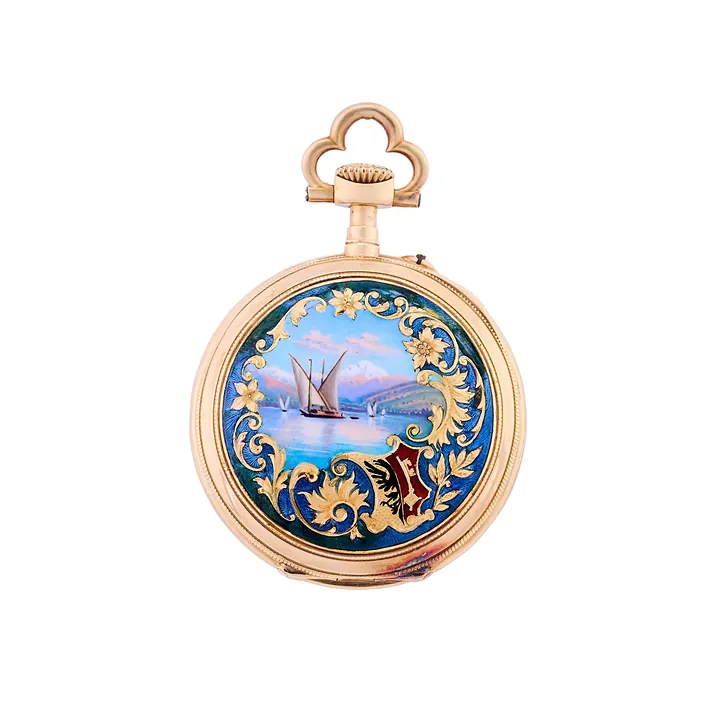
Vacheron Constantin “grand TIR de L’exposition Nationale, Genève 1896, c. 1896
Antiquorum auction archive, Geneva
Pocket Watches · c. 1940
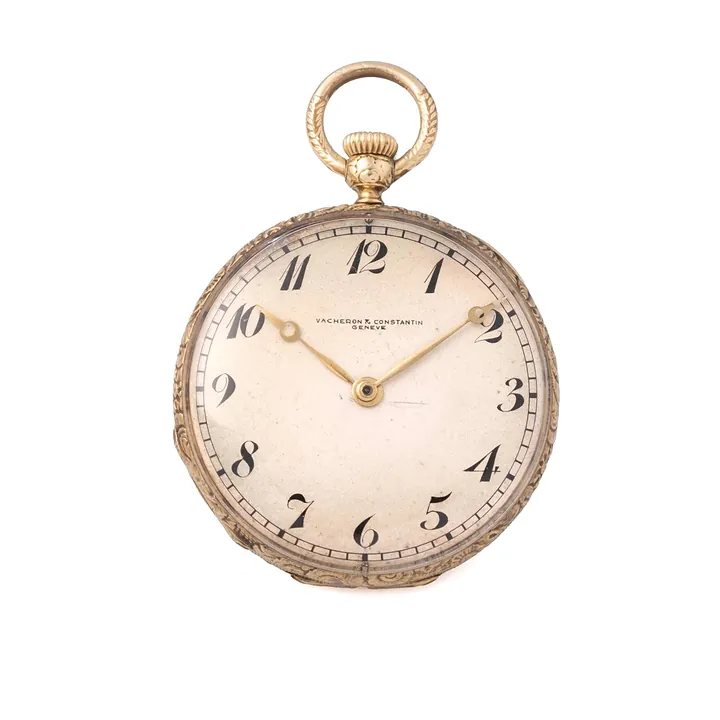
Vacheron Constantin pocket watch, ref. 345, c. 1940
Antiquorum auction archive, Geneva
Pocket Watches · c. 1945
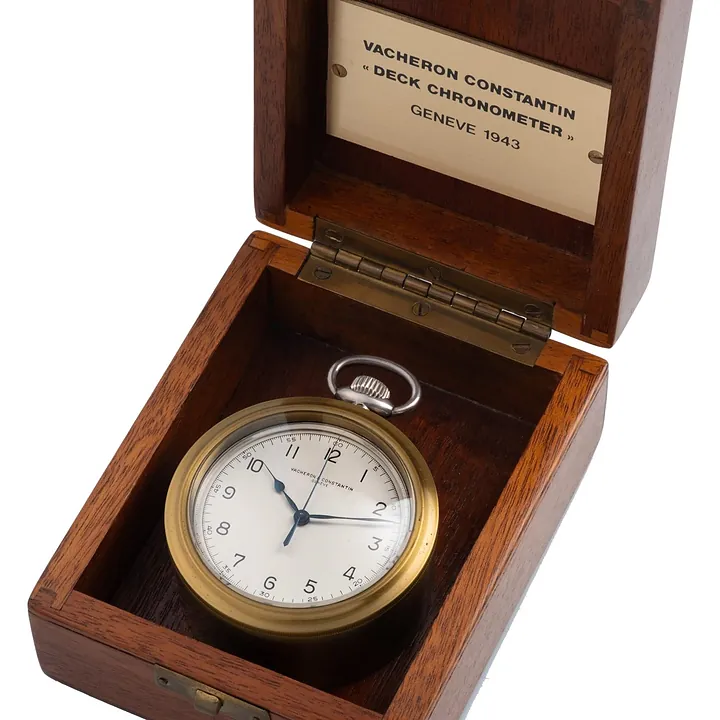
Vacheron Constantin pocket chronometer, c. 1945
Antiquorum auction archive, Geneva
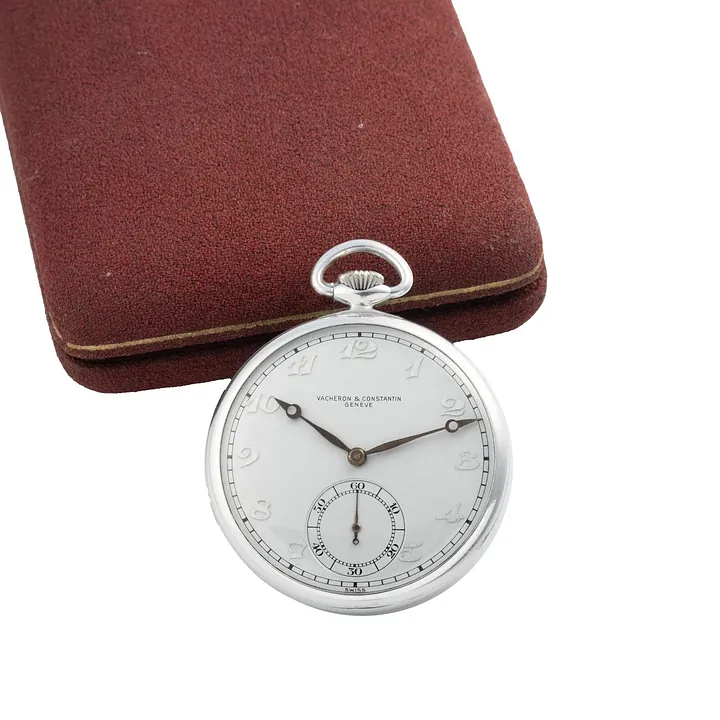
Pocket Watches · c. 1945
Vacheron Constantin watch, c. 1945
Antiquorum auction archive, Geneva

Wristwatches · 2008
Wristwatch by Breitling?, 2008
Museum Rotterdam

Wristwatches · c. 1990s
Audemars Piguet Bamboo, c. 1990s
Antiquorum auction archive, Geneva

Wristwatches · c. 1990
Audemars Piguet Huitieme Perpetual Calendar, ref. 25696PT, c. 1990
Antiquorum auction archive, Geneva

Wristwatches · c. 1990
Breitling Chronomat, ref. b13050.1, c. 1990
Antiquorum auction archive, Geneva