
Wristwatches · Wristwatch
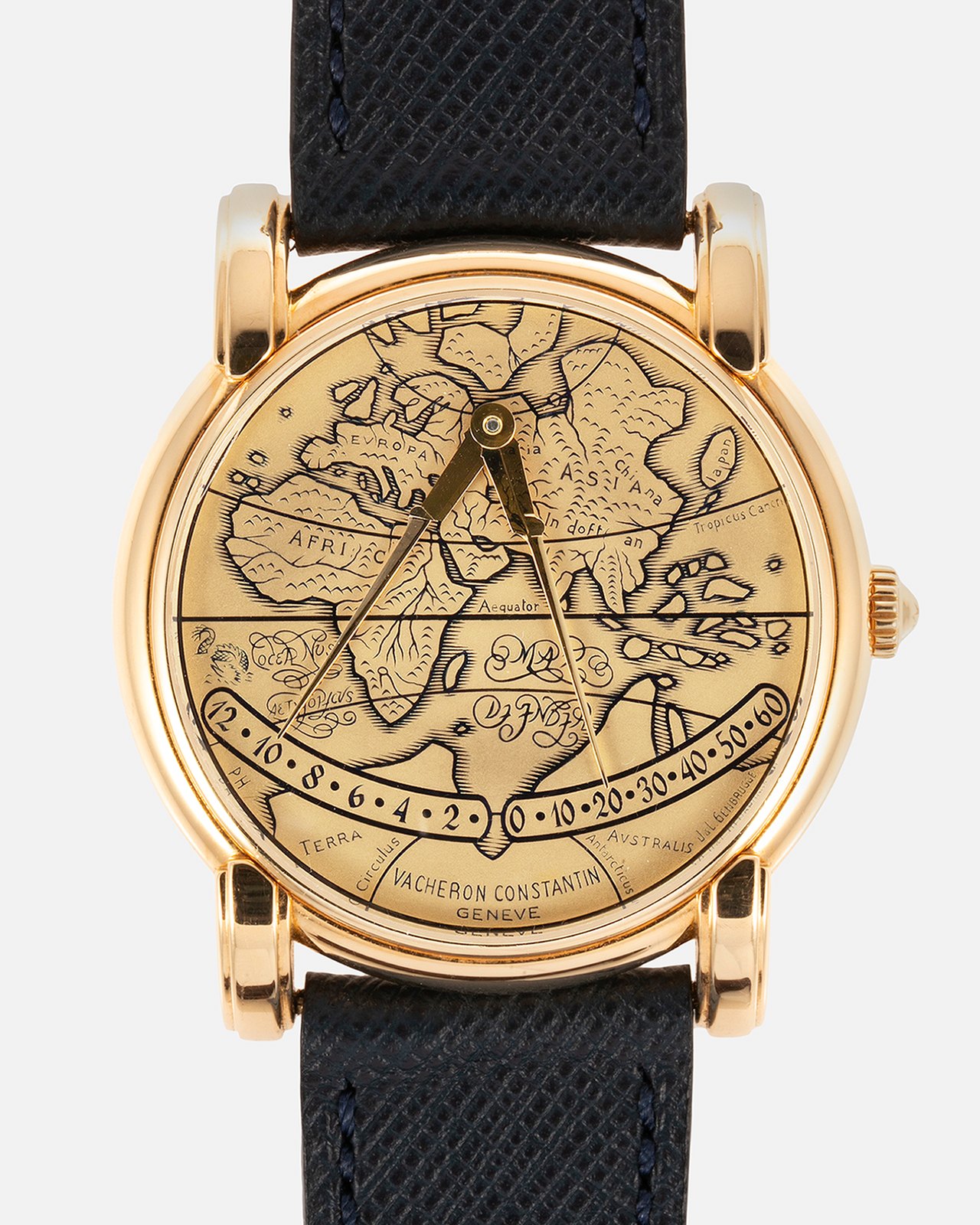
Vacheron Constantin Mercator Ref. 43050, 1994
- Maker / attribution
- Vacheron Constantin (maker)
- Date
- 1994
- Historical period
- Mechanical Renaissance (1990 – 2010)
- Country of origin
- Switzerland
- Object type
- Wristwatch
- Dimensions
- Case 36 mm
- Stock no.
- Product 6894293155927
- Credit line
- Dealer listing, S.Song Watches (product 6894293155927)
- Catalogue title (original)
- Vacheron Constantin Mercator Ref. 43050 (English)
View the source record (dealer listing) ↗ (opens another website in a new tab)Suggest a correction
Record summary
Catalogued by S.Song Watches (dealer), Seattle (stock number Product 6894293155927), this is a wristwatch by Vacheron Constantin, made in Switzerland, dated 1994. The Atlas places it in the Mechanical Renaissance period (1990 – 2010) of its Wristwatches collection. Recorded dimensions: Case 36 mm. The record is illustrated with 6 photographs.
Assembled from the source record's structured fields. Dates and attributions are given as the source states them; where a field is missing the Atlas leaves it blank rather than estimating.
Catalogue description
Dealer description — S.Song Watches
Time-only watches are pretty much commonplace in the world of watchmaking, but there are times I find myself yearning for something a little bit off the beaten path, something truly unconventional. With mainstream watchmaking becoming undecidedly sterile in recent times, lacking innovation and pushing lazy new releases, one can look to the 90s where there was a myriad of activity and creativity, fuelled by the onslaught of the preceding quartz crisis. Watch brands had to be different in order to survive and that’s exactly what they did. Despite Vacheron Constantin’s seemingly conservative and traditional approach to watchmaking, the 90s was an interesting period for the brand as they experimented with creative ways of displaying time. One of the most iconic and successful iterations of said experiment is what you see here today- the Vacheron Constantin Mercator 43050. Diving into the origin story of this reference, the Mercator Ref. 43050 was conceived by Jean Genbrugge, an accomplished enamelist and watchmaker who was contracted by Vacheron Constantin. Working together with his wife Lucie, the inspiration for the watch stemmed from their admiration for the renowned cartographer Gerardus Mercator, who revolutionised map-making by creating the first flat projections of the globe. This essentially laid the foundation for the modern world maps we use today. Released in 1994 to commemorate the 400th anniversary of Gerardus Mercator’s passing, the 43050 displayed time in an unconventional and original way, featuring two compass-shaped retrograde hands with the hour display on the left and the minute display on the right. My favourite part about this watch is how you can hear the movement of time, as when the minute hand glides past 60 there is a satisfying ‘click’ that bounces it back to zero while the hour hands simultaneously jump perfectly to the next hour. The most satisfying ‘click’ of course comes at 12:59, when both hands retrograde back to the centre at 1:00. Beneath the hands lies a beautifully crafted gold dial that depicts a historical map initially charted by Mercator, displaying the continents of Europe, Africa, Asia and Australia. Engraved into the dial, the map lines and names are filled with lustrous black enamel, adding a beautiful sheen and depth to the otherwise flat dial. Notably, at the 4 o'clock position of the dial’s periphery, you will also find a small, subtle line of text bearing the inscription " J&L Genbrugge ", a thoughtful detail that pays homage to the visionary couple who conceived and produced these beautiful Mercator watches. Housed in a classically round 36mm yellow gold case, the Mercator features a stepped bezel with thick and matching stepped lugs that finishes off the decidedly monochromatic watch. There is something about a gold-on-gold watch that really works, and especially for the 43050, this single tone of colour throughout really allows for the artwork on the dial to take centre stage. This Vacheron Constantin Mercator 43050 is powered by the VC Cal. 1120M, which is essentially a JLC Cal. 920 that has been heavily modified to allow for a dual retrograde function. Displayed through its sapphire caseback, it also features a 21-carat gold rotor with a hand engraving that says “ 1594 – Gerardus Mercator – 1994 ” on the outer edge. As far as wearability goes, the slim proportions of the Ref. 43050, with its gracefully stepped lugs gently sloping towards the edges create a gradual taper that ensures an impeccable fit on the wrist. The Mercator was made for roughly 10 years, with only 638 pieces produced throughout that time period, making this a rare find. If you are looking for something that is both classic and truly innovative and creative, look no further.
Historical context
Mechanical Renaissance (1990 – 2010)
Mechanical watches return as cultural objects; independent watchmaking flourishes.
Mechanical watches returned as cultural and luxury objects. Complications, tourbillons and new materials proliferated; independent watchmakers such as George Daniels, F.P. Journe and Philippe Dufour revived artisanal watchmaking; collecting vintage watches became a major field.
Read the period in the timelineMore wristwatches from this periodEarlier: Quartz Revolution
Atlas type guide
Wristwatches
Bracelet watches were worn by women from the early nineteenth century — Breguet made one for Caroline Murat, Queen of Naples, in 1810–12 — but the wristwatch only became a man's instrument with military use and aviation in the early twentieth century. Between the World Wars it overtook the pocket watch; the 1920s and 1930s brought rectangular Art Deco cases, water-resistant cases and the first automatic winding systems.
After 1945 the wristwatch became a carrier of identity — dress watches, sports and dive watches, chronographs, calendars — produced by Swiss, American, Japanese, German, Soviet and Chinese industries. The quartz revolution after 1969 and the mechanical renaissance since the 1990s, including the rise of independent watchmakers, complete the story.
What to look for
- The reference number (between the lugs or inside the case back) and serial number, the starting point for dating.
- The calibre: its maker and number are often stamped under the dial or on the bridge.
- Originality of dial, hands and crown — refinished ('redial') dials are common.
- Case material marks: 18K/750, 14K/585, stainless steel, gold-filled, plated.
Dating clues
- Wire-lug cases: before c. 1925.
- Water-resistant screw-down cases: from 1926.
- Quartz movements: from 1969; sapphire crystals widespread after c. 1980.
General guidance written by the Atlas editors about this kind of object. It is not a statement about this particular piece; for that, rely on the source record above and on physical examination.
Related records
Pocket Watches · c. 1896
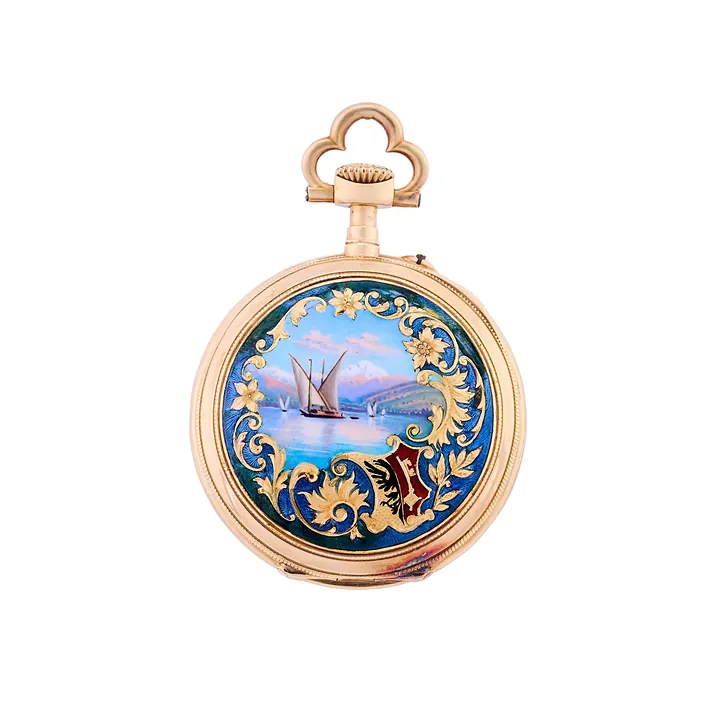
Vacheron Constantin “grand TIR de L’exposition Nationale, Genève 1896, c. 1896
Antiquorum auction archive, Geneva
Pocket Watches · c. 1940
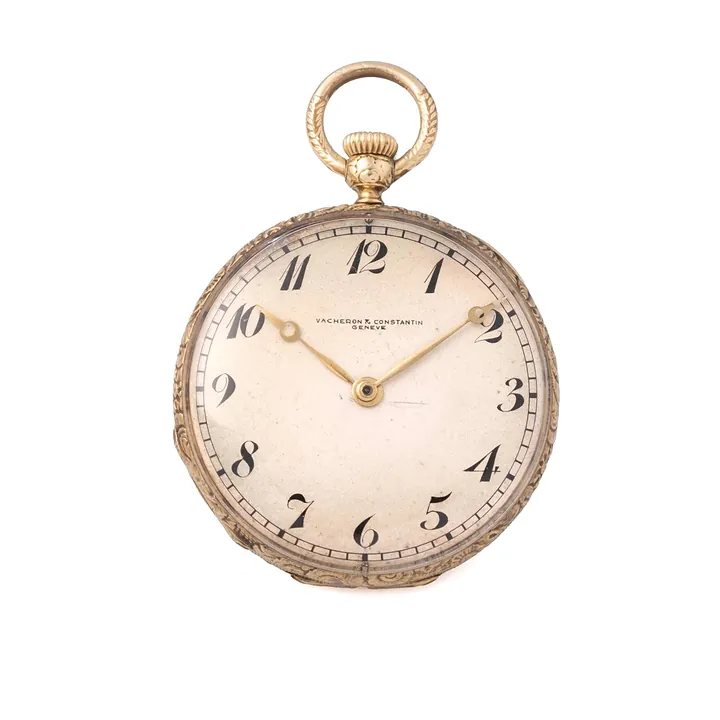
Vacheron Constantin pocket watch, ref. 345, c. 1940
Antiquorum auction archive, Geneva
Pocket Watches · c. 1945
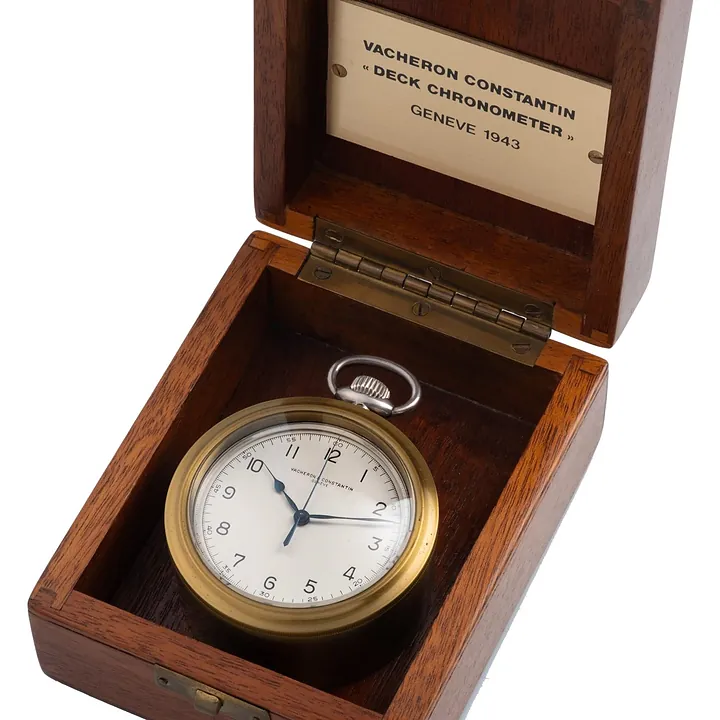
Vacheron Constantin pocket chronometer, c. 1945
Antiquorum auction archive, Geneva
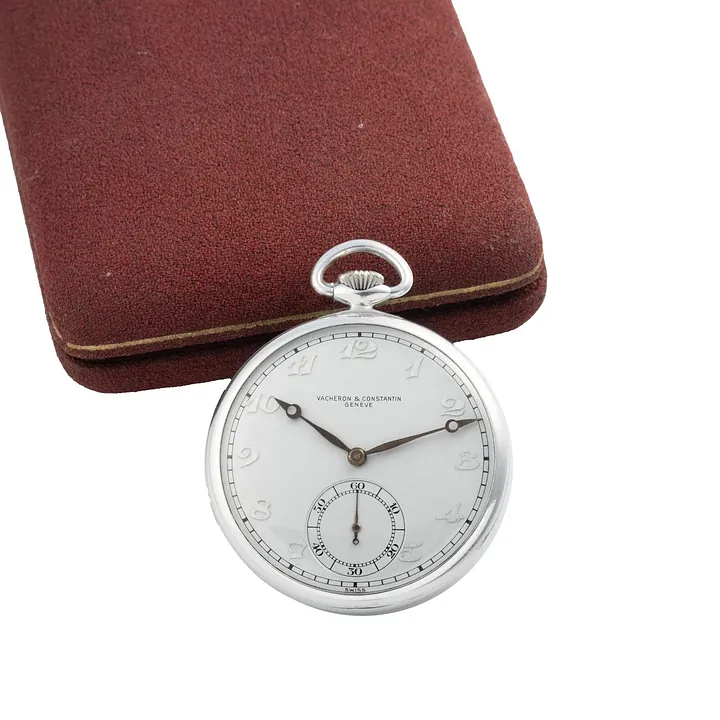
Pocket Watches · c. 1945
Vacheron Constantin watch, c. 1945
Antiquorum auction archive, Geneva

Wristwatches · 2008
Wristwatch by Breitling?, 2008
Museum Rotterdam

Wristwatches · c. 1990s
Audemars Piguet Bamboo, c. 1990s
Antiquorum auction archive, Geneva

Wristwatches · c. 1990
Audemars Piguet Huitieme Perpetual Calendar, ref. 25696PT, c. 1990
Antiquorum auction archive, Geneva

Wristwatches · c. 1990
Breitling Chronomat, ref. b13050.1, c. 1990
Antiquorum auction archive, Geneva