
Wristwatches · Wristwatch
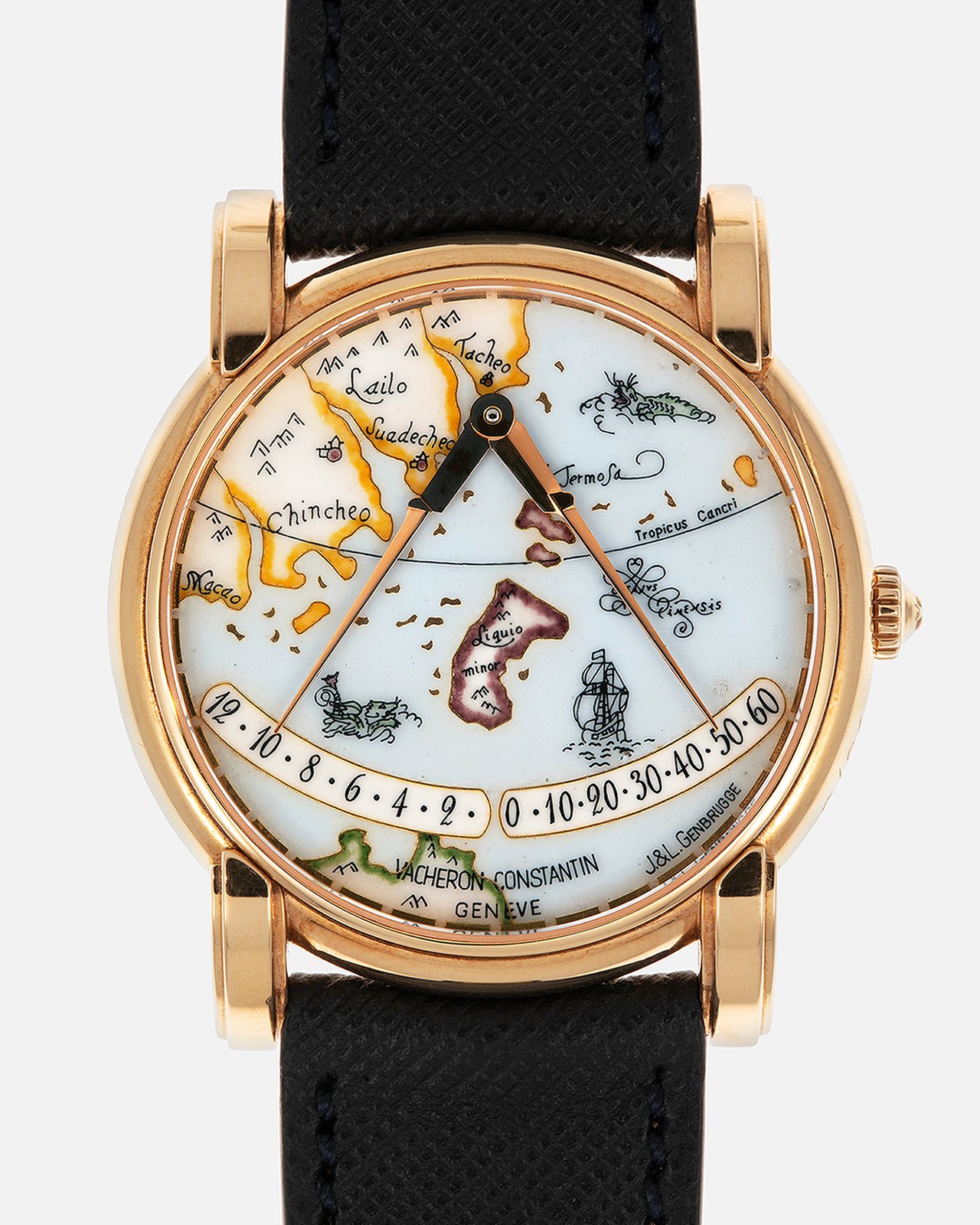
Vacheron Constantin Mercator 43050 Taiwan Enamel, 1998
- Maker / attribution
- Vacheron Constantin (maker)
- Date
- 1998
- Historical period
- Mechanical Renaissance (1990 – 2010)
- Country of origin
- Switzerland
- Object type
- Wristwatch
- Dimensions
- Case 36 mm
- Stock no.
- Product 7592667676759
- Credit line
- Dealer listing, S.Song Watches (product 7592667676759)
- Catalogue title (original)
- Vacheron Constantin Mercator 43050 Taiwan Enamel (English)
View the source record (dealer listing) ↗ (opens another website in a new tab)Suggest a correction
Record summary
Catalogued by S.Song Watches (dealer), Seattle (stock number Product 7592667676759), this is a wristwatch by Vacheron Constantin, made in Switzerland, dated 1998. The Atlas places it in the Mechanical Renaissance period (1990 – 2010) of its Wristwatches collection. Recorded dimensions: Case 36 mm. The record is illustrated with 6 photographs.
Assembled from the source record's structured fields. Dates and attributions are given as the source states them; where a field is missing the Atlas leaves it blank rather than estimating.
Catalogue description
Dealer description — S.Song Watches
Time-only watches are common in the world of watchmaking, but every now and then, I find myself yearning for something a little off the beaten path, for something truly unconventional. With mainstream watchmaking becoming increasingly sterile in recent times, lacking innovation and relying on lazy new releases, one can look back to the 90s, a period brimming with activity and creativity, fueled by the aftermath of the quartz crisis. Watch brands had to be different in order to survive, and that’s exactly what they did. Despite Vacheron Constantin’s traditional approach to watchmaking, the 90s proved to be an interesting period for the brand as they extensively experimented with creative ways of displaying time. One of the most iconic and successful products of that said experiment is the watch offered here today—the Vacheron Constantin Mercator 43050. Our example here is a spectacularly rare variant fitted with an exceptional enamel dial, but before diving into the specifics, we should first take a step back to understand the origins of the Mercator. The 43050 was conceived by Jean Genbrugge, an accomplished enamelist and watchmaker working under commission for Vacheron Constantin. Together with his wife Lucie, Genbrugge drew inspiration from their admiration for the legendary cartographer Gerardus Mercator, whose revolutionary flat projection of the globe reshaped how the world could be visualised and ultimately laid the foundation for modern cartography. First released in 1994 to commemorate the 400th anniversary of Gerardus Mercator’s passing, the 43050 introduced an unconventional method of displaying time to the world. Instead of using traditional hour and minute hands, it features a compass-like retrograde-style indicator, with the hours shown along the left arc and the minutes along the right, a display entirely in keeping with the cartographic theme. What makes the watch especially compelling is that you can quite literally hear time passing. As the minute hand reaches the 60 mark, it flicks crisply back to zero with an audibly decisive click, while the hour hand advances in perfect sync. The most satisfying moment comes at 12:59, when both hands recoil together and return to the centre at 1:00 in a single, coordinated motion. Here, the restrained time display serves one sole purpose: to frame the true focal point beneath the handset—a beautifully executed champlevé enamel dial. You see, while standard Mercator variants depicting the full world map are already quite scarce in their own right, this example is even more rare. Produced in a limited edition of only 26 pieces, it portrays the map region of the South China Sea, Taiwan, and the eastern coastline of China. The dial carries a distinct old-world charm, reminiscent of a finely detailed miniature painting from a bygone era. While we’re on the topic of the dial, I believe it is worth elaborating on the technical complexities of the champlevé enamel technique employed here. The process begins by carving the design directly into a solid metal base, creating recessed cells that define the map’s outlines. These cavities are then carefully filled with finely ground enamel powder and subjected to kiln firing at high temperatures multiple times until the material fuses onto the base. Once cooled, the surface is then meticulously polished, leaving luminous enamel fields bordered by the exposed ridges that articulate the cartographic detail. The result is not only decorative; it introduces a certain kind of depth, subtle visual relief, and permanence that printed dials cannot reproduce. Along the periphery at approximately 4:30, a discreet “J&L Genbrugge” signature can be found, a minimal yet meaningful tribute to the husband and wife team behind the conception and execution of these beautiful Mercator watches. Housed within a classically proportioned 36mm x 9mm rose gold case, the 43050 features a stepped bezel design complemented with substantial, matching stepped lugs that give the watch an ornate yet quiet architectural presence. On this particular variant, the lustrous warmth of the rose gold case works especially well against the radiance of the colourful enamel dial, like a painting housed within an equally beautiful frame. It provides a rich border that enhances the artwork without overpowering it. The result feels visually balanced and confident rather than ostentatious. As far as wearability goes, the slim proportions of the 43050, with its gracefully stepped lugs gently sloping towards the edges, create a gradual taper that ensures an impeccable fit on the wrist. From within, the 43050 is powered by the Vacheron Constantin Cal. 1120/2, which is based on a Jaeger LeCoultre Cal. 920 ébauche that has been heavily modified to accommodate a dual retrograde function. Displayed gloriously through its sapphire caseback, it also features a stunning 21-carat gold rotor with a hand-engraving that says “ 1594 – Gerardus Mercator – 1994 ” on the outer edge. The Mercator 43050 was made for roughly 10 years (between 1994 and 2004), with only 638 pieces produced throughout that time period, making this an incredibly rare find. If you are looking for something distinctive yet classical in design, look no further. The Mercator is a watch that stands in a class of its own, and one that serious collectors should not overlook.
Historical context
Mechanical Renaissance (1990 – 2010)
Mechanical watches return as cultural objects; independent watchmaking flourishes.
Mechanical watches returned as cultural and luxury objects. Complications, tourbillons and new materials proliferated; independent watchmakers such as George Daniels, F.P. Journe and Philippe Dufour revived artisanal watchmaking; collecting vintage watches became a major field.
Read the period in the timelineMore wristwatches from this periodEarlier: Quartz Revolution
Atlas type guide
Wristwatches
Bracelet watches were worn by women from the early nineteenth century — Breguet made one for Caroline Murat, Queen of Naples, in 1810–12 — but the wristwatch only became a man's instrument with military use and aviation in the early twentieth century. Between the World Wars it overtook the pocket watch; the 1920s and 1930s brought rectangular Art Deco cases, water-resistant cases and the first automatic winding systems.
After 1945 the wristwatch became a carrier of identity — dress watches, sports and dive watches, chronographs, calendars — produced by Swiss, American, Japanese, German, Soviet and Chinese industries. The quartz revolution after 1969 and the mechanical renaissance since the 1990s, including the rise of independent watchmakers, complete the story.
What to look for
- The reference number (between the lugs or inside the case back) and serial number, the starting point for dating.
- The calibre: its maker and number are often stamped under the dial or on the bridge.
- Originality of dial, hands and crown — refinished ('redial') dials are common.
- Case material marks: 18K/750, 14K/585, stainless steel, gold-filled, plated.
Dating clues
- Wire-lug cases: before c. 1925.
- Water-resistant screw-down cases: from 1926.
- Quartz movements: from 1969; sapphire crystals widespread after c. 1980.
General guidance written by the Atlas editors about this kind of object. It is not a statement about this particular piece; for that, rely on the source record above and on physical examination.
Related records
Pocket Watches · c. 1896
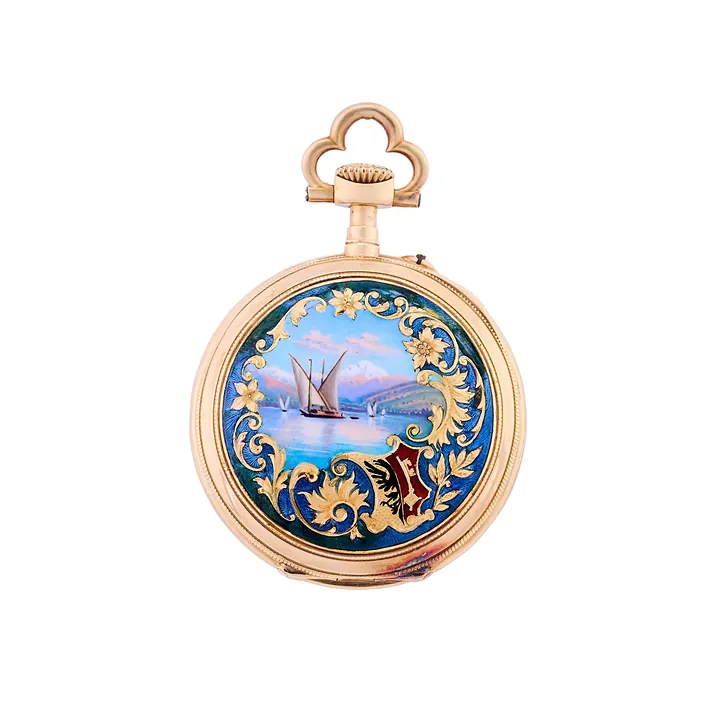
Vacheron Constantin “grand TIR de L’exposition Nationale, Genève 1896, c. 1896
Antiquorum auction archive, Geneva
Pocket Watches · c. 1940
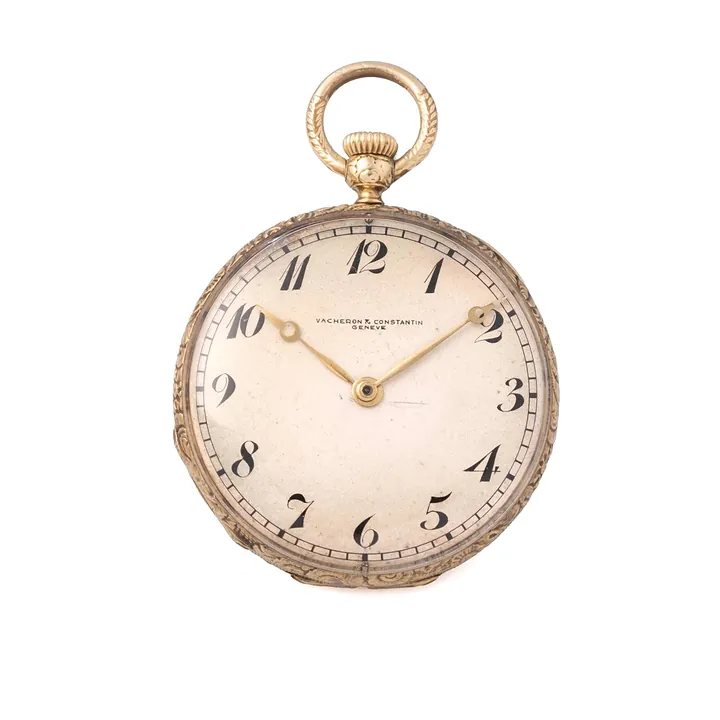
Vacheron Constantin pocket watch, ref. 345, c. 1940
Antiquorum auction archive, Geneva
Pocket Watches · c. 1945
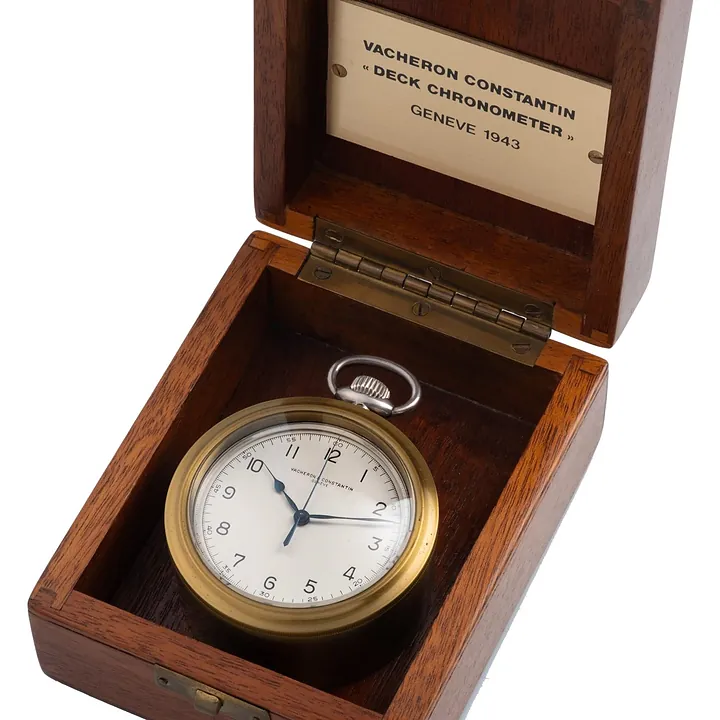
Vacheron Constantin pocket chronometer, c. 1945
Antiquorum auction archive, Geneva
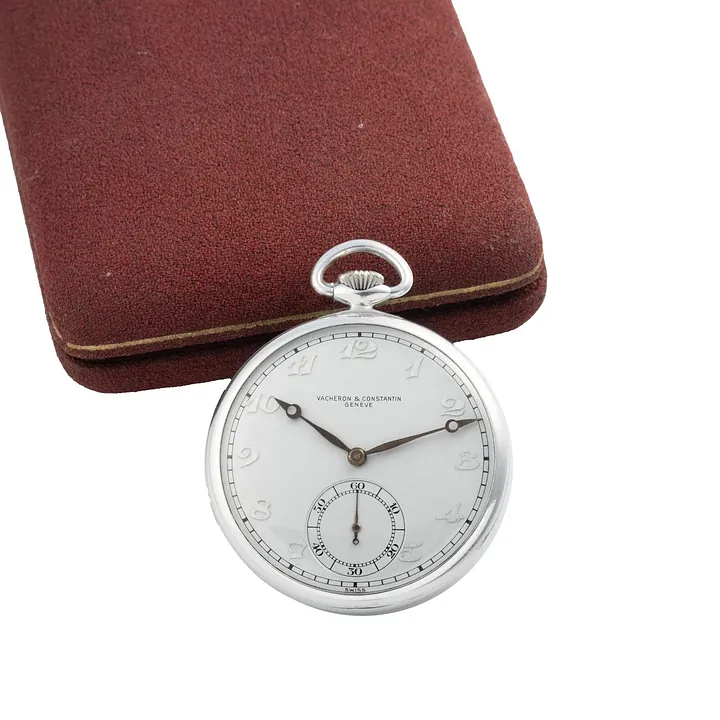
Pocket Watches · c. 1945
Vacheron Constantin watch, c. 1945
Antiquorum auction archive, Geneva

Wristwatches · 2008
Wristwatch by Breitling?, 2008
Museum Rotterdam

Wristwatches · c. 1990s
Audemars Piguet Bamboo, c. 1990s
Antiquorum auction archive, Geneva

Wristwatches · c. 1990
Audemars Piguet Huitieme Perpetual Calendar, ref. 25696PT, c. 1990
Antiquorum auction archive, Geneva

Wristwatches · c. 1990
Breitling Chronomat, ref. b13050.1, c. 1990
Antiquorum auction archive, Geneva