
Wristwatches · Wristwatch
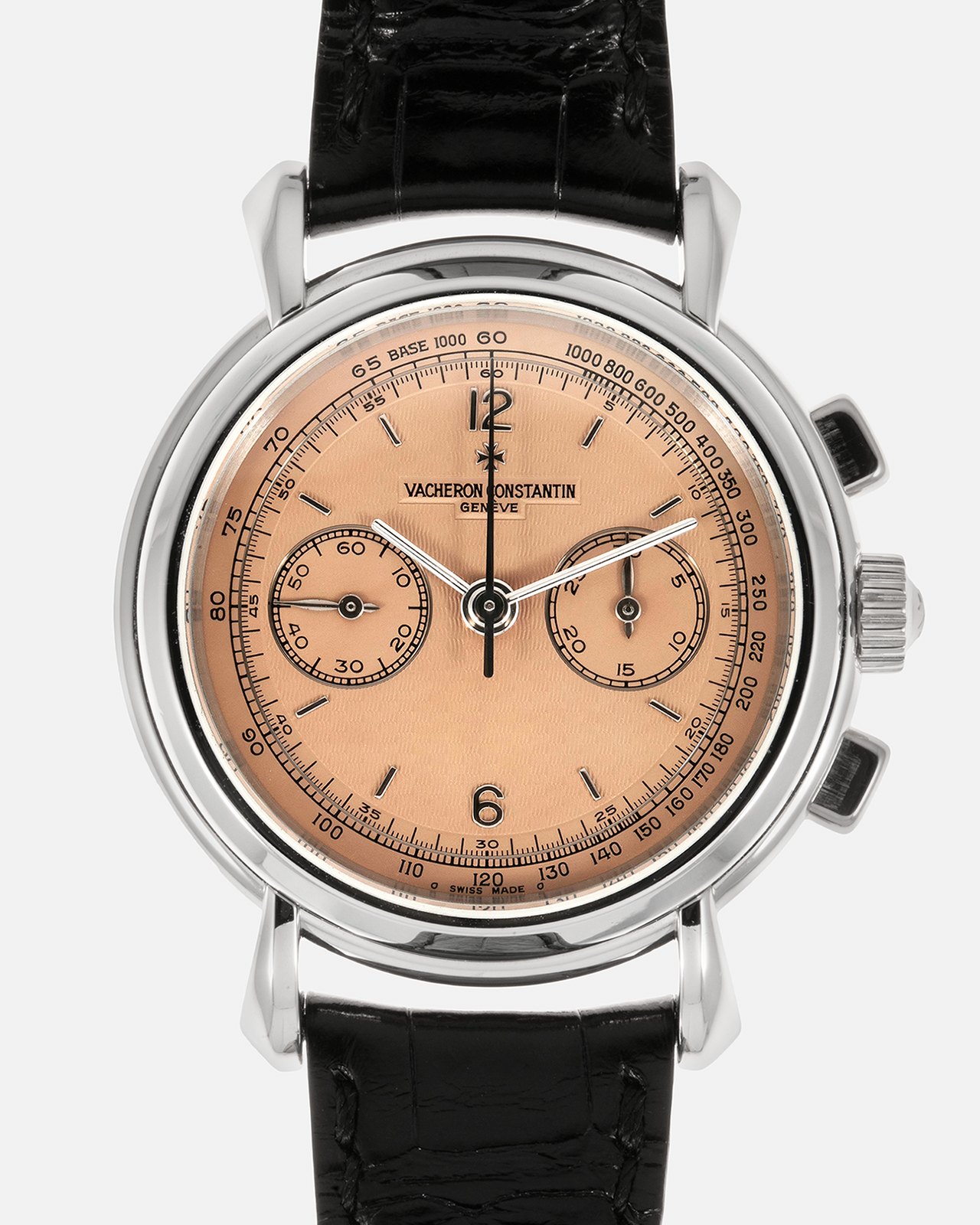
Vacheron Constantin Les Historiques Chronograph 47101 Platinum Salmon, 1996
- Maker / attribution
- Vacheron Constantin (maker)
- Date
- 1996
- Historical period
- Mechanical Renaissance (1990 – 2010)
- Country of origin
- Switzerland
- Object type
- Wristwatch
- Materials / technique
- platinum
- Dimensions
- Case 36 mm
- Stock no.
- Product 6971081850967
- Credit line
- Dealer listing, S.Song Watches (product 6971081850967)
- Catalogue title (original)
- Vacheron Constantin Les Historiques Chronograph 47101 Platinum Salmon (English)
View the source record (dealer listing) ↗ (opens another website in a new tab)Suggest a correction
Record summary
Catalogued by S.Song Watches (dealer), Seattle (stock number Product 6971081850967), this is a wristwatch by Vacheron Constantin, made in Switzerland, dated 1996. The Atlas places it in the Mechanical Renaissance period (1990 – 2010) of its Wristwatches collection. Materials and techniques recorded by the source: platinum. Recorded dimensions: Case 36 mm. The record is illustrated with 6 photographs.
Assembled from the source record's structured fields. Dates and attributions are given as the source states them; where a field is missing the Atlas leaves it blank rather than estimating.
Catalogue description
Dealer description — S.Song Watches
Beloved by collectors for their classical approach to watchmaking, Vacheron Constantin is the most traditional of the three Holy Trinity watchmakers thanks to their old-time aesthetic, heritage-inspired design, and traditionalist view of mechanics. With this, some of Vacheron's timepieces offer a wonderful view of the timepieces that came generations before the modern watches of today, and the Les Historiques Chronograph Ref. 47101 that I have here is a beautiful example of that. Some of you may have noticed that we have sold quite a handful of Ref. 47101s in the past (they were all in 18-carat yellow gold), but mind you, this example here is not just any regular Ref. 47101s, this rare variant comes encased in platinum featuring a stunning salmon dial —an aspect we will delve into shortly. For those who don’t know, the 1990s were an interesting period for watch collecting. It signified a radical change in the watchmaking industry as it gradually crawled out of its darkest days - the quartz crisis. Mechanical horology was regaining popularity and again, making a comeback. Now in 2023, watches from this particular 90s era, now known as “neo-vintage watches”, represent a significant shift in mindset for many luxury brands who were once again getting back into producing mechanical watches during that time. The Vacheron Constantin Historiques Chronograph Ref. 47101 represented Vacheron’s way of kick-starting the 90s on a strong note. It was first introduced in 1989 as part of the brand’s Historiques collection as a tribute to the Geneva watchmaker’s archives (specifically the iconic manual-wind chronograph Ref. 4178 from the 1940s) and the majority of them were encased in 18-carat yellow gold. Returning to the unique configuration of our present example, scholarly sources suggest that only 300 examples were ever crafted in platinum, and notably among them, only a mere 60 pieces were fitted with salmon dials, making this particular example we have here extremely rare and highly sought-after. Having a beautiful and balanced aesthetic is one thing Vacheron did right on the Ref. 47101, but I think what sets this one apart from the other examples is its pleasingly symmetrical and charismatic salmon dial with an exquisite guilloché. The dial layout incorporates two sub-dials featuring concentric circles, elegantly displaying the running seconds at 9 o'clock and the 30-minute counter for the chronograph at 3 o'clock. Despite the tachymeter scale being placed along its chapter ring, the Ref. 47101's dial remains clean and retains its legibility, as its applied hour markers and Arabic numerals contrast nicely against the striking salmon dial. By looking over the images, I am certain that you’d be inclined to agree with us that the Ref. 47101 is, without a doubt, a perfectly elegant and dressy chronograph. When you turn the case over, you will see that it houses a highly finished Vacheron Cal. 1140, which was based on the legendary Nouvelle Lémania Cal. 2310 ebauche. The Cal. 1140 features 21 jewels, and comes with a self-compensating Breguet spring, a swan-neck regulator, and is adjusted to 5 positions. It fully displays Lemania's signature labyrinthine architecture with an array of Vacheron's emphatic finishing techniques on its bridges, baseplate, levers, and screws. A beautiful watch on the wrist and off it, the Ref. 47101 presents itself as a pure expression of classical watchmaking, long before the advent of modern manufacturing and flashy design. As far as wearability goes, the 36mm case wears on the wrist very well. To some, 36mm may sound small on paper, but the teardrop lugs here perceptively increased the wrist presence of the case ever so slightly, which contributes to overall wearability. I must also emphasize that there is something about this watch that exudes a certain old-world charm that I haven’t felt with many other watches I’ve handled in the past. Its outstanding design and proportions make the Ref. 47101 a very attractive watch to reach for in the watch box regularly, even with its attention-catching salmon dial. Although I've generally enjoyed my time spent with all the previously sold Ref. 47101s, there's a special sentiment attached to my time with this exceptionally rare Ref. 47101/3, and to be honest, bidding farewell to this piece will be somewhat bittersweet. The unique charm of a timepiece with a stunning salmon guilloché dial fitted within a hefty platinum case, as showcased here, is truly unmatched. As part of the recent resurgence of neo-vintage timepieces from the ’90s, I am elated to see elegant and historically important dress watches such as this one come back to importance.
Historical context
Mechanical Renaissance (1990 – 2010)
Mechanical watches return as cultural objects; independent watchmaking flourishes.
Mechanical watches returned as cultural and luxury objects. Complications, tourbillons and new materials proliferated; independent watchmakers such as George Daniels, F.P. Journe and Philippe Dufour revived artisanal watchmaking; collecting vintage watches became a major field.
Read the period in the timelineMore wristwatches from this periodEarlier: Quartz Revolution
Atlas type guide
Chronographs and split-seconds watches
A chronograph is a watch with an additional seconds hand that can be started, stopped and returned to zero independently of the timekeeping. Louis Moinet built an early example in 1816 and Nicolas Rieussec a recording 'chronographe' in 1821; Adolphe Nicole's heart-shaped reset cam (patented 1862) made the modern return-to-zero possible. Split-seconds (rattrapante) chronographs add a second hand that can be stopped for intermediate times; flyback chronographs restart instantly.
Chronographs were essential tools for doctors (pulsometer scales), artillery (telemeter), engineers and sport. In wristwatches, Valjoux, Venus, Lemania and later the automatic chronographs of 1969 (Zenith El Primero, the Chronomatic Calibre 11 group and Seiko 6139) are milestones.
What to look for
- Push-pieces on the case band or a single button in the crown (monopusher).
- Subsidiary registers for minutes and hours; tachymeter, telemeter or pulsometer scales.
- Column wheel versus cam control visible in the movement.
- Calibre markings of specialist makers (Valjoux, Lemania, Venus, Landeron).
Dating clues
- Pocket chronographs with heart cam reset: after 1862.
- Wrist chronographs: from c. 1910; two-button designs from the 1930s.
- Automatic chronographs: from 1969.
General guidance written by the Atlas editors about this kind of object. It is not a statement about this particular piece; for that, rely on the source record above and on physical examination.
Read next:Flyback chronographChronograph
Related records
Pocket Watches · c. 1896
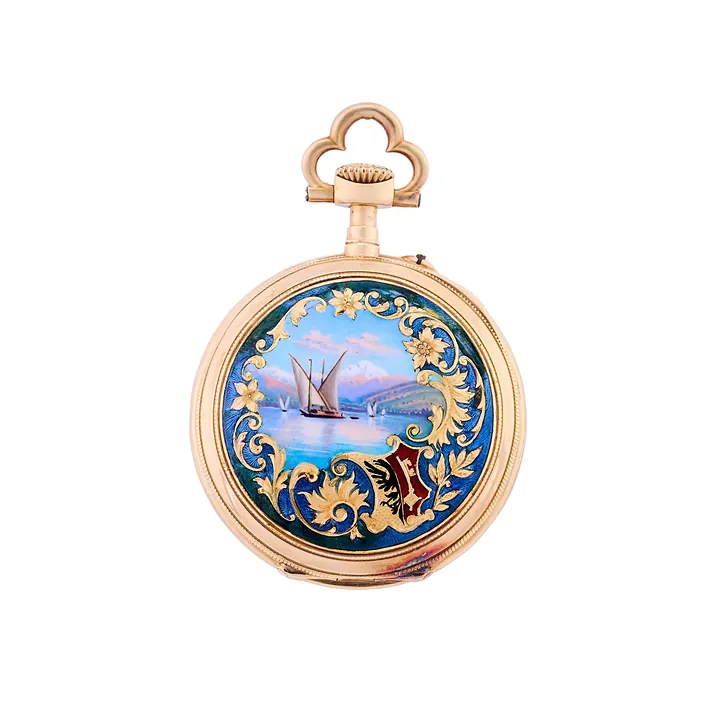
Vacheron Constantin “grand TIR de L’exposition Nationale, Genève 1896, c. 1896
Antiquorum auction archive, Geneva
Pocket Watches · c. 1940
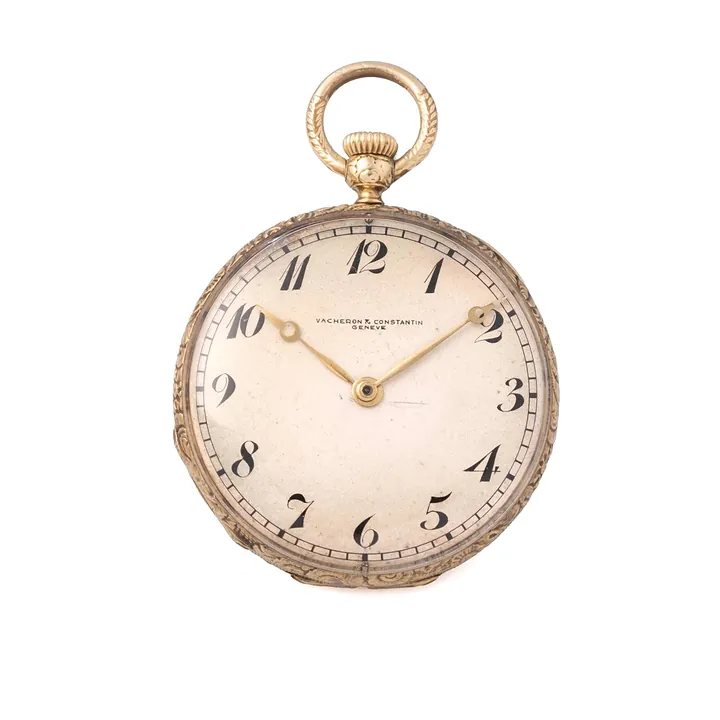
Vacheron Constantin pocket watch, ref. 345, c. 1940
Antiquorum auction archive, Geneva
Pocket Watches · c. 1945
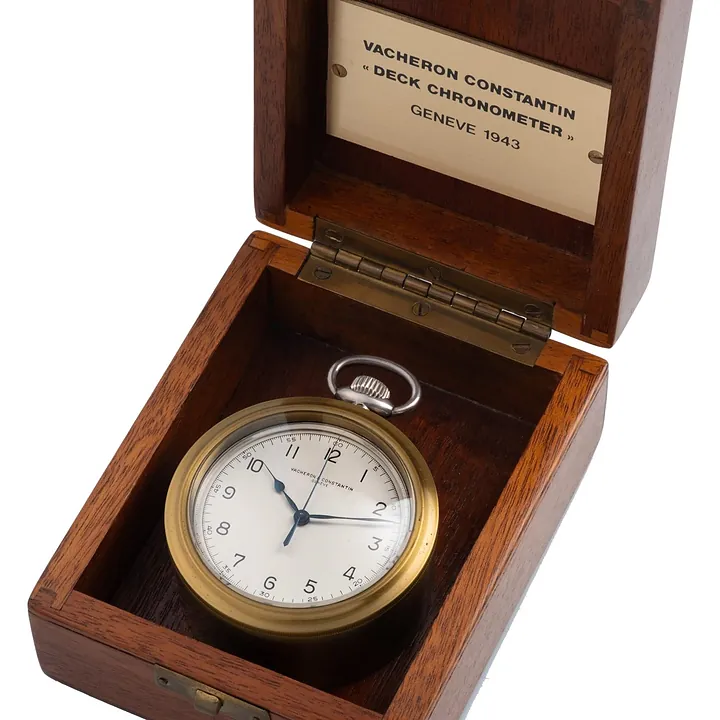
Vacheron Constantin pocket chronometer, c. 1945
Antiquorum auction archive, Geneva
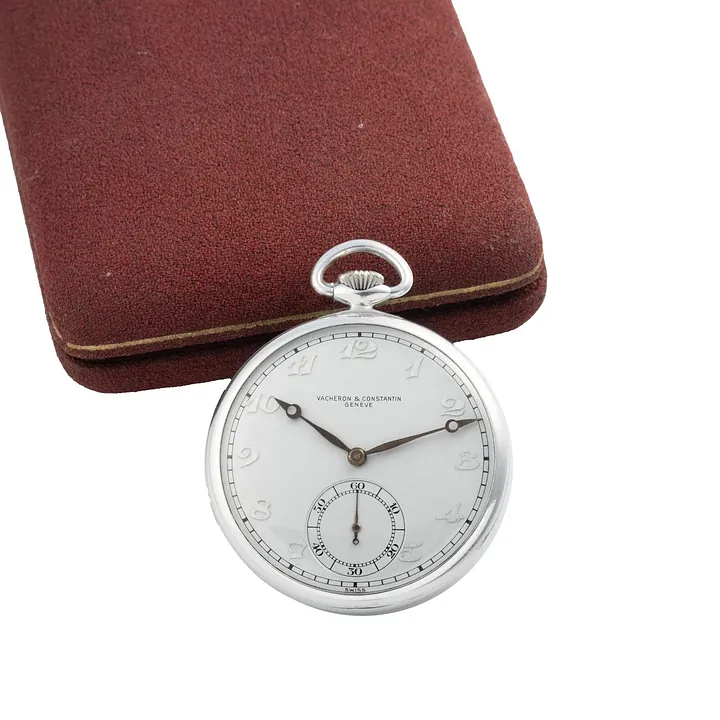
Pocket Watches · c. 1945
Vacheron Constantin watch, c. 1945
Antiquorum auction archive, Geneva

Wristwatches · 2008
Wristwatch by Breitling?, 2008
Museum Rotterdam

Wristwatches · c. 1990s
Audemars Piguet Bamboo, c. 1990s
Antiquorum auction archive, Geneva

Wristwatches · c. 1990
Audemars Piguet Huitieme Perpetual Calendar, ref. 25696PT, c. 1990
Antiquorum auction archive, Geneva

Wristwatches · c. 1990
Breitling Chronomat, ref. b13050.1, c. 1990
Antiquorum auction archive, Geneva