
Wristwatches · Wristwatch
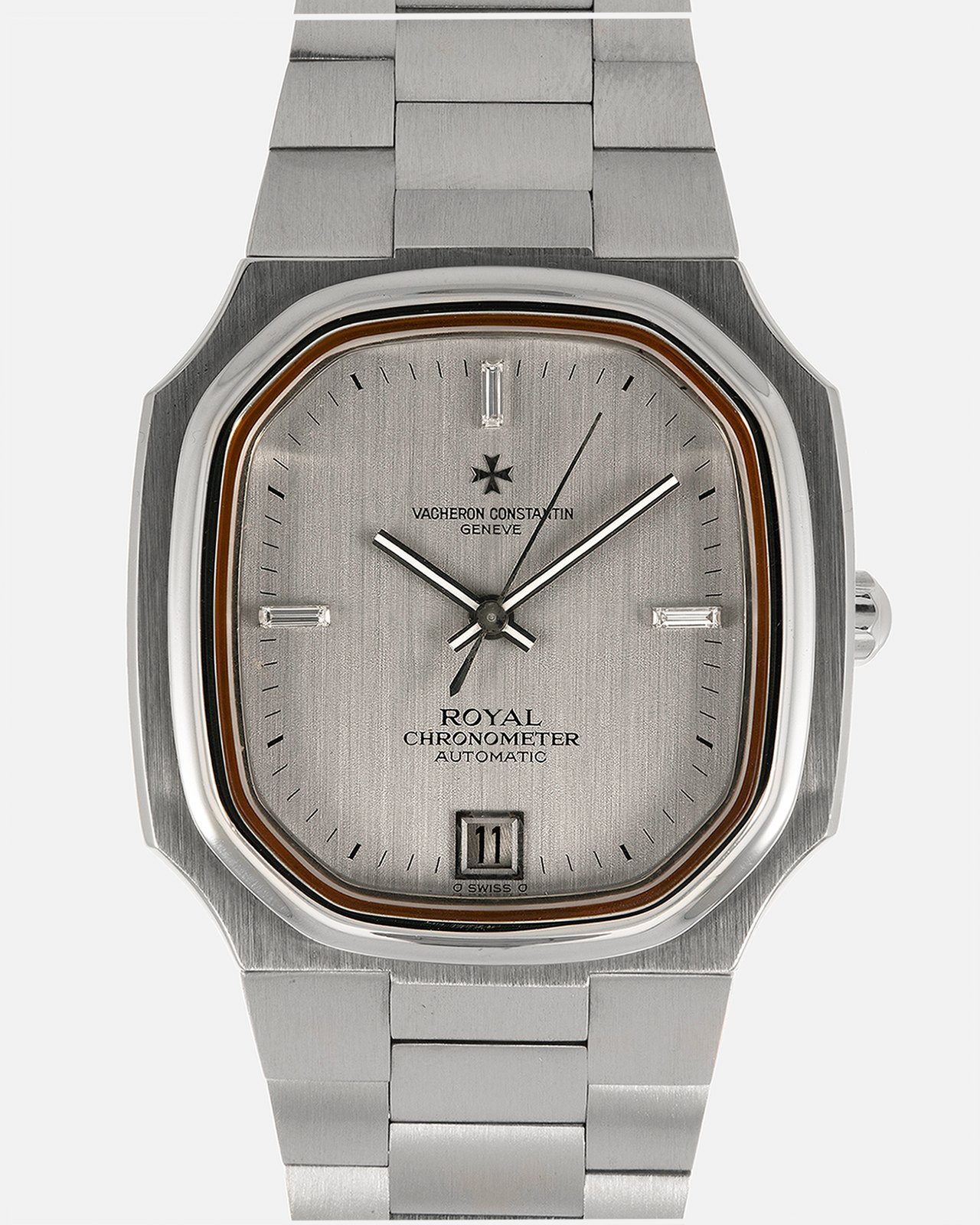
Vacheron Constantin Chronometer Royal ‘Diamonds’ Ref. 2215, 1970s
- Maker / attribution
- Vacheron Constantin (maker)
- Date
- 1970s
- Historical period
- Quartz Revolution (1969 – 1990)
- Country of origin
- Switzerland
- Object type
- Wristwatch
- Dimensions
- Case 37 mm
- Stock no.
- Product 7261139402839
- Credit line
- Dealer listing, S.Song Watches (product 7261139402839)
- Catalogue title (original)
- Vacheron Constantin Chronometer Royal ‘Diamonds’ Ref. 2215 (English)
View the source record (dealer listing) ↗ (opens another website in a new tab)Suggest a correction
Record summary
Catalogued by S.Song Watches (dealer), Seattle (stock number Product 7261139402839), this is a wristwatch by Vacheron Constantin, made in Switzerland, dated 1970s. The Atlas places it in the Quartz Revolution period (1969 – 1990) of its Wristwatches collection. Recorded dimensions: Case 37 mm. The record is illustrated with 6 photographs.
Assembled from the source record's structured fields. Dates and attributions are given as the source states them; where a field is missing the Atlas leaves it blank rather than estimating.
Catalogue description
Dealer description — S.Song Watches
Collectors all know that the 1970s was a pivotal era in watchmaking, marked by significant experimentation among brands that led to the creation of some of today's most iconic watch designs. One particularly influential design archetype was the luxury sports watch with integrated bracelets – a trend that was spearheaded by the Audemars Piguet Royal Oak in 1972, followed by the Patek Philippe Nautilus in 1976, and eventually, the Vacheron Constantin Ref. 222 in 1977. Prior to the Ref. 222, Vacheron Constantin introduced a reference that is seldom discussed but arguably paved the way for its successor: the Vacheron Constantin Chronometer Royal Ref. 2215. Introduced in 1975 and later discontinued in 1977, the Ref. 2215 we have here today represents Vacheron’s initial foray into the realm of luxury sport watches with integrated bracelets. Featuring a distinctive stainless steel case measuring 37mm x 10.3mm, this design was considered quite contemporary for its time. Despite its outward simplicity, the Ref. 2215 reveals hidden intricacies upon closer inspection. It features a semi-elongated octagonal case with a gentle concave bezel, exquisite bevelling, and a vertically brushed finish that seamlessly extends onto its integrated three-link bracelet. Also, if you look long enough, you’ll notice that there is a discernible resemblance that echoes to certain design elements of the Patek Philippe Nautilus in the Ref. 2215, though these similarities are subtle and nuanced. The silver dial on this Ref. 2215 showcases a vertical satin-brushed texture, complemented by a set of finely crafted white gold baton hands and applied baguette diamonds at 3:00, 9:00 and 12:00. At 6:00, you’ll see that a date window aperture is discreetly incorporated, with the date wheel also finished in a similarly brushed texture to match the dial—a subtle yet thoughtful little detail. If you look even closer, beneath this date window you will find a “σ SWISS σ” signature. Here, the sigma symbol is intentionally used to signify the use of precious metal on the hands. Powering the Ref. 2215 from within is Vacheron’s very own self-winding, Contrôle Officiel Suisse des Chronomètres (COSC) certified Cal. 1096. Although concealed beneath a solid engraved caseback, the 21-jewel Cal. 1096 also features Côtes de Genève striping, a free-sprung flat balance, and a beautifully decorated, engine-turned gold rotor. As I briefly mentioned above, the Ref. 2215 saw a brief production span of only two years from 1975 until it was eventually succeeded by its legendary sibling Ref. 222 in 1977. This makes it a very rare and collectable reference to boot, especially in this particular configuration featuring baguette diamonds, which are rarely offered publicly in the market today. That being said, while the Ref. 2215 may seem overshadowed by its sibling Ref. 222, its significance simply cannot be overlooked, because without it, Vacheron Constantin's role and status in the luxury sports watch landscape might have been markedly different today. In a market where significant attention is often given to well-established and highly acclaimed designs such as the Royal Oak and Nautilus, the Ref. 2215 shines as one of the most underrated Vacheron Constantin references for collectors. Personally, I find great satisfaction in seeking out lesser-known gems like this one. It's truly a delight for us to offer such a unique watch for sale on our site today.
Historical context
Quartz Revolution (1969 – 1990)
Seiko's Astron begins mass quartz timekeeping; traditional industries contract sharply.
Quartz and digital watches transformed the market after 1969. Swiss employment collapsed, Japanese and Hong Kong production soared, and the Swatch (1983) helped the Swiss industry recover; mechanical watches survived as luxury goods.
Read the period in the timelineMore wristwatches from this periodEarlier: Modern Mechanical Horology
Atlas type guide
Wristwatches
Bracelet watches were worn by women from the early nineteenth century — Breguet made one for Caroline Murat, Queen of Naples, in 1810–12 — but the wristwatch only became a man's instrument with military use and aviation in the early twentieth century. Between the World Wars it overtook the pocket watch; the 1920s and 1930s brought rectangular Art Deco cases, water-resistant cases and the first automatic winding systems.
After 1945 the wristwatch became a carrier of identity — dress watches, sports and dive watches, chronographs, calendars — produced by Swiss, American, Japanese, German, Soviet and Chinese industries. The quartz revolution after 1969 and the mechanical renaissance since the 1990s, including the rise of independent watchmakers, complete the story.
What to look for
- The reference number (between the lugs or inside the case back) and serial number, the starting point for dating.
- The calibre: its maker and number are often stamped under the dial or on the bridge.
- Originality of dial, hands and crown — refinished ('redial') dials are common.
- Case material marks: 18K/750, 14K/585, stainless steel, gold-filled, plated.
Dating clues
- Wire-lug cases: before c. 1925.
- Water-resistant screw-down cases: from 1926.
- Quartz movements: from 1969; sapphire crystals widespread after c. 1980.
General guidance written by the Atlas editors about this kind of object. It is not a statement about this particular piece; for that, rely on the source record above and on physical examination.
Related records
Pocket Watches · c. 1896
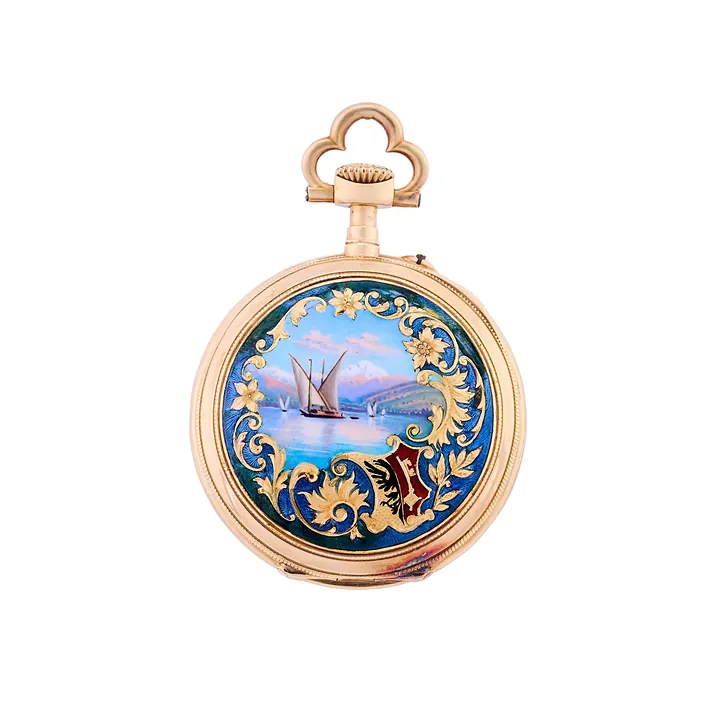
Vacheron Constantin “grand TIR de L’exposition Nationale, Genève 1896, c. 1896
Antiquorum auction archive, Geneva
Pocket Watches · c. 1940
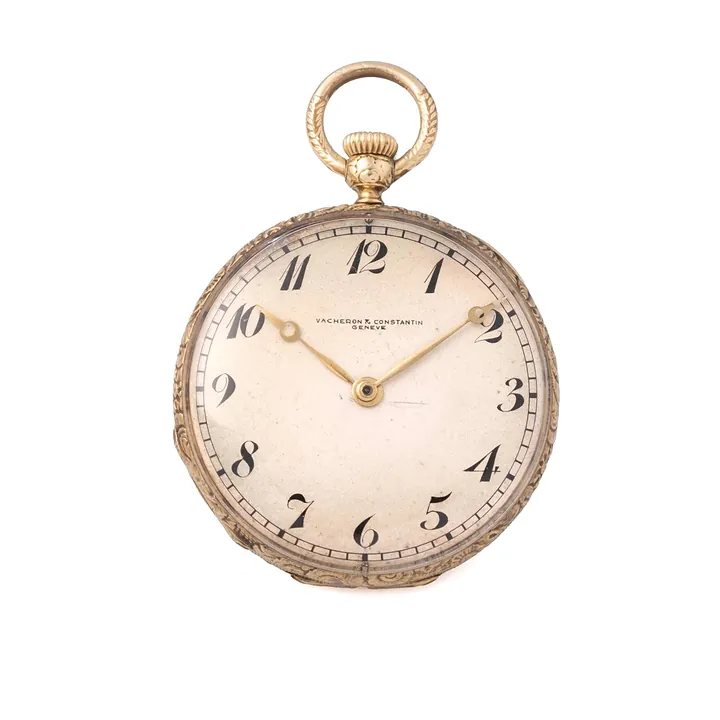
Vacheron Constantin pocket watch, ref. 345, c. 1940
Antiquorum auction archive, Geneva
Pocket Watches · c. 1945
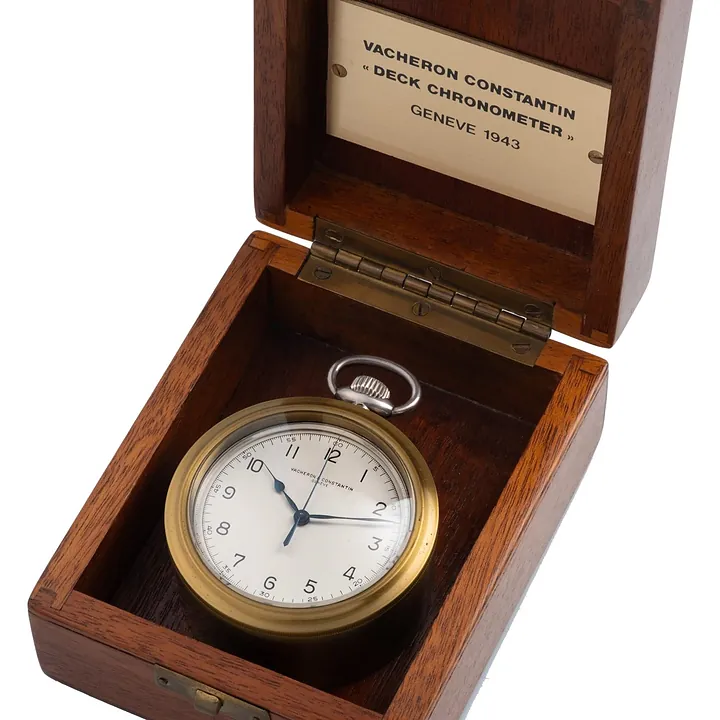
Vacheron Constantin pocket chronometer, c. 1945
Antiquorum auction archive, Geneva
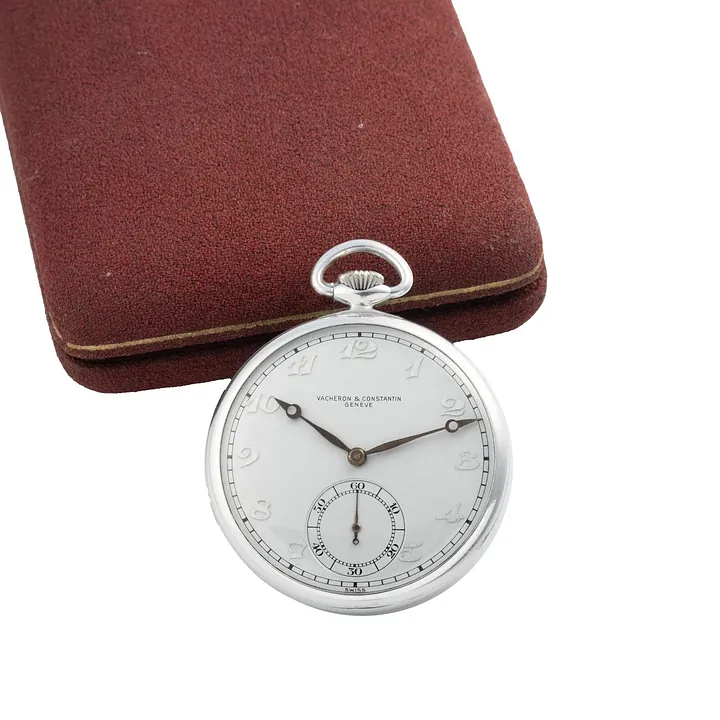
Pocket Watches · c. 1945
Vacheron Constantin watch, c. 1945
Antiquorum auction archive, Geneva

Wristwatches · 1970
Wristwatch by Heno, Switzerland, 1970
Museum Rotterdam

Wristwatches · 1960–1986
'Tri-Compax' calendar chronograph wristwatch in gold case, by Universal, Geneva, Switzerland, 1960–1986.
Science Museum Group, London

Wristwatches · 1969–1970
Beta 21 Quartz wristwatch movement, made in Switzerland, 1970.
Science Museum Group, London

Wristwatches · c. 1969
Omega Speedmaster Moonwatch, ref. 145022-69st, c. 1969
Antiquorum auction archive, Geneva