
Wristwatches · Wristwatch
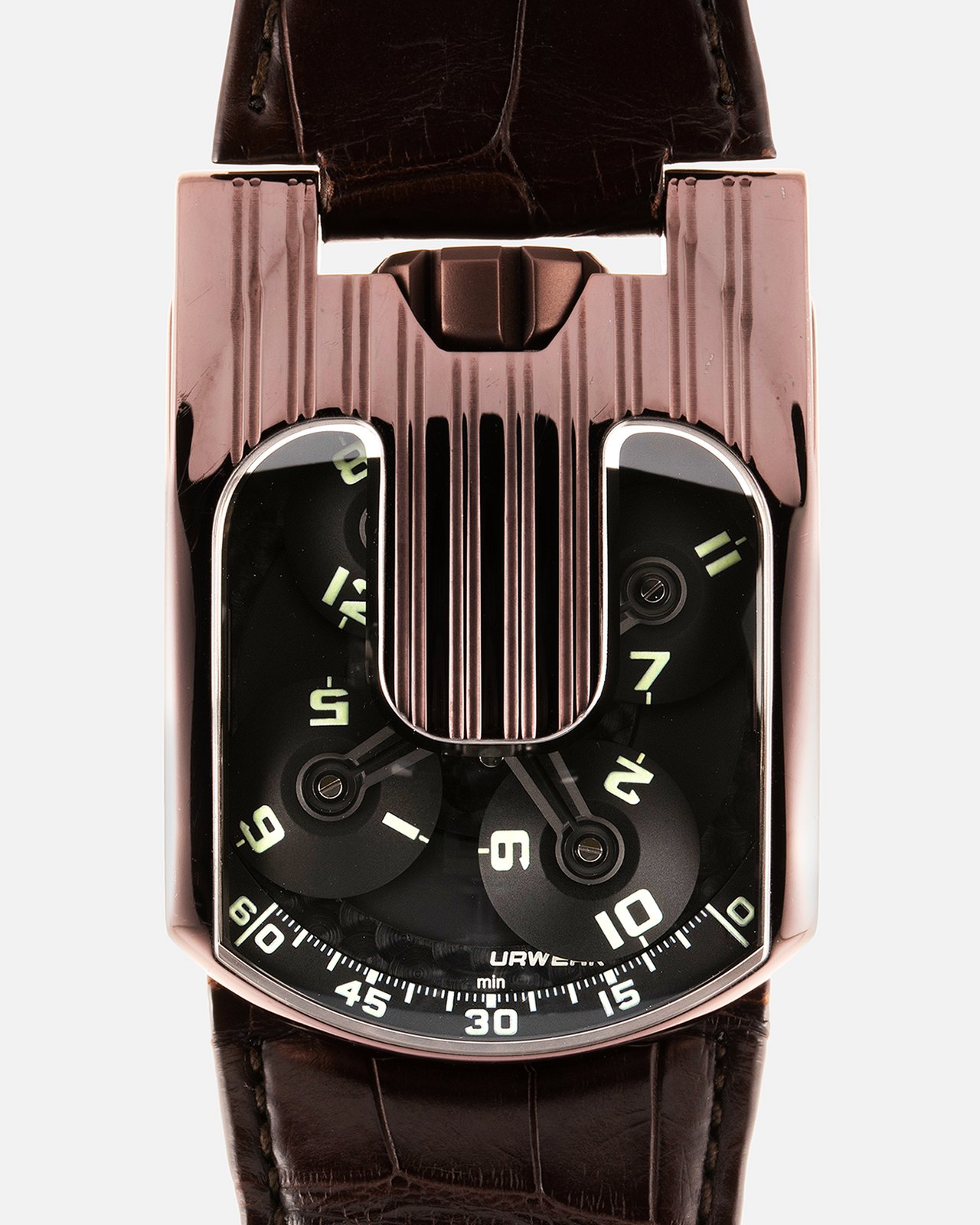
Urwerk UR103.08 TiAlN, 2007
- Maker / attribution
- Urwerk (maker)
- Date
- 2007
- Historical period
- Mechanical Renaissance (1990 – 2010)
- Country of origin
- Switzerland
- Object type
- Wristwatch
- Stock no.
- Product 6888706637911
- Credit line
- Dealer listing, S.Song Watches (product 6888706637911)
- Catalogue title (original)
- Urwerk UR103.08 TiAlN (English)
View the source record (dealer listing) ↗ (opens another website in a new tab)Suggest a correction
Record summary
Catalogued by S.Song Watches (dealer), Seattle (stock number Product 6888706637911), this is a wristwatch by Urwerk, made in Switzerland, dated 2007. The Atlas places it in the Mechanical Renaissance period (1990 – 2010) of its Wristwatches collection. The record is illustrated with 6 photographs.
Assembled from the source record's structured fields. Dates and attributions are given as the source states them; where a field is missing the Atlas leaves it blank rather than estimating.
Catalogue description
Dealer description — S.Song Watches
Founded in 1997 by Martin Frei and Felix Baumgartner, Urwerk is one of the independent watchmaking industry's most prolific brands with a sense of watchmaking that fuses the traditional with futuristic design and a somewhat novel appreciation for the very concept of time. As such, Urwerk's timepieces are outside of the ordinary regarding their mechanical operation and aesthetic design. On offer today is the Urwerk UR103.08 TiAlN, a reference that is aesthetically rooted in the revered UR103 model, which holds an esteemed position in the illustrious history of the brand as it cemented Urwerk's reputation as one of the foremost independent brands in the world of haute horlogerie. Originally unveiled in 2007, the UR103.08 TiAlN remains an extraordinary variant of the venerable UR103 that continues to captivate collectors and connoisseurs alike, making it one of the most highly coveted Urwerk references to this day. For those who are unfamiliar, TiAlN stands for titanium-aluminium-nitride, a cutting-edge coating that bestows upon the UR103.08 its distinctive deep purple-ish brown hue, showcasing varying tones depending on the surrounding lighting conditions. This treatment not only adds to its aesthetic appeal but also holds exceptional industrial properties, enhancing the resilience of the underlying metal. In fact, TiAlN surpasses DLC (Diamond-Like Carbon) in terms of hardness, boasting an impressive Vickers rating of 3500. To put this into perspective, traditional steel only achieves a Vickers rating of 600, while gold measures at 380 and sapphire at approximately 4000 Vickers. Given its exceptional visual and material-enhancing properties, it comes as no surprise that Urwerk has embraced this innovative approach as part of the design of this particular UR103 variant. Moving on to the display of the UR103.08, it is worth noting that many Urwerk enthusiasts are already acquainted with one of the most iconic aspects of the UR103 series: the distinctive satellite complication, which displays the hours on four orbiting satellites that gracefully traverse along the minute track from east to west, akin to the movement of the sun. The UR-103.08 is essentially Urwerk's interpretation of the wandering hours complication. A quick glance at the top display reveals the mesmerizing arrangement of the four satellites made from PVD-coated aluminium, grouped in sets of three numbers, carried on arms crafted from PVD-coated grade 2 titanium which are attached to the main unit revolving carousel. As the carousel rotates, the satellites rotate to indicate the hours as it gently grazes along the minute track to indicate the time. Powering this display from within is Urwerk's manual-winding Cal 3.03 with a power reserve of 43 hours. Flipping the watch over reveals a ‘control board’ crafted from grade 5 titanium, which serves as a hub for several indicators. Among them, you’ll find a power reserve indicator, 15-minute and small seconds sub-dials for precise and convenient time setting, as well as a fine-tuning screw, allowing adjustments to the watch's rate if it runs fast or slow. This is a rare feature in modern timepieces and it is reminiscent of older pocket watches from bygone eras. In terms of wearability, the UR103.08 TiAlN case, while sharing its design origins with other UR103 models, offers a notable advantage. Thanks to the darker tone of the TiAlN coating which lends it some aesthetic versatility, the UR103.08 appears slightly smaller on wrist and can complement any modern-sized wrist nicely. Undoubtedly, the UR103.08 TiAlN stands as a truly unique and rare variant within the Urwerk collection. With the appreciation of independent brands growing to an all-time high in recent times, Urwerk is certainly a brand to watch, creating watches that are both rare and truly unique.
Historical context
Mechanical Renaissance (1990 – 2010)
Mechanical watches return as cultural objects; independent watchmaking flourishes.
Mechanical watches returned as cultural and luxury objects. Complications, tourbillons and new materials proliferated; independent watchmakers such as George Daniels, F.P. Journe and Philippe Dufour revived artisanal watchmaking; collecting vintage watches became a major field.
Read the period in the timelineMore wristwatches from this periodEarlier: Quartz Revolution
Atlas type guide
Wristwatches
Bracelet watches were worn by women from the early nineteenth century — Breguet made one for Caroline Murat, Queen of Naples, in 1810–12 — but the wristwatch only became a man's instrument with military use and aviation in the early twentieth century. Between the World Wars it overtook the pocket watch; the 1920s and 1930s brought rectangular Art Deco cases, water-resistant cases and the first automatic winding systems.
After 1945 the wristwatch became a carrier of identity — dress watches, sports and dive watches, chronographs, calendars — produced by Swiss, American, Japanese, German, Soviet and Chinese industries. The quartz revolution after 1969 and the mechanical renaissance since the 1990s, including the rise of independent watchmakers, complete the story.
What to look for
- The reference number (between the lugs or inside the case back) and serial number, the starting point for dating.
- The calibre: its maker and number are often stamped under the dial or on the bridge.
- Originality of dial, hands and crown — refinished ('redial') dials are common.
- Case material marks: 18K/750, 14K/585, stainless steel, gold-filled, plated.
Dating clues
- Wire-lug cases: before c. 1925.
- Water-resistant screw-down cases: from 1926.
- Quartz movements: from 1969; sapphire crystals widespread after c. 1980.
General guidance written by the Atlas editors about this kind of object. It is not a statement about this particular piece; for that, rely on the source record above and on physical examination.
Related records
Wristwatches · 2014
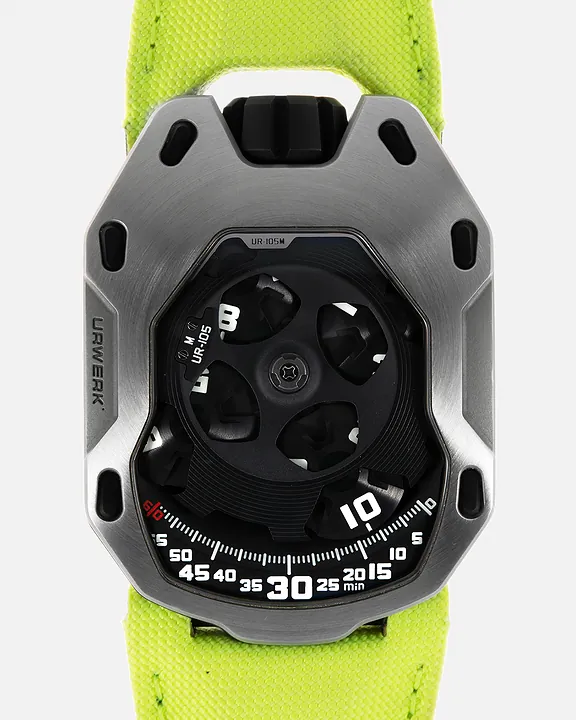
Urwerk UR105M Iron Knight, 2014
S.Song Watches (dealer), Seattle
Wristwatches · 2021
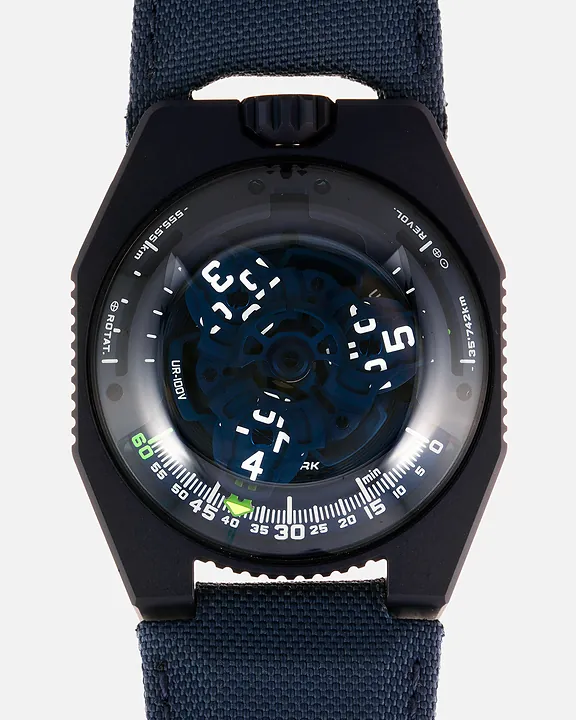
Urwerk UR100 Blue Planet, 2021
S.Song Watches (dealer), Seattle
Wristwatches · 2023
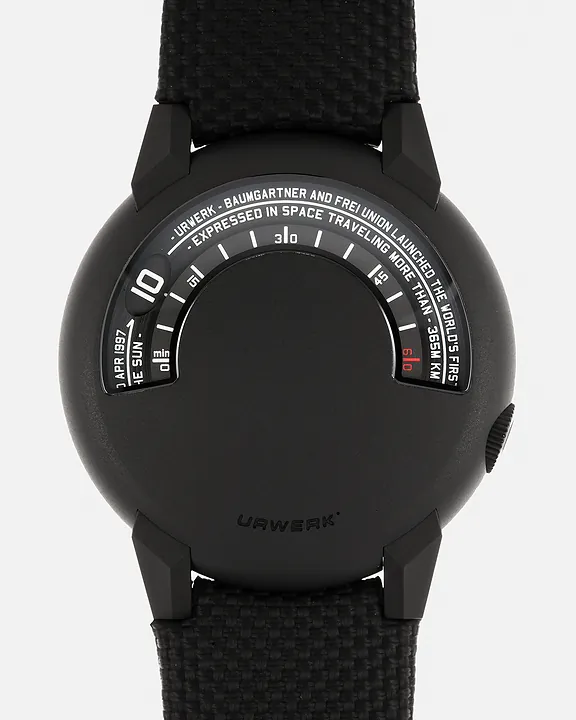
Urwerk UR102 Reloaded Black, 2023
S.Song Watches (dealer), Seattle
Wristwatches · 2021
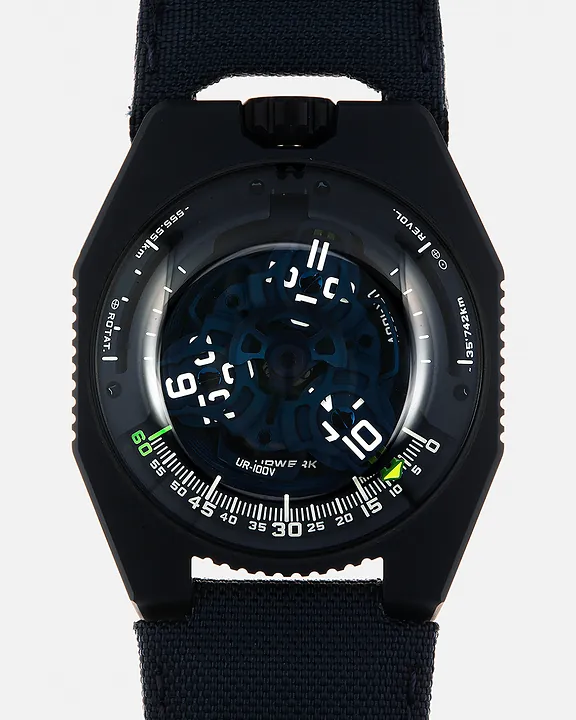
Urwerk UR100 Blue Planet, 2021
S.Song Watches (dealer), Seattle

Wristwatches · 2008
Wristwatch by Breitling?, 2008
Museum Rotterdam

Wristwatches · c. 1990s
Audemars Piguet Bamboo, c. 1990s
Antiquorum auction archive, Geneva

Wristwatches · c. 1990
Audemars Piguet Huitieme Perpetual Calendar, ref. 25696PT, c. 1990
Antiquorum auction archive, Geneva

Wristwatches · c. 1990
Breitling Chronomat, ref. b13050.1, c. 1990
Antiquorum auction archive, Geneva