
Wristwatches · Wristwatch
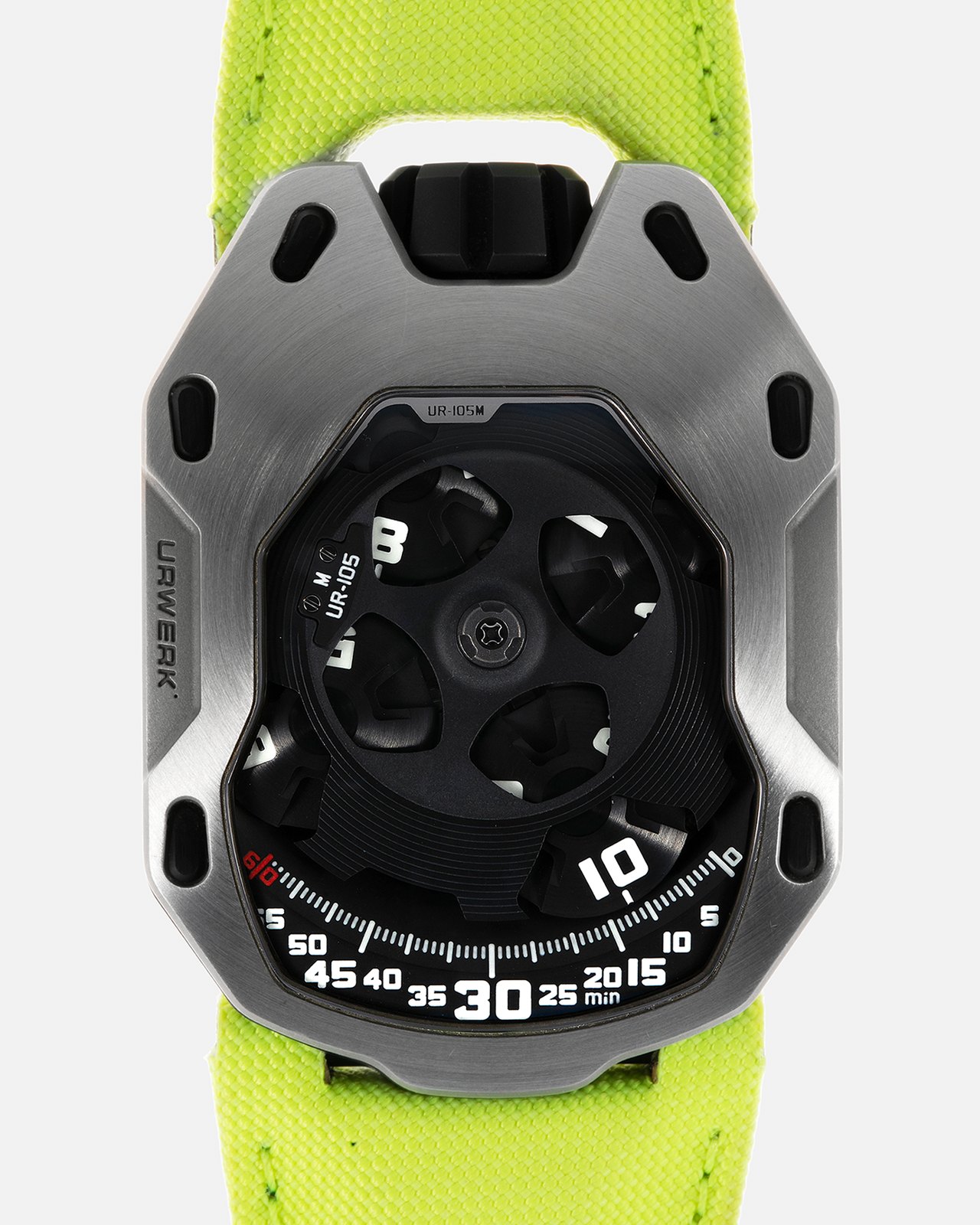
Urwerk UR105M Iron Knight, 2014
- Maker / attribution
- Urwerk (maker)
- Date
- 2014
- Historical period
- Contemporary Horology (2010 – Present)
- Country of origin
- Switzerland
- Object type
- Wristwatch
- Dimensions
- Case 50 mm
- Stock no.
- Product 7135419531351
- Credit line
- Dealer listing, S.Song Watches (product 7135419531351)
- Catalogue title (original)
- Urwerk UR105M Iron Knight (English)
View the source record (dealer listing) ↗ (opens another website in a new tab)Suggest a correction
Record summary
Catalogued by S.Song Watches (dealer), Seattle (stock number Product 7135419531351), this is a wristwatch by Urwerk, made in Switzerland, dated 2014. The Atlas places it in the Contemporary Horology period (2010 – Present) of its Wristwatches collection. Recorded dimensions: Case 50 mm. The record is illustrated with 6 photographs.
Assembled from the source record's structured fields. Dates and attributions are given as the source states them; where a field is missing the Atlas leaves it blank rather than estimating.
Catalogue description
Dealer description — S.Song Watches
Founded in 1997 by Martin Frei and Felix Baumgartner, Urwerk is one of the independent watchmaking industry's most prolific brands with a sense of watchmaking that fuses the traditional with futuristic design and a somewhat novel appreciation for the very concept of time. As such, Urwerk's timepieces are outside of the ordinary regarding their mechanical operation and aesthetic design. An exemplary instance is the UR105M, initially unveiled in 2014 as a pair known as the "Iron Knight" and the "Dark Knight". Our offered example here, being the former, features a titanium mid-case enveloped by a strong and bold-looking ‘armor bezel’ in brushed stainless steel. In contrast, the latter variant showcases a more subdued, sleek black TiAlN-treated (titanium-aluminium-nitride) armor bezel. Taking inspiration from the medieval tradition of knights engaging in competitive jousting matches, as explained by Martin and Felix, the UR105M embodies and expresses this theme through its visual design. The dial showcases Urwerk's signature satellite-style display of hour discs, an iconic design element Urwerk enthusiasts are well acquainted with, nestled beneath an ornamental 'canopy' crafted from a specialized lightweight material called PEEK (Polyether Ether Ketone), a durable thermoplastic commonly utilized in engineering applications across various industries such as aerospace, automotive, and medical fields. As time elapses, the hour discs would rotate beneath the 'canopy', as the corresponding hour disc gracefully traverses across the stationary minute scale positioned at 6 o'clock, indicating the passage of time. If you look closer, a small digital seconds display can be observed at the beginning portion of the fixed minutes track, showcasing the passage of seconds in increments of ten. Moving over to the mid-case section of the UR105M, here you’ll find two additional indicators which have been discretely embedded within. One is a running seconds display presented on a vibrant red disk, with markings every two seconds and numerals every ten seconds. The second indicator is a power reserve gauge, which displays white when fully wound and gradually transitions to black as its power reserve depletes over time. Powering this display from within is Urwerk’s very own manual-winding Cal. UR5.01, which is encased within a solid titanium case and offers a respectable power reserve of 42 hours on a full wind. Flipping the UR105M over unveils a 'control board,' serving as a central hub for various indicators. Among them, you’ll find a power reserve indicator, an ‘oil change’ indicator which indicates up to five years, serving as a reminder to the user when the watch becomes due for a service as it transitions into the red zone. Finally, you’ll also find a fine-tuning screw, allowing adjustments to the watch's rate if it runs fast or slow. This is a rare feature in modern timepieces and it is reminiscent of older pocket watches from bygone eras. Limited to only 77 pieces (for each variant), this UR105M “Iron Knight” is as cool as it gets, especially in terms of design and technical execution. What stands out about Urwerk timepieces is their distinctive and unmistakable design language, a trait exemplified by the UR105M. Despite its dimensions of 39.50mm x 53mm x 16.65mm on paper, Urwerk cases are remarkably ergonomic on the wrist, a fact I can attest to after spending some time with the UR105M (as well as other Urwerk pieces we’ve offered in the past). With the appreciation for independent brands reaching an all-time high in recent years, Urwerk is certainly an independent brand to closely follow, creating watches that are not only rare but also exceptionally distinctive. If you’re looking for a watch from an independent brand with a decorated track record as well as some truly unique offerings, this is a chance you do not want to miss out on.
Historical context
Contemporary Horology (2010 – Present)
Silicon components, connected watches, optical-lattice research clocks and a thriving independent scene.
Smartwatches became the world's best-selling watches, while mechanical watchmaking focuses on craft, innovation (silicon components, new escapements) and independent makers.
Read the period in the timelineMore wristwatches from this periodEarlier: Mechanical Renaissance
Atlas type guide
Wristwatches
Bracelet watches were worn by women from the early nineteenth century — Breguet made one for Caroline Murat, Queen of Naples, in 1810–12 — but the wristwatch only became a man's instrument with military use and aviation in the early twentieth century. Between the World Wars it overtook the pocket watch; the 1920s and 1930s brought rectangular Art Deco cases, water-resistant cases and the first automatic winding systems.
After 1945 the wristwatch became a carrier of identity — dress watches, sports and dive watches, chronographs, calendars — produced by Swiss, American, Japanese, German, Soviet and Chinese industries. The quartz revolution after 1969 and the mechanical renaissance since the 1990s, including the rise of independent watchmakers, complete the story.
What to look for
- The reference number (between the lugs or inside the case back) and serial number, the starting point for dating.
- The calibre: its maker and number are often stamped under the dial or on the bridge.
- Originality of dial, hands and crown — refinished ('redial') dials are common.
- Case material marks: 18K/750, 14K/585, stainless steel, gold-filled, plated.
Dating clues
- Wire-lug cases: before c. 1925.
- Water-resistant screw-down cases: from 1926.
- Quartz movements: from 1969; sapphire crystals widespread after c. 1980.
General guidance written by the Atlas editors about this kind of object. It is not a statement about this particular piece; for that, rely on the source record above and on physical examination.
Related records
Wristwatches · 2007
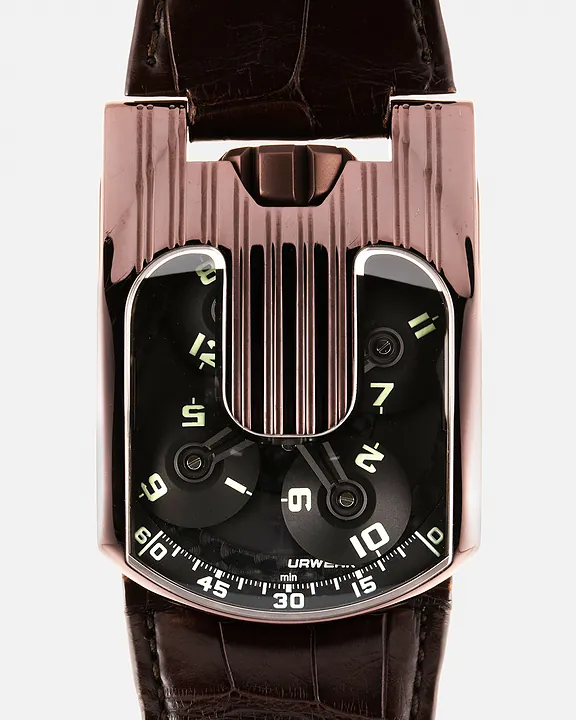
Urwerk UR103.08 TiAlN, 2007
S.Song Watches (dealer), Seattle
Wristwatches · 2021
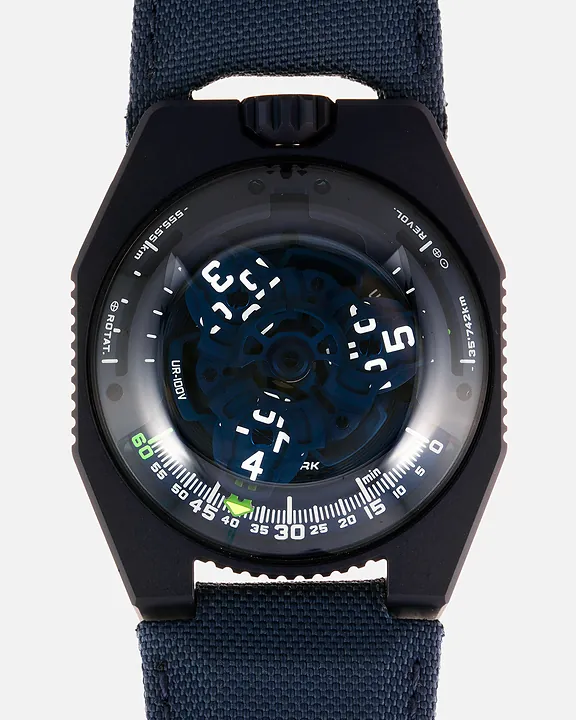
Urwerk UR100 Blue Planet, 2021
S.Song Watches (dealer), Seattle
Wristwatches · 2023
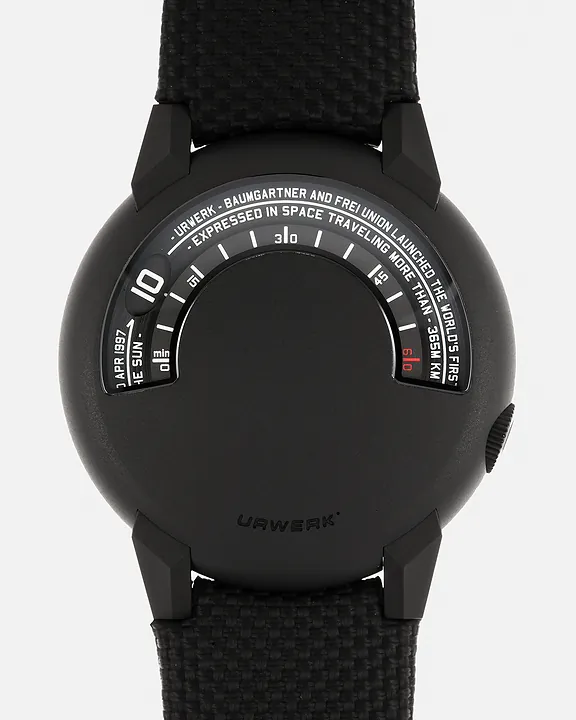
Urwerk UR102 Reloaded Black, 2023
S.Song Watches (dealer), Seattle
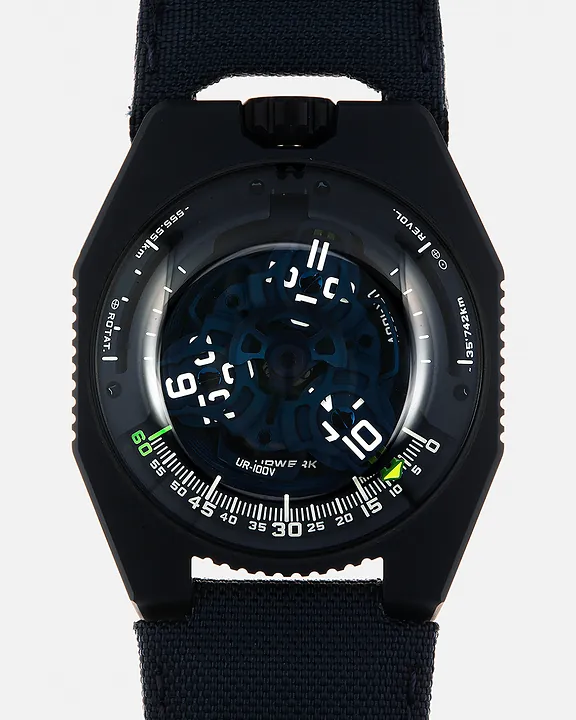
Wristwatches · 2021
Urwerk UR100 Blue Planet, 2021
S.Song Watches (dealer), Seattle

Wristwatches · c. 2010s
Breguet Type XXI, ref. 3810, c. 2010s (Antiquorum Lot 381-24)
Antiquorum auction archive, Geneva

Wristwatches · c. 2010s
Breguet Type XXI, ref. 3810, c. 2010s (Antiquorum Lot 386-229)
Antiquorum auction archive, Geneva

Wristwatches · Sold in September 2010
Breitling Cosmonaute, ref. A 22322, Sold in September 2010
Antiquorum auction archive, Geneva

Wristwatches · c. 2010
Corum Bubble Chrono, ref. 396.150.20, c. 2010
Antiquorum auction archive, Geneva