
Wristwatches · Wristwatch
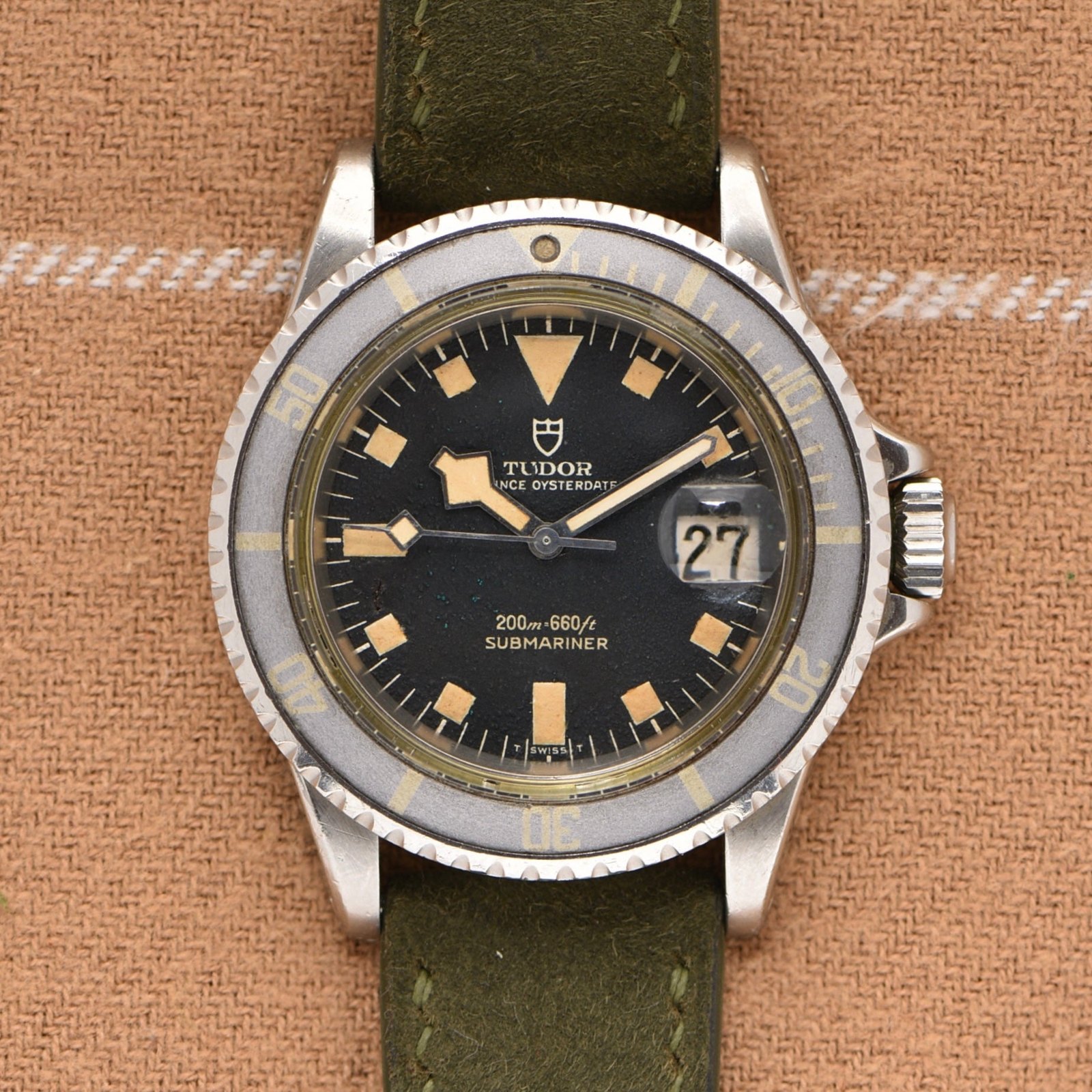
Tudor Submariner Snowflake Blue Dial - Ghost Bezel •Pending•, 1971
- Maker / attribution
- Tudor (maker)
- Date
- 1971
- Historical period
- Quartz Revolution (1969 – 1990)
- Country of origin
- Switzerland
- Object type
- Wristwatch
- Dimensions
- Case 40 mm
- Stock no.
- Product 7437607436471
- Credit line
- Dealer listing, Huntington Company (product 7437607436471)
- Catalogue title (original)
- 1971 Tudor Submariner Snowflake Blue Dial - Ghost Bezel •Pending• (English)
View the source record (dealer listing) ↗ (opens another website in a new tab)Suggest a correction
Record summary
Catalogued by Huntington Company (dealer) (stock number Product 7437607436471), this is a wristwatch by Tudor, made in Switzerland, dated 1971. The Atlas places it in the Quartz Revolution period (1969 – 1990) of its Wristwatches collection. Recorded dimensions: Case 40 mm. The record is illustrated with 6 photographs.
Assembled from the source record's structured fields. Dates and attributions are given as the source states them; where a field is missing the Atlas leaves it blank rather than estimating.
Catalogue description
Dealer description — Huntington Company
Reference 7021/0 Watch Only Specifications Year: 1971 Model: Submariner Case Diameter: 40mm Lug to Lug: 47mm Case: Stainless steel Condition: No significant wear as seen Dial: Blue Movement: Automatic Condition Let's start with the case. The watch case holes have no distortion which makes us believe the case is unpolished. The lug chamfers are also still very prominent. The original blue bezel insert is in amazing condition with a stunning ghost fade that is even. The dial has a crazy patina with a raised texture. The dial has been touched up between 8 and 9. The minute hand looks to have been relumed in the past but we suspect it was done closer to the early part of the watch's life. The dial, because of the raised texture that has happened over time, has caused the U in TUDOR to slightly move. The Story The "Snowflake" Submariner is a significant watch that Tudor has ever released, marking the first major stylistic departure from its big brother, the Rolex Submariner. Introduced in 1969, the snowflake design became the foundation of Tudor's return to North American prominence, imbuing the original references from the 1960s with even more importance in the collector community. Snowflakes had a continuous production run of roughly a decade, initially appearing as the reference 7016/0 and 7021/0, and later as the references 9401/0 and 9411/0, which were introduced in 1975 and featured newer movements. These snowflake references also became the most widely distributed military dive watches ever produced by Tudor, as they graced the wrists of military divers all the way from France to Jamaica. The author's interest in the Tudor side of the Submariner spectrum is due to the unique and endlessly interesting niche created by Tudor's packaging of the Oyster case and bracelet with more creative riffs on the traditional Submariner and dive watch design. The story behind owning a Tudor "Snowflake" Submariner began in 2018 when an estate picker listed a blue Snowflake that immediately stuck out to the author. Bidding was strong in the early going, and the watch continued to climb towards a fair market value over the ensuing days. The Snowflake Submariner was produced for over a decade across two references: the reference 7021/0 and the reference 9411/0. The most obvious differences between the two references are the "roulette" date wheel that alternates between red and black text each day, wider chamfers on earlier 7021/0 cases, and lighter dials, often referred to as "confetti" dials. The Brand Tudor has a history of use in military and sporting contexts, with France's Marine Nationale issuing Tudor watches to its members throughout the 20th century. Other military organizations, such as the Jamaican Defense Force, Canadian Navy, and United States Navy, chose the Tudor Submariner as their go-to watch due to its outstanding durability and build quality. Tudor is known for its experimental designs, including unique integrated cases, colorful dial chronographs, and "Montecarlo"-inspired color schemes. Today, Tudor's lineup combines minimalistic tool watches and eye-catching chronographs. Five of its most popular modern models include the Black Bay, Black Shield, Ranger, and Pelagos. The Black Bay is a stylish, functional dive watch inspired by Tudor watches of the 1950s. It measures 41mm and is waterproof to 200m, drawing inspiration from several of Tudor's iconic 1950s Submariner dive watches. The Black Bay's dial is both functional and elegant, with pink gold hands and lume plots and a unidirectional rotating bezel made from steel. The Fastrider Black Shield is a bold, midsized chronograph with a matte black dial, bezel, and ceramic monobloc case. Inspired by the Ducati XDiavel, the Black Shield is a tactical watch that brings Tudor's sense of style into the modern day. The Tudor Heritage Ranger is a minimalist, function-over-form tool watch that closely resembles the Oyster Prince Ranger of the 1960s. It features an Explorer-inspired dial, a larger stainless steel case, and an in-house TUDOR calibre 2824 movement with a total power reserve of approximately 38 hours.
Historical context
Quartz Revolution (1969 – 1990)
Seiko's Astron begins mass quartz timekeeping; traditional industries contract sharply.
Quartz and digital watches transformed the market after 1969. Swiss employment collapsed, Japanese and Hong Kong production soared, and the Swatch (1983) helped the Swiss industry recover; mechanical watches survived as luxury goods.
Read the period in the timelineMore wristwatches from this periodEarlier: Modern Mechanical Horology
Atlas type guide
Dive and water-resistant watches
Keeping water and dust out of a wristwatch was a long-standing challenge. Rolex's screw-down Oyster case (1926) and Omega's Marine (1932) were landmarks; in the early 1950s Blancpain's Fifty Fathoms and Rolex's Submariner defined the professional dive watch with rotating bezels for timing dives, luminous dials and high water resistance. The ISO 6425 standard (1982) later codified what a 'diver's watch' must do.
Dive watches became icons of post-war design and exploration, and their evolution — helium escape valves, ceramic bezels, saturation-diving depth ratings — records the history of underwater work.
What to look for
- Unidirectional or bidirectional rotating bezel with minute markings.
- Screw-down crown and case back; depth rating printed on the dial.
- Luminous hands and markers (radium before c. 1960, tritium c. 1960–1998, then Super-LumiNova).
- Reference numbers on the case between the lugs or inside the back.
Dating clues
- Screw-down Oyster cases: from 1926.
- Professional dive watches: from 1953.
- Tritium 'T' marks on dials: c. 1960–1998.
General guidance written by the Atlas editors about this kind of object. It is not a statement about this particular piece; for that, rely on the source record above and on physical examination.
Related records
Wristwatches · c. 1973
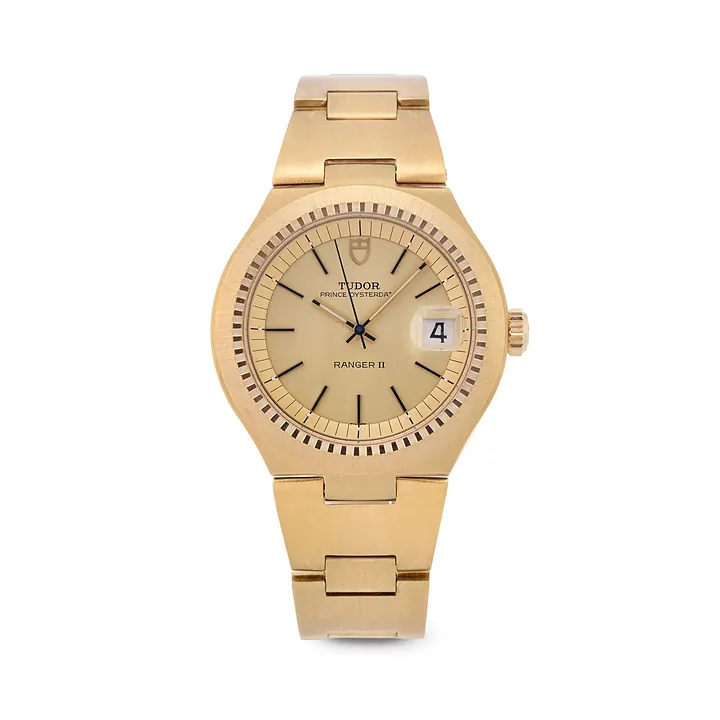
Tudor Prince Oysterdate Ranger II, ref. 9101/1, c. 1973
Antiquorum auction archive, Geneva
Wristwatches · c. 1973
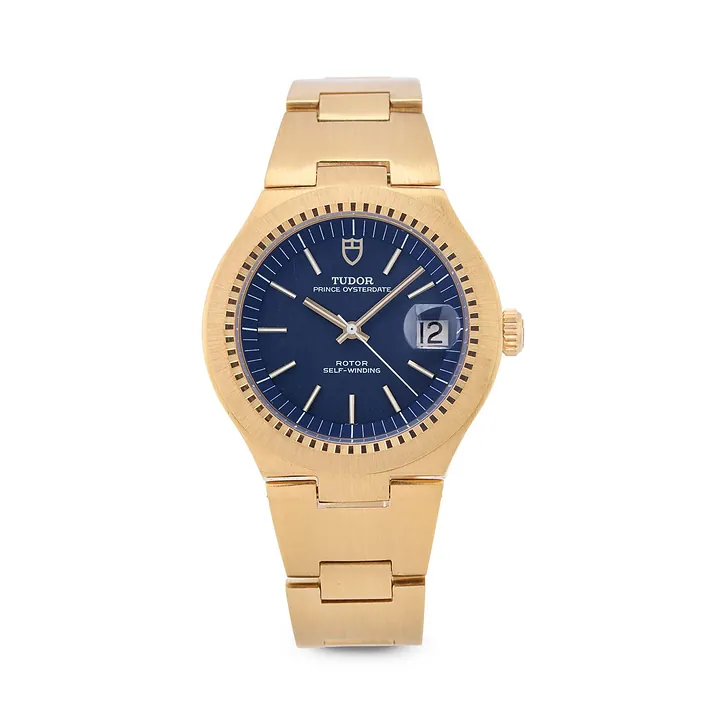
Tudor Prince Oysterdate, ref. 9101/1, c. 1973 (Antiquorum Lot 389-114)
Antiquorum auction archive, Geneva
Wristwatches · c. 1973
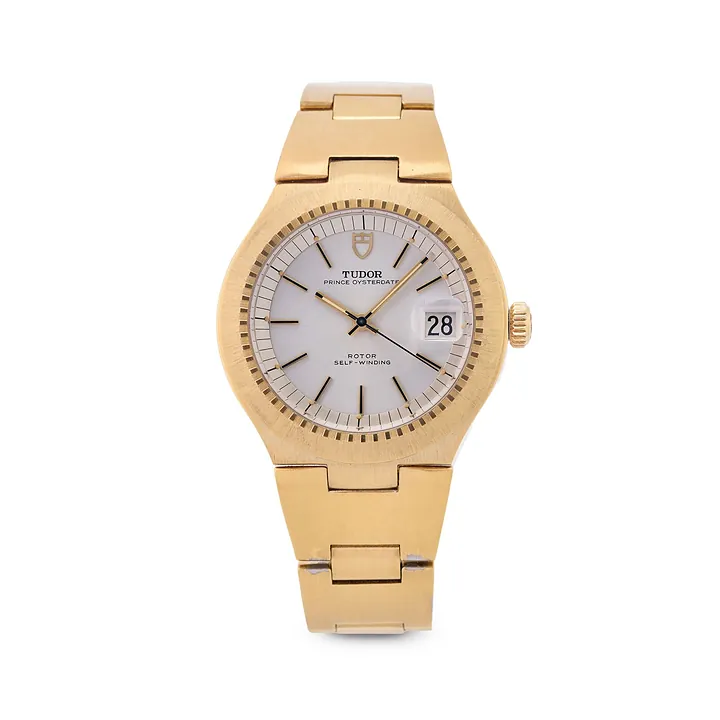
Tudor Prince Oysterdate, ref. 9101/1, c. 1973 (Antiquorum Lot 389-115)
Antiquorum auction archive, Geneva
Wristwatches · c. 1974
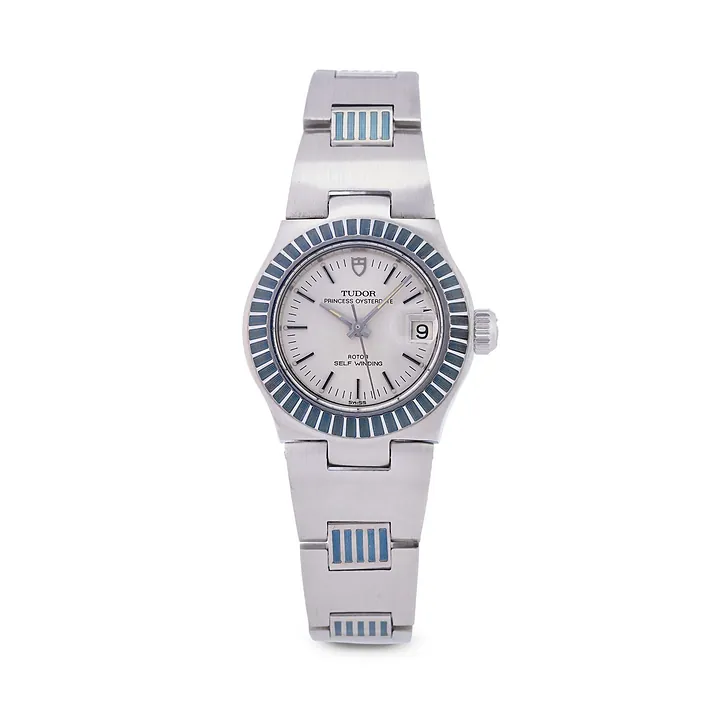
Tudor Princess Oysterdate, ref. 9311/0, c. 1974
Antiquorum auction archive, Geneva

Wristwatches · 1970
Wristwatch by Heno, Switzerland, 1970
Museum Rotterdam

Wristwatches · 1960–1986
'Tri-Compax' calendar chronograph wristwatch in gold case, by Universal, Geneva, Switzerland, 1960–1986.
Science Museum Group, London

Wristwatches · 1969–1970
Beta 21 Quartz wristwatch movement, made in Switzerland, 1970.
Science Museum Group, London

Wristwatches · c. 1969
Omega Speedmaster Moonwatch, ref. 145022-69st, c. 1969
Antiquorum auction archive, Geneva