
Wristwatches · Radio-controlled watch
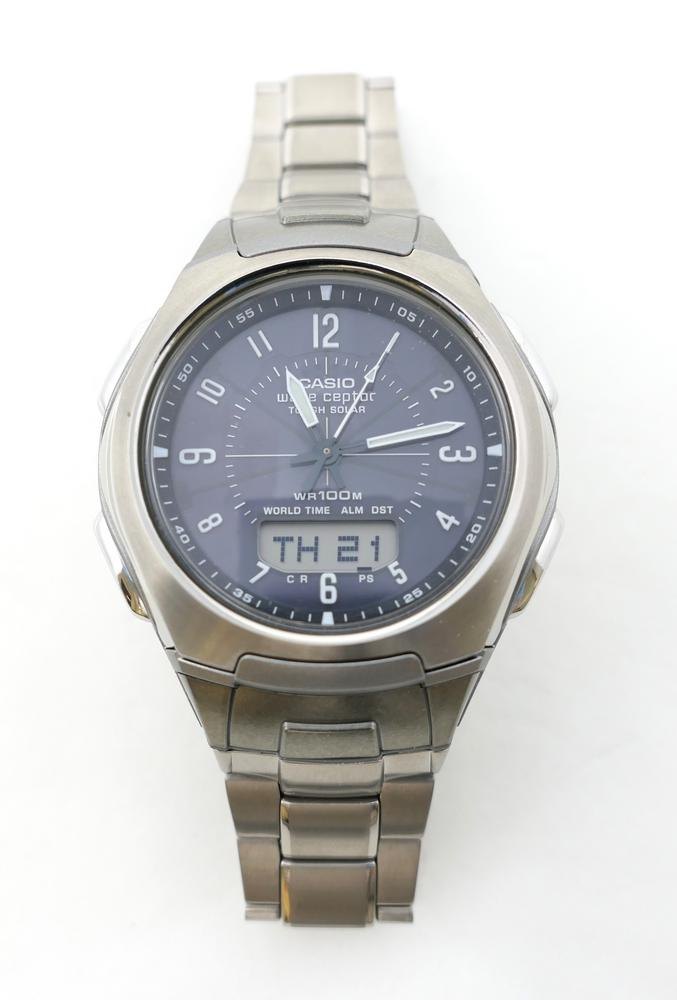
Titanium cased radio-controlled solar-powered wrist watch
- Maker / attribution
- Casio (Made by)
- Date
- 2007
- Historical period
- Mechanical Renaissance (1990 – 2010)
- Country of origin
- Japan
- Place
- Japan (movement), Thailand (case), China (titanium base)
- Object type
- Radio-controlled watch
- Materials / technique
- titanium
- Dimensions
- Diameter: 33.60 millimetres (dial)
- Holding institution
- British Museum
- Accession / object no.
- 2007,8011.1
- Credit line
- British Museum, London
- Catalogue title (original)
- Titanium cased radio-controlled solar-powered wrist watch (English)
View the source record ↗ (opens another website in a new tab)Suggest a correction
Record summary
Held and catalogued by British Museum (object number 2007,8011.1), this is a radio-controlled watch by Casio, made in Japan (movement), Thailand (case), China (titanium base), dated 2007. The Atlas places it in the Mechanical Renaissance period (1990 – 2010) of its Wristwatches collection. Materials and techniques recorded by the source: titanium. Recorded dimensions: Diameter: 33.60 millimetres (dial). The record is illustrated with 6 photographs.
Assembled from the source record's structured fields. Dates and attributions are given as the source states them; where a field is missing the Atlas leaves it blank rather than estimating.
Catalogue description
Description — British Museum
Titanium cased radio-controlled solar-powered wrist watch. Titanium case with linked bracelet. Four push-buttons around the band for setting and mode selection. Charcoal grey dial with an outer circle for minutes, Arabic hours 1-12 also with an inner circle divided to seconds.All main calibrations are luminous painted. Between 5 and 7 o'clock a rectangular aperture has an LCD screen displating various modes. Luminous-painted baton hour and minute hands, arrow head centre-seconds hand. Complete with instruction book and original blue card box.
Curator's comments — British Museum
Text from 'Watches', by David Thompson, London, 2008, p. 166-167. Casio Computer Company Ltd TITANIUM CASED RADIO-CONTROLLED WRISTWATCH TOKYO, 2007 While the quartz clock achieved previously unrivalled levels of accuracy, the story does not end there. At the same time that it was being developed as the new time standard, Isidor Isaac Rabi, working with other leading physicists, was investigating the properties of using beams of atomic particles as a frequency standard, based on earlier research by Otto Stern. In 1952 Jesse Sherwood, working at the National Bureau of Standards in America, successfully completed a new form of timekeeper based on the behaviour of atomic particles emitted from caesium isotope 133. After a visit to America to discuss progress being made there, Louis Essen, working with John V.L. Parry, developed an atomic beam clock, which was completed in 1955 at the National Physics Laboratories in England. The emission of particles passed though magnetic fields was measured at a frequency of 9,192,631,770 cycles per second and was found to be extraordinarily constant, producing an accuracy of one second in three hundred years. Subsequent developments have produced atomic clocks of staggering accuracy. The latest examples - caesium fountain clocks - have produced even greater stability, providing a new absolute for the definition of time. In 1967 it was internationally agreed that the standard unit of time henceforth would be based on the period of particle emission of the atomic clock. The idea of transmitting time signals for correcting clocks around the world originated in the nineteenth century with the use of telegraph signals. By the mid-1870s Greenwich Royal Observatory was providing time signals by telegraph to various locations in Britain, and by the early twentieth century the US Naval Observatory in Washington was sending a time signal by telegraph to 70,000 locations in the United States. With the advent of radio, the possibilities of time distribution widened further. As early as 1904, the US Naval Observatory began transmitting time signals by wireless telegraph. The first radio clock appeared much later, in 1952, and in 1977 the first public radio time signals were broadcast, first in Germany by the Braunschweig transmitter. In 1986 the first radio-controlled clock, the Junghans RCS1, went on sale. It was only a matter of time before the technology would be miniaturized for use in a wristwatch, and in 1991 the Junghans Mega1 was made available to the general public. Today it is possible to purchase a whole range of radio-controlled quartz watches. These contain a standard quartz watch, which is periodically corrected by a time signal sent from one of a number of transmitters around the world that broadcast time signals provided by atomic clocks. This example by Casio is one of the newest and has a light but robust titanium case and bracelet. The dial also functions as a photo-electric cell, generating the electricity necessary to power the watch, making the task of changing batteries a thing of the past. Although there is a battery for illuminating the dial. [PB].
Inscriptions & marks
inscription; dial; Casio; Wave Ceptor; Tough-Solar; WR100M; World Time ALM DST; C R PS; inscription; case back; CASIO; WAVE CEPTOR; ILLUMINATOR; WORLD TIME; 3854 WVA-430TE; TITANIUM BACK; WATER RESISTANT 10 BAR; JAPAN MOV'T Y; CASED IN THAILAND; CE; 212A022G
Provenance
Purchased from:, H Samuel Ltd
Historical context
Mechanical Renaissance (1990 – 2010)
Mechanical watches return as cultural objects; independent watchmaking flourishes.
Mechanical watches returned as cultural and luxury objects. Complications, tourbillons and new materials proliferated; independent watchmakers such as George Daniels, F.P. Journe and Philippe Dufour revived artisanal watchmaking; collecting vintage watches became a major field.
Read the period in the timelineMore wristwatches from this periodEarlier: Quartz Revolution
Atlas type guide
Quartz, digital and electronic watches
Electronic watches arrived in three steps. The Hamilton Electric 500 (1957) was the first battery-powered wristwatch, still with a balance; Bulova's Accutron (1960) used a tuning fork. On 25 December 1969 Seiko released the Astron 35SQ, the first quartz wristwatch, closely followed by the Swiss Beta 21 group. In 1972 Hamilton's Pulsar introduced the LED digital watch, and LCD displays soon made digital watches cheap.
The 'Quartz Crisis' that followed devastated the Swiss mechanical industry, which lost two-thirds of its workforce between 1970 and 1984 before recovering with the Swatch (1983) and the luxury mechanical revival. Solar, radio-controlled, kinetic and connected smartwatches continue the electronic line.
What to look for
- Battery hatch in the case back and calibre markings with 'Quartz' or a crystal frequency.
- Display technology: LED (red, push-button) versus LCD (always-on).
- Tuning-fork hum and a smoothly sweeping seconds hand on Accutrons.
- Model and reference numbers, often printed on the back.
Dating clues
- Electric balance watches: from 1957.
- Tuning-fork watches: 1960–c. 1977.
- Quartz analogue: from December 1969; LED digital: 1972–c. 1978; LCD from 1973.
General guidance written by the Atlas editors about this kind of object. It is not a statement about this particular piece; for that, rely on the source record above and on physical examination.
Read next:Seiko calibre 35A (Astron)
Related records
Wristwatches · 1999
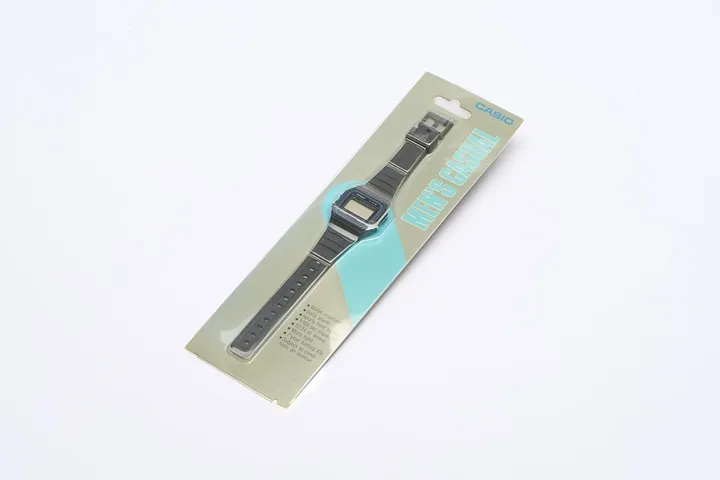
Casio gents LCD digital watch, black resin case and strap, in packaging, model F-91W, with alarm, stopwatch, 7-year battery life. 1999.
Science Museum Group, London
Wristwatches · 2009
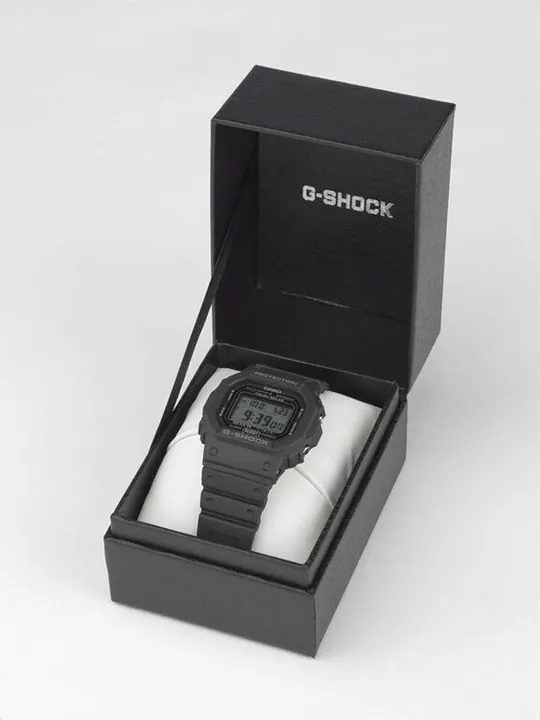
'GW-5000-1JF' G-Shock designed by Casio, 2009.
Victoria and Albert Museum, London
Wristwatches · c. 1976
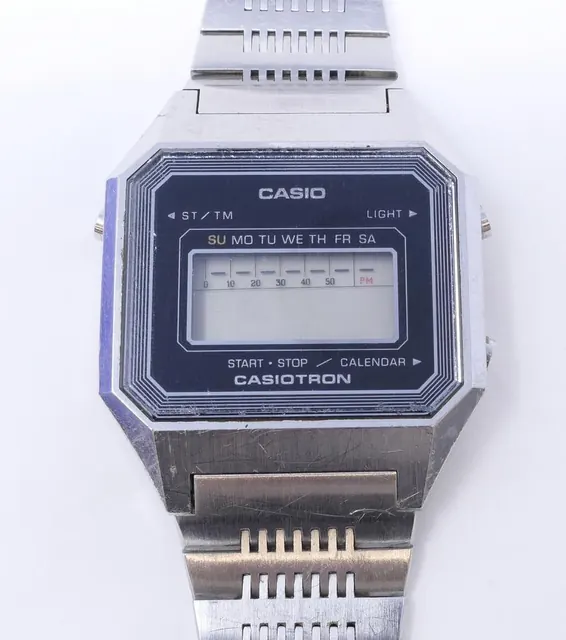
LCD digital wrist-watch with day/date and stopwatch mechanism with stainless-steel case and bracelet
British Museum
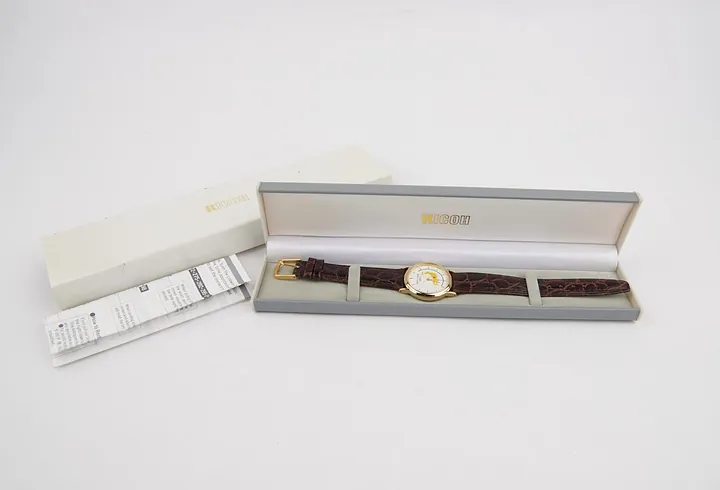
Wristwatches · 1990–1996
Wristwatch by Ricoh Elemex Corporation, Japan, 1990–1996
Science Museum Group, London
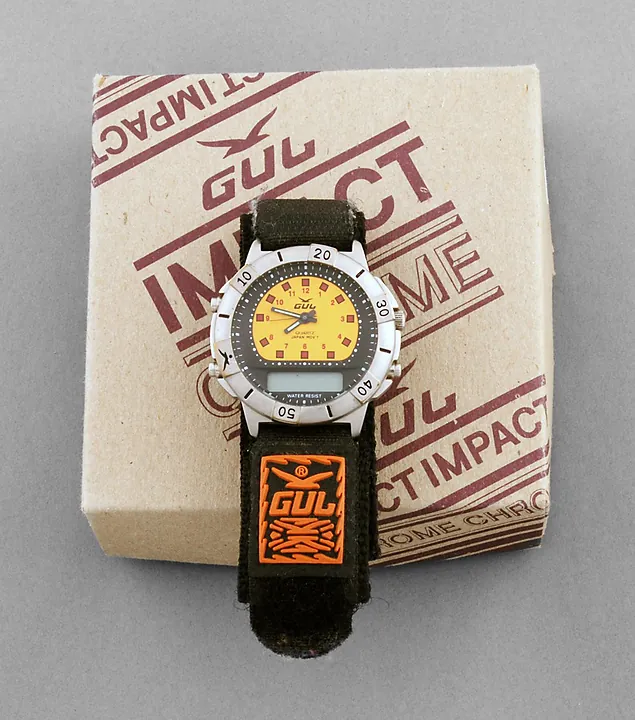
Wristwatches · 1990
Wristwatch, Japan, 1990
Blekinge Museum
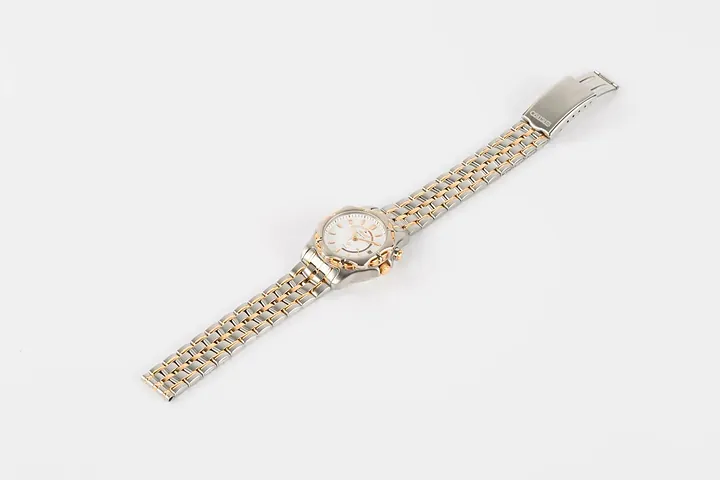
Wristwatches · 1995
Wristwatch, Japan, 1995 (no. 57932)
German Clock Museum
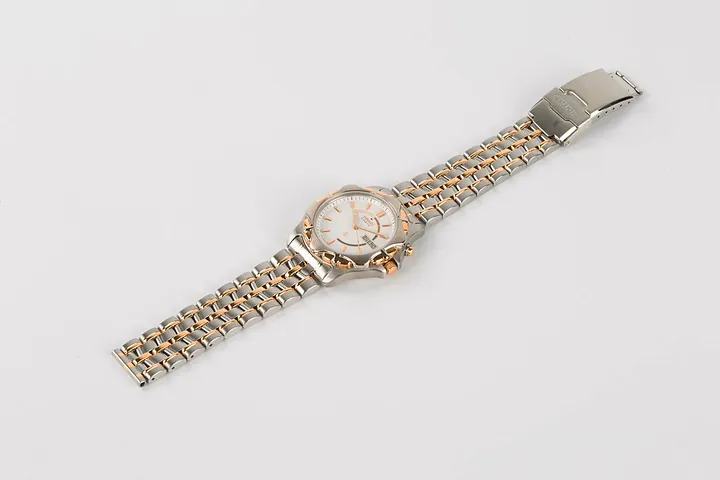
Wristwatches · 1995
Wristwatch, Japan, 1995 (no. 57933)
German Clock Museum
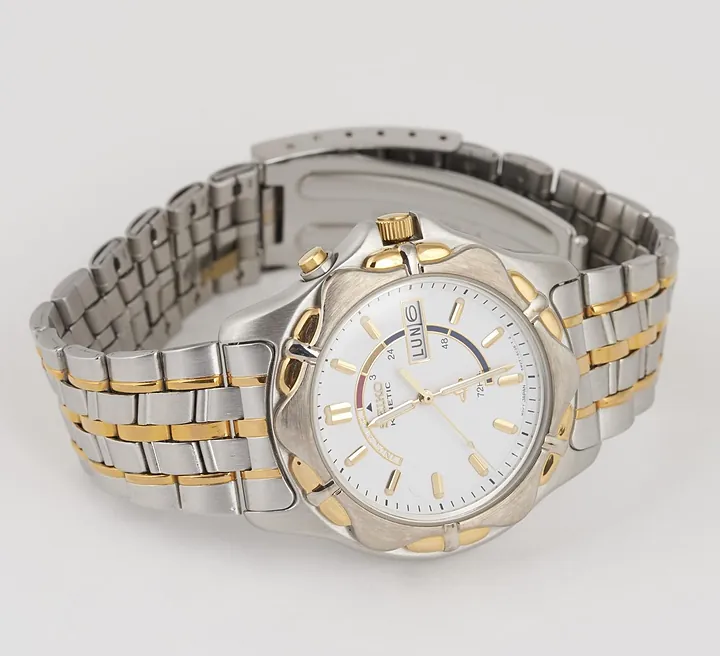
Wristwatches · 1996
Seiko 'Kinetic' wrist watch, 1996.
Science Museum Group, London