Wristwatches · Digital watch
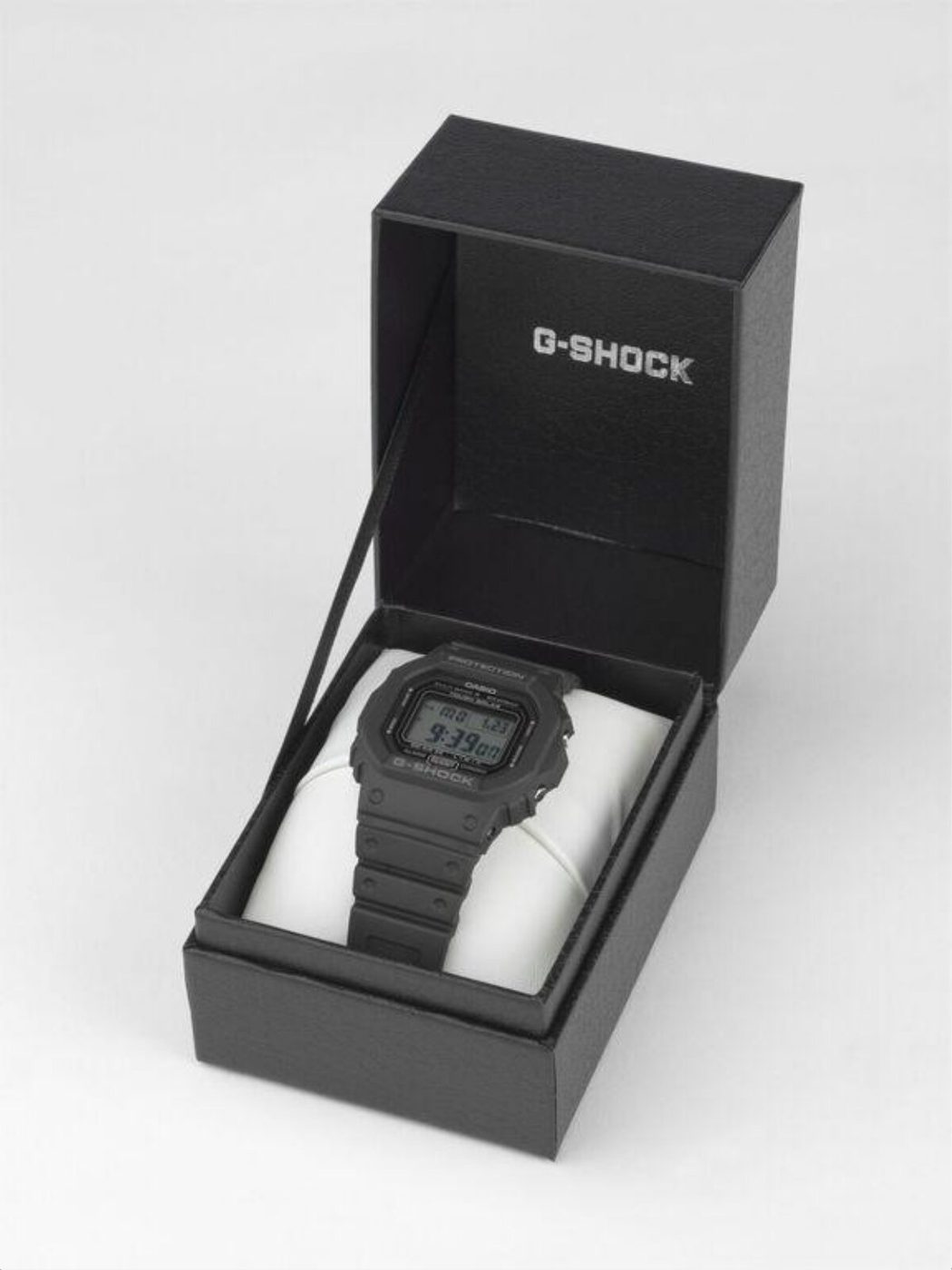
'GW-5000-1JF' G-Shock designed by Casio, 2009.
- Maker / attribution
- Casio
- Date
- 2009
- Historical period
- Mechanical Renaissance (1990 – 2010)
- Country of origin
- Japan
- Place
- Japan
- Object type
- Digital watch
- Materials / technique
- stainless steel, urethane-resin, glass, rubber
- Dimensions
- Height: 24.7 cm; Width: 4.3 cm; Depth: 2 cm; Height: 8.3 cm; Width: 4.3 cm; Depth: 2 cm
- Holding institution
- Victoria and Albert Museum, London
- Accession / object no.
- CD.79:1 to 3-2016
- Catalogue title (original)
- 'GW-5000-1JF' G-Shock
Record summary
Held and catalogued by Victoria and Albert Museum, London (object number CD.79:1 to 3-2016), this is a digital watch by Casio, made in Japan, dated 2009. The Atlas places it in the Mechanical Renaissance period (1990 – 2010) of its Wristwatches collection. Materials and techniques recorded by the source: stainless steel, urethane-resin, glass, rubber. Recorded dimensions: Height: 24.7 cm; Width: 4.3 cm; Depth: 2 cm; Height: 8.3 cm; Width: 4.3 cm; Depth: 2 cm. The record is illustrated with 3 photographs.
Assembled from the source record's structured fields. Dates and attributions are given as the source states them; where a field is missing the Atlas leaves it blank rather than estimating.
Catalogue description
V&A — Summary
G-Shock is a line of highly durable watches first released by Casio in the 1980s. This is an example of the first G-Shock (DW-5000) which was designed in 1983 by Casio engineer Kikuo Ibe, who is now the company’s Chief Engineer for Research and Development. The idea for this watch came to Kikuo Ibe when he accidentally dropped and broke his own watch while at work. The dropped watch had sentimental value as it was a gift from his father, so in reaction he endeavored to design a watch that could withstand such accidents. After more than 200 prototypes, the first G-Shock watch was released. It was designed to survive a ten-metre drop, be water resistant up to 100 metres and have a ten-year battery life. G-Shock is short for Gravitational Shock, connoting its rugged durable design. The design achieves shock resistance due to a urethane foam cradle which protects its quartz mechanism, as well as nine other protective layers, including a stainless steel case, a urethane rubber bumper, and hardened mineral glass watch crystal. The outer buttons and LCD are attached with flexible cables and the wrist strap is also designed to absorb shocks as it is fixed in a curved shape that enables it to act as a shock absorber to guard the back of the case from direct shocks. This watch is a re-issue of the DW-5000 with a few added features. It is equipped with ‘Tough Solar’, a type of solar-charging system, as well as a ‘Multi-Band 6 Atomic Timekeeping’ feature, which enables the watch to receive time calibration radio signals from six transmitters worldwide. This object represents part of a wider trend for high performance athletic wear, which began in the 1970s and continues today. This trend has prompted ever more sophisticated, durable, and lightweight devices to be designed and marketed to a consumer-base interested in apparel and equipment that can both perform well and connote a sporty outdoors lifestyle. This watch was acquired as part of the Shekou Project, an international partnership between the V&A and China Merchant Shekou Holdings (CMSK) to open a new cultural platform called Design Society in Shekou. The watch was included in the inaugural exhibition, ‘Values of Design’, in the V&A Gallery at Design Society in a section exploring durable design.
V&A — Physical description
A wrist watch with black rubber curved wrist strap with ridges and metal buckle. The watch has a digital face with four buttons surrounding it. The words 'CASIO' and 'G-SHOCK' are inscribed around the digital face.
V&A — Object history
This watch was included in ‘Values of Design’ at the V&A Gallery, Design Society in Shenzhen, China in 2017.
V&A gallery label
G-Shock Watch Casio Japan, 2009 G-Shock is a line of highly durable watches first released by Casio in the 1980s. The watch has a 10-year battery life, is water resistant to at least 100 metres, and can survive a 10-metre fall. Their ruggedness has made them popular with sports enthusiasts.
Historical context
Mechanical Renaissance (1990 – 2010)
Mechanical watches return as cultural objects; independent watchmaking flourishes.
Mechanical watches returned as cultural and luxury objects. Complications, tourbillons and new materials proliferated; independent watchmakers such as George Daniels, F.P. Journe and Philippe Dufour revived artisanal watchmaking; collecting vintage watches became a major field.
Read the period in the timelineMore wristwatches from this periodEarlier: Quartz Revolution
Atlas type guide
Quartz, digital and electronic watches
Electronic watches arrived in three steps. The Hamilton Electric 500 (1957) was the first battery-powered wristwatch, still with a balance; Bulova's Accutron (1960) used a tuning fork. On 25 December 1969 Seiko released the Astron 35SQ, the first quartz wristwatch, closely followed by the Swiss Beta 21 group. In 1972 Hamilton's Pulsar introduced the LED digital watch, and LCD displays soon made digital watches cheap.
The 'Quartz Crisis' that followed devastated the Swiss mechanical industry, which lost two-thirds of its workforce between 1970 and 1984 before recovering with the Swatch (1983) and the luxury mechanical revival. Solar, radio-controlled, kinetic and connected smartwatches continue the electronic line.
What to look for
- Battery hatch in the case back and calibre markings with 'Quartz' or a crystal frequency.
- Display technology: LED (red, push-button) versus LCD (always-on).
- Tuning-fork hum and a smoothly sweeping seconds hand on Accutrons.
- Model and reference numbers, often printed on the back.
Dating clues
- Electric balance watches: from 1957.
- Tuning-fork watches: 1960–c. 1977.
- Quartz analogue: from December 1969; LED digital: 1972–c. 1978; LCD from 1973.
General guidance written by the Atlas editors about this kind of object. It is not a statement about this particular piece; for that, rely on the source record above and on physical examination.
Read next:Seiko calibre 35A (Astron)
Related records
Wristwatches · 1999
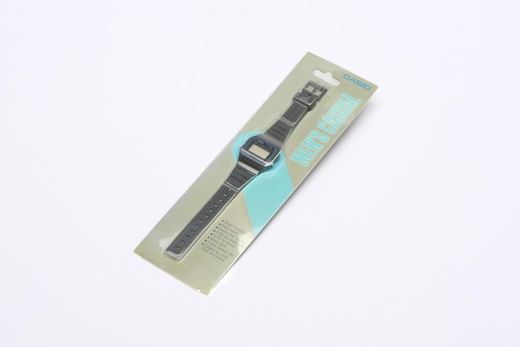
Casio gents LCD digital watch, black resin case and strap, in packaging, model F-91W, with alarm, stopwatch, 7-year battery life. 1999.
Science Museum Group, London
Wristwatches · 1990-1996
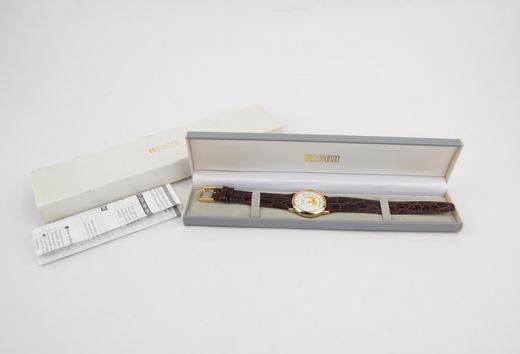
Wristwatch by Ricoh Elemex Corporation, Japan, 1990-1996
Science Museum Group, London
Wristwatches · 1990
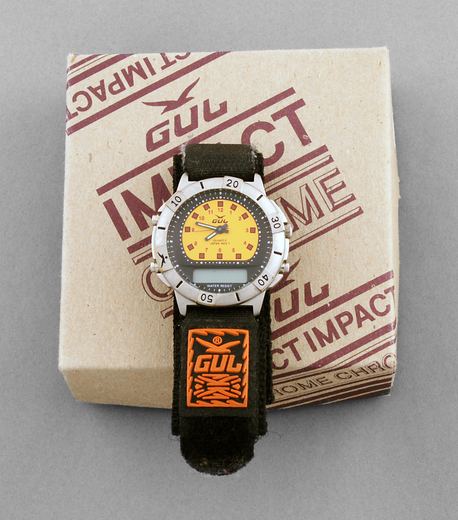
Wristwatch, Japan, 1990
Blekinge Museum
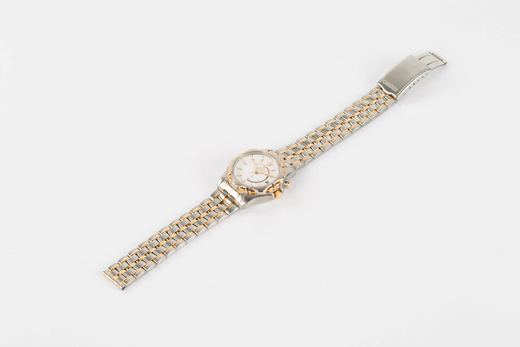
Wristwatches · 1995
Wristwatch, Japan, 1995 (German Clock Museum Museu_ProvidedCHO_museum_digital_57932__technical_number_)
German Clock Museum
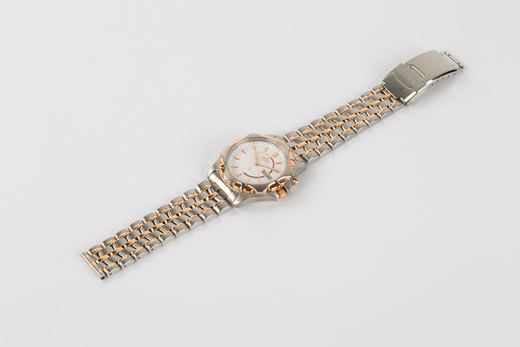
Wristwatches · 1995
Wristwatch, Japan, 1995 (German Clock Museum Museu_ProvidedCHO_museum_digital_57933__technical_number_)
German Clock Museum
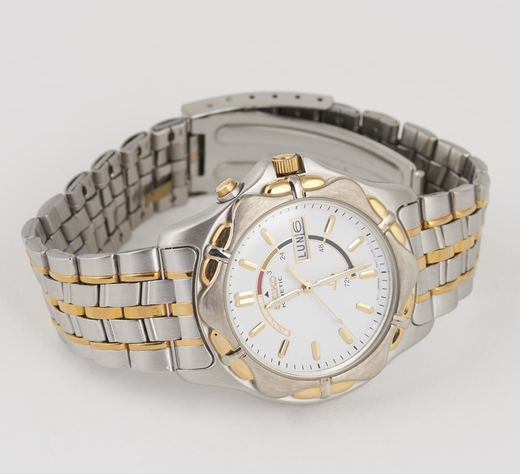
Wristwatches · 1996
Seiko 'Kinetic' wrist watch, 1996.
Science Museum Group, London
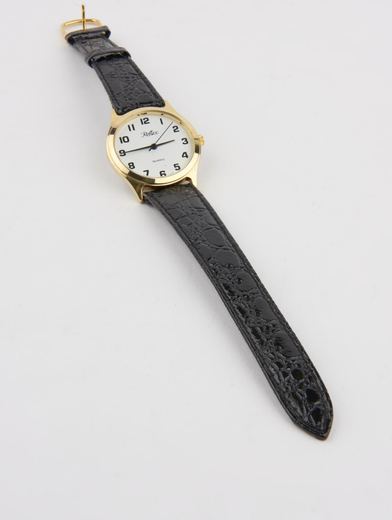
Wristwatches · 1996
Wristwatch by Reflex, Japan, 1996
Science Museum Group, London
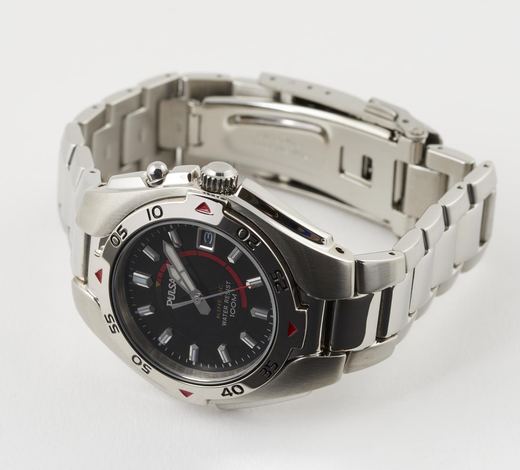
Wristwatches · 2000
Wristwatch by Pulsar, Japan, 2000
Science Museum Group, London