
Wristwatches · Wristwatch
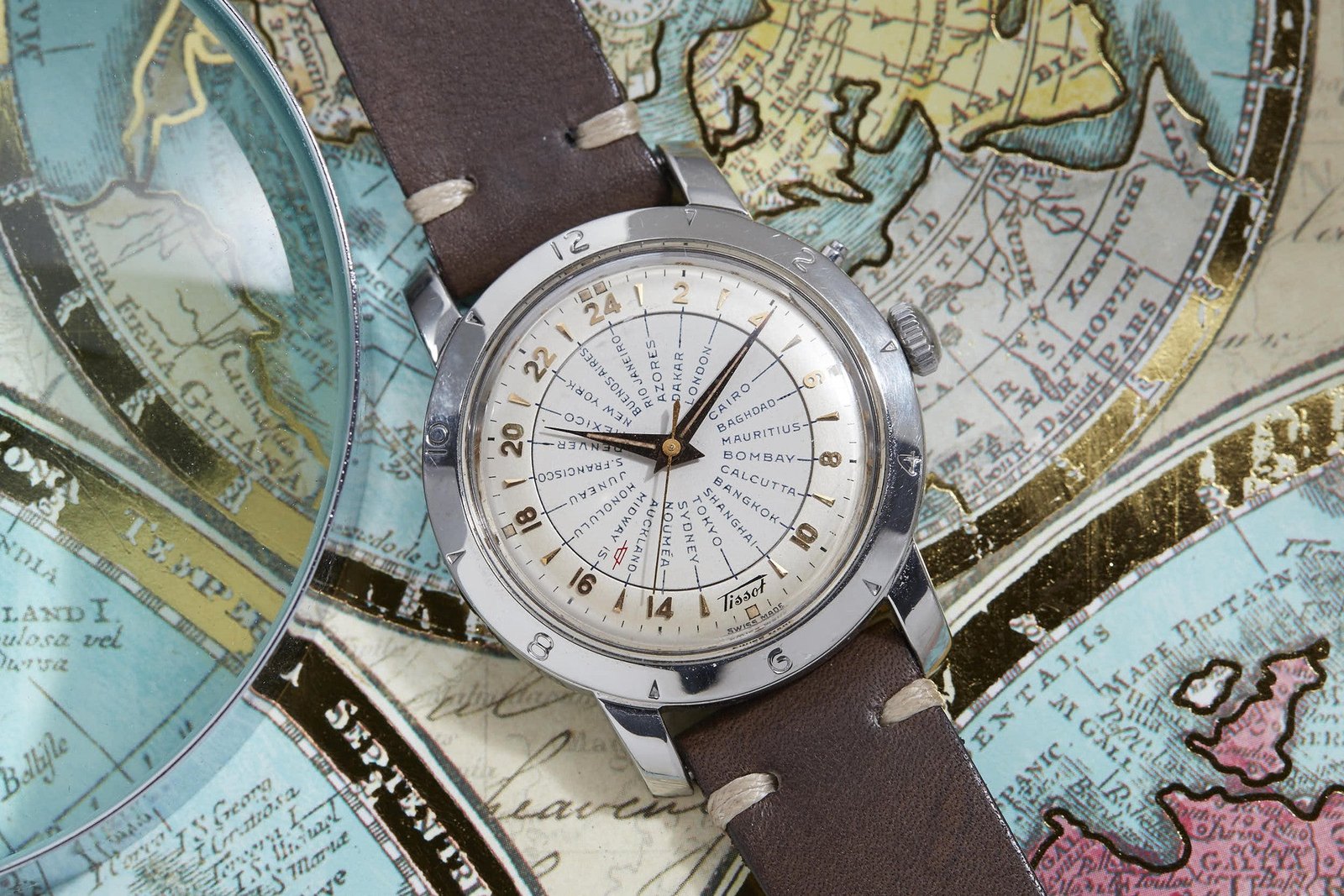
Tissot Navigator World Time, 1950s
- Maker / attribution
- Tissot (maker)
- Date
- 1950s
- Historical period
- Modern Mechanical Horology (1945 – 1969)
- Country of origin
- Switzerland
- Object type
- Wristwatch
- Dimensions
- Case 36 mm
- Stock no.
- Product 8574061889
- Credit line
- Dealer listing, Analog/Shift (product 8574061889)
- Catalogue title (original)
- Tissot Navigator World Time (English)
View the source record (dealer listing) ↗ (opens another website in a new tab)Suggest a correction
Record summary
Catalogued by Analog/Shift (dealer), New York (stock number Product 8574061889), this is a wristwatch by Tissot, made in Switzerland, dated 1950s. The Atlas places it in the Modern Mechanical Horology period (1945 – 1969) of its Wristwatches collection. Recorded dimensions: Case 36 mm. The record is illustrated with 6 photographs.
Assembled from the source record's structured fields. Dates and attributions are given as the source states them; where a field is missing the Atlas leaves it blank rather than estimating.
Catalogue description
Dealer description — Analog/Shift
The Jet Age shrunk the world. The advent of transcontinental and transatlantic jet travel made it possible for a person to sip an espresso in the Bar Della Pace in the morning and still make an 8:00 reservation at Lutèce that same evening. But despite this revolutionary development, it was merely the result of old technologies being adapted to suit the unprecedented proliferation and relative ease of global travel. After all, the Trans-Siberian Railway had been ferrying passengers across eight timezones since 1916. To meet the demands prompted by the establishment of railway time in the 1860s, watch manufacturers such as Hamilton and Elgin developed railroad pocket chronometers that had a third hand to indicate an additional timezone. At the higher-end of the spectrum, in the 1930s and 1940s manufactures such as Vacheron Constantin and Patek Philippe produced world time pocket watches (and later wristwatches) using a World Time dial layout designed by Louis Cottier. But since a journey from Moscow to Vladivostok on the Rossiya could take six days—roughly the same as a transatlantic crossing on the Queen Mary e—passengers could merely set their watches to the local time upon arrival, thus rendering the GMT or world time pocket watches expensive and whimsical. However, the sheer immediacy of jet travel—and the frequency at which these transatlantic and transcontinental flights occurred— made it necessary for travelers to have a type of wristwatch that could display two timezones at once. While the Rolex GMT Master is arguably the best-known of all wristwatches to emerge from this era, other manufactures raced to develop a wristwatch that did more than just indicate a second time zone with a fixed 24-hour hand. These wristwatches employed rotating discs that displayed the world’s timezones, with names of major cities to represent each region. Perhaps the most elegant and visually-arresting of these is the Tissot Navigator World Time. In fact, the Navigator World Time debuted in 1953, a year before the GMT Master. Tissot produced the Navigator throughout the 1960s, shifting from a pusher-operated system to one with a rotating inner bezel. This particular example dates from the 1950s and is thus an earlier one with pushers. To set it, you merely align the disc depicting your home timezone to midnight, stop the discs using the pusher at 2 o’clock, and then set the hour and minute hands the usual way. The case, though only 36mm, is beefy, with fat lugs and a steel bezel. The watch is powered by an in-house Tissot Caliber 28.5N-21T automatic bumper-wind movement, which Tissot used exclusively for the Navigator. With similar early examples from the 1950s rarely surfacing on the market, they’re still relatively affordable. They’re certainly more attainable than the versions produced by Patek Philippe or Vacheron Constantin, or even a Rolex GMT. For a budget vintage world timer that exudes Jet Set elegance, the Tissot Navigator is it.
Historical context
Modern Mechanical Horology (1945 – 1969)
Tool watches for divers, pilots and astronauts; electric watches anticipate the electronic age.
The classic era of the mechanical wristwatch: dive watches, chronographs for motor racing and space flight, GMT watches for jet travel, slim dress watches, automatic calendars, and the rise of Japanese manufacturers alongside Swiss, American, German and Soviet industries.
Read the period in the timelineMore wristwatches from this periodEarlier: Golden Age of Mechanical Watchmaking
Atlas type guide
Military, pilot and travel watches
The wristwatch owes much of its adoption by men to warfare and aviation. Wristlets — small pocket watches soldered with lugs and worn on a strap — were used in colonial campaigns and became standard equipment in the First World War, with protective grilles over the crystal ('shrapnel guards'). Louis Cartier's Santos (1904), designed for the aviator Alberto Santos-Dumont, is often cited as an early purpose-made pilot's watch.
In the Second World War governments specified watches in detail: the German B-Uhr observation watches, the American A-11, and the British 'W.W.W.' (the 'Dirty Dozen' set of 1945). After the war, jet travel brought GMT and world-time watches, which show two or more time zones at once — Louis Cottier's world-time mechanism and the Rolex GMT-Master (1955) are examples.
What to look for
- Military markings on the case back: broad arrow, issue numbers, 'W.W.W.', 'A.T.P.'
- High-legibility black dials with luminous Arabic numerals; oversized crowns for gloved hands.
- 24-hour hands and rotating 24-hour bezels or city rings on GMT/world-time watches.
- Wire lugs on early wristlets converted from pocket watches.
Dating clues
- Wire-lug wristlets: c. 1900–1925.
- Military specifications of the Second World War: 1939–1945.
- GMT and world-time wristwatches: mainly after 1950.
General guidance written by the Atlas editors about this kind of object. It is not a statement about this particular piece; for that, rely on the source record above and on physical examination.
Related records
Pocket Watches · 1971–2001
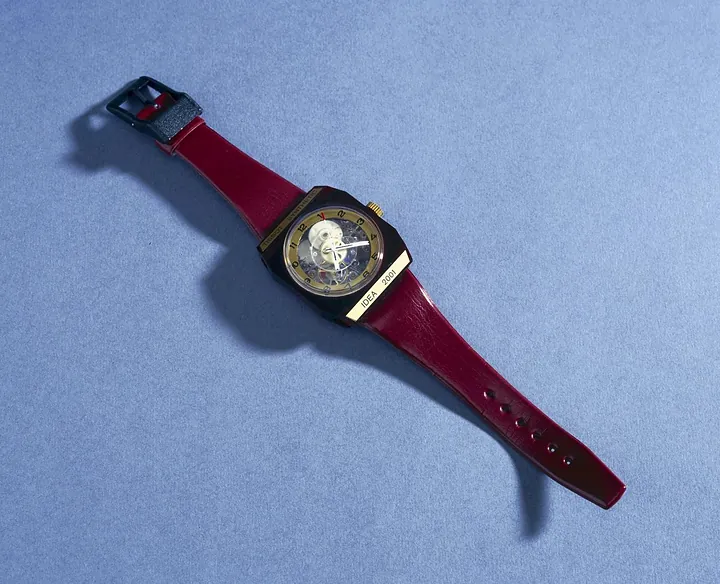
"Tissot synthetic idea 2001" the first plastic watch, introduced in 1971
Science Museum Group, London
Wristwatches · c. 1960
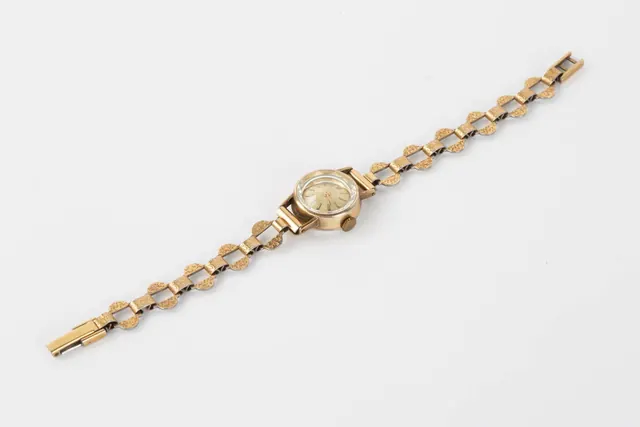
Wristwatch by Tissot, Switzerland, c. 1960
German Clock Museum
Wristwatches · 1930s
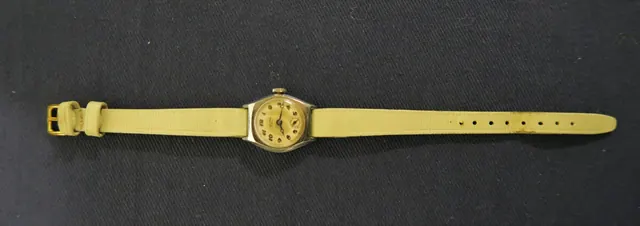
Wristwatch by Tissot, Switzerland, 1930s
HKM / Kulttuurihistoriallinen
Wristwatches · 1950–1960
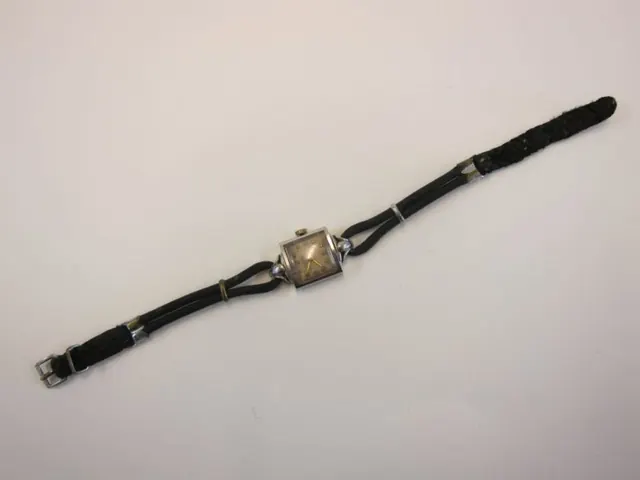
Wristwatch by Tissot, 1950–1960
Modemuseum Hasselt

Wristwatches · 1945
Wristwatch by Eterna, 1945
Museum Rotterdam

Wristwatches · c. 1945
Breitling Premier, ref. 790, c. 1945
Antiquorum auction archive, Geneva

Wristwatches · c. 1945
Universal Genève Uni-Compax, ref. 22492, c. 1945
Antiquorum auction archive, Geneva

Wristwatches · c. 1950s
Baume & Mercier wristwatch, c. 1950s
Antiquorum auction archive, Geneva