
Clocks · Tall case clock
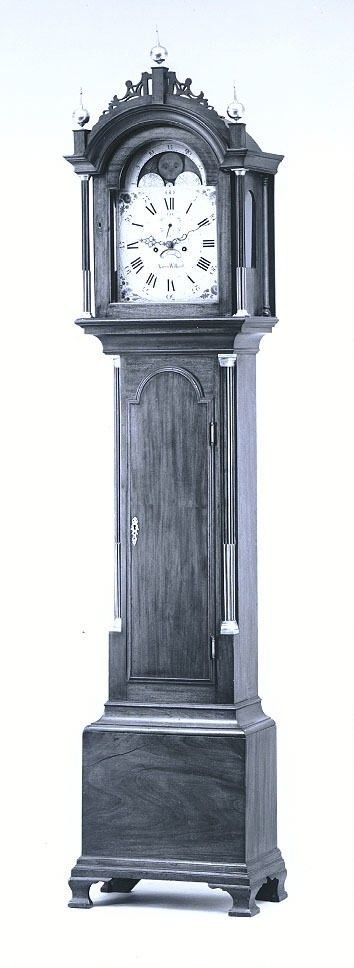
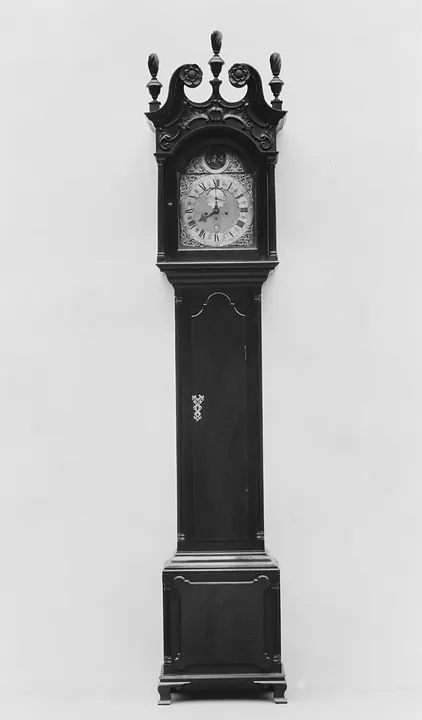
Tall Case Clock by Aaron Willard
- Maker / attribution
- Aaron Willard (maker)
- Date
- 1790–1810
- Historical period
- Precision & Scientific Horology (1750 – 1850)
- Country of origin
- United States
- Place
- Grafton; Roxbury
- Object type
- Tall case clock
- Materials / technique
- mahogany; base molding of hood, cherry; back of rear feet and back of hood, white pine
- Dimensions
- 91 1/16 × 20 3/8 × 10 1/4 in. (231.3 × 51.8 × 26.1 cm) other (Frame, case): 15 11/16 in. (39.8 cm) other (Lower case): 59 3/4 × 18 7/8 × 9 3/4 in. (151.8 × 47.9 × 24.8 cm) other (Frame, lower case): 13 3/4 × 7 1/4 in. (34.9 × 18.4 cm) other (Dial): 17 × 12 1/4 in. (43.2 × 31.1 cm) other (Movement): 6 7/16 × 4 1/2 × 2 1/2 in. (16.4 × 11.5 × 6.4 cm)
- Holding institution
- Yale University Art Gallery, New Haven
- Accession / object no.
- 1946.1
- Credit line
- Gift of Mrs. Clark R. McIlwaine in memory of her mother Margaret Tyler Clark
- Catalogue title (original)
- Tall Case Clock (English)
View the source record ↗ (opens another website in a new tab)Suggest a correction
Record summary
Held and catalogued by Yale University Art Gallery, New Haven (object number 1946.1), this is a tall case clock by Aaron Willard, made in Grafton; Roxbury, United States, dated 1790–1810. The Atlas places it in the Precision & Scientific Horology period (1750 – 1850) of its Clocks collection. Materials and techniques recorded by the source: mahogany; base molding of hood, cherry; back of rear feet and back of hood, white pine. Recorded dimensions: 91 1/16 × 20 3/8 × 10 1/4 in. (231.3 × 51.8 × 26.1 cm) other (Frame, case): 15 11/16 in. (39.8 cm) other (Lower case): 59 3/4 × 18 7/8 × 9 3/4 in. (151.8 × 47.9 × 24.8 cm) other (Frame, lower case): 13 3/4 × 7 1/4 in. (34.9 × 18.4 cm) other (Dial): 17 × 12 1/4 in. (43.2 × 31.1 cm) other (Movement): 6 7/16 × 4 1/2 × 2 1/2 in. (16.4 × 11.5 × 6.4 cm). The record is illustrated with 6 photographs.
Assembled from the source record's structured fields. Dates and attributions are given as the source states them; where a field is missing the Atlas leaves it blank rather than estimating.
Catalogue description
Published references — Yale University Art Gallery
Edwin A. Battison and Patricia E. Kane, The American Clock, 1725–1865: The Mabel Brady Garvan and Other Collections at Yale University (Greenwich, Conn.: New York Graphic Society, 1973), 66–69, no. 12, ill. · Elise K. Kenney, ed., Handbook of the Collections: Yale University Art Gallery (New Haven, Conn.: Yale University Art Gallery, 1992), 93, ill.
Inscriptions & marks
"Aaron Willard.," painted, on dial
Provenance
Mrs. Clark McIlwaine, West Hartford, Conn., and Washington, D.C.; gift in 1946 to Yale University Art Gallery, New Haven, Conn.
Historical context
Precision & Scientific Horology (1750 – 1850)
Harrison solves longitude; Mudge invents the lever; Breguet's Paris workshop defines the modern watch.
The age of the deadbeat escapement, compensated pendulums and observatory regulators. Domestic clocks spread through the middle classes: English longcase and bracket clocks, French gilt-bronze mantel clocks, Viennese Biedermeier wall clocks, Black Forest painted-shield clocks, and the first American shelf clocks.
Read the period in the timelineMore clocks from this periodEarlier: Early Modern Horology
Atlas type guide
Longcase (tall-case or grandfather) clocks
The longcase clock was born from two seventeenth-century innovations: Christiaan Huygens's pendulum (1656–57) and the anchor escapement (c. 1670). A long seconds pendulum, nearly a metre long, swings with a small arc, and enclosing it together with the driving weights in a tall wooden case protected the mechanism and created a new piece of furniture. London makers such as Ahasuerus Fromanteel, Thomas Tompion and Joseph Knibb set the pattern.
By the eighteenth century longcase clocks were made throughout Britain, the Netherlands, Scandinavia (the Swedish Mora clock), France (the Comtoise from the Franche-Comté), Germany and colonial America. Eight-day movements with two weights became standard in better clocks; thirty-hour clocks with one weight and a rope or chain were cheaper alternatives.
What to look for
- Winding holes in the dial: two (eight-day, going and striking) or none (thirty-hour, pulled up by a chain).
- Brass dials with applied chapter rings (earlier) versus painted iron 'white' dials (after c. 1770 in Britain).
- Moon-phase arches, date apertures, seconds dials and maker's name on the dial.
- Case woods and style: ebonised, walnut marquetry, lacquer, oak or mahogany; regional styles from London, Lancashire, Scotland or America.
- Whether the movement and dial match the case — 'marriages' are common.
Dating clues
- Square brass dials suggest c. 1670–1720; arched brass dials c. 1715–1790.
- Painted (white) dials were made by Birmingham dial-makers from about 1772.
- Comtoise clocks with repoussé pendulums are mostly nineteenth century.
General guidance written by the Atlas editors about this kind of object. It is not a statement about this particular piece; for that, rely on the source record above and on physical examination.
Read next:Anchor (recoil) escapementDeadbeat escapementAnchor escapement
Related records
Clocks · c. 1795
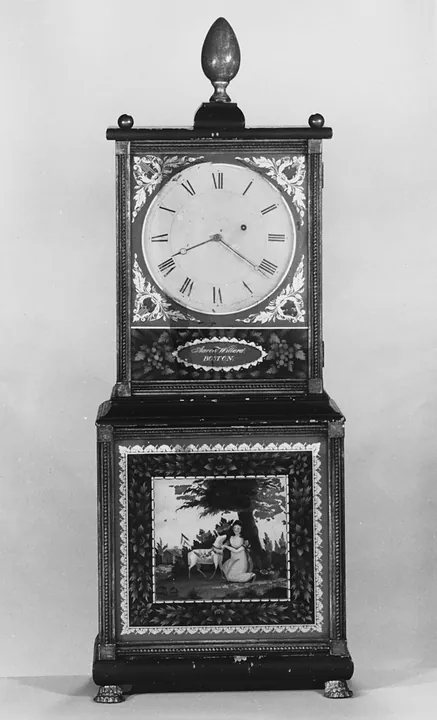
Shelf clock by Aaron Willard, United States, c. 1795
The Metropolitan Museum of Art, New York
Clocks · 1772–82
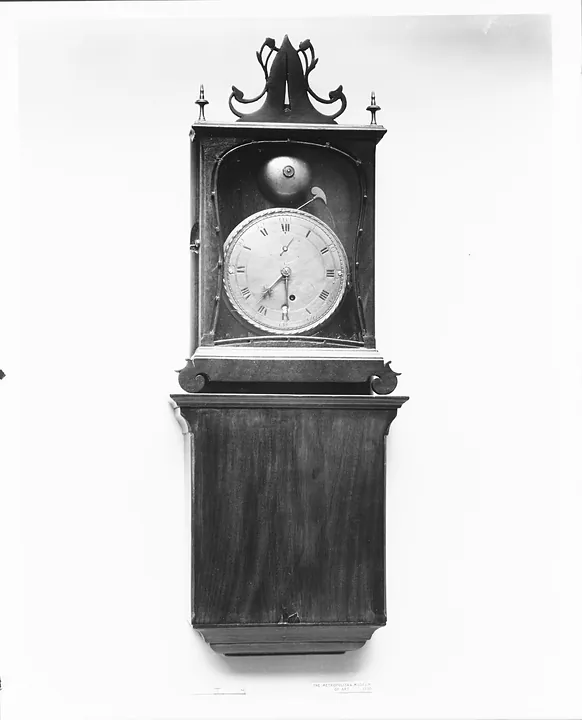
Wall clock by Aaron Willard, United States, 1772–82
The Metropolitan Museum of Art, New York
Clocks · 1800–1810
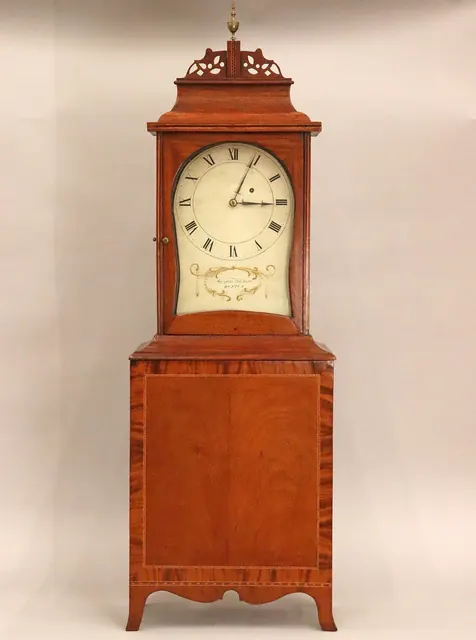
Shelf Clock by Aaron Willard
Yale University Art Gallery, New Haven
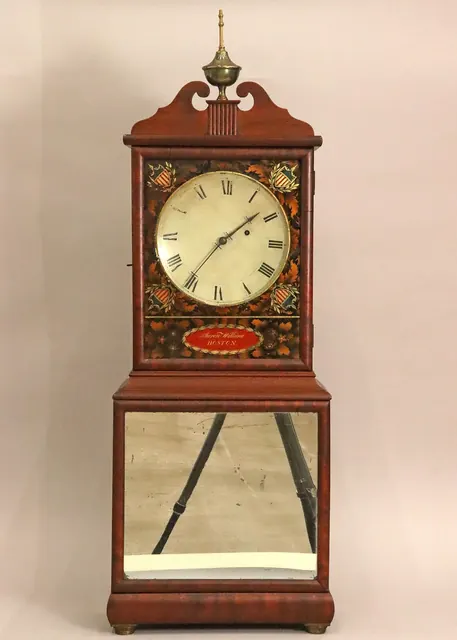
Clocks · 1815–20
Shelf Clock by Aaron Willard
Yale University Art Gallery, New Haven
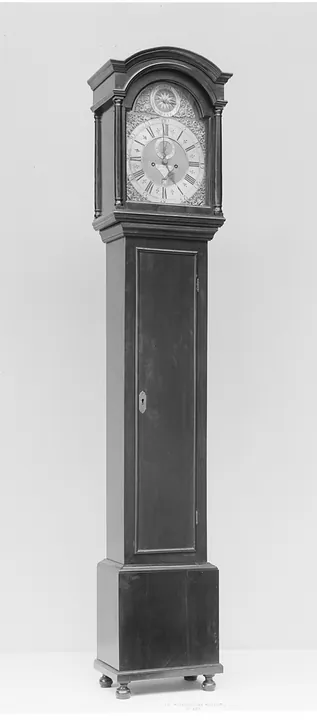
Clocks · 1740–60
Tall clock by Samuel Bagnall, United States, 1740–60
The Metropolitan Museum of Art, New York
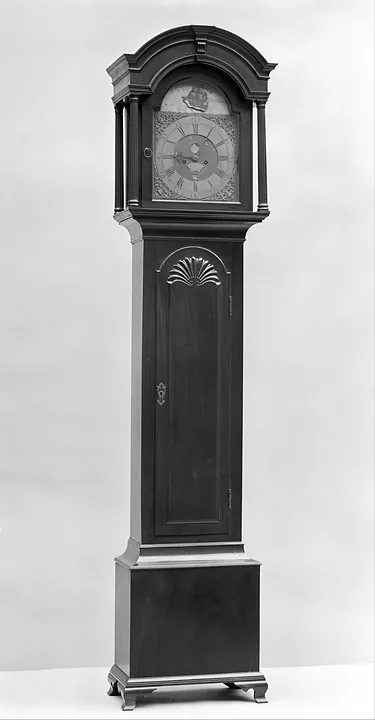
Clocks · 1750–60
Tall clock by Gawen Brown, United States, 1750–60
The Metropolitan Museum of Art, New York
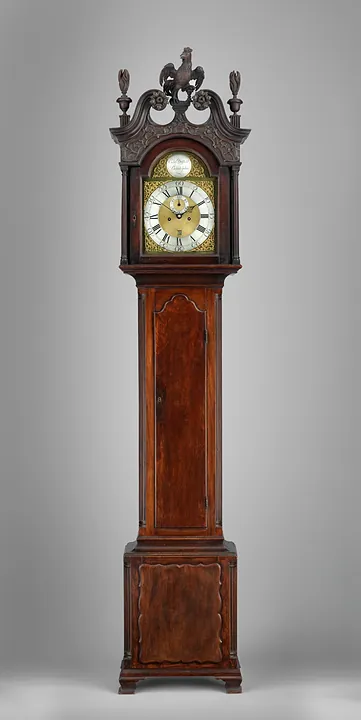
Clocks · 1765–75
Clock by Edward Duffield, United States, 1765–75
The Metropolitan Museum of Art, New York
Clocks · 1767–71
Tall clock by William Huston, United States, 1767–71
The Metropolitan Museum of Art, New York