
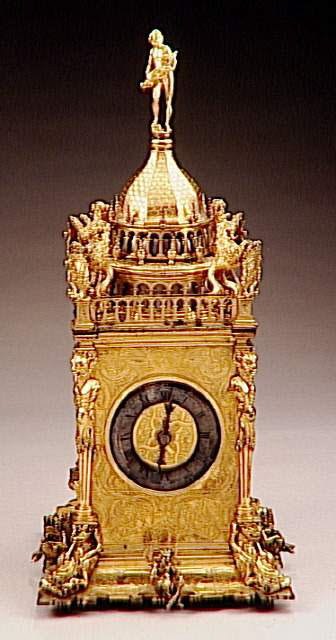
Clocks · Table clock
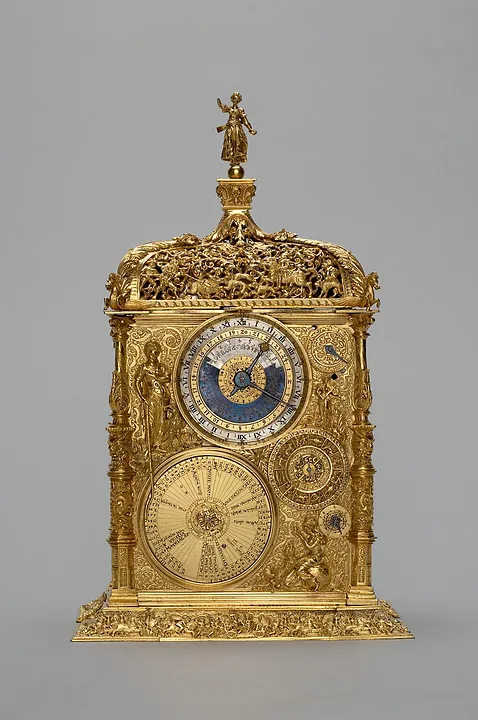
Table clock, Germany, 1585 – 1600 (uncertain)
- Maker / attribution
- Unrecorded in source
- Date
- 1585 – 1600 (uncertain)
- Historical period
- Renaissance Horology (1400 – 1600)
- Country of origin
- Germany
- Place
- Allemagne, Germany
- Object type
- Table clock
- Materials / technique
- silver, bronze, brass
- Dimensions
- height 36,2 cm; depth 15,8 cm
- Holding institution
- Musée du Louvre, Paris
- Accession / object no.
- OA 671
- Credit line
- Musée du Louvre, Département des Objets d'art du Moyen Age, de la Renaissance et des temps modernes
- Catalogue title (original)
- Horloge de table en forme de tour carrée (French)
View the source record ↗ (opens another website in a new tab)Suggest a correction
Record summary
Held and catalogued by Musée du Louvre, Paris (object number OA 671), this is a table clock, made in Allemagne, Germany, dated 1585 – 1600 (uncertain). The Atlas places it in the Renaissance Horology period (1400 – 1600) of its Clocks collection. Materials and techniques recorded by the source: silver, bronze, brass. Recorded dimensions: height 36,2 cm; depth 15,8 cm. The record is illustrated with 3 photographs.
Assembled from the source record's structured fields. Dates and attributions are given as the source states them; where a field is missing the Atlas leaves it blank rather than estimating.
Catalogue description
Catalogue description — Musée du Louvre (French)
Horloge de table en forme de tour carrée, aux armes des Farnèse. Au milieu des quatre côtés du rampant, quatre satyres ailés assis alternant avec quatre monstres à mains d'homme et pied de bouc aux angles, chacun supportant un terme à tête barbue. Face du cadran et socle gravés de rinceaux feuillagés et volutes. Cadran à chiffres romains et arabes ; centre orné d'entrelacs. Sur la face postérieure, la Justice armée d'un glaive et tenant une balance, encadrée de cuirs découpés, accompagnée d'une maxime. Faces latérales garnies de plaques de verre biseautées portant aussi une devise. Dôme orné d'écailles de poisson, de forme ogivale, surmonté d'une figure de Neptune tenant un dauphin, présentant deux étages entourés d'arcatures ornées de vases. Coins de la balustrade garnis de quatre lions héraldiques tenant l'écu des Farnèse, ducs de Palerme et de Plaisance. Boîte vitrée dévoilant le mouvement à pendule, la fusée à chaîne, les deux barillets. Pendule disparu ; reste la suspension.
Shown in the original language of the source catalogue. An editor-reviewed English translation has not yet been published; we do not publish machine translations as authoritative text.
Dating and period as catalogued (French)
Epoque / période : Henri IV (1589-1610) (Occident->Renaissance->dynastie des Bourbons) · · Date de création/fabrication : 1585 - 1600
Shown in the original language of the source catalogue. An editor-reviewed English translation has not yet been published; we do not publish machine translations as authoritative text.
Materials and techniques as catalogued (French)
Matériau : argent · Matériau : bronze · Matériau : laiton
Shown in the original language of the source catalogue. An editor-reviewed English translation has not yet been published; we do not publish machine translations as authoritative text.
Inscriptions & marks
Inscription : ; armoiries : Farnèse ; face postérieure : AVSZ AD VD GVST ICH KEIS VERSCHO / WAS RECHT IST SOLL SEI FORGAG HA [Je n'éparge personne par faveur. Le droit doit suivre son cours] ; faces latérales : WENS VBEL GEHT HAB ICH GEDVLDT VERZAGT ICH NIT ES BRIGT MIR HVLDT [Dans l'adversité je prends patience. Si je ne me décourage pas, la fortune me sourira] ; ICH HEISZ MIT NAME DIE KLVGHEIT WEISZ ALLER SACHE RECT BESCHEIDT [J'ai pour nom Sagesse. Je sais tout bien expliquer]
Provenance
collection Alexandre-Charles Sauvageot (1781-1860) ; acquise en 1847, cf. le Livre d'achat n° 2240 : "pendule en cuivre doré, quatre caryatides et lions héraldiques allemands de la fin du XVIè, 777 francs, dorure ciselure 67,50 francs, horloger 25 francs, socle en ébène 130 francs, applique en cuivre doré pour le socle 40 francs / 1039,50 francs" ; minute de la donation Sauvageot 1DD139 série K n° 11 p. 176 : "Horloge cuivre doré, forme carrée à 4 cariatides aux angles surmontés de 4 lions appuyés sur les écussons des ducs de Parme et de Plaisance grands Gonfaloniers du Pape. Au-dessus une coupole à jour sur laquelle pose debout une figurine tenant un poisson. A la base 4 petites figures de diables assis sur les moulures ; les 2 côtés à glaces biseautées, le tout sur un socle en ébène à profils et tiroir" ; donation acceptée en 1856, acte notarié le 6 mars 1857, n° 1366 : "Horloge cuivre doré, forme carré à quatre cariatides aux angles, surmontés de quatre Lions appuyés sur les écussons des ducs de Parme et de Plaisance, au dessus une coupole à jour, estimée deux-mille francs" ; note de Sauvageot : "En 1848, le grand ressort de l'horloge s'étant cassé, on eut l'occasion de voir qu'il portait la date 1680, et que le barillet qui le contenait portait celle de 1590."
Historical context
Renaissance Horology (1400 – 1600)
Spring power makes clocks portable; Nuremberg and Augsburg produce the first watches; the Prague Orloj is built.
Spring power made the domestic clock portable. Augsburg and Nuremberg produced gilt-brass table clocks, often with astronomical dials and alarms; weight-driven Gothic wall clocks and English lantern clocks served households. Clocks of this period have foliot or balance-wheel control and usually only an hour hand.
Read the period in the timelineMore clocks from this periodEarlier: Medieval Period
Atlas type guide
Bracket, table and spring-driven clocks
Spring-driven clocks freed timekeeping from the hanging weight. The coiled mainspring, documented from the fifteenth century, made portable table clocks possible; to even out its declining force, makers used the fusee, a conical pulley connected to the barrel by a gut line or chain. Renaissance table clocks from Augsburg and Nuremberg — drum-shaped, square or tower-shaped in gilt brass — were luxury scientific objects, often with astronomical dials and alarms.
After the pendulum, English makers developed the bracket clock: a wooden case with a carrying handle, a short pendulum with a verge escapement, and often repeating work to sound the hours on demand at night. Later examples use the anchor escapement. In the nineteenth century, 'table clock' became a broad term for spring clocks of every nationality.
What to look for
- A fusee in the movement (cone-shaped pulley) and the type of line — gut or chain.
- Verge escapement with a short bob pendulum, often with a decoratively engraved backplate.
- Repeat cords or buttons that make the clock strike again on demand.
- Gilt-brass engraved cases and horizontal dials on Renaissance pieces.
- Case shapes: inverted bell, bell top, break-arch, lancet or balloon.
Dating clues
- Drum and tower table clocks: c. 1520–1650.
- Ebony veneered English bracket clocks with verge escapements: c. 1670–1800.
- Engraved backplates were usual on English clocks until c. 1800, then generally plain.
General guidance written by the Atlas editors about this kind of object. It is not a statement about this particular piece; for that, rely on the source record above and on physical examination.
Related records
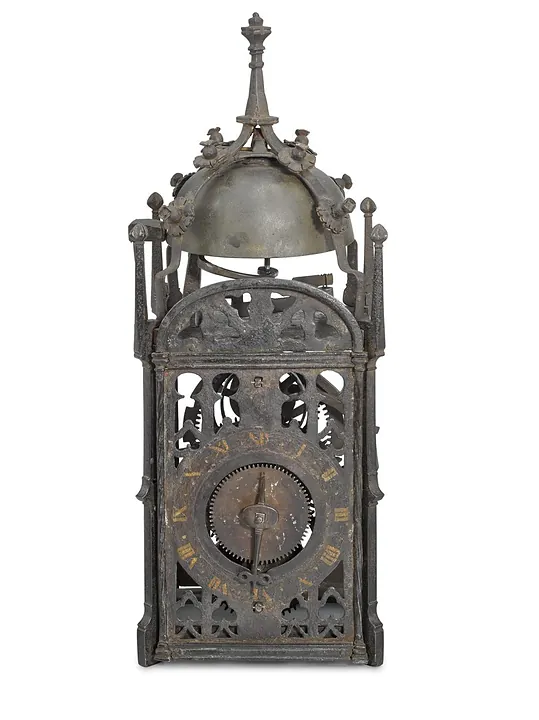
Clocks · 1400–1499
Lantern clock, Germany, 1400–1499
Science Museum Group, London
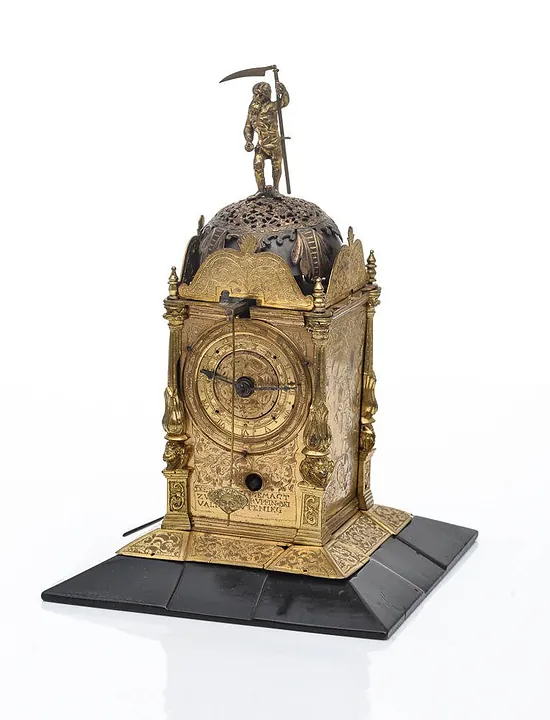
Clocks · 1500–1599
Table clock by Valentin Rutenieg, Germany, 1500–1599
City Museum Berlin
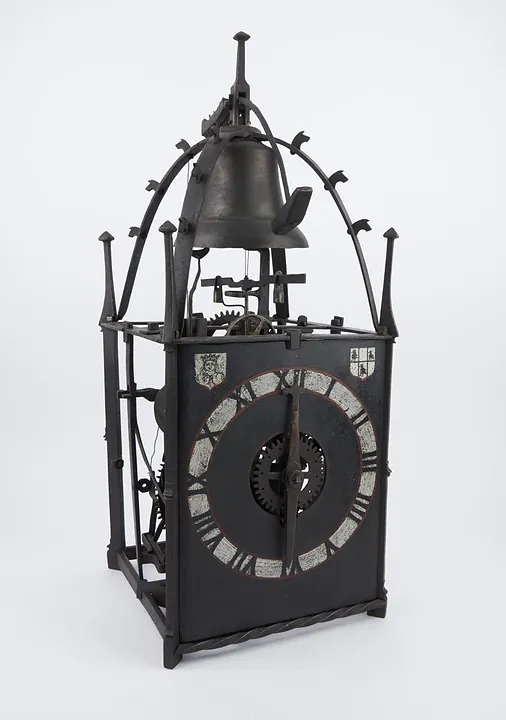
Clocks · 1501–1600
German 16th century iron chamber clock
Science Museum Group, London
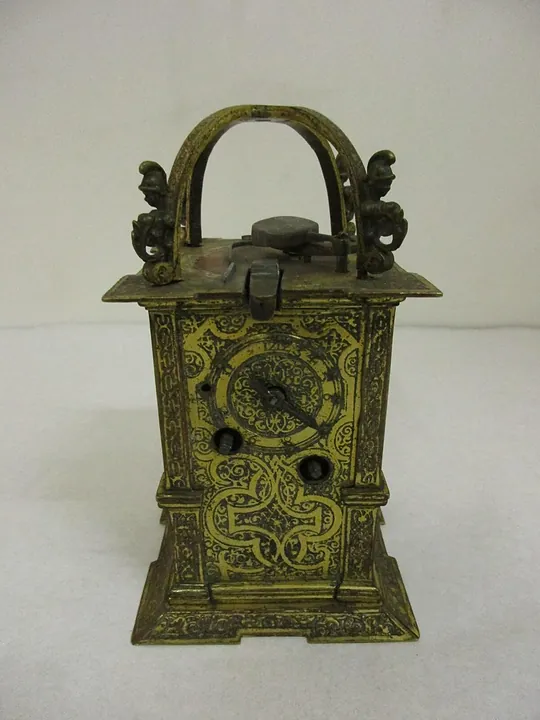
Clocks · c.1550
Clock, a striking alarm clock in a gilt brass case, Germany, c.1550.
Victoria and Albert Museum, London
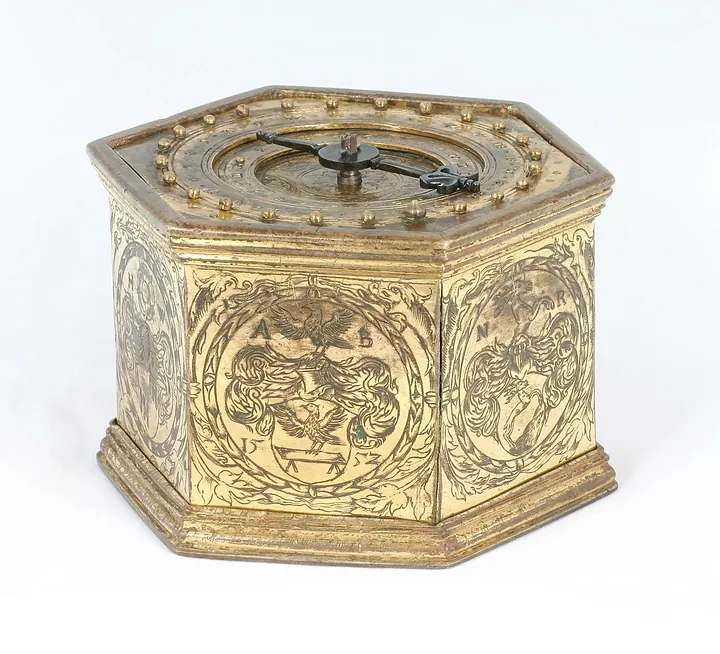
Clocks · 1552
Carriage / travel clock, Germany, 1552
German Clock Museum
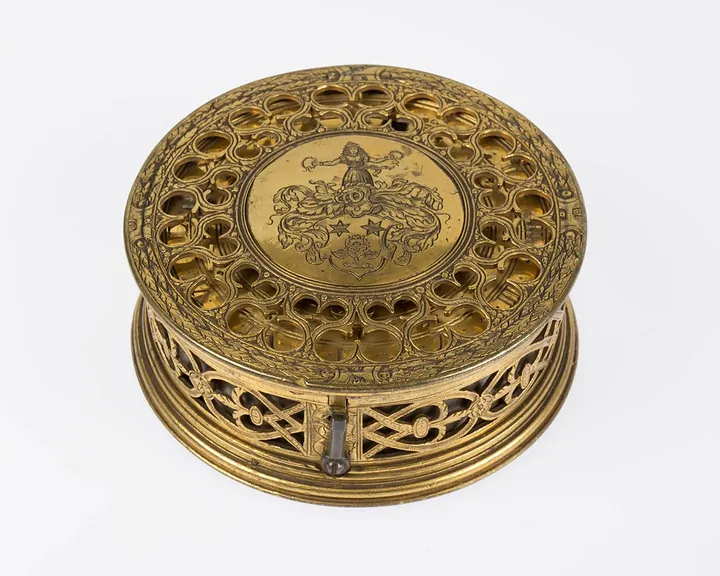
Clocks · c. 1560
Carriage / travel clock by HG, probably Germany, c. 1560
German Clock Museum
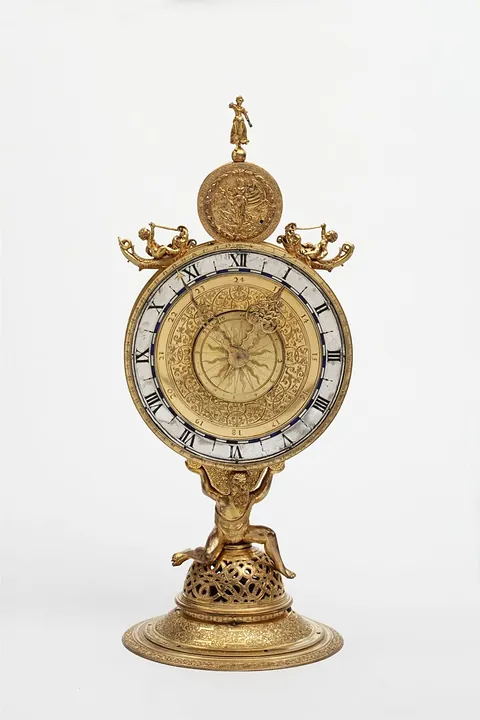
Clocks · 1564
Clock, gilt brass with enamelled silver dial ring, signed by Jeremias Metzger, Augsburg, southern Germany, dated 1564
Victoria and Albert Museum, London
Clocks · 1564
Table clock by Jeremias Metzker, Germany, 1564
Fine Arts Museum Vienna