
Clocks · Table clock
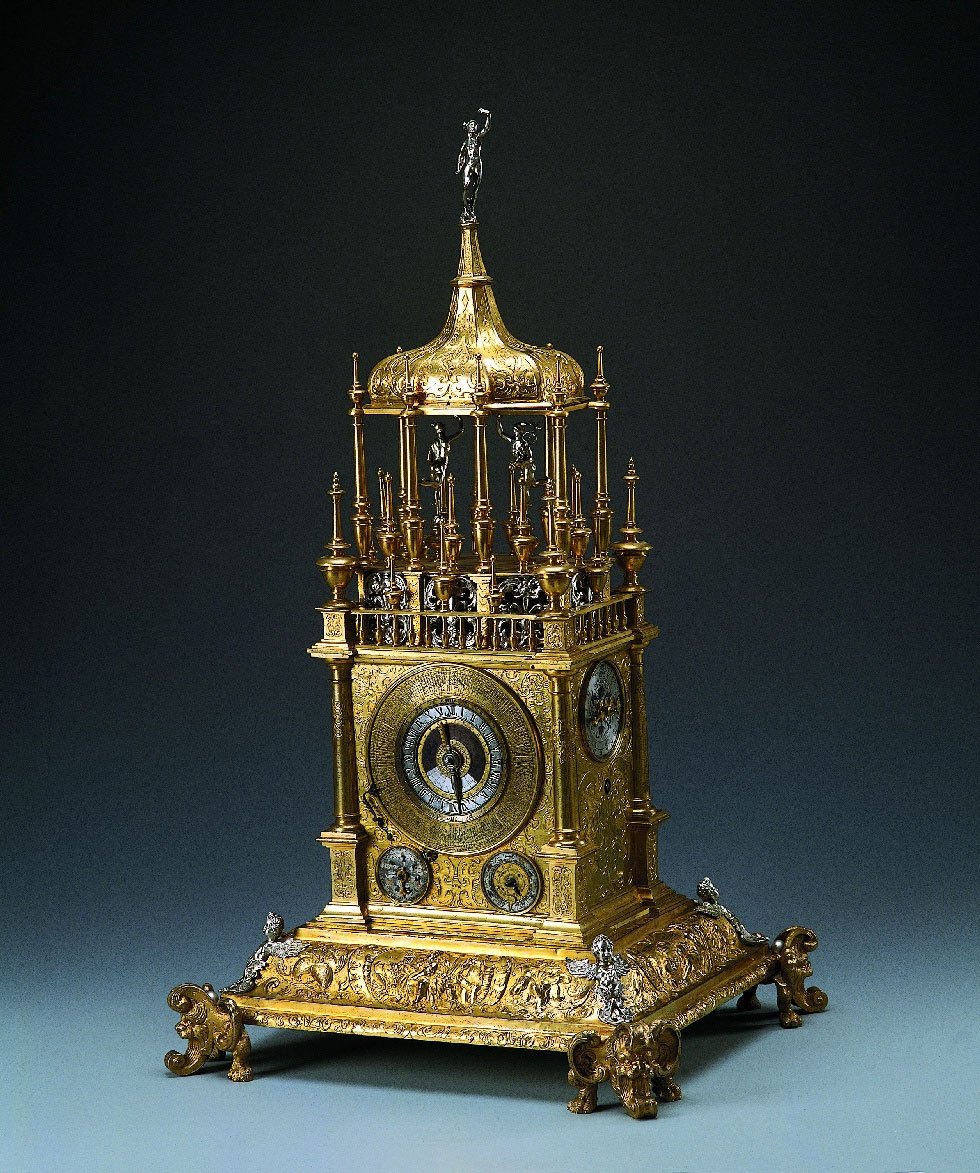
Table clock by Wilhelm Pepfenhauser, Germany, 1647
- Maker / attribution
- Wilhelm Pepfenhauser (Created)
- Date
- 1647
- Historical period
- Early Modern Horology (1600 – 1750)
- Country of origin
- Germany
- Place
- Augsburg
- Object type
- Table clock
- Materials / technique
- Gehäuse: Bronze, Messing feuervergoldet, Maleremail, Silber; Uhrwerk: Messing, Eisen
- Dimensions
- 60,5 x 35 x 30,2 cm
- Holding institution
- Stiftung Schloß Friedenstein Gotha: Schloßmuseum
- Accession / object no.
- U-50-T
- Credit line
- Stiftung Schloß Friedenstein Gotha: Schloßmuseum
- Catalogue title (original)
- Astronomische Tischuhr (German)
View the source record ↗ (opens another website in a new tab)Suggest a correction
Record summary
Held and catalogued by Stiftung Schloß Friedenstein Gotha: Schloßmuseum (object number U-50-T), this is a table clock by Wilhelm Pepfenhauser, made in Augsburg, Germany, dated 1647. The Atlas places it in the Early Modern Horology period (1600 – 1750) of its Clocks collection. Materials and techniques recorded by the source: Gehäuse: Bronze, Messing feuervergoldet, Maleremail, Silber; Uhrwerk: Messing, Eisen. Recorded dimensions: 60,5 x 35 x 30,2 cm. The record is illustrated with 1 photograph.
Assembled from the source record's structured fields. Dates and attributions are given as the source states them; where a field is missing the Atlas leaves it blank rather than estimating.
Catalogue description
Catalogue description from Stiftung Schloß Friedenstein Gotha: Schloßmuseum (German)
Die Tischuhr trägt die Signatur des Augsburger Uhrmachers Wilhelm Pepfenhausers und gilt als dessen Meisterstück. Ihre äußere Gestalt wie auch ihre zahlreichen Funktionen entsprechen den Anforderungen, welche die Augsburger Zunft der Uhrmacher bereits seit 1588 an ein Meisterstück gestellt hat. Das Architekturgehäuse der sogenannten Türmchenuhr besitzt ein baldachinförmiges Dach, welches von einer silbernen Figur des fliegenden Merkur nach Giambologna (1529-1608) bekrönt wird. Unter dem Baldachin befinden sich zwei weitere Silberfiguren, die ebenfalls den Götterboten darstellen. Das Gehäuse ruht auf vier Füßen in Gestalt von Rollwerkkartuschen mit Löwenmasken und je zwei Tatzen. Die reliefierte Sockelzone zeigt auf jeder Seite die allegorische Darstellung eines Erdteils und an den vier Ecken befinden sich silberne Cherubine. Die Uhr besitzt zehn verschiedene Zifferblätter: an den beiden Schauseiten drei bzw. fünf und an den Schmalseiten jeweils eines. Das Werk besteht aus Geh-, Viertelstunden- und Stundenschlagwerk. Außer der Uhrzeit kann man den Stand von Sonne, Mond und Sternen ablesen. Ein Kalenderring zeigt Datum, Sonntagsbuchstaben und den Namen des Tagesheiligen an. Von Herzog Ernst I. von Sachsen-Gotha in der Mitte des 17. Jahrhunderts erworben, gelangte die Uhr im frühen 19. Jahrhundert als Geschenk des Herzogshauses in den Besitz der Familie von Thümmel, deren Mitglieder hohe Staatsämter in Gotha und Altenburg innehatten. 1831 von dem späteren Herzog Ernst II. von Sachsen-Coburg- Gotha (1818-1893) zurückgekauft, verblieb die Uhr bis 1945 in den Gothaer Kunstsammlungen und wurde kurz nach Ende des Zweiten Weltkrieges von der damaligen Museumsleitung veräußert. Zuletzt in kanadischem Privatbesitz befindlich, konnte das bedeutende Stück 1992 mit Unterstützung der Kulturstiftung der Länder für die Sammlung des Schlossmuseums zurückerworben werden. [Ute Däberitz]
Shown in the original language of the source catalogue. An editor-reviewed English translation has not yet been published; we do not publish machine translations as authoritative text.
Provenance
Literature: Bellstedt, Ronald [u. a.]: Museen der Stiftung Schloss Friedenstein Gotha: Führer (2007); Cramer, Ute [Red.]: Eine Tischuhr von Wilhelm Pepfenhauser (1992); Maurice, Klaus: Die deutsche Räderuhr: zur Kunst und Technik des mechanischen Zeitmessers im deutschen Sprachraum (1976)
Historical context
Early Modern Horology (1600 – 1750)
Huygens' pendulum and balance spring transform accuracy; English makers develop the anchor and deadbeat escapements.
Huygens's pendulum (1656–57) improved clock accuracy from about a quarter of an hour to under a minute a day. The anchor escapement (c. 1670) and the long seconds pendulum created the longcase clock; London makers such as Fromanteel, Knibb, Tompion and Quare led European clockmaking, and French makers created the Boulle pendule.
Read the period in the timelineMore clocks from this periodEarlier: Renaissance Horology
Atlas type guide
Bracket, table and spring-driven clocks
Spring-driven clocks freed timekeeping from the hanging weight. The coiled mainspring, documented from the fifteenth century, made portable table clocks possible; to even out its declining force, makers used the fusee, a conical pulley connected to the barrel by a gut line or chain. Renaissance table clocks from Augsburg and Nuremberg — drum-shaped, square or tower-shaped in gilt brass — were luxury scientific objects, often with astronomical dials and alarms.
After the pendulum, English makers developed the bracket clock: a wooden case with a carrying handle, a short pendulum with a verge escapement, and often repeating work to sound the hours on demand at night. Later examples use the anchor escapement. In the nineteenth century, 'table clock' became a broad term for spring clocks of every nationality.
What to look for
- A fusee in the movement (cone-shaped pulley) and the type of line — gut or chain.
- Verge escapement with a short bob pendulum, often with a decoratively engraved backplate.
- Repeat cords or buttons that make the clock strike again on demand.
- Gilt-brass engraved cases and horizontal dials on Renaissance pieces.
- Case shapes: inverted bell, bell top, break-arch, lancet or balloon.
Dating clues
- Drum and tower table clocks: c. 1520–1650.
- Ebony veneered English bracket clocks with verge escapements: c. 1670–1800.
- Engraved backplates were usual on English clocks until c. 1800, then generally plain.
General guidance written by the Atlas editors about this kind of object. It is not a statement about this particular piece; for that, rely on the source record above and on physical examination.
Related records
Clocks · 1600–1700
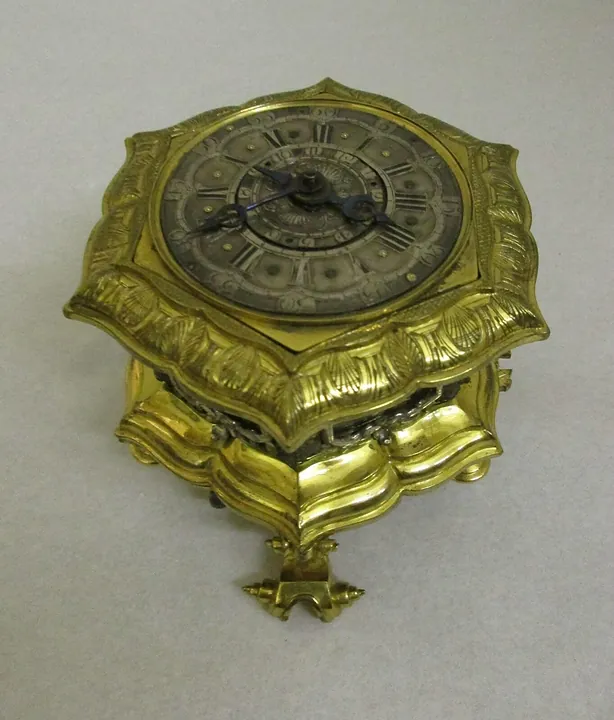
Clock, Germany, 1600–1700
Victoria and Albert Museum, London
Clocks · 1600–1699
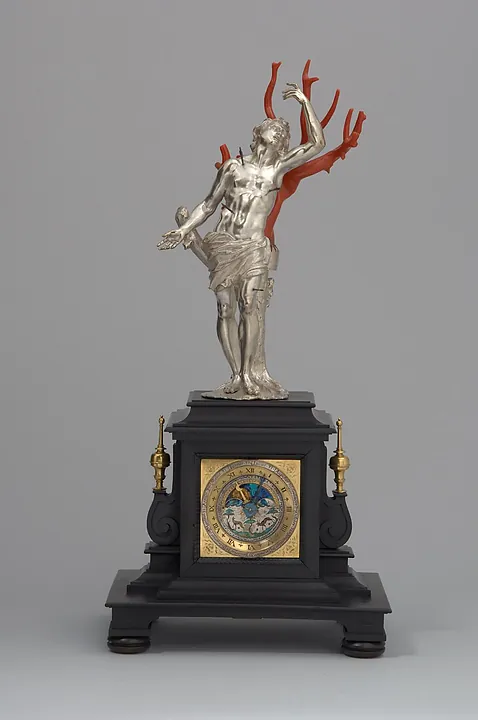
Table clock by Hans Christoph II. Fesenmair, Germany, 1600–1699
Fine Arts Museum Vienna
Clocks · 1600–1699
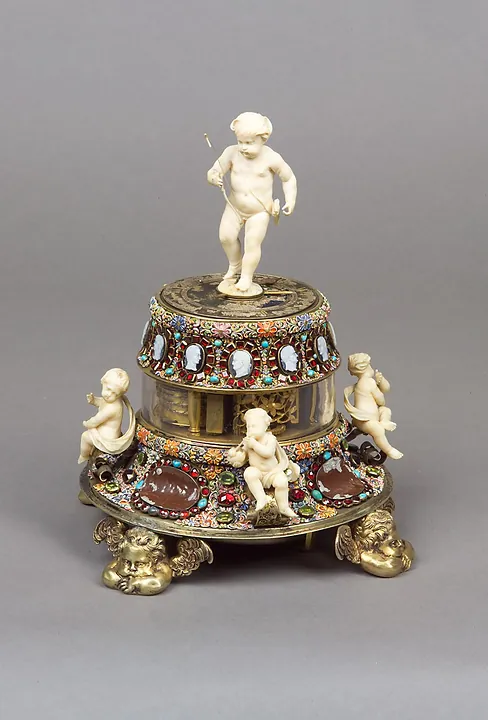
Table clock by Hans Jakob Mair, Germany, 1600–1699
Fine Arts Museum Vienna
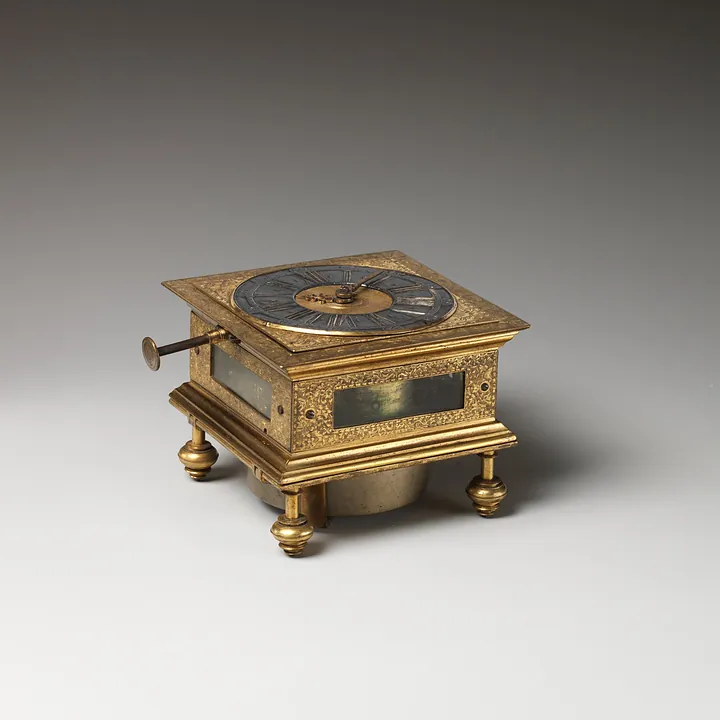
Clocks · 17th century
Table clock by Johann Heinrich Kleinschmidt, Germany, 17th century
The Metropolitan Museum of Art, New York
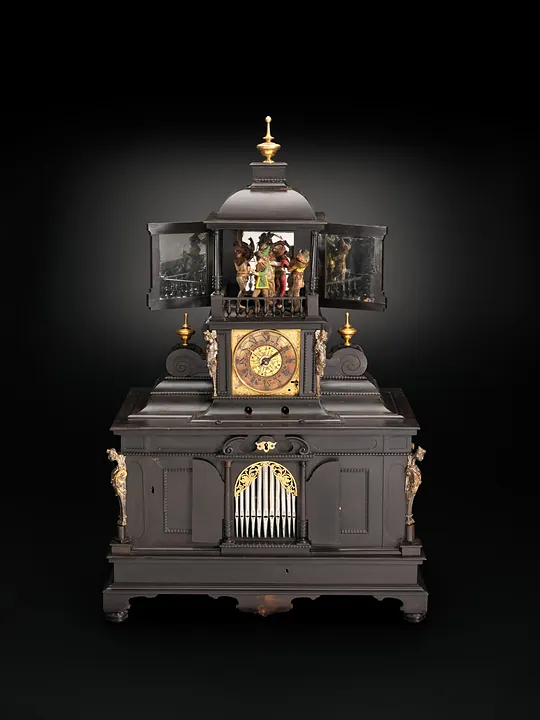
Clocks · c. 1625
Musical clock with spinet and organ by Veit Langenbucher, Germany, c. 1625
The Metropolitan Museum of Art, New York
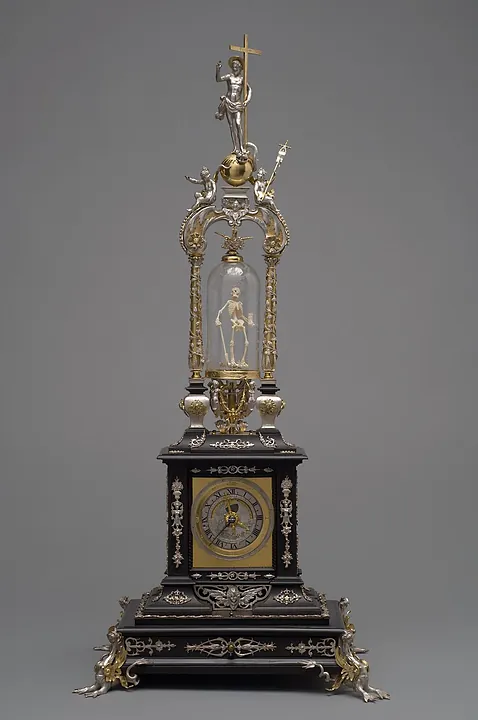
Clocks · 1624–1630
Table clock by Christoph Angermair, Germany, 1624–1630
Fine Arts Museum Vienna
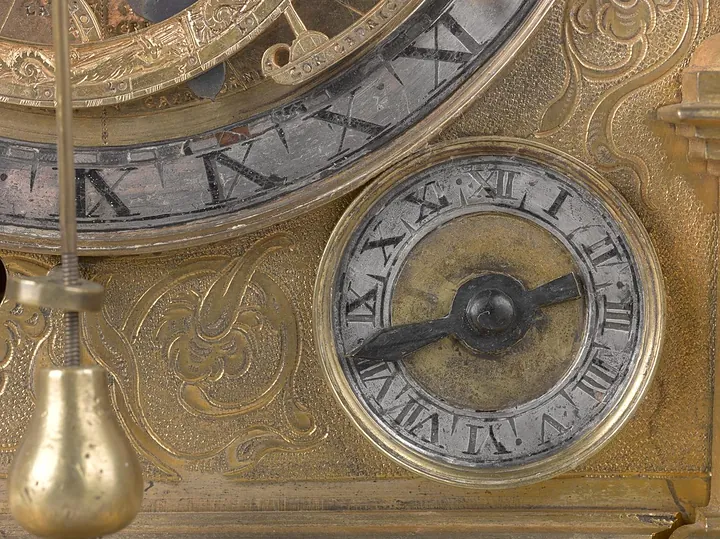
Clocks · 1625–1635
Upright table clock with winding key, by unknown maker, made in Augsburg, Germany, 1625–1635
Science Museum Group, London
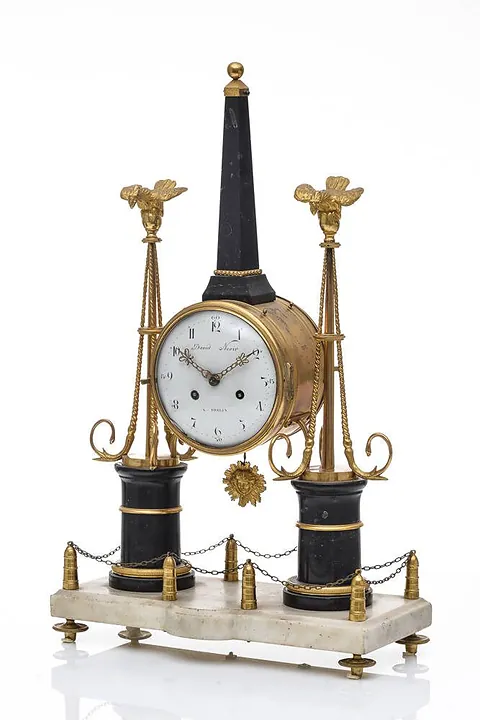
Clocks · 1700–1799
Mantel clock by David Nevir, Germany, 1700–1799
City Museum Berlin