
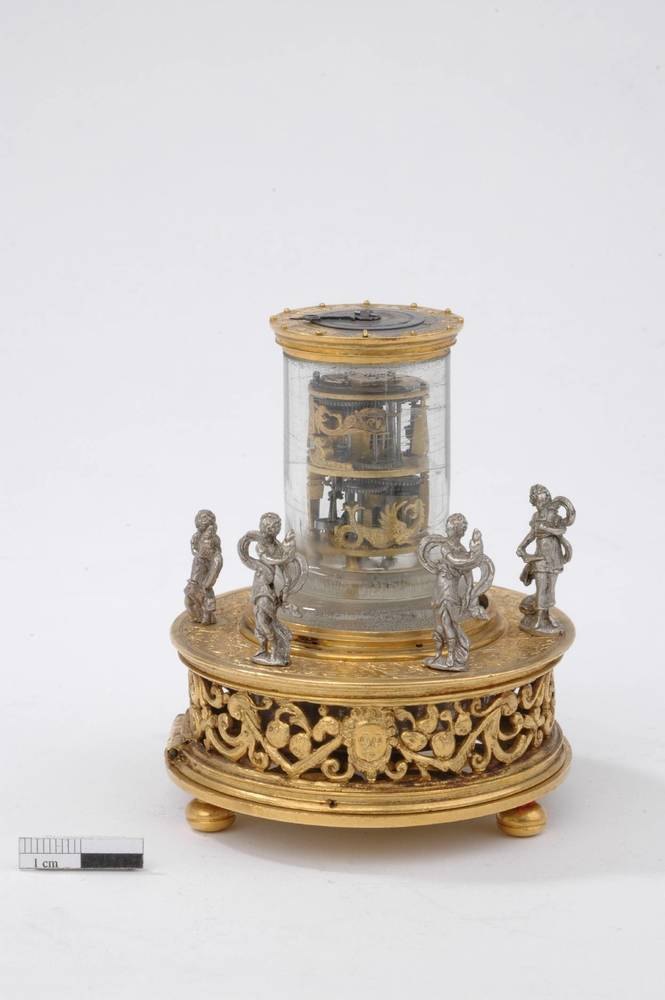
Clocks · Table clock
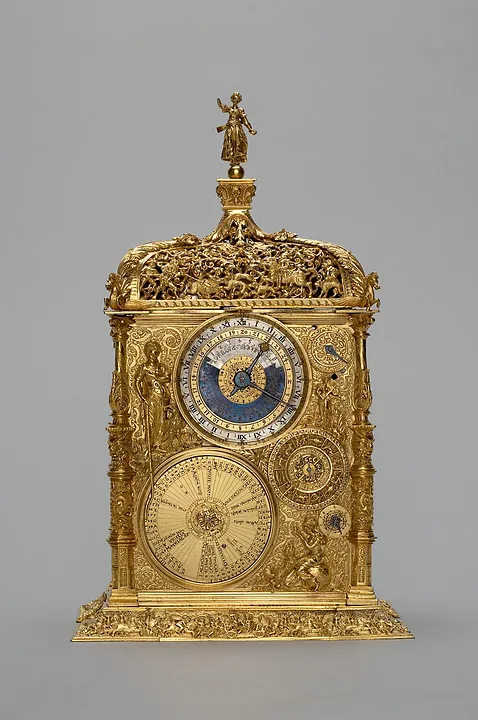
Table clock, Germany, Süddeutschland, c. 1590
- Maker / attribution
- Unrecorded in source
- Date
- c. 1590
- Historical period
- Renaissance Horology (1400 – 1600)
- Country of origin
- Germany
- Place
- Süddeutschland
- Object type
- Table clock
- Materials / technique
- Stahl (Material) vergoldet (Technik)
- Dimensions
- Höhe = 8,5 cm; Durchmesser = 7,0 cm
- Holding institution
- Dresden State Art Collections. Royal Cabinet of Mathematical and Physical Instruments
- Accession / object no.
- D IV b 3 (Inventarnummer)
- Credit line
- Dresden State Art Collections. Royal Cabinet of Mathematical and Physical Instruments
- Catalogue title (original)
- Etagen Tischuhr (German)
View the source record ↗ (opens another website in a new tab)Suggest a correction
Record summary
Held and catalogued by Dresden State Art Collections. Royal Cabinet of Mathematical and Physical Instruments (object number D IV b 3 (Inventarnummer)), this is a table clock, made in Süddeutschland, Germany, dated c. 1590. The Atlas places it in the Renaissance Horology period (1400 – 1600) of its Clocks collection. Materials and techniques recorded by the source: Stahl (Material) vergoldet (Technik). Recorded dimensions: Höhe = 8,5 cm; Durchmesser = 7,0 cm. The record is illustrated with 1 photograph.
Assembled from the source record's structured fields. Dates and attributions are given as the source states them; where a field is missing the Atlas leaves it blank rather than estimating.
Catalogue description
The source record does not include a narrative description. The structured fields above are reproduced from it.
Historical context
Renaissance Horology (1400 – 1600)
Spring power makes clocks portable; Nuremberg and Augsburg produce the first watches; the Prague Orloj is built.
Spring power made the domestic clock portable. Augsburg and Nuremberg produced gilt-brass table clocks, often with astronomical dials and alarms; weight-driven Gothic wall clocks and English lantern clocks served households. Clocks of this period have foliot or balance-wheel control and usually only an hour hand.
Read the period in the timelineMore clocks from this periodEarlier: Medieval Period
Atlas type guide
Bracket, table and spring-driven clocks
Spring-driven clocks freed timekeeping from the hanging weight. The coiled mainspring, documented from the fifteenth century, made portable table clocks possible; to even out its declining force, makers used the fusee, a conical pulley connected to the barrel by a gut line or chain. Renaissance table clocks from Augsburg and Nuremberg — drum-shaped, square or tower-shaped in gilt brass — were luxury scientific objects, often with astronomical dials and alarms.
After the pendulum, English makers developed the bracket clock: a wooden case with a carrying handle, a short pendulum with a verge escapement, and often repeating work to sound the hours on demand at night. Later examples use the anchor escapement. In the nineteenth century, 'table clock' became a broad term for spring clocks of every nationality.
What to look for
- A fusee in the movement (cone-shaped pulley) and the type of line — gut or chain.
- Verge escapement with a short bob pendulum, often with a decoratively engraved backplate.
- Repeat cords or buttons that make the clock strike again on demand.
- Gilt-brass engraved cases and horizontal dials on Renaissance pieces.
- Case shapes: inverted bell, bell top, break-arch, lancet or balloon.
Dating clues
- Drum and tower table clocks: c. 1520–1650.
- Ebony veneered English bracket clocks with verge escapements: c. 1670–1800.
- Engraved backplates were usual on English clocks until c. 1800, then generally plain.
General guidance written by the Atlas editors about this kind of object. It is not a statement about this particular piece; for that, rely on the source record above and on physical examination.
Related records
Clocks · 1400–1499
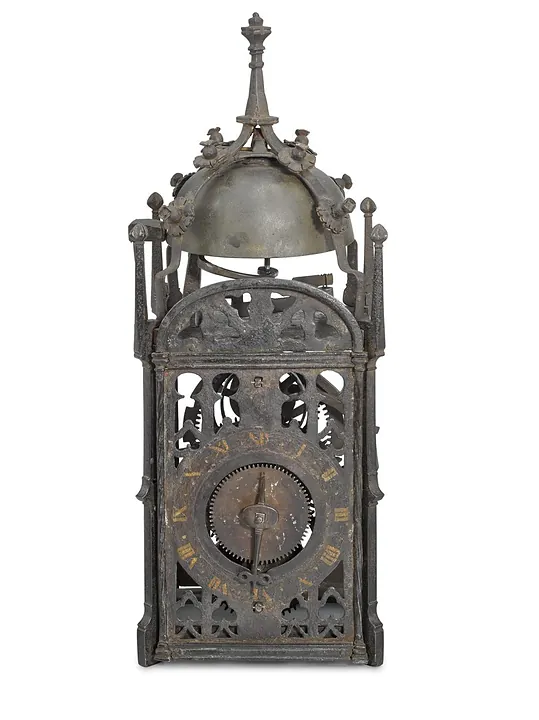
Lantern clock, Germany, 1400–1499
Science Museum Group, London
Clocks · 1500–1599
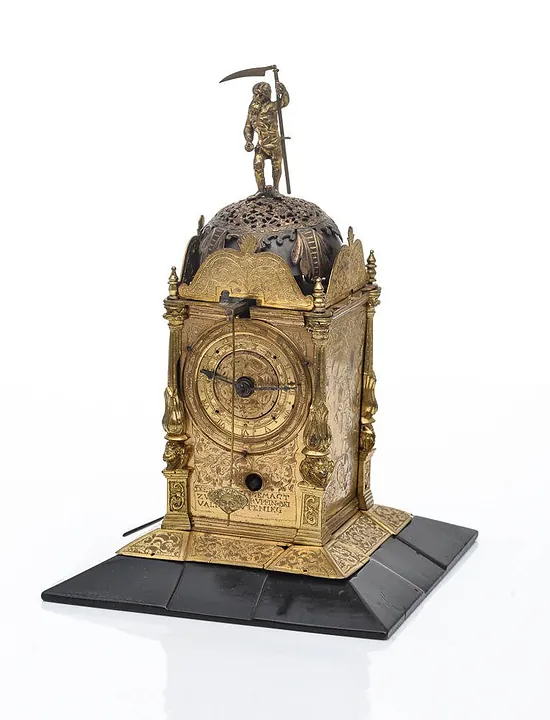
Table clock by Valentin Rutenieg, Germany, 1500–1599
City Museum Berlin
Clocks · 1501–1600
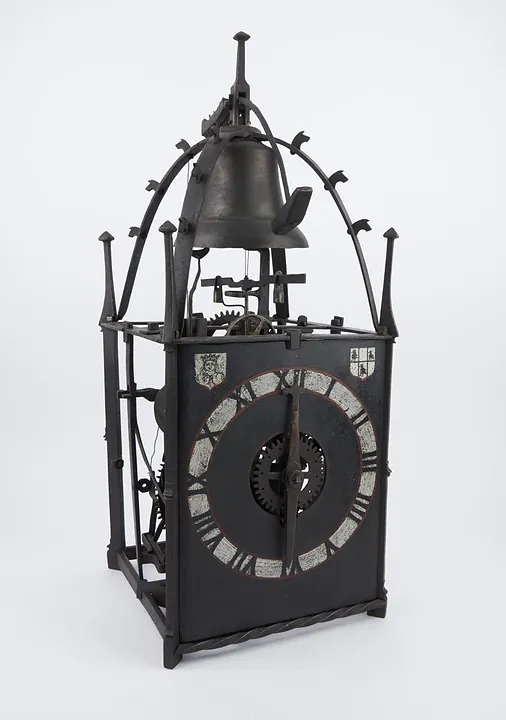
German 16th century iron chamber clock
Science Museum Group, London
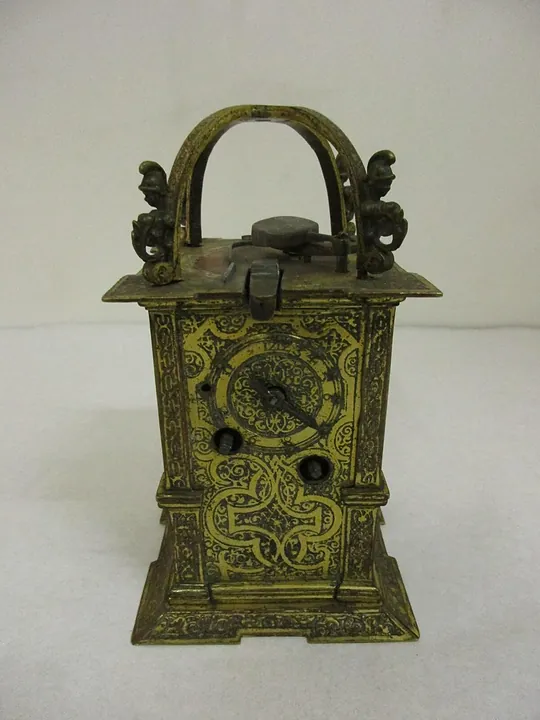
Clocks · c.1550
Clock, a striking alarm clock in a gilt brass case, Germany, c.1550.
Victoria and Albert Museum, London
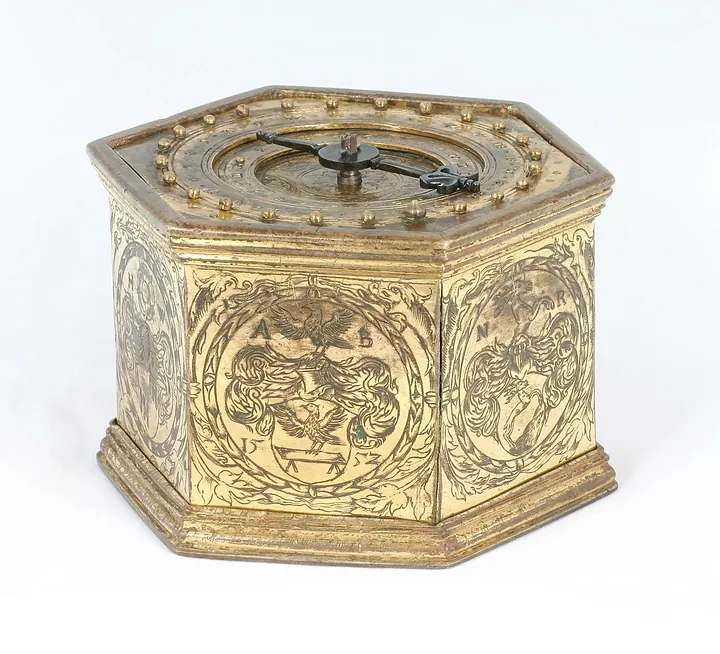
Clocks · 1552
Carriage / travel clock, Germany, 1552
German Clock Museum
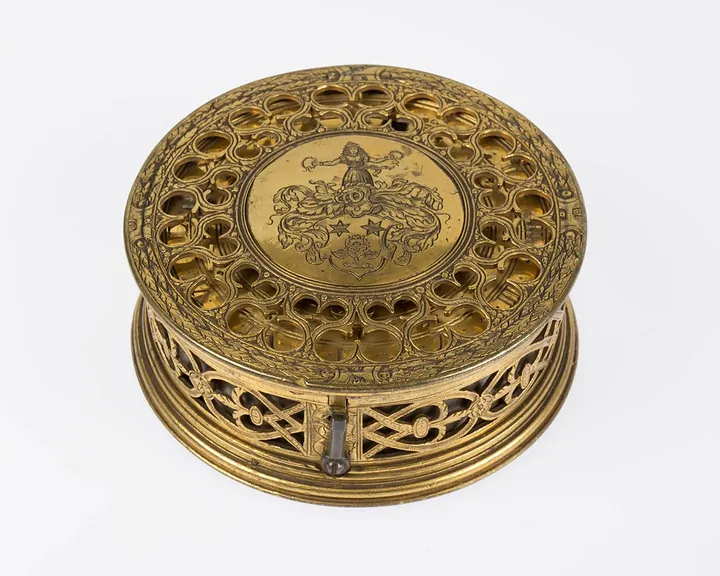
Clocks · c. 1560
Carriage / travel clock by HG, probably Germany, c. 1560
German Clock Museum
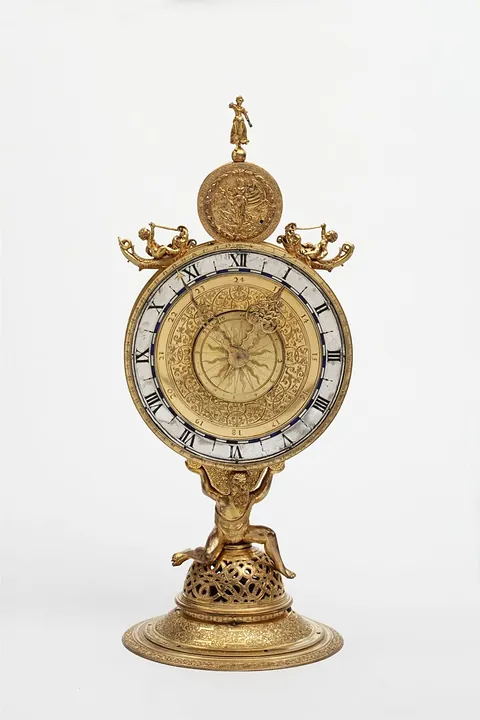
Clocks · 1564
Clock, gilt brass with enamelled silver dial ring, signed by Jeremias Metzger, Augsburg, southern Germany, dated 1564
Victoria and Albert Museum, London
Clocks · 1564
Table clock by Jeremias Metzker, Germany, 1564
Fine Arts Museum Vienna