
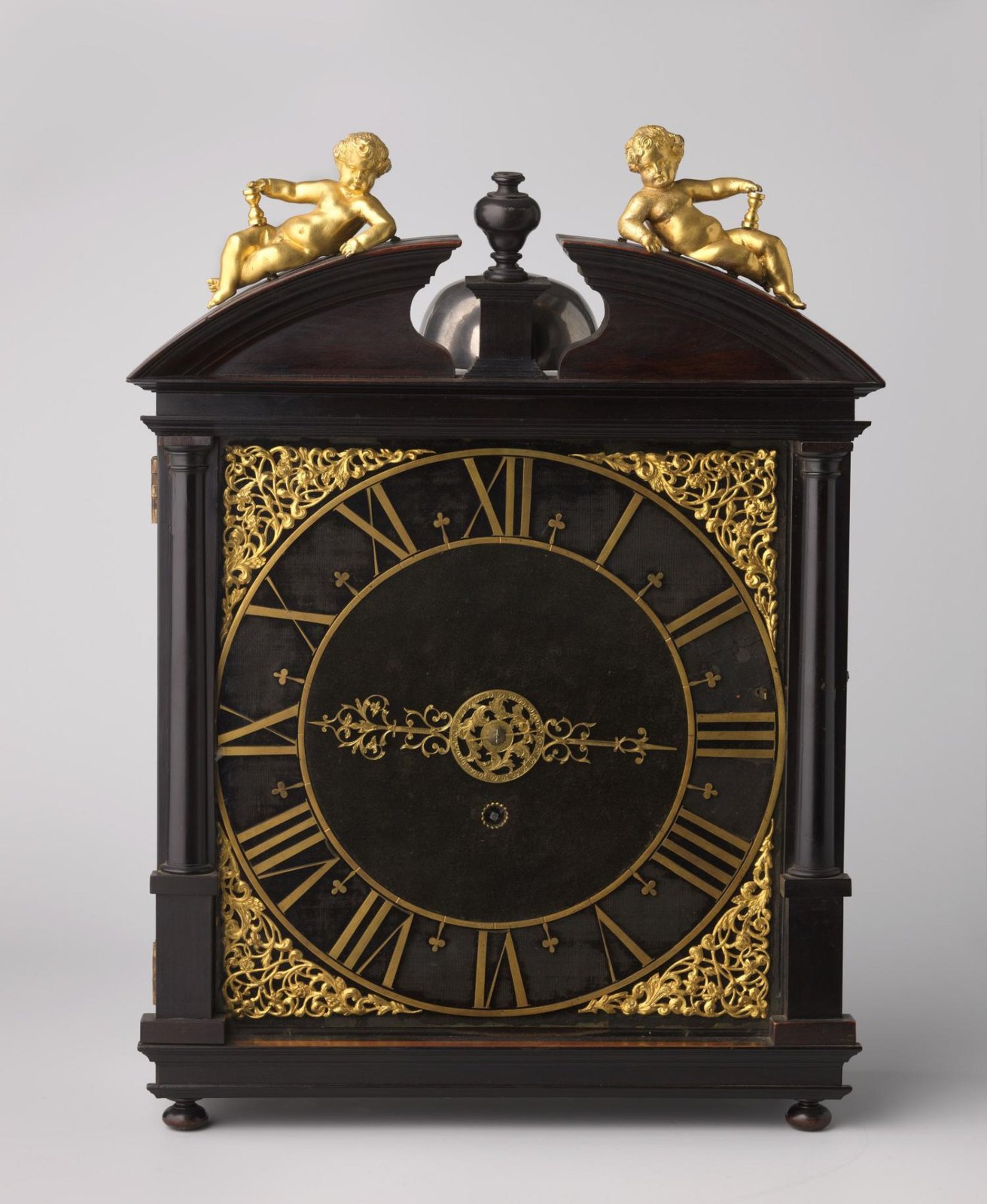
Clocks · Table clock
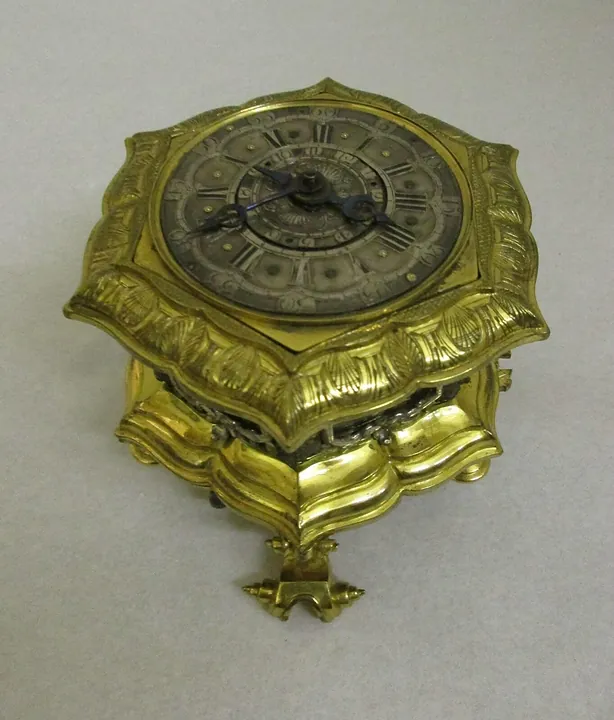
Table clock by Pieter Visbach (I), 1650–1700
- Maker / attribution
- Pieter Visbach (I) (clockmaker)
- Date
- 1650–1700
- Historical period
- Early Modern Horology (1600 – 1750)
- Country of origin
- Unrecorded in source
- Object type
- Table clock
- Materials / technique
- bronze (metal), ebony (wood), pine (wood), wood (plant material), velvet (fabric weave), pear (wood), padouk (wood), brass (alloy), glass
- Dimensions
- diameter 0.9 cm; diameter 27.5 cm; diameter 4.5 cm; height 48.3 cm x width 32.5 cm x depth 13.2 cm; length 11.9 cm x width 9.5 cm; length 28.7 cm x width 27.4 cm
- Holding institution
- Rijksmuseum
- Accession / object no.
- BK-NM-3483
- Credit line
- Rijksmuseum, Amsterdam
- Catalogue title (original)
- Tafelklok van hout; vierkante kast op afgeplatte bolpoten, tussen twee Toscaanse halfzuilen (Dutch)
View the source record ↗ (opens another website in a new tab)Suggest a correction
Record summary
Held and catalogued by Rijksmuseum (object number BK-NM-3483), this is a table clock by Pieter Visbach (I), dated 1650–1700. The Atlas places it in the Early Modern Horology period (1600 – 1750) of its Clocks collection. Materials and techniques recorded by the source: bronze (metal), ebony (wood), pine (wood), wood (plant material), velvet (fabric weave), pear (wood), padouk (wood), brass (alloy), glass. Recorded dimensions: diameter 0.9 cm; diameter 27.5 cm; diameter 4.5 cm; height 48.3 cm x width 32.5 cm x depth 13.2 cm; length 11.9 cm x width 9.5 cm; length 28.7 cm x width 27.4 cm. The record is illustrated with 1 photograph.
Assembled from the source record's structured fields. Dates and attributions are given as the source states them; where a field is missing the Atlas leaves it blank rather than estimating.
Catalogue description
Description — Rijksmuseum (Dutch)
Houten tafelklok. Het uurwerk is gevat in een kleine vierkante kast op afgeplatte bolpoten, tussen twee Toscaanse halfzuilen. De zwikken zijn gevuld met opengewerkte rankmotieven. De kast wordt bekroond met een gebroken kwartrond fronton, met in het midden een vaas op een voetstuk. Op de twee delen van het fronton rusten twee kinderen, met de ruggen naar elkaar toe. Het uurwerk is aan de achterzijde gemerkt: "Pieter Visbach Fecit Hagae". De klok zou volgens overlevering van Michiel Adriaenszoon de Ruyter zijn geweest.
Shown in the original language of the source catalogue. An editor-reviewed English translation has not yet been published; we do not publish machine translations as authoritative text.
Description — Rijksmuseum (Dutch)
Koperen wijzerplaat overtrokken met zwart fluweel. Koperen wijzerring en los opgebrachte Romeinse cijfers. Drielobbige versieringen. Koperen repousséversiering in de hoeken. Opengewerkte uurwijzer gezet aan versierd schijfje met 12 x 60/30 min. apart wijzertje. Uurwerk: Platines. Stellingpoten in slanke vaasvorm. L. enr. van de spilkloof eenvoudige versiering in ajour. Sluitschijf voor slagwerk van 12 uren. Kast: Voordeurtje met pilasters en gebroken timpaan. In het midden een piëdestal met vaas. Gesigneerd. [beschrijving voorheen onder nummer NG-NM-3483]
Shown in the original language of the source catalogue. An editor-reviewed English translation has not yet been published; we do not publish machine translations as authoritative text.
Inscriptions & marks
signature: ‘Pieter Visbach // Fecit Hagae’
Historical context
Early Modern Horology (1600 – 1750)
Huygens' pendulum and balance spring transform accuracy; English makers develop the anchor and deadbeat escapements.
Huygens's pendulum (1656–57) improved clock accuracy from about a quarter of an hour to under a minute a day. The anchor escapement (c. 1670) and the long seconds pendulum created the longcase clock; London makers such as Fromanteel, Knibb, Tompion and Quare led European clockmaking, and French makers created the Boulle pendule.
Read the period in the timelineMore clocks from this periodEarlier: Renaissance Horology
Atlas type guide
Bracket, table and spring-driven clocks
Spring-driven clocks freed timekeeping from the hanging weight. The coiled mainspring, documented from the fifteenth century, made portable table clocks possible; to even out its declining force, makers used the fusee, a conical pulley connected to the barrel by a gut line or chain. Renaissance table clocks from Augsburg and Nuremberg — drum-shaped, square or tower-shaped in gilt brass — were luxury scientific objects, often with astronomical dials and alarms.
After the pendulum, English makers developed the bracket clock: a wooden case with a carrying handle, a short pendulum with a verge escapement, and often repeating work to sound the hours on demand at night. Later examples use the anchor escapement. In the nineteenth century, 'table clock' became a broad term for spring clocks of every nationality.
What to look for
- A fusee in the movement (cone-shaped pulley) and the type of line — gut or chain.
- Verge escapement with a short bob pendulum, often with a decoratively engraved backplate.
- Repeat cords or buttons that make the clock strike again on demand.
- Gilt-brass engraved cases and horizontal dials on Renaissance pieces.
- Case shapes: inverted bell, bell top, break-arch, lancet or balloon.
Dating clues
- Drum and tower table clocks: c. 1520–1650.
- Ebony veneered English bracket clocks with verge escapements: c. 1670–1800.
- Engraved backplates were usual on English clocks until c. 1800, then generally plain.
General guidance written by the Atlas editors about this kind of object. It is not a statement about this particular piece; for that, rely on the source record above and on physical examination.
Related records
Clocks · Early 17th century
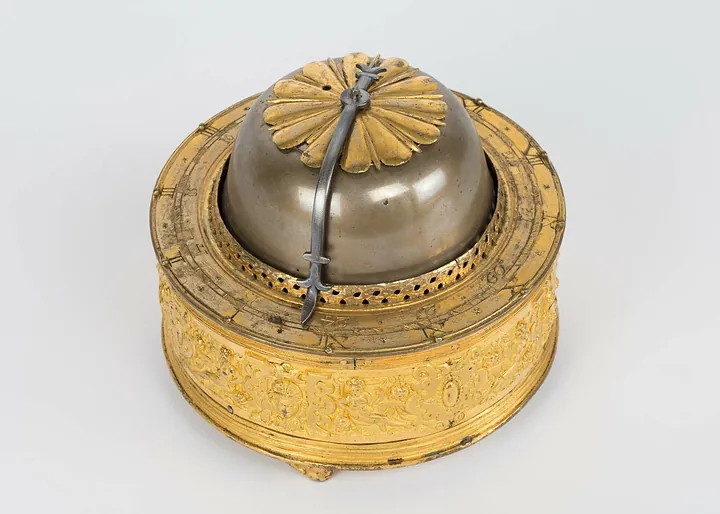
Table clock, probably Denmark, early 17th century
German Clock Museum
Clocks · 1590–1610
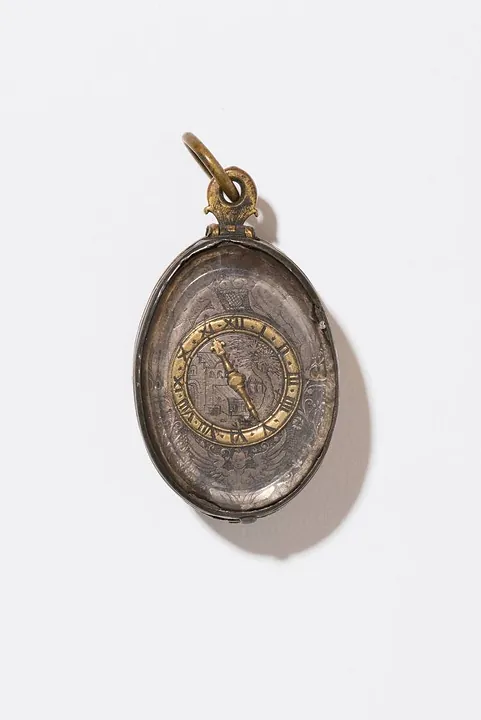
Clock, France, 1590–1610
MAK – Museum of Applied Arts
Clocks · c. 1600
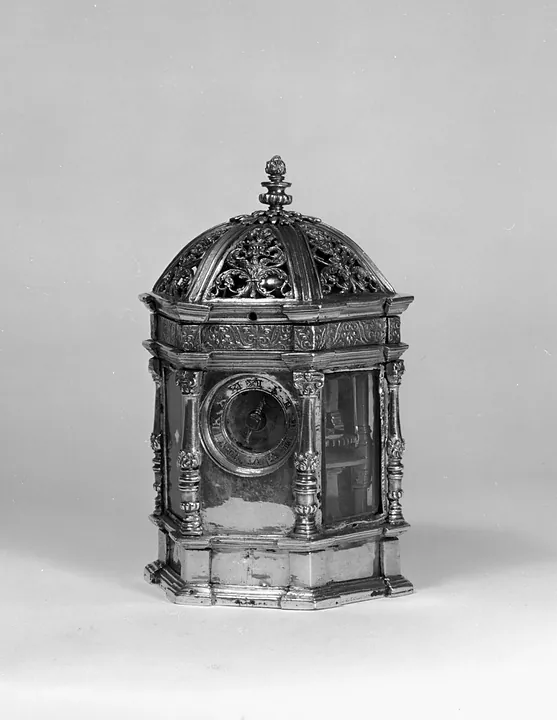
Table Clock, sheet brass, engraved, pierced and gilt, Paris, ca.1600, signed 'B(?) Pichard, à Paris'
Victoria and Albert Museum, London
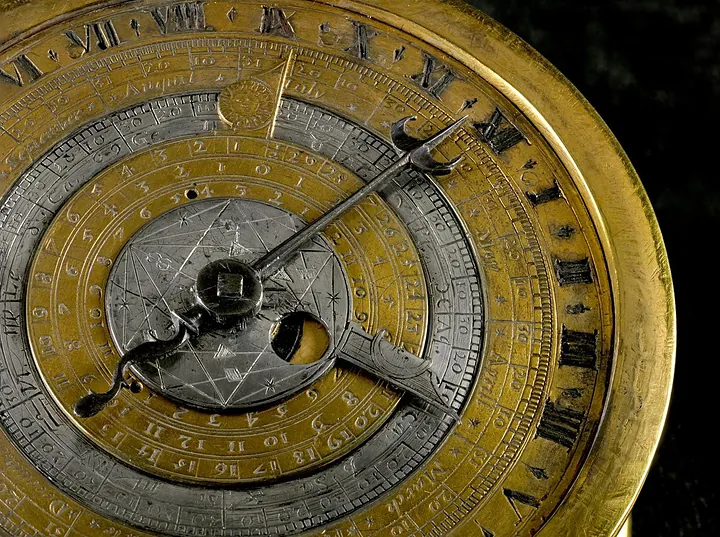
Clocks · 1598–1603
Circular table-clock with calendrical and lunar indications made by Nicholas Vallin in London between 1598 and 1603.
Science Museum Group, London
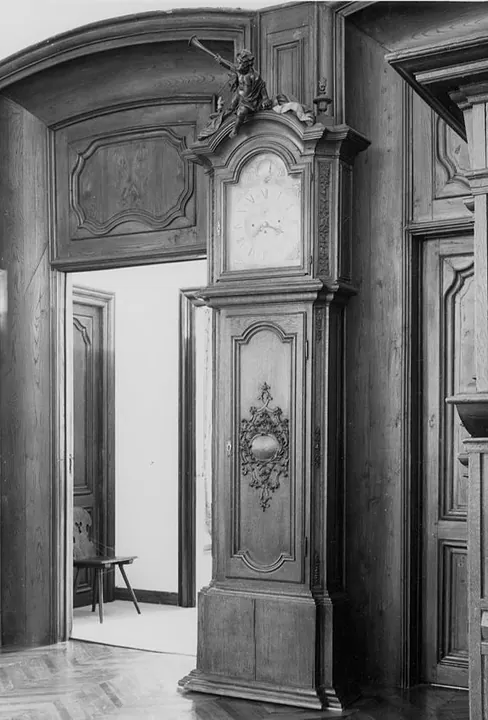
Clocks · 1600–1699
Clock by Joannes Volcker, Belgium, 1600–1699 (no. AP_10156031)
Royal Institute for Cultural Heritage
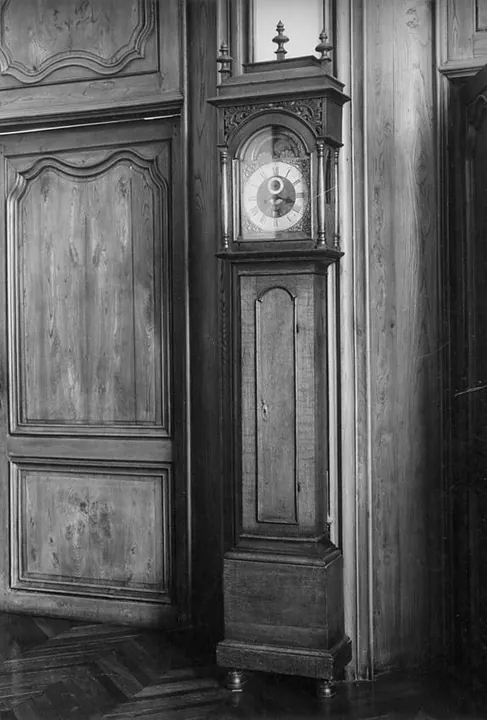
Clocks · 1600–1699
Clock by Joannes Volcker, Belgium, 1600–1699 (no. AP_10156032)
Royal Institute for Cultural Heritage
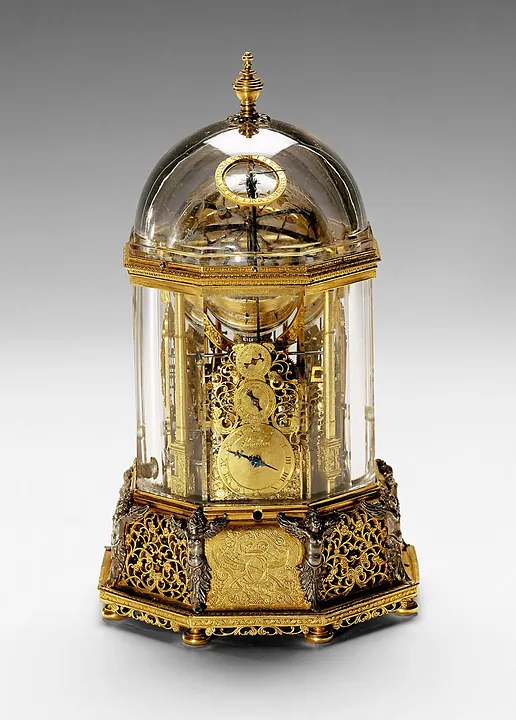
Clocks · 1600–1699
Clock attributed to Jobst Bürgi, Czech Republic, 1600–1699
Fine Arts Museum Vienna
Clocks · 1600–1700
Clock, Germany, 1600–1700
Victoria and Albert Museum, London