
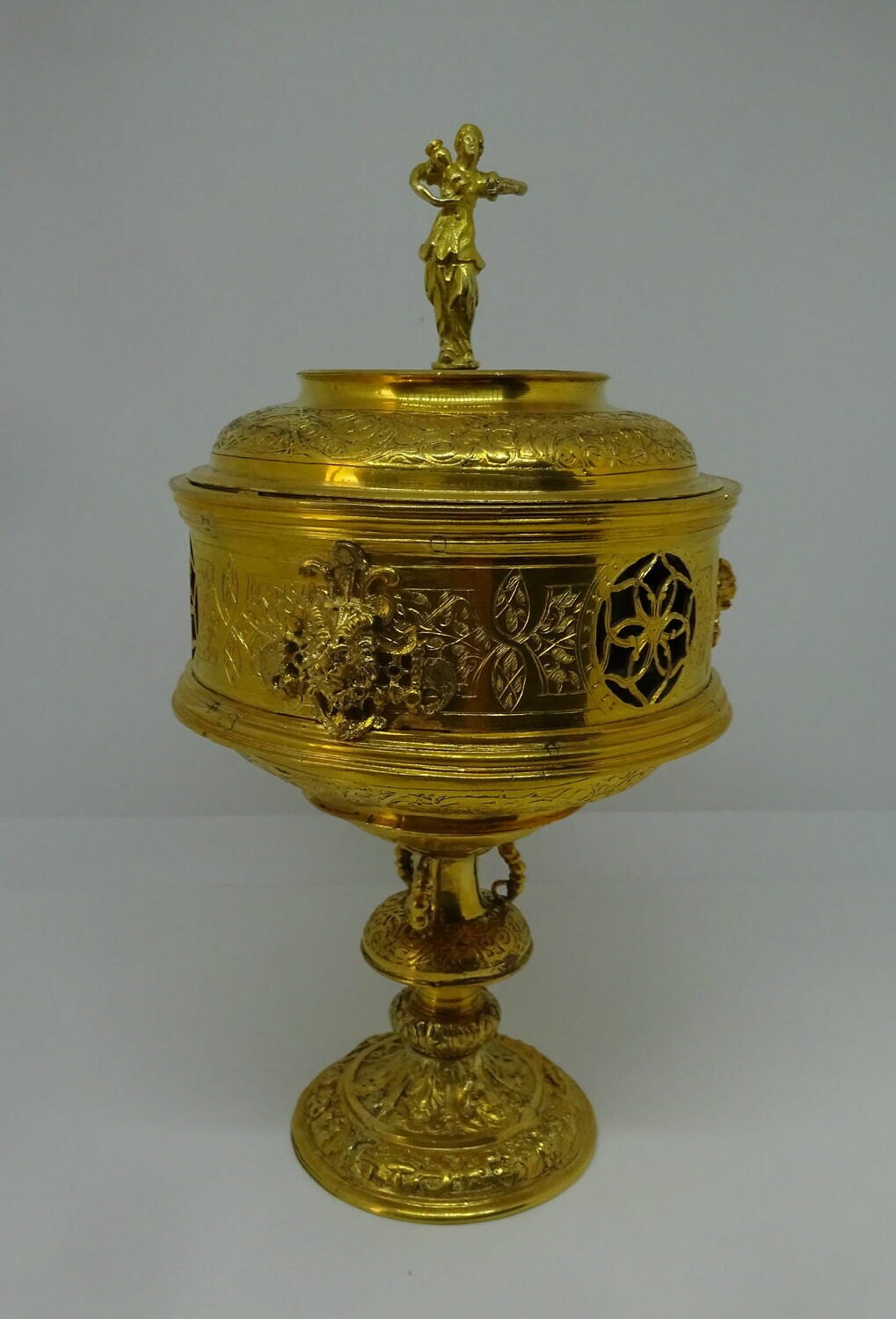
Clocks · Table clock
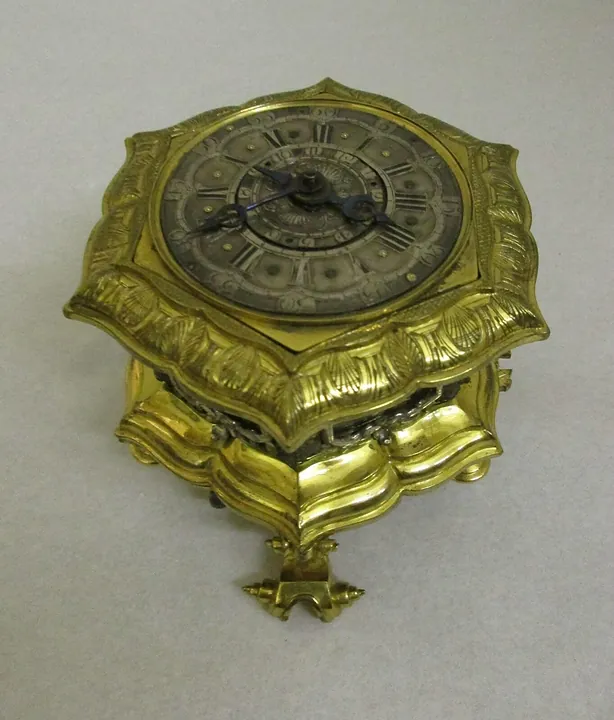
Table clock, 1600–1615
- Maker / attribution
- Unrecorded in source
- Date
- 1600–1615
- Historical period
- Early Modern Horology (1600 – 1750)
- Country of origin
- Unrecorded in source
- Object type
- Table clock
- Materials / technique
- brass, silver, bronze
- Dimensions
- height 21,6 cm; height 17,4 cm; diameter 11,5 cm
- Holding institution
- Musée du Louvre, Paris
- Accession / object no.
- OA 6945
- Credit line
- Musée du Louvre, Département des Objets d'art du Moyen Age, de la Renaissance et des temps modernes
- Catalogue title (original)
- Horloge de table en forme de ciboire (French)
View the source record ↗ (opens another website in a new tab)Suggest a correction
Record summary
Held and catalogued by Musée du Louvre, Paris (object number OA 6945), this is a table clock, dated 1600–1615. The Atlas places it in the Early Modern Horology period (1600 – 1750) of its Clocks collection. Materials and techniques recorded by the source: brass, silver, bronze. Recorded dimensions: height 21,6 cm; height 17,4 cm; diameter 11,5 cm. The record is illustrated with 5 photographs.
Assembled from the source record's structured fields. Dates and attributions are given as the source states them; where a field is missing the Atlas leaves it blank rather than estimating.
Catalogue description
Catalogue description — Musée du Louvre (French)
Horloge de table ; pourtour de la boîte ajouré de trois rosaces alternant avec trois têtes de bouc en relief ; motifs se détachant sur des médaillons rectangulaires gravés de feuilles. Partie inférieure gravée de rubans et rinceaux entrelacés, en symétrie, le goulot supporte le cadran horizontal orné d'émaux champlevés à double numérotage. Goulot surmonté d'une statuette féminine portant un sablier. Pied en forme de balustre flanqué de trois consoles ; orné de rinceaux similaires à ceux de la boîte. Base ciselée en relief de grotesques. Mouvement suisse du 18e siècle muni d'une sonnerie.
Shown in the original language of the source catalogue. An editor-reviewed English translation has not yet been published; we do not publish machine translations as authoritative text.
Dating and period as catalogued (French)
Epoque / période : Henri IV (1589-1610) (Occident->Renaissance->dynastie des Bourbons) · · Date de création/fabrication : 1600 - 1615
Shown in the original language of the source catalogue. An editor-reviewed English translation has not yet been published; we do not publish machine translations as authoritative text.
Materials and techniques as catalogued (French)
Matériau : laiton · Matériau : argent · Matériau : bronze · Technique : émaillé = émaillage = émail = émaux (techniques métal)
Shown in the original language of the source catalogue. An editor-reviewed English translation has not yet been published; we do not publish machine translations as authoritative text.
Provenance
Collection Marie Peyrat, marquise Arconati-Visconti (1840-1923), à Paris. Don de la marquise Arconati-Visconti, en 1916.
Historical context
Early Modern Horology (1600 – 1750)
Huygens' pendulum and balance spring transform accuracy; English makers develop the anchor and deadbeat escapements.
Huygens's pendulum (1656–57) improved clock accuracy from about a quarter of an hour to under a minute a day. The anchor escapement (c. 1670) and the long seconds pendulum created the longcase clock; London makers such as Fromanteel, Knibb, Tompion and Quare led European clockmaking, and French makers created the Boulle pendule.
Read the period in the timelineMore clocks from this periodEarlier: Renaissance Horology
Atlas type guide
Bracket, table and spring-driven clocks
Spring-driven clocks freed timekeeping from the hanging weight. The coiled mainspring, documented from the fifteenth century, made portable table clocks possible; to even out its declining force, makers used the fusee, a conical pulley connected to the barrel by a gut line or chain. Renaissance table clocks from Augsburg and Nuremberg — drum-shaped, square or tower-shaped in gilt brass — were luxury scientific objects, often with astronomical dials and alarms.
After the pendulum, English makers developed the bracket clock: a wooden case with a carrying handle, a short pendulum with a verge escapement, and often repeating work to sound the hours on demand at night. Later examples use the anchor escapement. In the nineteenth century, 'table clock' became a broad term for spring clocks of every nationality.
What to look for
- A fusee in the movement (cone-shaped pulley) and the type of line — gut or chain.
- Verge escapement with a short bob pendulum, often with a decoratively engraved backplate.
- Repeat cords or buttons that make the clock strike again on demand.
- Gilt-brass engraved cases and horizontal dials on Renaissance pieces.
- Case shapes: inverted bell, bell top, break-arch, lancet or balloon.
Dating clues
- Drum and tower table clocks: c. 1520–1650.
- Ebony veneered English bracket clocks with verge escapements: c. 1670–1800.
- Engraved backplates were usual on English clocks until c. 1800, then generally plain.
General guidance written by the Atlas editors about this kind of object. It is not a statement about this particular piece; for that, rely on the source record above and on physical examination.
Related records
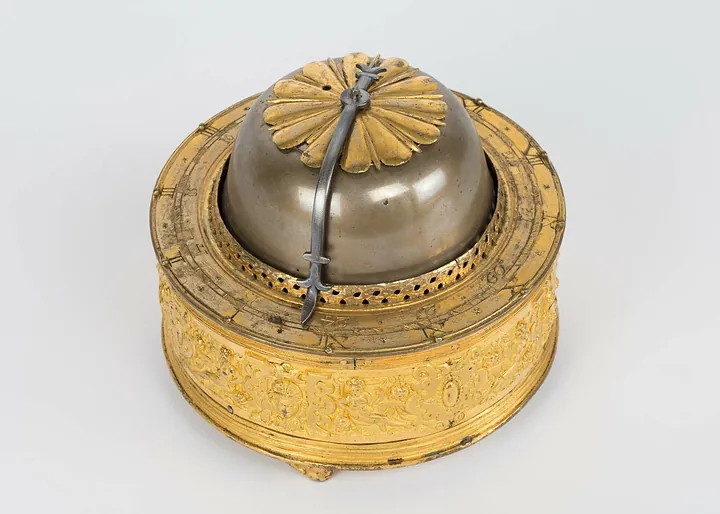
Clocks · Early 17th century
Table clock, probably Denmark, early 17th century
German Clock Museum
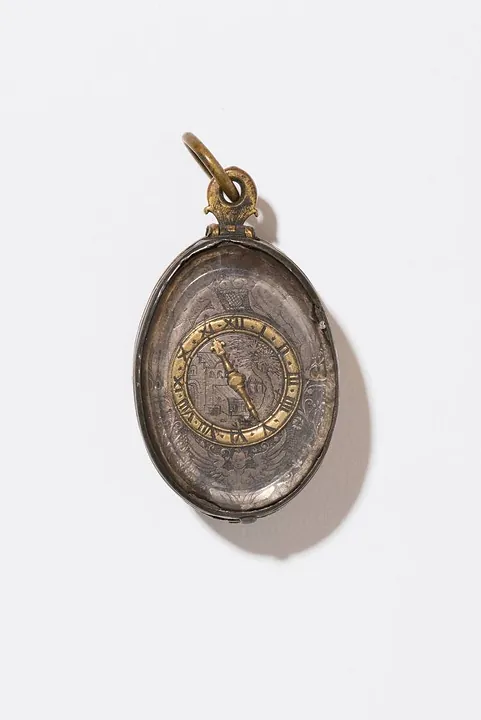
Clocks · 1590–1610
Clock, France, 1590–1610
MAK – Museum of Applied Arts
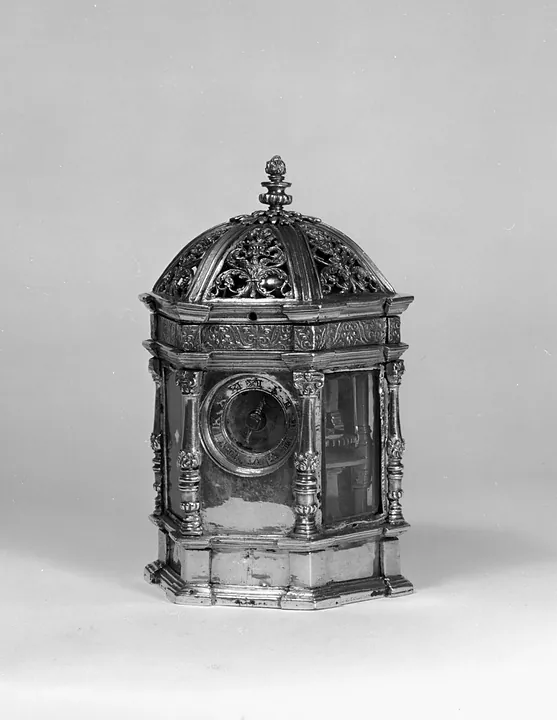
Clocks · c. 1600
Table Clock, sheet brass, engraved, pierced and gilt, Paris, ca.1600, signed 'B(?) Pichard, à Paris'
Victoria and Albert Museum, London
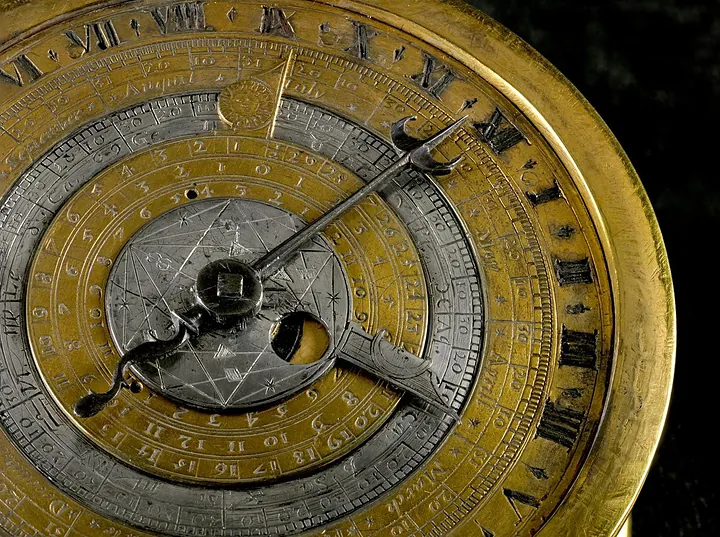
Clocks · 1598–1603
Circular table-clock with calendrical and lunar indications made by Nicholas Vallin in London between 1598 and 1603.
Science Museum Group, London
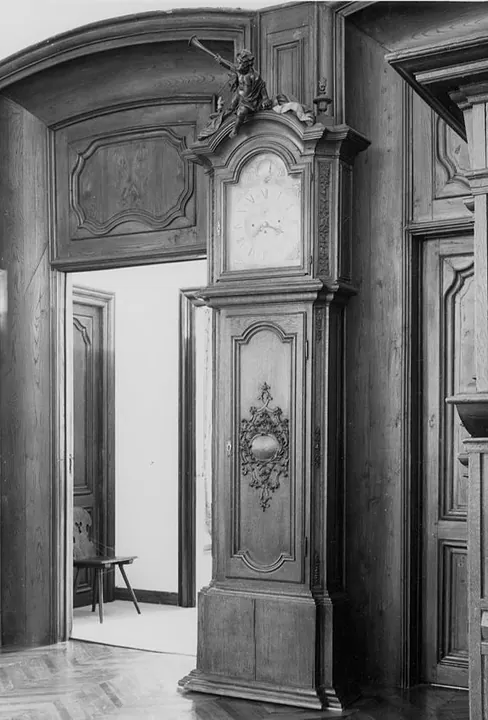
Clocks · 1600–1699
Clock by Joannes Volcker, Belgium, 1600–1699 (no. AP_10156031)
Royal Institute for Cultural Heritage
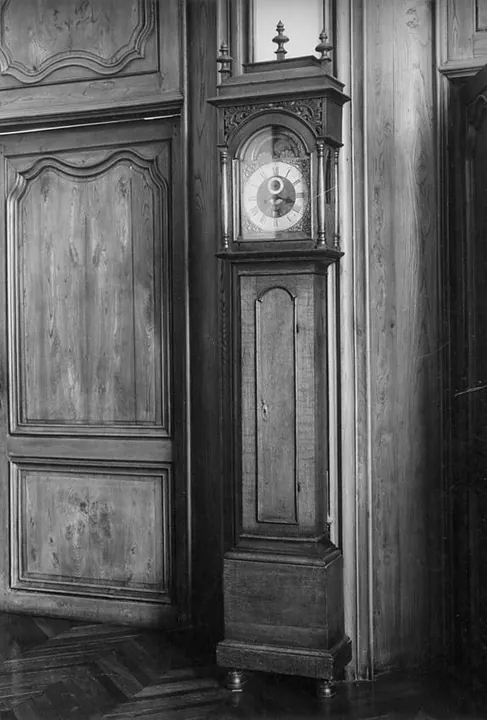
Clocks · 1600–1699
Clock by Joannes Volcker, Belgium, 1600–1699 (no. AP_10156032)
Royal Institute for Cultural Heritage
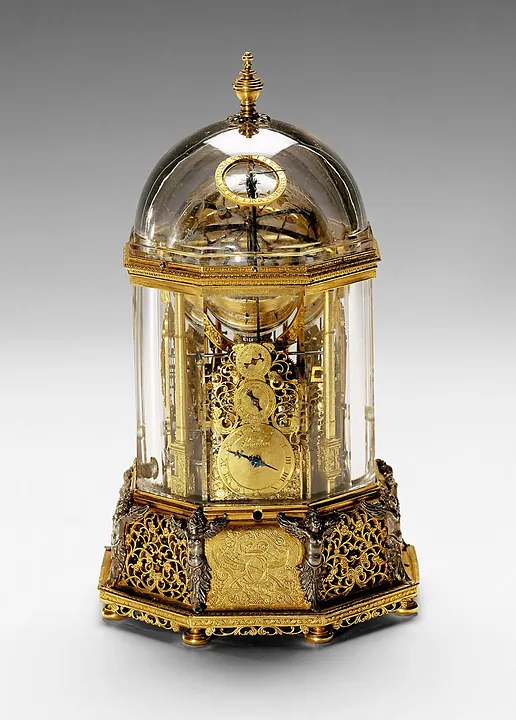
Clocks · 1600–1699
Clock attributed to Jobst Bürgi, Czech Republic, 1600–1699
Fine Arts Museum Vienna
Clocks · 1600–1700
Clock, Germany, 1600–1700
Victoria and Albert Museum, London