
Clocks · Longcase clock
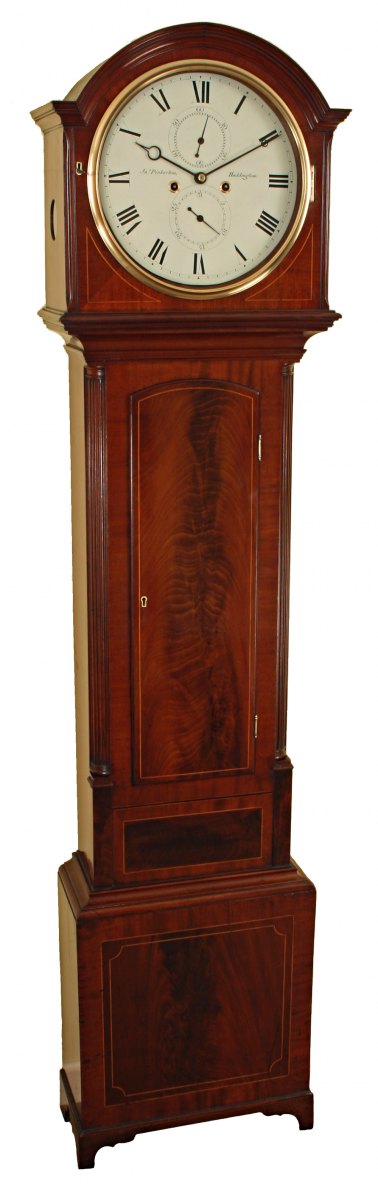
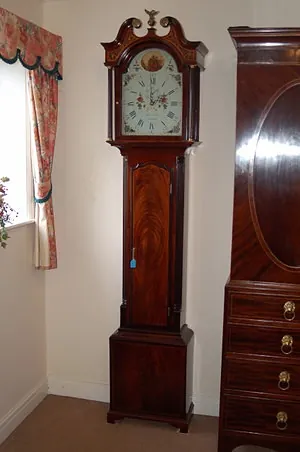
Small Scottish longcase clock by Pinkerton, Haddington, c. 1820
- Maker / attribution
- Pinkerton (maker)
- Date
- c. 1820
- Historical period
- Precision & Scientific Horology (1750 – 1850)
- Country of origin
- Scotland
- Place
- Haddington
- Object type
- Longcase clock
- Materials / technique
- mahogany
- Dimensions
- Height 6 ft 6 in (198 cm)
- Stock no.
- Product 470
- Credit line
- Dealer listing, P A Oxley (product 470)
- Catalogue title (original)
- Small Scottish Longcase Clock by Pinkerton of Haddington (English)
View the source record (dealer listing) ↗ (opens another website in a new tab)Suggest a correction
Record summary
Catalogued by P A Oxley (dealer), Wiltshire (stock number Product 470), this is a longcase clock by Pinkerton, made in Haddington, Scotland, dated c. 1820. The Atlas places it in the Precision & Scientific Horology period (1750 – 1850) of its Clocks collection. Materials and techniques recorded by the source: mahogany. Recorded dimensions: Height 6 ft 6 in (198 cm). The record is illustrated with 5 photographs.
Assembled from the source record's structured fields. Dates and attributions are given as the source states them; where a field is missing the Atlas leaves it blank rather than estimating.
Catalogue description
Dealer description — P A Oxley
A small round dial Scottish longcase clock by this prolific Clockmaker. The 8 day duration movement strikes the hours on a bell and has a round painted dial showing seconds, date, matching blued steel hands and the makers name and place of work to the centre of the dial. The excellent quality mahogany veneered case has well figured flame veneers to both the trunk door and base. Cross banding and boxwood inlay is also a feature used throughout the case along with reeded quarter columns with wooden capitals and a three quarter length trunk door. The base has small bracket feet which are typical of this area of Scotland and the period. The hood has a lockable glazed brass bezel and with an optional solid mahogany cresting terminating with a gilt wooden ball finial to the centre. This can easily be removed to reduce the clock in height and it subsequently becomes a plain broken arch top. Note: John Pinkerton of Haddington is listed as working between 1805-1840. He is also listed in the 1841 Census as living in the High Street, aged 55 and Married with 6 children. Maker Pinkerton of Haddington
Historical context
Precision & Scientific Horology (1750 – 1850)
Harrison solves longitude; Mudge invents the lever; Breguet's Paris workshop defines the modern watch.
The age of the deadbeat escapement, compensated pendulums and observatory regulators. Domestic clocks spread through the middle classes: English longcase and bracket clocks, French gilt-bronze mantel clocks, Viennese Biedermeier wall clocks, Black Forest painted-shield clocks, and the first American shelf clocks.
Read the period in the timelineMore clocks from this periodEarlier: Early Modern Horology
Atlas type guide
Longcase (tall-case or grandfather) clocks
The longcase clock was born from two seventeenth-century innovations: Christiaan Huygens's pendulum (1656–57) and the anchor escapement (c. 1670). A long seconds pendulum, nearly a metre long, swings with a small arc, and enclosing it together with the driving weights in a tall wooden case protected the mechanism and created a new piece of furniture. London makers such as Ahasuerus Fromanteel, Thomas Tompion and Joseph Knibb set the pattern.
By the eighteenth century longcase clocks were made throughout Britain, the Netherlands, Scandinavia (the Swedish Mora clock), France (the Comtoise from the Franche-Comté), Germany and colonial America. Eight-day movements with two weights became standard in better clocks; thirty-hour clocks with one weight and a rope or chain were cheaper alternatives.
What to look for
- Winding holes in the dial: two (eight-day, going and striking) or none (thirty-hour, pulled up by a chain).
- Brass dials with applied chapter rings (earlier) versus painted iron 'white' dials (after c. 1770 in Britain).
- Moon-phase arches, date apertures, seconds dials and maker's name on the dial.
- Case woods and style: ebonised, walnut marquetry, lacquer, oak or mahogany; regional styles from London, Lancashire, Scotland or America.
- Whether the movement and dial match the case — 'marriages' are common.
Dating clues
- Square brass dials suggest c. 1670–1720; arched brass dials c. 1715–1790.
- Painted (white) dials were made by Birmingham dial-makers from about 1772.
- Comtoise clocks with repoussé pendulums are mostly nineteenth century.
General guidance written by the Atlas editors about this kind of object. It is not a statement about this particular piece; for that, rely on the source record above and on physical examination.
Read next:Anchor (recoil) escapementDeadbeat escapementAnchor escapement
Related records
Clocks · c. 1825
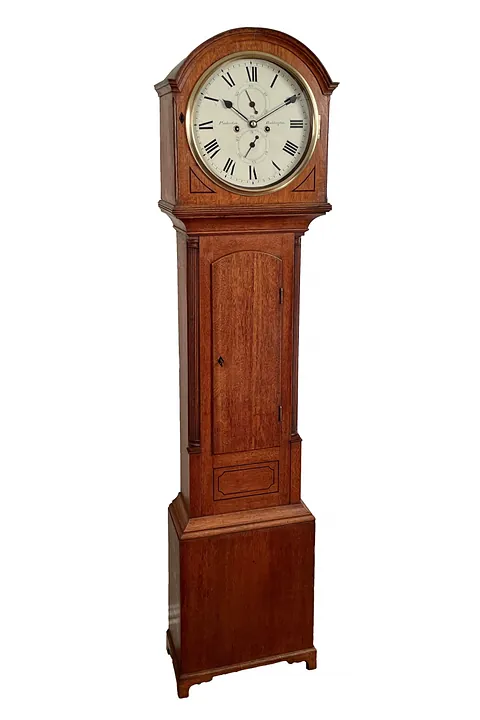
Oak longcase clock by Pinkerton, Haddington, c. 1825
P A Oxley (dealer), Wiltshire
Clocks · c. 1820–1830
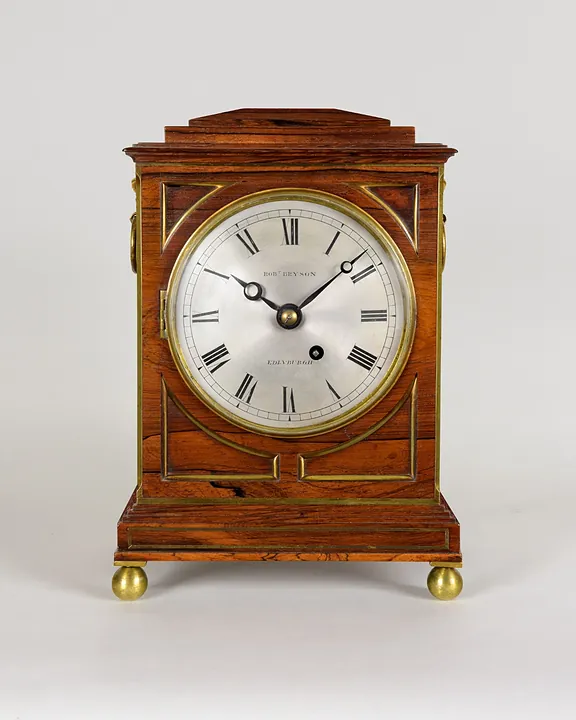
Bracket clock by Bryson, Edinburgh, c. 1820–1830
Howard Walwyn Fine Antique Clocks (dealer), London
Clocks · c. 1820–1830
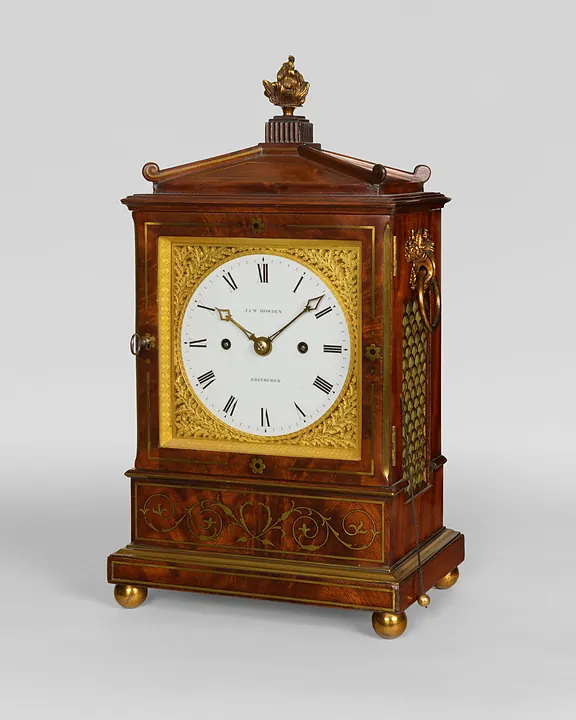
Bracket clock by J & W Howden, Edinburgh, c. 1820–1830
Howard Walwyn Fine Antique Clocks (dealer), London
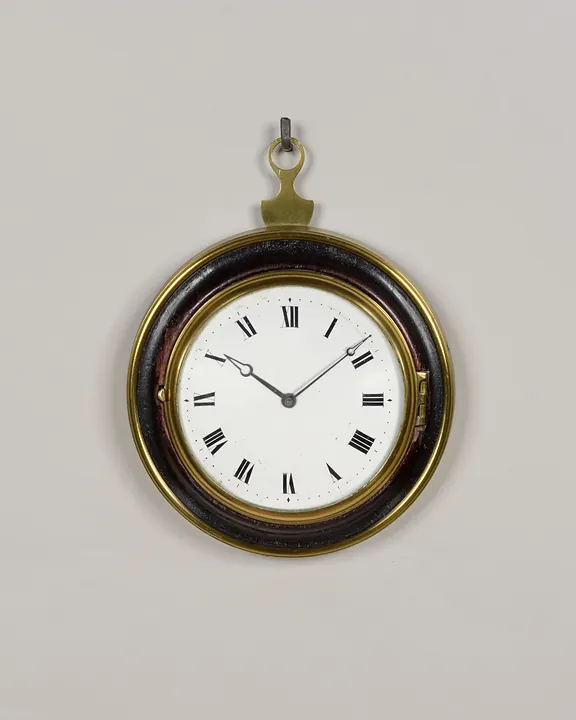
Clocks · c. 1810
Clock by Reid and Auld, Edinburgh, c. 1810
Howard Walwyn Fine Antique Clocks (dealer), London
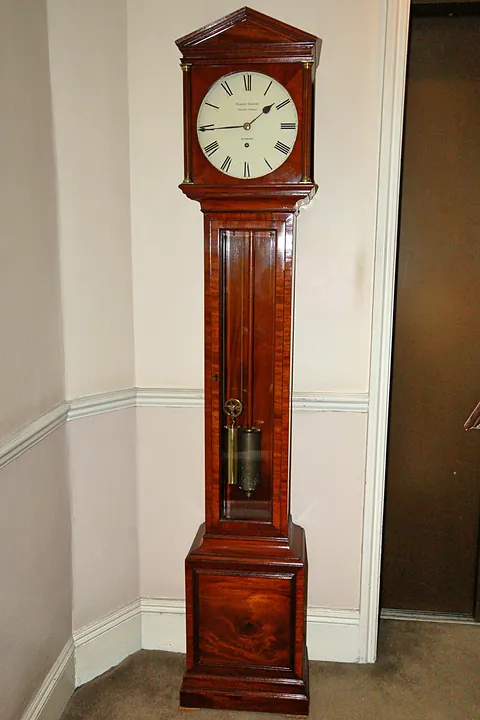
Clocks · c. 1810
Grandfather Clock by Robert Bryson, Edinburgh, c. 1810
Pendulum of Mayfair (dealer), London
Clocks · c. 1790
Grandfather Clock by James Gray, Edinburgh, c. 1790
Pendulum of Mayfair (dealer), London
Clocks · c. 1785
Grandfather Clock by Robert Clidsdale, Edinburgh, c. 1785
Pendulum of Mayfair (dealer), London
Clocks · c. 1795
Grandfather Clock by John Scott, Edinburgh, c. 1795
Pendulum of Mayfair (dealer), London