
Clocks · Shelf clock
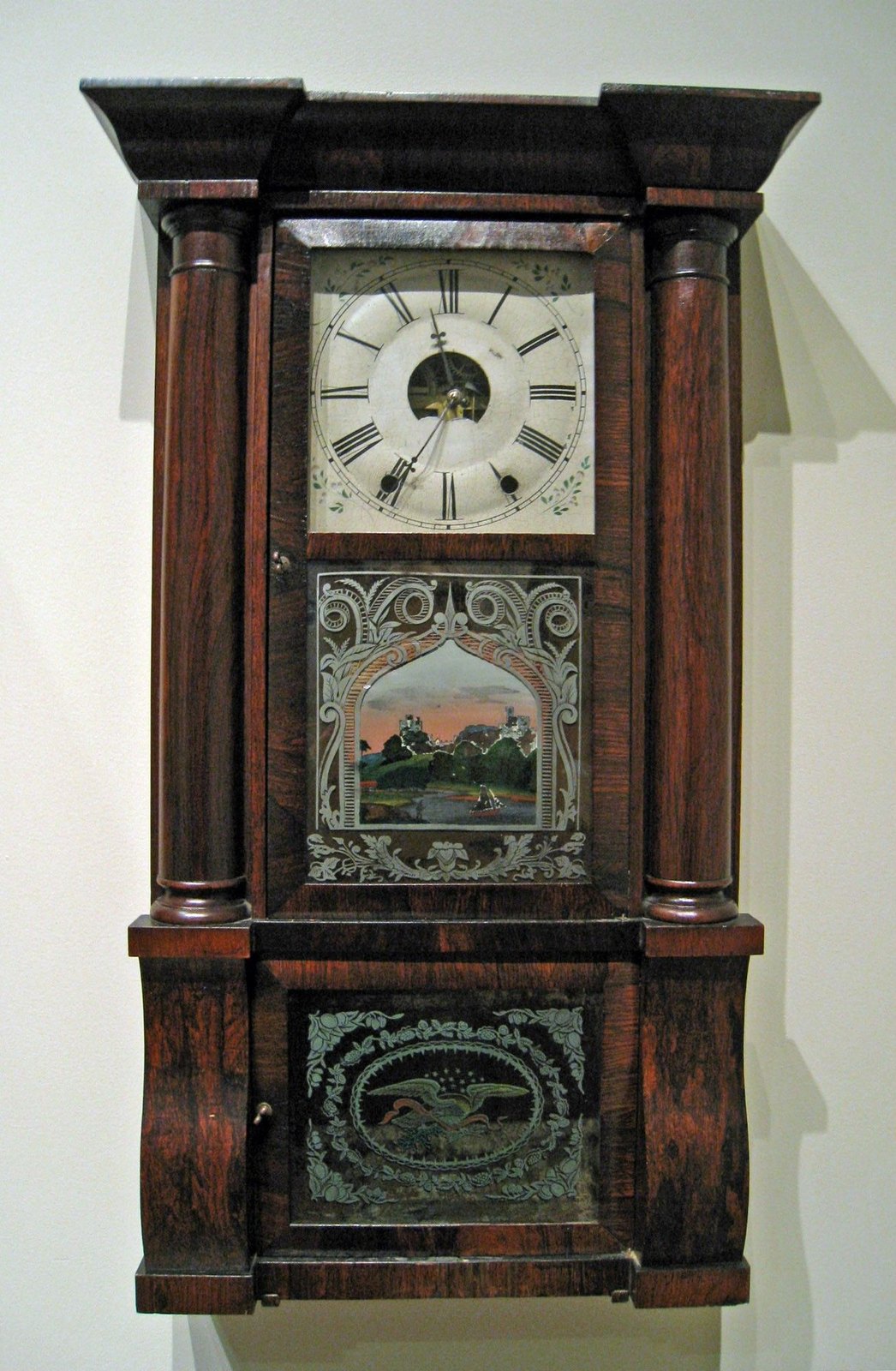
Shelf Clock by William L. Gilbert
- Maker / attribution
- William L. Gilbert (manufacturer)
- Date
- 1850–70
- Historical period
- Industrial Revolution (1850 – 1900)
- Country of origin
- United States
- Place
- Winchester
- Object type
- Shelf clock
- Materials / technique
- rosewood veneer, reverse-painted glass, brass, and other metals
- Dimensions
- 32 × 19 × 6 in. (81.28 × 48.26 × 15.24 cm)
- Holding institution
- Yale University Art Gallery, New Haven
- Accession / object no.
- 2007.154.1
- Credit line
- Gift of Charles T. Clark
- Catalogue title (original)
- Shelf Clock (English)
View the source record ↗ (opens another website in a new tab)Suggest a correction
Record summary
Held and catalogued by Yale University Art Gallery, New Haven (object number 2007.154.1), this is a shelf clock by William L. Gilbert, made in Winchester, United States, dated 1850–70. The Atlas places it in the Industrial Revolution period (1850 – 1900) of its Clocks collection. Materials and techniques recorded by the source: rosewood veneer, reverse-painted glass, brass, and other metals. Recorded dimensions: 32 × 19 × 6 in. (81.28 × 48.26 × 15.24 cm). The record is illustrated with 1 photograph.
Assembled from the source record's structured fields. Dates and attributions are given as the source states them; where a field is missing the Atlas leaves it blank rather than estimating.
Catalogue description
Catalogue description — Yale University Art Gallery
During the nineteenth century, Connecticut was a leading manufacturer of clocks, particularly of domestically scaled shelf clocks. These industrially produced timepieces were eagerly consumed by a growing middle class hungry for well-made, attractive domestic goods. Shelf clocks were available in every conceivable style; this example is in a late Neoclassical style. With an emphasis on clean, unadorned forms, lavish use of vividly figured wood veneers, and Neoclassical cornice moldings, scroll brackets, and columns, furniture of this type is commonly referred to as "pillar and scroll." This stately piece is labeled by William Lewis Gilbert, a clockmaker working out of Farmington, Bristol, and Winsted, Connecticut.
Published references — Yale University Art Gallery
"Acquisitions, July 1, 2007–June 30, 2008," Yale University Art Gallery Bulletin (2008), 177 · Christina Borger, "Hidden Treasures," New Haven Register (December 13, 2009), E3, ill.
Inscriptions & marks
On printed paper label on inside back panel of lower section: "IMPROVED / BRASS CLOCKS, / MADE AND SOLD BY / WM. L. GILBERT & CO., / Winchester, Conn. / WARRANTED GOOD / Directions for setting the Clock running and keeping it in order. / [directions] / HERALD JOB PRESS. WINSTED, CONN"
Provenance
Messrs. Charles D. & John C. Spalding; by inheritance, c. 1980 to Charles T. Clark, by gift to Yale University Art Gallery 2007.
Historical context
Industrial Revolution (1850 – 1900)
American interchangeable-parts manufacture; railroad time standards; Swiss and German factory systems.
Factory production transformed the clock into an everyday object. American makers (Seth Thomas, Ansonia, Waterbury) and German factories (Junghans, Gustav Becker, Lenzkirch) sold millions of shelf, wall and alarm clocks worldwide; France produced standardised Paris movements and carriage clocks; electric time distribution began.
Read the period in the timelineMore clocks from this periodEarlier: Precision & Scientific Horology
Atlas type guide
Bracket, table and spring-driven clocks
Spring-driven clocks freed timekeeping from the hanging weight. The coiled mainspring, documented from the fifteenth century, made portable table clocks possible; to even out its declining force, makers used the fusee, a conical pulley connected to the barrel by a gut line or chain. Renaissance table clocks from Augsburg and Nuremberg — drum-shaped, square or tower-shaped in gilt brass — were luxury scientific objects, often with astronomical dials and alarms.
After the pendulum, English makers developed the bracket clock: a wooden case with a carrying handle, a short pendulum with a verge escapement, and often repeating work to sound the hours on demand at night. Later examples use the anchor escapement. In the nineteenth century, 'table clock' became a broad term for spring clocks of every nationality.
What to look for
- A fusee in the movement (cone-shaped pulley) and the type of line — gut or chain.
- Verge escapement with a short bob pendulum, often with a decoratively engraved backplate.
- Repeat cords or buttons that make the clock strike again on demand.
- Gilt-brass engraved cases and horizontal dials on Renaissance pieces.
- Case shapes: inverted bell, bell top, break-arch, lancet or balloon.
Dating clues
- Drum and tower table clocks: c. 1520–1650.
- Ebony veneered English bracket clocks with verge escapements: c. 1670–1800.
- Engraved backplates were usual on English clocks until c. 1800, then generally plain.
General guidance written by the Atlas editors about this kind of object. It is not a statement about this particular piece; for that, rely on the source record above and on physical examination.
Related records
Clocks · c. 1852
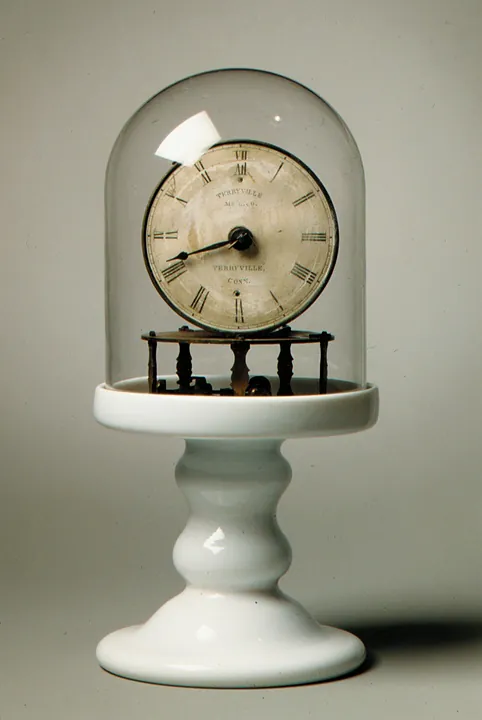
Clock, United States, c. 1852
The Metropolitan Museum of Art, New York
Clocks · c. 1850
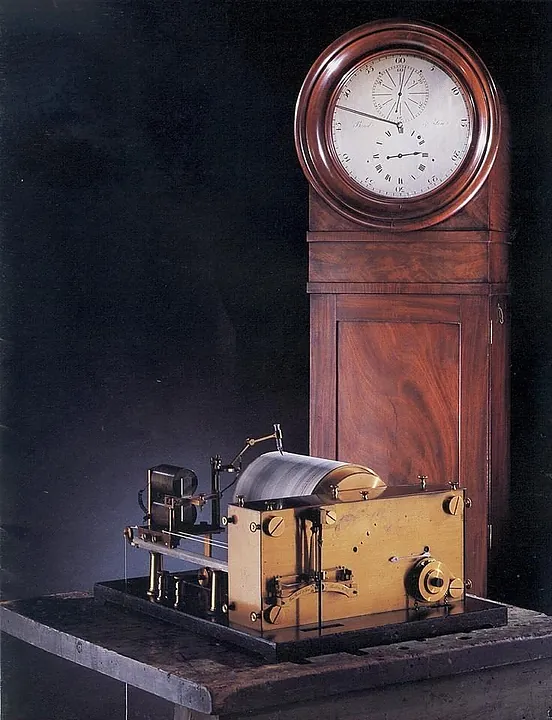
Clock by William Bond & Son, United States, c. 1850
National Museum of American History, Smithsonian Institution, Washington DC
Clocks · c. 1882–85
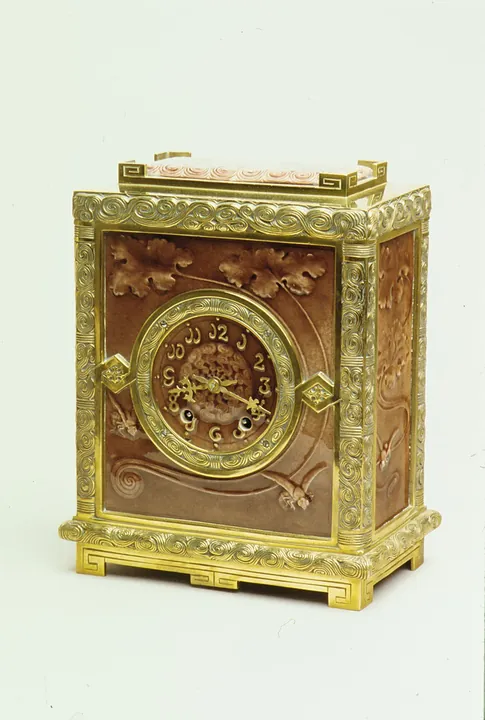
Clock by J. and J. G. Low Art Tile Works, United States, c. 1882–85
The Metropolitan Museum of Art, New York
Clocks · c. 1882–85
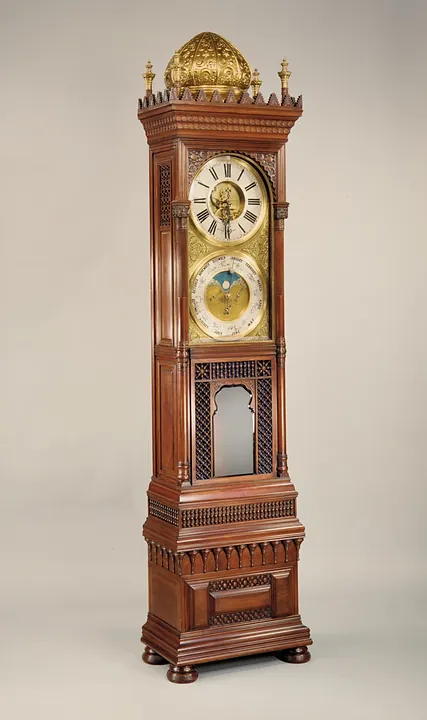
Tall clock by Tiffany & Co., United States, c. 1882–85
The Metropolitan Museum of Art, New York
Clocks · c. 1890
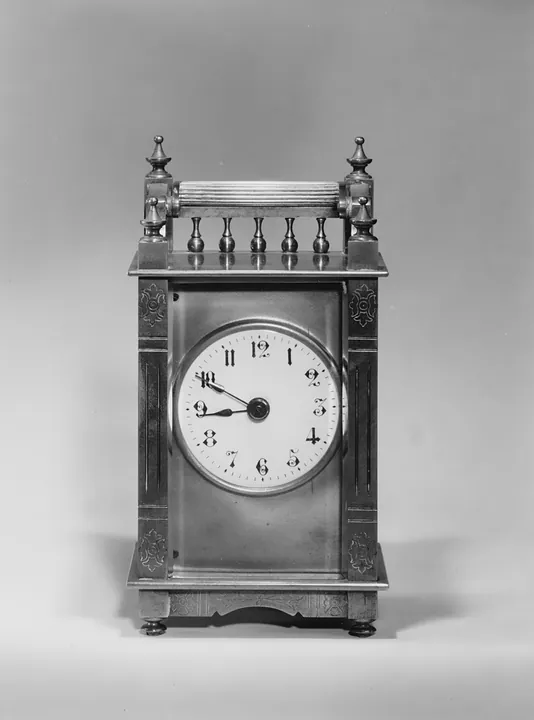
Carriage clock by Boston Clock Company, United States, c. 1890
The Metropolitan Museum of Art, New York
Clocks · c. 1880
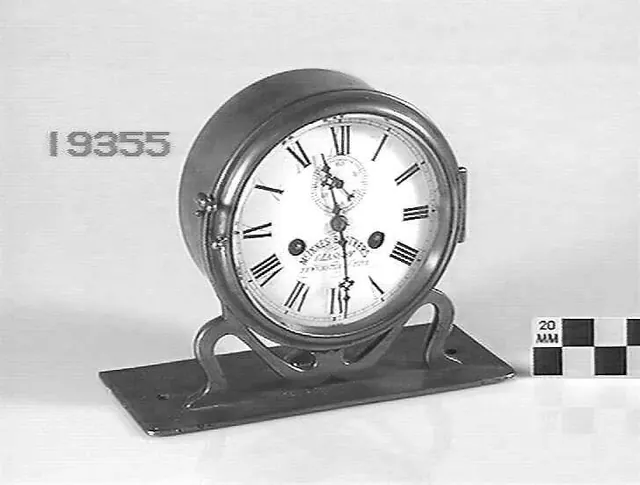
Marine Clock - E.N. Welch, Forestville, Connecticut, c. 1880
Museums Victoria, Melbourne
Clocks · c. 1890
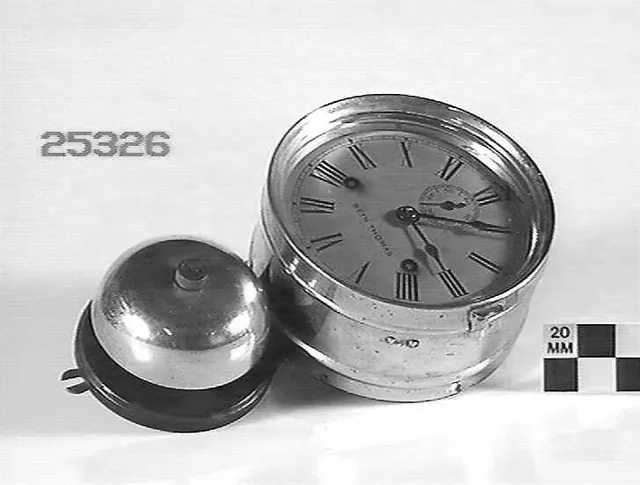
Marine Clock - Seth Thomas Clock Co, Thomaston, Connecticut, c. 1890
Museums Victoria, Melbourne
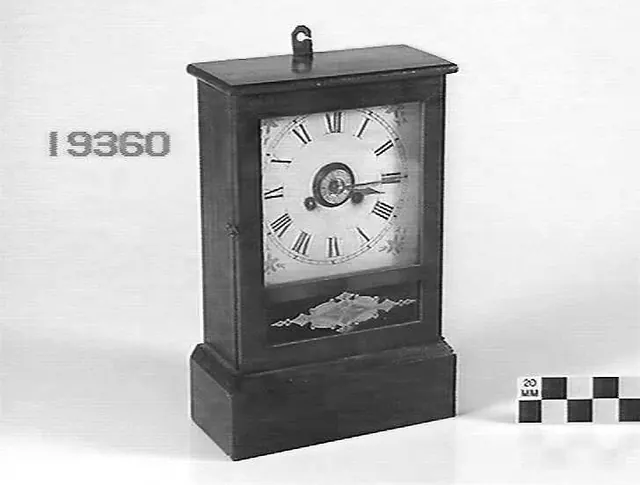
Clocks · c. 1850
Mantel Clock - Jerome & Co, New Haven, c. 1850
Museums Victoria, Melbourne