Clocks · Clock
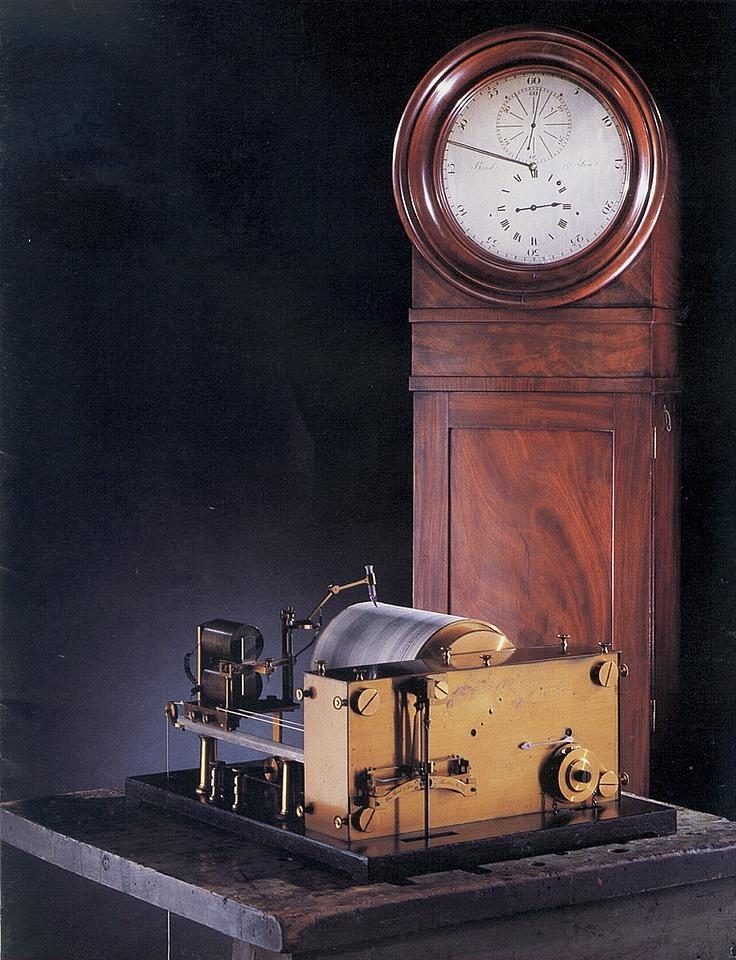
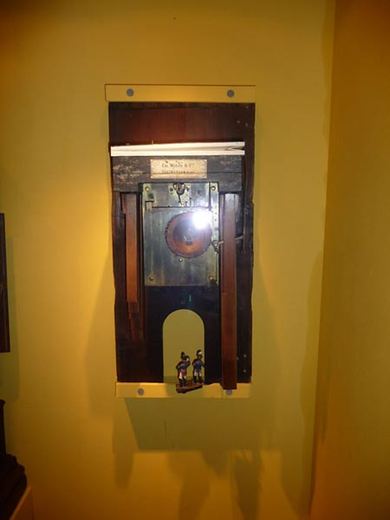
Clock by William Bond & Son, United States, ca 1850
- Maker / attribution
- William Bond & Son (maker)
- Date
- ca 1850
- Historical period
- Industrial Revolution (1850 – 1900)
- Country of origin
- United States
- Place
- United States: Massachusetts, Boston
- Object type
- Clock
- Dimensions
- "brass" (movement material); wood (case material); glass (pendulum bob, part of material); overall: clock: 78 in x 16 in x 8 1/2 in; 198.12 cm x 40.64 cm x 21.59 cm; overall: crate: 89 in x 40 in x 29 in; 226.06 cm x 101.6 cm x 73.66 cm; weight: 8 3/32 in x 1 3/4 in; 20.574 cm x 4.445 cm; hood: 16 in x 15 1/2 in x 10 in; 40.64 cm x 39.37 cm x 25.4 cm; case and movement: 75 in x 16 1/2 in x 10 in;…
- Holding institution
- National Museum of American History, Smithsonian Institution, Washington DC
- Accession / object no.
- 1981.0322.01
- Catalogue title (original)
- "American Method in Astronomical Observation"
Record summary
Held and catalogued by National Museum of American History, Smithsonian Institution, Washington DC (object number 1981.0322.01), this is a clock by William Bond & Son, made in United States: Massachusetts, Boston, dated ca 1850. The Atlas places it in the Industrial Revolution period (1850 – 1900) of its Clocks collection. Recorded dimensions: "brass" (movement material); wood (case material); glass (pendulum bob, part of material); overall: clock: 78 in x 16 in x 8 1/2 in; 198.12 cm x 40.64 cm x 21.59 cm; overall: crate: 89 in x 40 in x 29 in; 226.06 cm x 101.6 cm x 73.66 cm; weight: 8 3/32 in x 1 3/4 in; 20.574 cm x 4.445 cm; hood: 16 in x 15 1/2 in x 10 in; 40.64 cm x 39.37 cm x 25.4 cm; case and movement: 75 in x 16 1/2 in x 10 in;…. The record is illustrated with 1 photograph.
Assembled from the source record's structured fields. Dates and attributions are given as the source states them; where a field is missing the Atlas leaves it blank rather than estimating.
Catalogue description
Description
From its infancy, timekeeping has depended on astronomy. The motion of celestial bodies relative to the rotating Earth provided the most precise measure of time until the mid-twentieth century, when quartz and atomic clocks proved more constant. Until that time, mechanical observatory clocks were set and continuously corrected to agree with astronomical observations.
Description
The application of electricity to observatory timepieces in the late 1840s revolutionized the way American astronomers noted the exact movement of celestial events. U.S. Coast Survey teams devised a method to telegraph clock beats, both within an observatory and over long distances, and to record both the beats and the moment of observation simultaneously. British astronomers dubbed it the "American method of astronomical observation" and promptly adopted it themselves.
Description
Transmitting clock beats by telegraph not only provided astronomers with a means of recording the exact moment of astronomical observations but also gave surveyors a means of determining longitude. Because the Earth rotates on its axis every twenty-four hours, longitude and time are equivalent (fifteen degrees of longitude equals one hour).
Description
In 1849 William Cranch Bond, then director of the Harvard College Observatory, devised an important improvement for clocks employed in the "American method." He constructed several versions of break-circuit devices—electrical contracts and insulators attached to the mechanical clock movement—for telegraphing clock beats once a second. The Bond regulator shown here incorporates such a device. Bond's son Richard designed the accompanying drum chronograph, an instrument that touched a pen to a paper-wrapped cylinder to record both the beats of the clock and the instant of a celestial event, signaled when an observer pressed a telegraph key.
Historical context
Industrial Revolution (1850 – 1900)
American interchangeable-parts manufacture; railroad time standards; Swiss and German factory systems.
Factory production transformed the clock into an everyday object. American makers (Seth Thomas, Ansonia, Waterbury) and German factories (Junghans, Gustav Becker, Lenzkirch) sold millions of shelf, wall and alarm clocks worldwide; France produced standardised Paris movements and carriage clocks; electric time distribution began.
Read the period in the timelineMore clocks from this periodEarlier: Precision & Scientific Horology
Atlas type guide
Astronomical, musical and automaton clocks
Astronomical clocks display more than the hour: the positions of the sun and moon in the zodiac, the phase of the moon, the calendar, sometimes the planets and eclipses. From Richard of Wallingford's and Giovanni de' Dondi's fourteenth-century clocks to the Prague Orloj and the Strasbourg cathedral clocks, they demonstrated the order of the cosmos. Renaissance makers in Augsburg and Nuremberg built celestial globe clocks and monstrance clocks as princely treasures.
Automaton and musical clocks entertained as well as informed: figures move, birds sing, organs and carillons play tunes from pinned cylinders. The eighteenth-century trade with China ('sing-songs') and Ottoman Turkey created a market for elaborate English, Swiss and French automata.
What to look for
- Subsidiary dials for moon phase, calendar, zodiac and planetary positions.
- Celestial globes or armillary spheres turned by the movement.
- Pinned cylinders, bellows and pipes or bells for music.
- Figures on cams and levers; separate trains for automaton work.
Dating clues
- Renaissance astronomical table and globe clocks: c. 1550–1650.
- English and Swiss automaton clocks for the Chinese market: c. 1760–1820.
- Picture clocks (clockwork pictures) are mostly nineteenth century.
General guidance written by the Atlas editors about this kind of object. It is not a statement about this particular piece; for that, rely on the source record above and on physical examination.
Read next:Verge escapementFusee
Related records
Clocks · ca. 1852
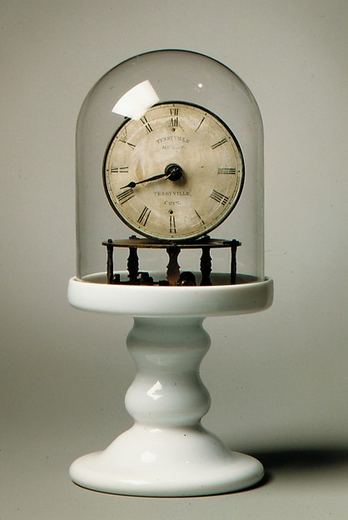
Clock, United States, ca. 1852
The Metropolitan Museum of Art, New York
Clocks · ca. 1882–85
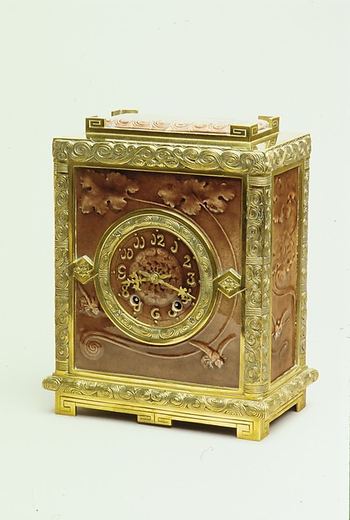
Clock by J. and J. G. Low Art Tile Works, United States, ca. 1882–85
The Metropolitan Museum of Art, New York
Clocks · ca. 1882–85
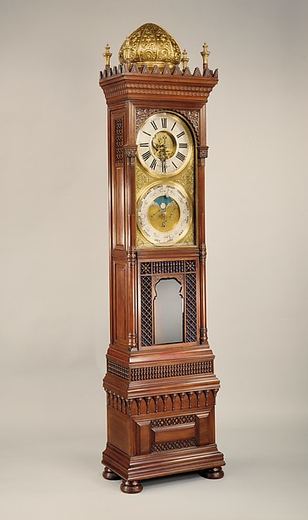
Tall clock by Tiffany & Co., United States, ca. 1882–85
The Metropolitan Museum of Art, New York
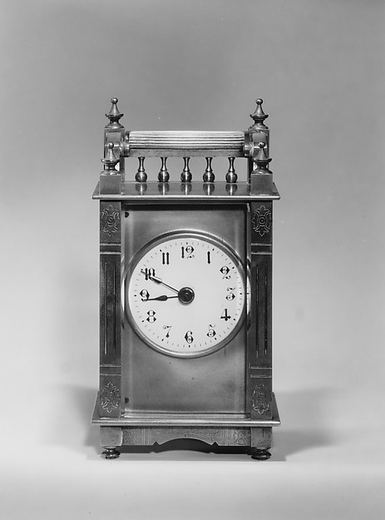
Clocks · ca. 1890
Carriage clock by Boston Clock Company, United States, ca. 1890
The Metropolitan Museum of Art, New York
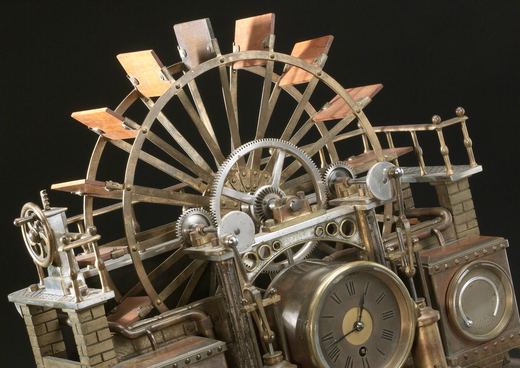
Clocks · 1801-1900
Clock (French) symbolising motive power, gilt bronze finish, with two keys, 1801-1900
Science Museum Group, London
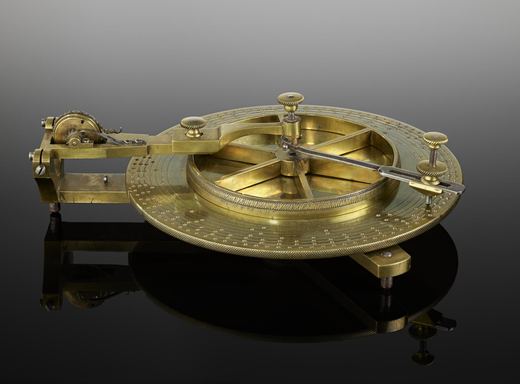
Clocks · 1801-1900
Instrument for ruling clock dials, 1800s.
Science Museum Group, London
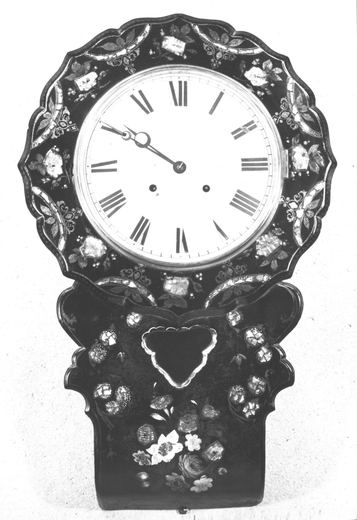
Clocks · 1830-1870
Wall clock in a papier mâché case with painted decoration. English, mid 19th century.
Victoria and Albert Museum, London
Clocks · 1832–1896
Clock by Emilian Wehrle, Germany, 1832–1896
Badisches Landesmuseum Karlsruhe