
Wristwatches · Wristwatch
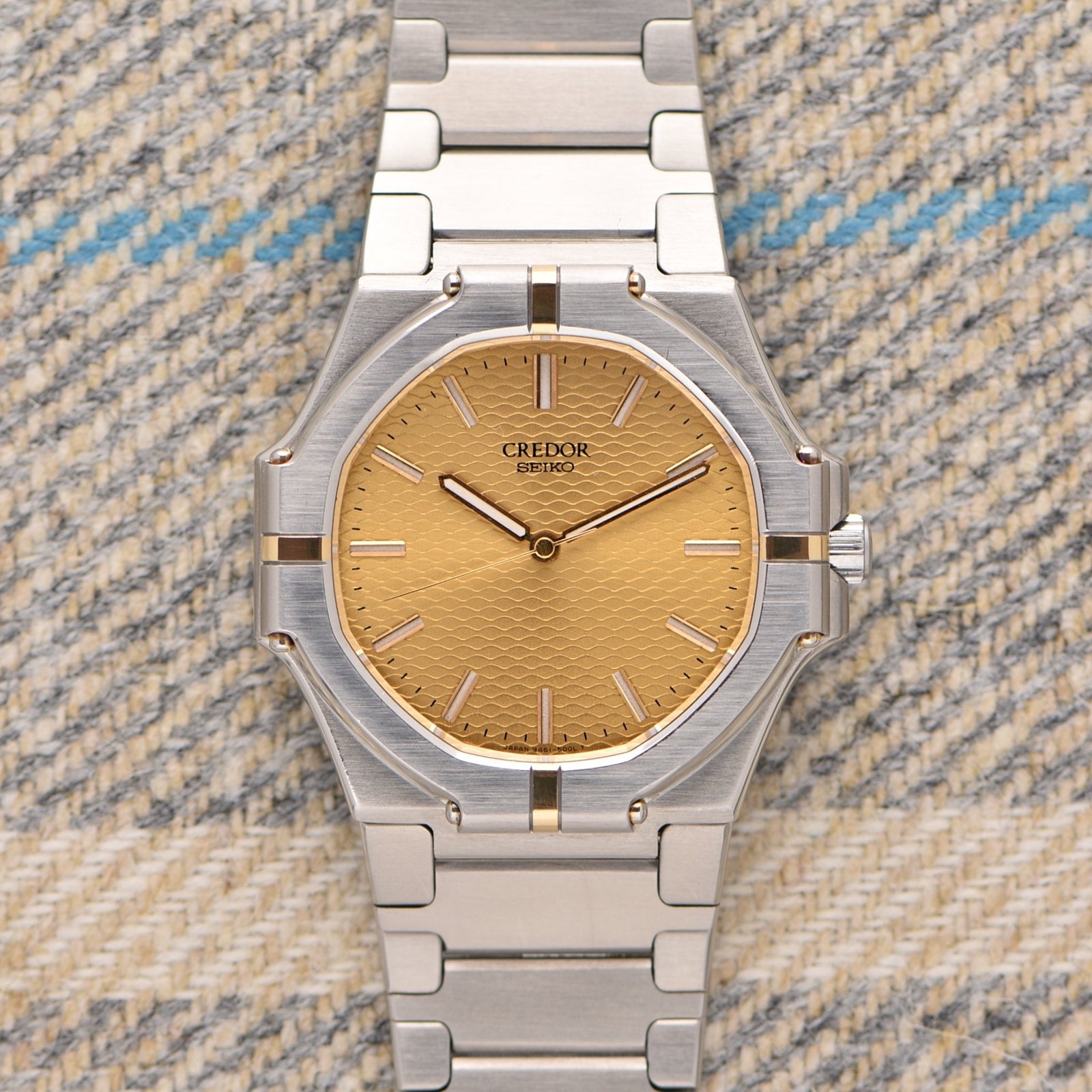
Seiko Credor Twin Quartz 'Nautilus' - Gerald Genta Era, 1981
- Maker / attribution
- Seiko Credor (maker)
- Date
- 1981
- Historical period
- Quartz Revolution (1969 – 1990)
- Country of origin
- Unrecorded in source
- Object type
- Wristwatch
- Dimensions
- Case 36 mm
- Stock no.
- Product 7389034184887
- Credit line
- Dealer listing, Huntington Company (product 7389034184887)
- Catalogue title (original)
- 1981 Seiko Credor Twin Quartz 'Nautilus' - Gerald Genta Era (English)
View the source record (dealer listing) ↗ (opens another website in a new tab)Suggest a correction
Record summary
Catalogued by Huntington Company (dealer) (stock number Product 7389034184887), this is a wristwatch by Seiko Credor, dated 1981. The Atlas places it in the Quartz Revolution period (1969 – 1990) of its Wristwatches collection. Recorded dimensions: Case 36 mm. The record is illustrated with 6 photographs.
Assembled from the source record's structured fields. Dates and attributions are given as the source states them; where a field is missing the Atlas leaves it blank rather than estimating.
Catalogue description
Dealer description — Huntington Company
Reference 9461-5010 Watch Only Specifications Year: 1981 Model: 9461-5010 Case Diameter: 36mm Lug to Lug: 39mm Case: Stainless steel Condition: No significant wear as seen Dial: Great condition Movement: Quartz Condition This Credor is in amazing condition. It comes on a large bracelet. The dial and hands are very clean. The case is sharp and clean. The watch is unpolished. The Story The Credor brand, created in 1974, was initially a collection of models rather than a standalone brand. It was a few years before the name Credor and the distinctive "mountain" logo were introduced. In the early 1970s, Seiko produced high-end models with precious metal cases and bracelets, some of which were solid gold versions of standard stainless steel models or uniquely designed. These models were available in the standard Seiko Japanese domestic market (JDM) catalogs, while many were only available in the Seiko Luxury catalogs. According to the Credor site, the brand was first created in 1974, likely towards the end of the year. No references to Credor can be found in the 1974 Seiko JDM catalogs Volume 1 and 2 or the Volume 2 supplement. The first catalog reference to Credor can be found in the 1975 Volume 1 JDM catalog, which included the Special watches section with precious metal cases. The majority of watches were not separated into their own grouping but were identified with the Katakana text "クレドール" (Credor) and mixed in with other watches in the Speciality Watch section. Each watch featured Seiko branding on the dials, and only their catalog descriptions had the Credor reference. In the 1970s, Seiko introduced Twin Quartz movement families, with Suwa Seikosha being the first to introduce their Cal. 99 family in 1978. This approach used a second quartz crystal to detect temperature changes and tune the primary crystal's timing, resulting in accuracy as good as 5 seconds per year in the Seiko Superior Cal. 9983. Daini Seikosha averaging the timing between two crystals with different temperature characteristics, delivering excellent accuracy, especially in later movements like their Cal. 9682. Not many people know this but Gerald Genta did work with Seiko Credor. The Locomotive was Gerlad's design with elements stemming from his other watches. This Credor twin Quartz is from the Credor Gerald Genta era and you can totally see it in the design. The wavy dial pattern, sporty case, and integrated bracelet are all known Gerlad Genta design elements. The Brand Seiko, a Japanese watch brand, began in 1881 when Kintaro Hattori opened a small shop in Tokyo. The company's early focus was on producing high-quality wall clocks and pocket watches. In 1913, Seiko introduced its first wristwatch, the Laurel, marking the beginning of its journey into wristwatches. In 1956, Seiko introduced the Marvel, Japan's first automatic wristwatch, showcasing their dedication to creating mechanical watches that were accurate and convenient for everyday wear. In the 1960s, Seiko introduced the Seiko Sportsmatic 5, the world's first automatic watch with a day-date function, in 1964, solidifying its reputation as a pioneer in the industry. In 1969, Seiko launched the Seiko Astron, the world's first quartz watch, which revolutionized the watchmaking industry by being more accurate and reliable than traditional mechanical watches. Seiko continued to push the boundaries of innovation, introducing the Kinetic in 1988, which combined the accuracy of quartz with the self-energizing properties of automatic watches. This hybrid technology was a testament to Seiko's commitment to creating timepieces that were not only precise but also environmentally friendly. In recent years, Seiko has expanded its horizons beyond wristwatches, introducing the Grand Seiko collection, embodying the pinnacle of Japanese craftsmanship. This journey is a testament to the brand's unwavering commitment to excellence and innovation, leaving an indelible mark on the world of horology.
Historical context
Quartz Revolution (1969 – 1990)
Seiko's Astron begins mass quartz timekeeping; traditional industries contract sharply.
Quartz and digital watches transformed the market after 1969. Swiss employment collapsed, Japanese and Hong Kong production soared, and the Swatch (1983) helped the Swiss industry recover; mechanical watches survived as luxury goods.
Read the period in the timelineMore wristwatches from this periodEarlier: Modern Mechanical Horology
Atlas type guide
Quartz, digital and electronic watches
Electronic watches arrived in three steps. The Hamilton Electric 500 (1957) was the first battery-powered wristwatch, still with a balance; Bulova's Accutron (1960) used a tuning fork. On 25 December 1969 Seiko released the Astron 35SQ, the first quartz wristwatch, closely followed by the Swiss Beta 21 group. In 1972 Hamilton's Pulsar introduced the LED digital watch, and LCD displays soon made digital watches cheap.
The 'Quartz Crisis' that followed devastated the Swiss mechanical industry, which lost two-thirds of its workforce between 1970 and 1984 before recovering with the Swatch (1983) and the luxury mechanical revival. Solar, radio-controlled, kinetic and connected smartwatches continue the electronic line.
What to look for
- Battery hatch in the case back and calibre markings with 'Quartz' or a crystal frequency.
- Display technology: LED (red, push-button) versus LCD (always-on).
- Tuning-fork hum and a smoothly sweeping seconds hand on Accutrons.
- Model and reference numbers, often printed on the back.
Dating clues
- Electric balance watches: from 1957.
- Tuning-fork watches: 1960–c. 1977.
- Quartz analogue: from December 1969; LED digital: 1972–c. 1978; LCD from 1973.
General guidance written by the Atlas editors about this kind of object. It is not a statement about this particular piece; for that, rely on the source record above and on physical examination.
Read next:Seiko calibre 35A (Astron)
Related records

Wristwatches · 1970
Wristwatch by Heno, Switzerland, 1970
Museum Rotterdam
Wristwatches · 1970s
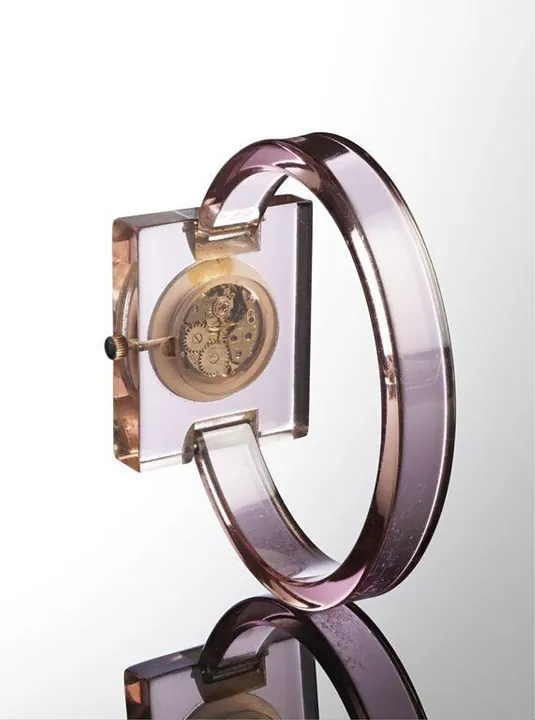
Wristwatch, plastic, by Gucci; Italy, 1970s.
Victoria and Albert Museum, London
Wristwatches · 1978
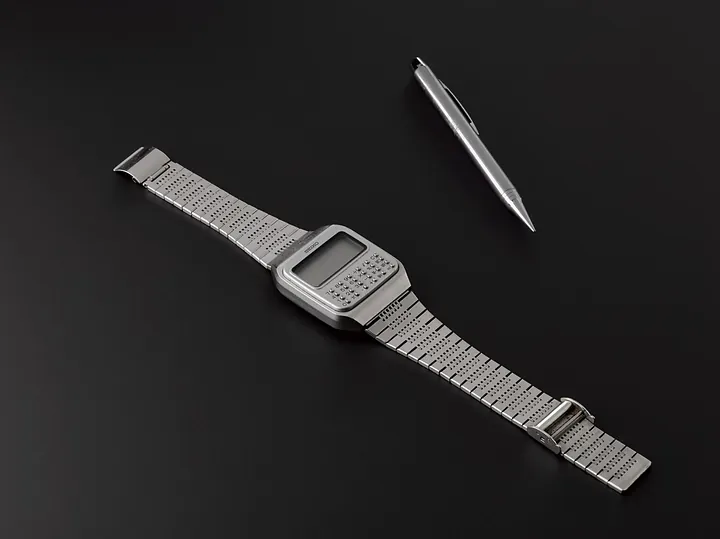
Calculator wristwatch by Suwa Seikosha Co. Limited, Japan, 1978
Science Museum Group, London
Wristwatches · 1980
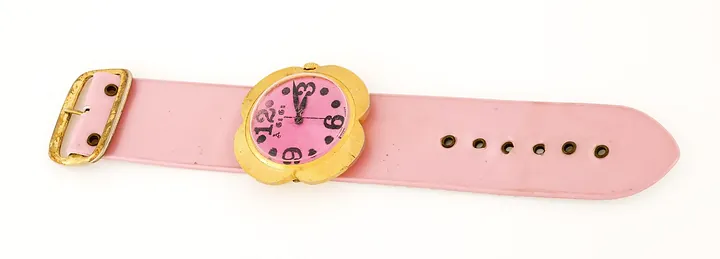
Wristwatch, 1980 (no. 71413)
Museum Rotterdam
Wristwatches · 1980
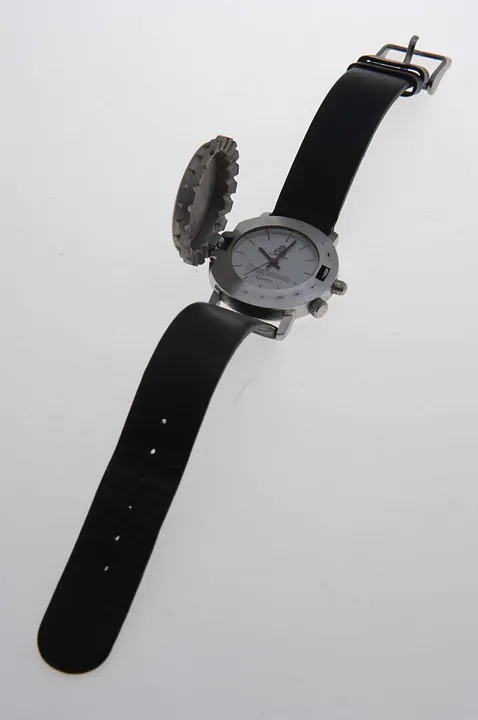
Wristwatch, 1980 (no. 91477)
Museum Rotterdam
Wristwatches · 1980–1982
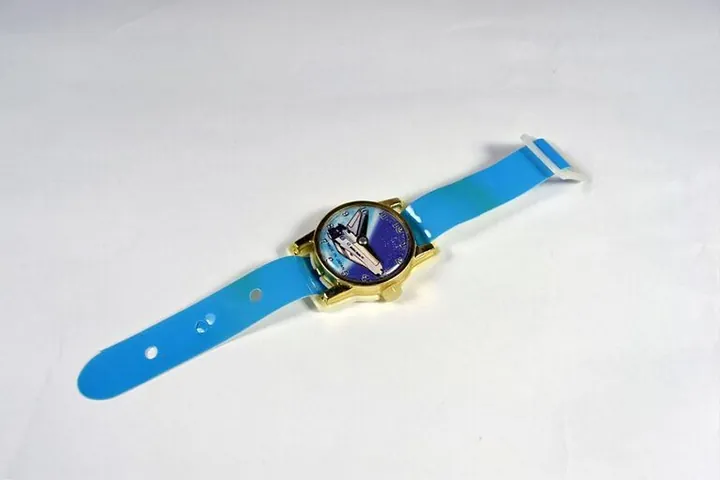
Wristwatch, Space Shuttle; plastic, Japan, 1970-1979?
Victoria and Albert Museum, London
Wristwatches · 1949–1992
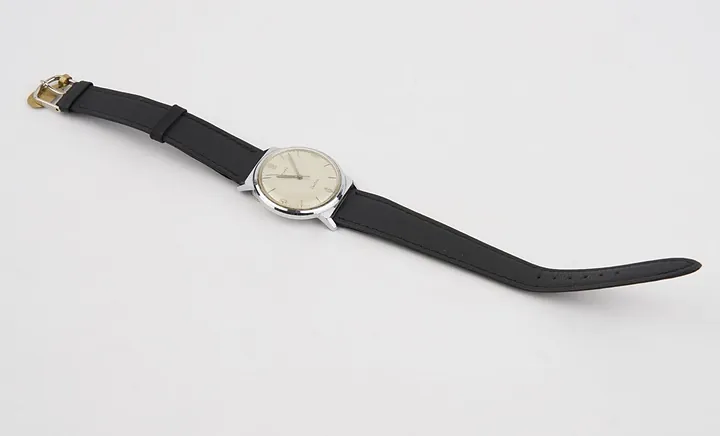
Timex `Electric' wristwatch, with electrically operated balance wheel mechanism, United States, 1949–1992
Science Museum Group, London

Wristwatches · 1960–1986
'Tri-Compax' calendar chronograph wristwatch in gold case, by Universal, Geneva, Switzerland, 1960–1986.
Science Museum Group, London