
Wristwatches · Wristwatch
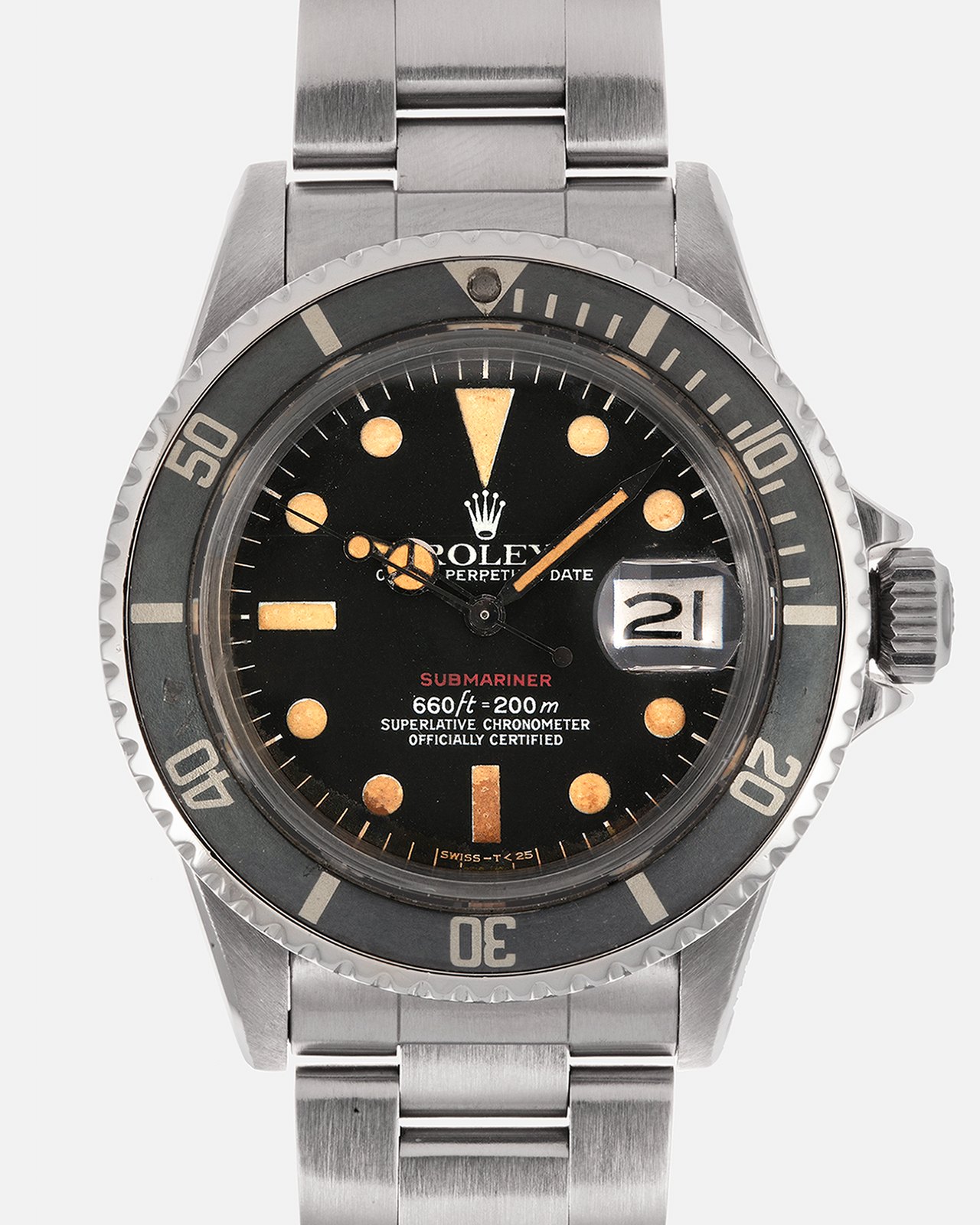
Rolex Red Submariner Ref. 1680 Mk 6 ‘Fuerza Aérea del Perú’, 1974
- Maker / attribution
- Rolex (maker)
- Date
- 1974
- Historical period
- Quartz Revolution (1969 – 1990)
- Country of origin
- Switzerland
- Object type
- Wristwatch
- Stock no.
- Product 7346510692439
- Credit line
- Dealer listing, S.Song Watches (product 7346510692439)
- Catalogue title (original)
- Rolex Red Submariner Ref. 1680 Mk 6 ‘Fuerza Aérea del Perú’ (English)
View the source record (dealer listing) ↗ (opens another website in a new tab)Suggest a correction
Record summary
Catalogued by S.Song Watches (dealer), Seattle (stock number Product 7346510692439), this is a wristwatch by Rolex, made in Switzerland, dated 1974. The Atlas places it in the Quartz Revolution period (1969 – 1990) of its Wristwatches collection. The record is illustrated with 6 photographs.
Assembled from the source record's structured fields. Dates and attributions are given as the source states them; where a field is missing the Atlas leaves it blank rather than estimating.
Catalogue description
Dealer description — S.Song Watches
The Rolex Submariner is one of the most recognisable and popular watches in the world, period. Like most Rolexes, it requires no introduction. While there are certainly more expensive and sought-after references out there, one of the most enduring and popular vintage variants of the Submariner would have to be the Ref. 1680 ‘Red’ Submariner. Named as such because this transitional reference had the ‘Submariner’ text in vibrant red rather than the conventional white, collectors have placed a premium on this as they were produced for a short time only, from 1967 up until 1975. Heck, these days, even non-vintage guys know what a ‘Red Sub’ is! What can I say? This particular Red Submariner is far from ordinary—though, to be fair, no Red Submariner could really ever be called ordinary. This specific example features a Mk 6 dial and bears a unique engraving on the caseback indicating it was issued to the Peruvian Air Force (Fuerza Aérea del Perú). You see, back in the 1960s, Rolex had a longstanding relationship with the Peruvian Air Force, and during this period, the Peruvian Air Force took delivery of an estimated 700-800 Rolex models. It is quite rare to find Red Subs issued to the Peruvian Air Force. These watches were fitted with standard dials but were uniquely marked with engravings on the casebacks. Needless to say, such variants are extremely rare and highly coveted by vintage Rolex enthusiasts and collectors, making pieces like this one truly exceptional. As mentioned earlier, the dial on this example features a stunning Mk 6 dial, with a rich, evenly aged, pumpkin-colored patina on the lume markers. For those unfamiliar, Mk 6 dials are easy to identify, as they are the only Red Submariner dials across the entire production run that has a closed ‘6’ in the text inscription at 6:00. Additionally, this piece is fitted with a ‘fat font’ Mk 3 aluminum bezel insert that shows some signs of ghosting—an appealing characteristic often seen on vintage Rolex models with pre-Cerachrom bezel inserts, particularly when the effect is as evenly distributed as it is here. Another noteworthy trait of Peruvian Air Force Rolex references is that the full serial number of the watch is engraved on the underside of the caseback, alongside its corresponding reference number—unlike standard Submariners, which usually only feature the reference number in that location. Powering the Ref. 1680 from within is Rolex’s Cal. 1575, a robust self-winding movement that beats at a rate of 19,800 vph and carries a power reserve of 42 hours on a full wind. It is also worth noting that, while the movement's rotor bridge is stamped '1570', which denotes the calibre number, this is actually a legitimate discrepancy. The Cal. 1575 is essentially identical to the Cal. 1570, differing only by the addition of a calendar module. The internal components of both movements are fundamentally the same, and Rolex employed a single part labelled with the base calibre number, a practice that greatly contrasts with today's highly standardized Rolex production process. I believe there’s a compelling reason why vintage Rolex Submariners have always been so popular—just take a look at this one. It’s an exceptional tool watch, offering a perfect balance of design, functionality, and character, even for those who aren’t hardcore watch enthusiasts like us. With its beautifully aged ‘ghosted’ bezel, bold, bevelled Oyster case, Red Submariner text, and matte black dial with evenly patinated luminous markers, it’s simply an undeniably handsome watch to wear and own. Again, what makes this particular example even more special is its connection to the Peruvian Air Force—it's not every day you come across a military Red Submariner like this.
Historical context
Quartz Revolution (1969 – 1990)
Seiko's Astron begins mass quartz timekeeping; traditional industries contract sharply.
Quartz and digital watches transformed the market after 1969. Swiss employment collapsed, Japanese and Hong Kong production soared, and the Swatch (1983) helped the Swiss industry recover; mechanical watches survived as luxury goods.
Read the period in the timelineMore wristwatches from this periodEarlier: Modern Mechanical Horology
Atlas type guide
Dive and water-resistant watches
Keeping water and dust out of a wristwatch was a long-standing challenge. Rolex's screw-down Oyster case (1926) and Omega's Marine (1932) were landmarks; in the early 1950s Blancpain's Fifty Fathoms and Rolex's Submariner defined the professional dive watch with rotating bezels for timing dives, luminous dials and high water resistance. The ISO 6425 standard (1982) later codified what a 'diver's watch' must do.
Dive watches became icons of post-war design and exploration, and their evolution — helium escape valves, ceramic bezels, saturation-diving depth ratings — records the history of underwater work.
What to look for
- Unidirectional or bidirectional rotating bezel with minute markings.
- Screw-down crown and case back; depth rating printed on the dial.
- Luminous hands and markers (radium before c. 1960, tritium c. 1960–1998, then Super-LumiNova).
- Reference numbers on the case between the lugs or inside the back.
Dating clues
- Screw-down Oyster cases: from 1926.
- Professional dive watches: from 1953.
- Tritium 'T' marks on dials: c. 1960–1998.
General guidance written by the Atlas editors about this kind of object. It is not a statement about this particular piece; for that, rely on the source record above and on physical examination.
Related records

Movements & Components · c. 1970s
Rolex watch movement, c. 1970s
Antiquorum auction archive, Geneva

Pocket Watches · 1982
Fake Rolex watch, gold coloured metal, possibly made in Taiwan, 1982; part of a casual outfit, UK, 1982-84.
Victoria and Albert Museum, London

Wristwatches · c. 1920s
Rolex wristwatch, c. 1920s
Antiquorum auction archive, Geneva

Wristwatches · c. 1920s
Rolex wristwatch, ref. 6194, c. 1920s
Antiquorum auction archive, Geneva

Wristwatches · 1970
Wristwatch by Heno, Switzerland, 1970
Museum Rotterdam

Wristwatches · 1960–1986
'Tri-Compax' calendar chronograph wristwatch in gold case, by Universal, Geneva, Switzerland, 1960–1986.
Science Museum Group, London

Wristwatches · 1969–1970
Beta 21 Quartz wristwatch movement, made in Switzerland, 1970.
Science Museum Group, London

Wristwatches · c. 1969
Omega Speedmaster Moonwatch, ref. 145022-69st, c. 1969
Antiquorum auction archive, Geneva