
Wristwatches · Wristwatch
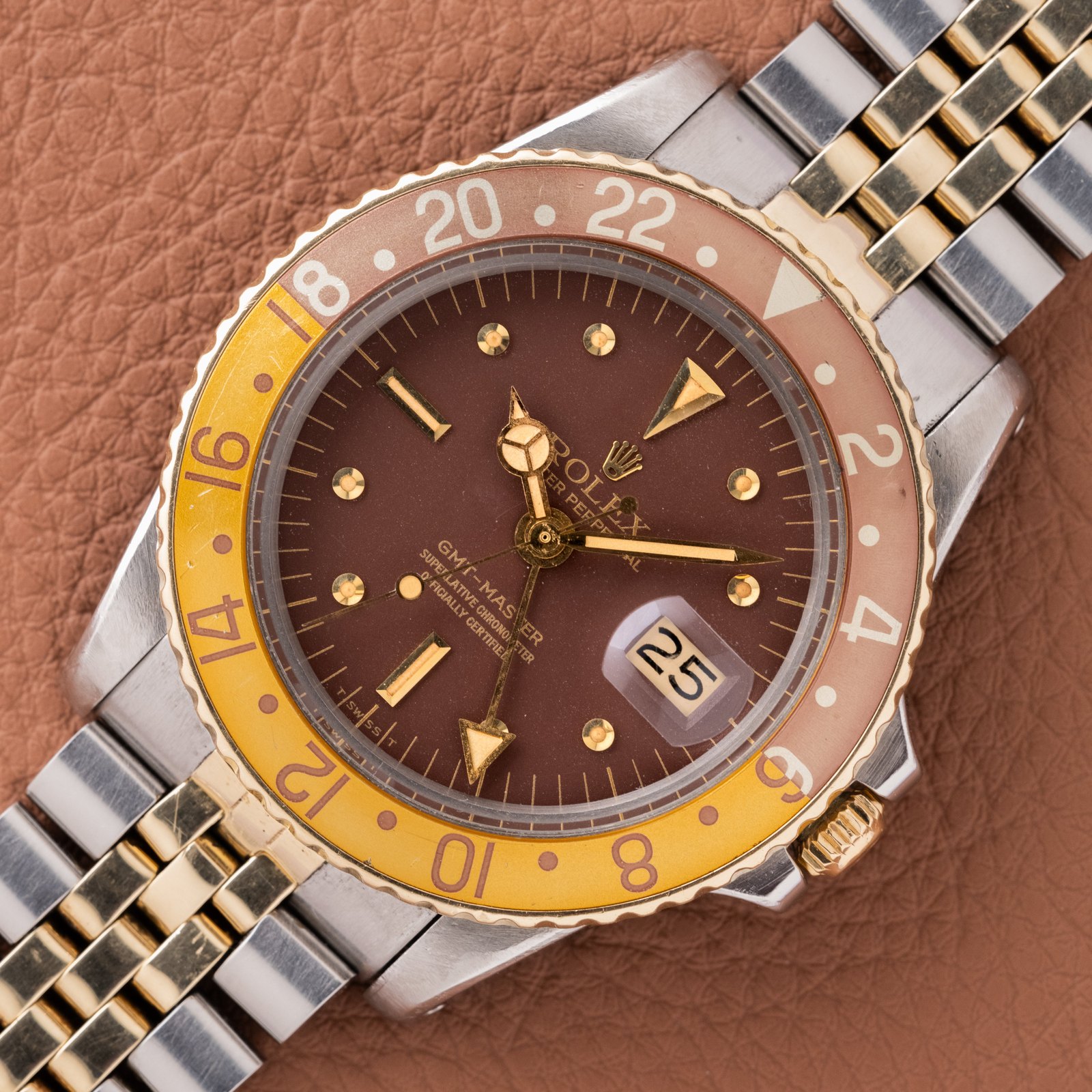
Rolex GMT-Master Root Beer (Ref. 1675), 1972
- Maker / attribution
- Rolex (maker)
- Date
- 1972
- Historical period
- Quartz Revolution (1969 – 1990)
- Country of origin
- Switzerland
- Object type
- Wristwatch
- Dimensions
- Case 40 mm
- Stock no.
- Product 15932520988855
- Credit line
- Dealer listing, Huntington Company (product 15932520988855)
- Catalogue title (original)
- 1972 Rolex GMT-Master Root Beer (Ref. 1675) (English)
View the source record (dealer listing) ↗ (opens another website in a new tab)Suggest a correction
Record summary
Catalogued by Huntington Company (dealer) (stock number Product 15932520988855), this is a wristwatch by Rolex, made in Switzerland, dated 1972. The Atlas places it in the Quartz Revolution period (1969 – 1990) of its Wristwatches collection. Recorded dimensions: Case 40 mm. The record is illustrated with 6 photographs.
Assembled from the source record's structured fields. Dates and attributions are given as the source states them; where a field is missing the Atlas leaves it blank rather than estimating.
Catalogue description
Dealer description — Huntington Company
History and Significance The Rolex GMT-Master has one of the most recognizable histories in watchmaking, born from an era when international air travel was transforming the world. Developed in collaboration with Pan American World Airways and introduced in 1954, the GMT-Master was designed to help pilots keep track of two time zones simultaneously. The addition of a fourth hand and a rotating 24-hour bezel provided a practical solution to a problem that had become increasingly common with the expansion of commercial aviation. What began as a professional instrument would eventually become one of Rolex's most celebrated collections, with numerous variations that have developed their own identities among collectors. The reference 1675 was introduced in 1959 and remained in production until approximately 1980, making it one of the longest-running references in the GMT-Master family. Over those two decades, Rolex introduced numerous changes to the dial, bezel, bracelet, and case construction, creating an exceptionally interesting field for vintage collectors. While the stainless steel examples with red and blue bezels became closely associated with the model's aviation heritage, the two-tone versions offered a distinctly different personality. Combining stainless steel with yellow gold, these watches introduced a more luxurious interpretation of the GMT-Master without abandoning its original functionality. The brown and gold color combination would eventually earn the affectionate nickname "Root Beer," becoming one of the most recognizable variations of the vintage GMT-Master. One of the most fascinating aspects of early Root Beer GMT-Masters is the remarkable variety of dial configurations produced throughout the reference's history. Brown dials with applied gold markers, often referred to as nipple dials because of their distinctive raised circular hour markers, became particularly associated with these early examples. The combination of the rich brown dial, yellow gold hands, and unusual hour markers creates an appearance unlike that of any other vintage Rolex sports watch. Rather than emphasizing the utilitarian character of the GMT-Master, these details give the watch a warmth and decorative quality that feels closely connected to the design language of the 1970s. The bezel is another important part of the Root Beer's identity, and one of the areas where vintage examples can develop particularly attractive character. Originally produced in brown and gold tones, these aluminum inserts can change color over decades of exposure and use. Some retain their original contrast, while others develop softer shades of copper, bronze, champagne, or amber. The resulting variations make individual watches remarkably distinctive, with the condition and coloration of the bezel becoming an important part of their appeal. On this 1972 example, the bezel has developed a particularly attractive fade, with warm copper-brown tones transitioning into a vibrant golden lower half. The period-correct oval-link Jubilee bracelet completes the watch's unmistakably vintage appearance. Earlier Jubilee bracelets have a different construction and visual character from their modern counterparts, with smaller, more delicate links that give the watch a particularly comfortable and fluid appearance. Paired with the two-tone case, the bracelet reinforces the Root Beer's unusual position between a professional travel watch and a more luxurious everyday Rolex. It is precisely this combination of practicality, distinctive materials, and unmistakable period styling that has made early two-tone GMT-Masters increasingly appreciated among vintage collectors. Writer’s Thoughts The reference 1675 already has an abundance of character, but the combination of a beautifully preserved brown nipple dial, creamy luminous plots, and a naturally faded bezel takes the watch into an entirely different category. Although the case may have received a polish in the past, the chamfers remain substantial and well defined, preserving much of the original case character. The period-correct oval-link Jubilee bracelet is another significant advantage, particularly in such attractive condition. Altogether, this is the sort of vintage Rolex where the individual components have aged into a combination that would be difficult to replicate. Our Promise Every watch is thoroughly vetted, carefully described with complete transparency, and guaranteed authentic. Each piece is offered in honest condition, ensuring collectors receive a timepiece that reflects both originality and integrity. Specifications Brand: Rolex Model: GMT-Master Root Beer Reference: 1675 Year: 1972 Case Material: Stainless Steel and 18k Yellow Gold Case Size: 40mm Dial: Brown Nipple Dial with Applied Gold Hour Markers and Aged Luminous Plots Movement: Automatic Mechanical GMT Movement Strap/Buckle: Period-Correct Two-Tone Oval-Link Jubilee Bracelet Buckle/Clasp: Rolex Folding Clasp Contents: Watch only Condition Case: Stainless steel and yellow gold case remains in excellent vintage condition with light surface wear consistent with age. The case may have been polished in the past, but retains thick, well-defined chamfers and attractive proportions. Dial: Brown nipple dial remains in excellent condition with beautifully preserved printing and applied gold markers. The luminous plots have developed an attractive, even creamy patina. Hands: Gold-tone hands remain in excellent vintage condition with luminous material that was professionally color-matched. Crystal: Crystal remains in good condition with light surface wear consistent with normal use. Strap/Buckle: Period-correct two-tone oval-link Jubilee bracelet remains in great condition with attractive overall preservation and light wear consistent with age. Buckle/Clasp: Rolex folding clasp remains in good condition with normal surface wear consistent with age and use.
Historical context
Quartz Revolution (1969 – 1990)
Seiko's Astron begins mass quartz timekeeping; traditional industries contract sharply.
Quartz and digital watches transformed the market after 1969. Swiss employment collapsed, Japanese and Hong Kong production soared, and the Swatch (1983) helped the Swiss industry recover; mechanical watches survived as luxury goods.
Read the period in the timelineMore wristwatches from this periodEarlier: Modern Mechanical Horology
Atlas type guide
Military, pilot and travel watches
The wristwatch owes much of its adoption by men to warfare and aviation. Wristlets — small pocket watches soldered with lugs and worn on a strap — were used in colonial campaigns and became standard equipment in the First World War, with protective grilles over the crystal ('shrapnel guards'). Louis Cartier's Santos (1904), designed for the aviator Alberto Santos-Dumont, is often cited as an early purpose-made pilot's watch.
In the Second World War governments specified watches in detail: the German B-Uhr observation watches, the American A-11, and the British 'W.W.W.' (the 'Dirty Dozen' set of 1945). After the war, jet travel brought GMT and world-time watches, which show two or more time zones at once — Louis Cottier's world-time mechanism and the Rolex GMT-Master (1955) are examples.
What to look for
- Military markings on the case back: broad arrow, issue numbers, 'W.W.W.', 'A.T.P.'
- High-legibility black dials with luminous Arabic numerals; oversized crowns for gloved hands.
- 24-hour hands and rotating 24-hour bezels or city rings on GMT/world-time watches.
- Wire lugs on early wristlets converted from pocket watches.
Dating clues
- Wire-lug wristlets: c. 1900–1925.
- Military specifications of the Second World War: 1939–1945.
- GMT and world-time wristwatches: mainly after 1950.
General guidance written by the Atlas editors about this kind of object. It is not a statement about this particular piece; for that, rely on the source record above and on physical examination.
Related records

Movements & Components · c. 1970s
Rolex watch movement, c. 1970s
Antiquorum auction archive, Geneva

Pocket Watches · 1982
Fake Rolex watch, gold coloured metal, possibly made in Taiwan, 1982; part of a casual outfit, UK, 1982-84.
Victoria and Albert Museum, London

Wristwatches · c. 1920s
Rolex wristwatch, c. 1920s
Antiquorum auction archive, Geneva

Wristwatches · c. 1920s
Rolex wristwatch, ref. 6194, c. 1920s
Antiquorum auction archive, Geneva

Wristwatches · 1970
Wristwatch by Heno, Switzerland, 1970
Museum Rotterdam

Wristwatches · 1960–1986
'Tri-Compax' calendar chronograph wristwatch in gold case, by Universal, Geneva, Switzerland, 1960–1986.
Science Museum Group, London

Wristwatches · 1969–1970
Beta 21 Quartz wristwatch movement, made in Switzerland, 1970.
Science Museum Group, London

Wristwatches · c. 1969
Omega Speedmaster Moonwatch, ref. 145022-69st, c. 1969
Antiquorum auction archive, Geneva