
Wristwatches · Wristwatch
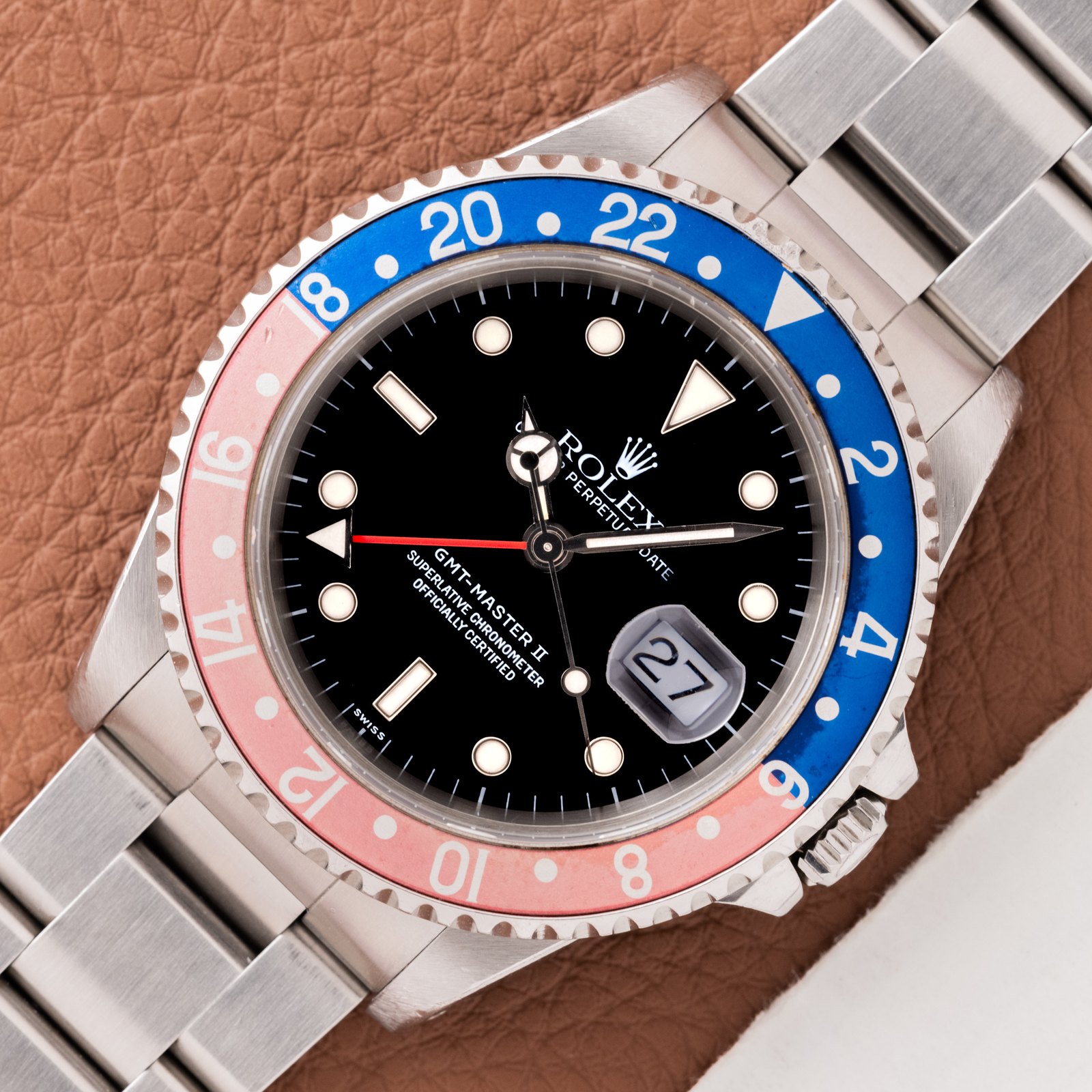
Rolex GMT-Master II Swiss Only Faded Pepsi (Ref. 16710), 1998
- Maker / attribution
- Rolex (maker)
- Date
- 1998
- Historical period
- Mechanical Renaissance (1990 – 2010)
- Country of origin
- Switzerland
- Object type
- Wristwatch
- Dimensions
- Case 40 mm
- Stock no.
- Product 8737819885751
- Credit line
- Dealer listing, Huntington Company (product 8737819885751)
- Catalogue title (original)
- 1998 Rolex GMT-Master II Swiss Only Faded Pepsi - Papers (Ref. 16710) (English)
View the source record (dealer listing) ↗ (opens another website in a new tab)Suggest a correction
Record summary
Catalogued by Huntington Company (dealer) (stock number Product 8737819885751), this is a wristwatch by Rolex, made in Switzerland, dated 1998. The Atlas places it in the Mechanical Renaissance period (1990 – 2010) of its Wristwatches collection. Recorded dimensions: Case 40 mm. The record is illustrated with 6 photographs.
Assembled from the source record's structured fields. Dates and attributions are given as the source states them; where a field is missing the Atlas leaves it blank rather than estimating.
Catalogue description
Dealer description — Huntington Company
History and Significance The reference 16710 had a remarkably long production run, but small changes made throughout those years created configurations that can feel substantially different from one another today. This 1998 example comes from one of the most interesting transitional periods, when Rolex was moving away from tritium luminous material and toward LumiNova. Watches produced during this brief period can be found with the distinctive “SWISS” signature positioned alone beneath the six o’clock marker. That seemingly minor line of text has become one of the easiest ways to recognize the transitional “Swiss Only” dial. The dial gives this GMT-Master II an identity that goes well beyond its production year. Rather than the longer signatures seen before and after it, the single “SWISS” marking places the watch within a relatively narrow moment in the evolution of the reference 16710. The rest of the dial remains wonderfully familiar, with the black surface, luminous hour plots, Mercedes hour hand, and red GMT hand forming the classic Rolex sports-watch layout. It is the kind of variation that remains subtle from across the room but becomes considerably more meaningful once the details are understood. Then there is the bezel. The original red and blue color combination has faded dramatically, leaving a blue section that resembles washed denim and a red section that has softened into an almost salmon tone. The transition between the two colors gives the watch an appearance that would be nearly impossible to duplicate exactly on another example. Aluminum GMT inserts are particularly compelling for this reason, as years of exposure can turn what began as an identical factory component into something completely individual. The 40mm stainless steel case appears unpolished and retains the strong geometry expected from a well-preserved Rolex sports watch. That matters especially on the reference 16710, where the slimmer case architecture and aluminum bezel create a noticeably different profile from later ceramic GMT-Master II models. The Oyster bracelet completes the familiar tool-watch construction and gives the watch the durability expected from a GMT. Despite being nearly three decades old, the proportions remain exceptionally easy to wear. Original papers accompany this example and provide an important additional element of completeness. Between the documented 1998 production period, transitional Swiss Only dial, apparently unpolished case, and extraordinarily attractive faded bezel, several desirable characteristics come together in a single watch. None of those details overwhelm the fundamental simplicity of the GMT-Master II, but each adds another reason to examine the watch more closely. The reference 16710 is often discussed as a single model, yet examples like this demonstrate how much variation can exist within that one reference. Writer's Thoughts A faded bezel can completely change the personality of a Rolex GMT-Master II, and this example demonstrates that better than most. The denim-like blue and salmon-toned red have moved far beyond the colors normally associated with a Pepsi insert, giving the watch an appearance that feels distinctly individual. The Swiss Only dial adds another layer of interest because the detail is subtle enough to be missed unless the production period of the reference 16710 is already familiar. Combined with the apparently unpolished case, the watch has the kind of honest character that makes neo-vintage Rolex particularly appealing. Our Promise Every watch is thoroughly vetted, carefully described with complete transparency, and guaranteed authentic. Each piece is offered in honest condition, ensuring collectors receive a timepiece that reflects both originality and integrity. Specifications Brand: Rolex Model: GMT-Master II Swiss Only Reference: 16710 Year: 1998 Case Material: Stainless steel Case Size: 40mm Dial: Black “Swiss Only” dial with luminous hour markers Movement: Automatic Strap/Bracelet: Rolex Oyster stainless steel bracelet Buckle/Clasp: Rolex Oyster folding clasp Contents: Original Rolex papers Condition Case: The stainless steel case appears unpolished and retains strong original proportions and attractive geometry. Surface wear is present throughout, consistent with age and normal use. Dial: The black Swiss Only dial presents very well, with clean printing and a strong overall appearance. The single "SWISS” signature remains clearly visible beneath the six o’clock marker. Hands: The hands present well overall and remain highly legible against the black dial. Crystal: The sapphire crystal presents well with light signs of wear consistent with age and use. Bezel: The aluminum Pepsi insert has developed substantial and particularly attractive fading. The blue has faded toward a denim-like tone, while the red has softened into a distinctive salmon color. Strap/Bracelet: The Rolex Oyster bracelet presents well overall with surface wear consistent with regular use. Buckle/Clasp: The Rolex folding clasp remains in good condition with age-appropriate surface wear.
Historical context
Mechanical Renaissance (1990 – 2010)
Mechanical watches return as cultural objects; independent watchmaking flourishes.
Mechanical watches returned as cultural and luxury objects. Complications, tourbillons and new materials proliferated; independent watchmakers such as George Daniels, F.P. Journe and Philippe Dufour revived artisanal watchmaking; collecting vintage watches became a major field.
Read the period in the timelineMore wristwatches from this periodEarlier: Quartz Revolution
Atlas type guide
Military, pilot and travel watches
The wristwatch owes much of its adoption by men to warfare and aviation. Wristlets — small pocket watches soldered with lugs and worn on a strap — were used in colonial campaigns and became standard equipment in the First World War, with protective grilles over the crystal ('shrapnel guards'). Louis Cartier's Santos (1904), designed for the aviator Alberto Santos-Dumont, is often cited as an early purpose-made pilot's watch.
In the Second World War governments specified watches in detail: the German B-Uhr observation watches, the American A-11, and the British 'W.W.W.' (the 'Dirty Dozen' set of 1945). After the war, jet travel brought GMT and world-time watches, which show two or more time zones at once — Louis Cottier's world-time mechanism and the Rolex GMT-Master (1955) are examples.
What to look for
- Military markings on the case back: broad arrow, issue numbers, 'W.W.W.', 'A.T.P.'
- High-legibility black dials with luminous Arabic numerals; oversized crowns for gloved hands.
- 24-hour hands and rotating 24-hour bezels or city rings on GMT/world-time watches.
- Wire lugs on early wristlets converted from pocket watches.
Dating clues
- Wire-lug wristlets: c. 1900–1925.
- Military specifications of the Second World War: 1939–1945.
- GMT and world-time wristwatches: mainly after 1950.
General guidance written by the Atlas editors about this kind of object. It is not a statement about this particular piece; for that, rely on the source record above and on physical examination.
Related records

Movements & Components · c. 1970s
Rolex watch movement, c. 1970s
Antiquorum auction archive, Geneva

Pocket Watches · 1982
Fake Rolex watch, gold coloured metal, possibly made in Taiwan, 1982; part of a casual outfit, UK, 1982-84.
Victoria and Albert Museum, London

Wristwatches · c. 1920s
Rolex wristwatch, c. 1920s
Antiquorum auction archive, Geneva

Wristwatches · c. 1920s
Rolex wristwatch, ref. 6194, c. 1920s
Antiquorum auction archive, Geneva

Wristwatches · 2008
Wristwatch by Breitling?, 2008
Museum Rotterdam

Wristwatches · c. 1990s
Audemars Piguet Bamboo, c. 1990s
Antiquorum auction archive, Geneva

Wristwatches · c. 1990
Audemars Piguet Huitieme Perpetual Calendar, ref. 25696PT, c. 1990
Antiquorum auction archive, Geneva

Wristwatches · c. 1990
Breitling Chronomat, ref. b13050.1, c. 1990
Antiquorum auction archive, Geneva