
Wristwatches · Wristwatch
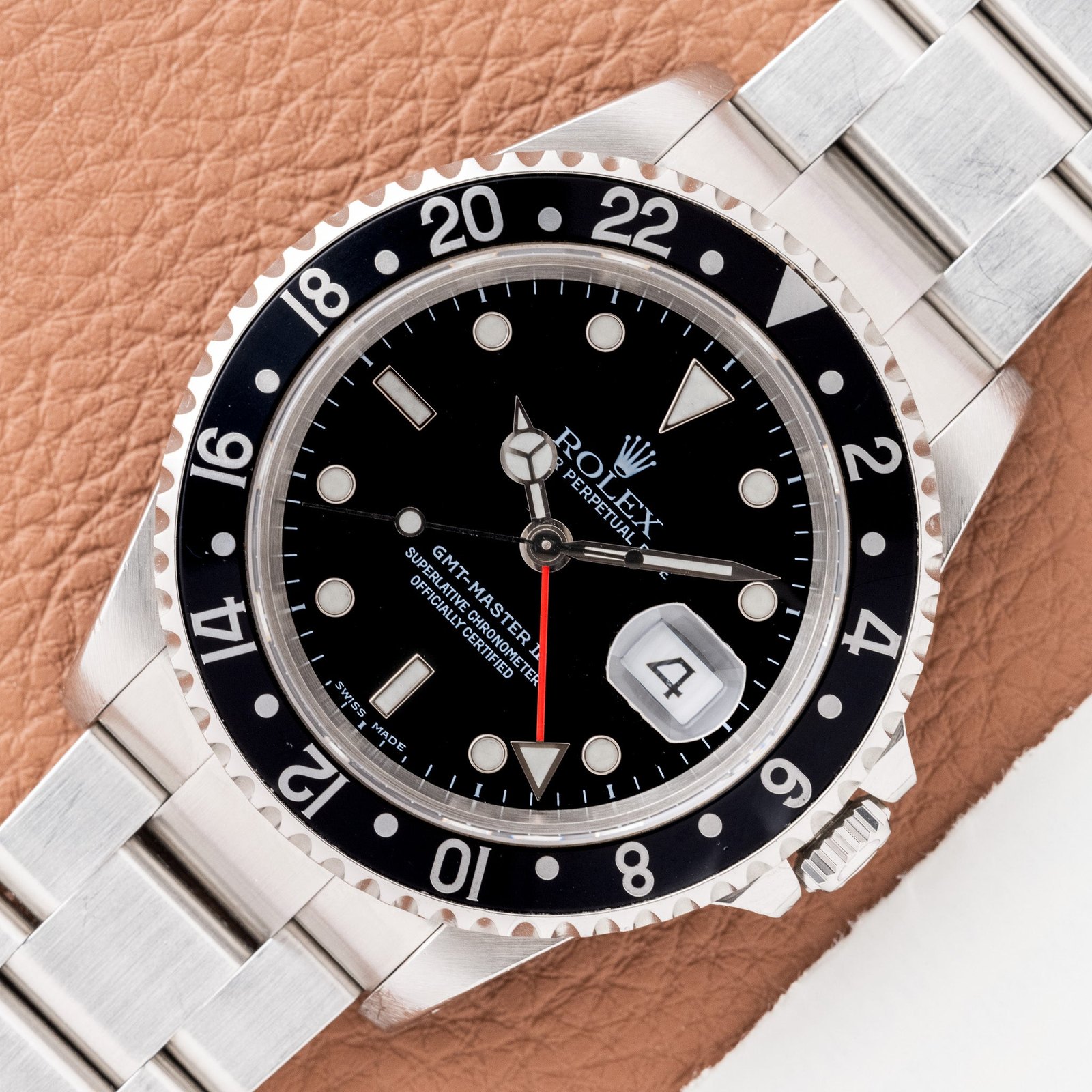
Rolex GMT Master II Black Bezel (Ref. 16710), 1999
- Maker / attribution
- Rolex (maker)
- Date
- 1999
- Historical period
- Mechanical Renaissance (1990 – 2010)
- Country of origin
- Switzerland
- Object type
- Wristwatch
- Dimensions
- Case 40 mm
- Stock no.
- Product 8364449398967
- Credit line
- Dealer listing, Huntington Company (product 8364449398967)
- Catalogue title (original)
- 1999 Rolex GMT Master II Black Bezel - Papers (Ref. 16710) (English)
View the source record (dealer listing) ↗ (opens another website in a new tab)Suggest a correction
Record summary
Catalogued by Huntington Company (dealer) (stock number Product 8364449398967), this is a wristwatch by Rolex, made in Switzerland, dated 1999. The Atlas places it in the Mechanical Renaissance period (1990 – 2010) of its Wristwatches collection. Recorded dimensions: Case 40 mm. The record is illustrated with 6 photographs.
Assembled from the source record's structured fields. Dates and attributions are given as the source states them; where a field is missing the Atlas leaves it blank rather than estimating.
Catalogue description
Dealer description — Huntington Company
History and Significance The Rolex GMT Master II ref. 16710 sits at an important crossroads in Rolex’s professional lineup. Produced from the late 1980s through the mid 2000s, it represents the final era of the classic aluminum-bezel GMT before Rolex transitioned the model into the modern ceramic format. As a result, the 16710 has become one of the most studied and collected modern-vintage Rolex references. Originally developed for Pan Am pilots in the 1950s, the GMT Master was designed to track multiple time zones simultaneously, a practical tool for long-haul travel in the jet age. By the time the GMT Master II was introduced, Rolex refined the concept further by allowing the local hour hand to be adjusted independently, making travel functionality significantly more user-friendly. The ref. 16710 embodies this evolution while retaining traditional proportions and design language. What makes the 16710 especially compelling is its versatility. The watch was delivered with different bezel insert configurations over its production run, including black, red and blue, and black and red combinations, all of which could be easily swapped. Combined with drilled lugs, a slimmer case profile, and the pre-ceramic aesthetic, this reference bridges the gap between vintage and modern. Today, the ref. 16710 is widely regarded as one of the last true tool GMTs from Rolex. It offers the usability expected of a contemporary sports watch while preserving the details and feel that collectors associate with Rolex’s earlier professional models. Its enduring appeal lies not in novelty, but in balance, practicality, and continuity within the GMT lineage. Writer’s Thoughts The 16710 is one of the most wearable sports Rolex references ever produced. Its balanced case, classic black dial, and red GMT hand give it timeless appeal while remaining practical for everyday wear. This example presents honestly with visible wear, reinforcing its tool-watch character without compromising structure or originality. Our Promise Every watch we offer is carefully inspected and verified for authenticity. We stand behind the integrity of each piece and represent it accurately and transparently. Our goal is to ensure complete confidence when purchasing from Huntington Company. Specifications Brand: Rolex Model: GMT Master II (Ref. 16710) Year: 1999 Case Material: Stainless steel Case Size: 40mm Bezel: Black aluminum GMT bezel insert Dial: Black dial with luminous hour markers Crystal: Sapphire crystal with cyclops magnifier Movement: Automatic Rolex GMT movement Strap/Bracelet: Stainless steel Oyster bracelet Buckle/Clasp: Rolex folding Oyster clasp Condition Case: Stainless steel case shows light surface wear consistent with age and careful use. Bezel: Black aluminum bezel insert shows light wear with clean numerals and even color. Crystal: Sapphire crystal is clean with no visible chips or cracks. Dial: Black dial is clean with well-preserved printing and even markers. Hands: Original hands are in excellent condition with matching lume and no corrosion. Strap/Bracelet: Original Oyster bracelet shows almost no stretch and surface wear consistent with use. Buckle/Clasp: Original Rolex clasp shows light handling marks and functions properly.
Historical context
Mechanical Renaissance (1990 – 2010)
Mechanical watches return as cultural objects; independent watchmaking flourishes.
Mechanical watches returned as cultural and luxury objects. Complications, tourbillons and new materials proliferated; independent watchmakers such as George Daniels, F.P. Journe and Philippe Dufour revived artisanal watchmaking; collecting vintage watches became a major field.
Read the period in the timelineMore wristwatches from this periodEarlier: Quartz Revolution
Atlas type guide
Military, pilot and travel watches
The wristwatch owes much of its adoption by men to warfare and aviation. Wristlets — small pocket watches soldered with lugs and worn on a strap — were used in colonial campaigns and became standard equipment in the First World War, with protective grilles over the crystal ('shrapnel guards'). Louis Cartier's Santos (1904), designed for the aviator Alberto Santos-Dumont, is often cited as an early purpose-made pilot's watch.
In the Second World War governments specified watches in detail: the German B-Uhr observation watches, the American A-11, and the British 'W.W.W.' (the 'Dirty Dozen' set of 1945). After the war, jet travel brought GMT and world-time watches, which show two or more time zones at once — Louis Cottier's world-time mechanism and the Rolex GMT-Master (1955) are examples.
What to look for
- Military markings on the case back: broad arrow, issue numbers, 'W.W.W.', 'A.T.P.'
- High-legibility black dials with luminous Arabic numerals; oversized crowns for gloved hands.
- 24-hour hands and rotating 24-hour bezels or city rings on GMT/world-time watches.
- Wire lugs on early wristlets converted from pocket watches.
Dating clues
- Wire-lug wristlets: c. 1900–1925.
- Military specifications of the Second World War: 1939–1945.
- GMT and world-time wristwatches: mainly after 1950.
General guidance written by the Atlas editors about this kind of object. It is not a statement about this particular piece; for that, rely on the source record above and on physical examination.
Related records

Movements & Components · c. 1970s
Rolex watch movement, c. 1970s
Antiquorum auction archive, Geneva

Pocket Watches · 1982
Fake Rolex watch, gold coloured metal, possibly made in Taiwan, 1982; part of a casual outfit, UK, 1982-84.
Victoria and Albert Museum, London

Wristwatches · c. 1920s
Rolex wristwatch, c. 1920s
Antiquorum auction archive, Geneva

Wristwatches · c. 1920s
Rolex wristwatch, ref. 6194, c. 1920s
Antiquorum auction archive, Geneva

Wristwatches · 2008
Wristwatch by Breitling?, 2008
Museum Rotterdam

Wristwatches · c. 1990s
Audemars Piguet Bamboo, c. 1990s
Antiquorum auction archive, Geneva

Wristwatches · c. 1990
Audemars Piguet Huitieme Perpetual Calendar, ref. 25696PT, c. 1990
Antiquorum auction archive, Geneva

Wristwatches · c. 1990
Breitling Chronomat, ref. b13050.1, c. 1990
Antiquorum auction archive, Geneva