
Wristwatches · Wristwatch
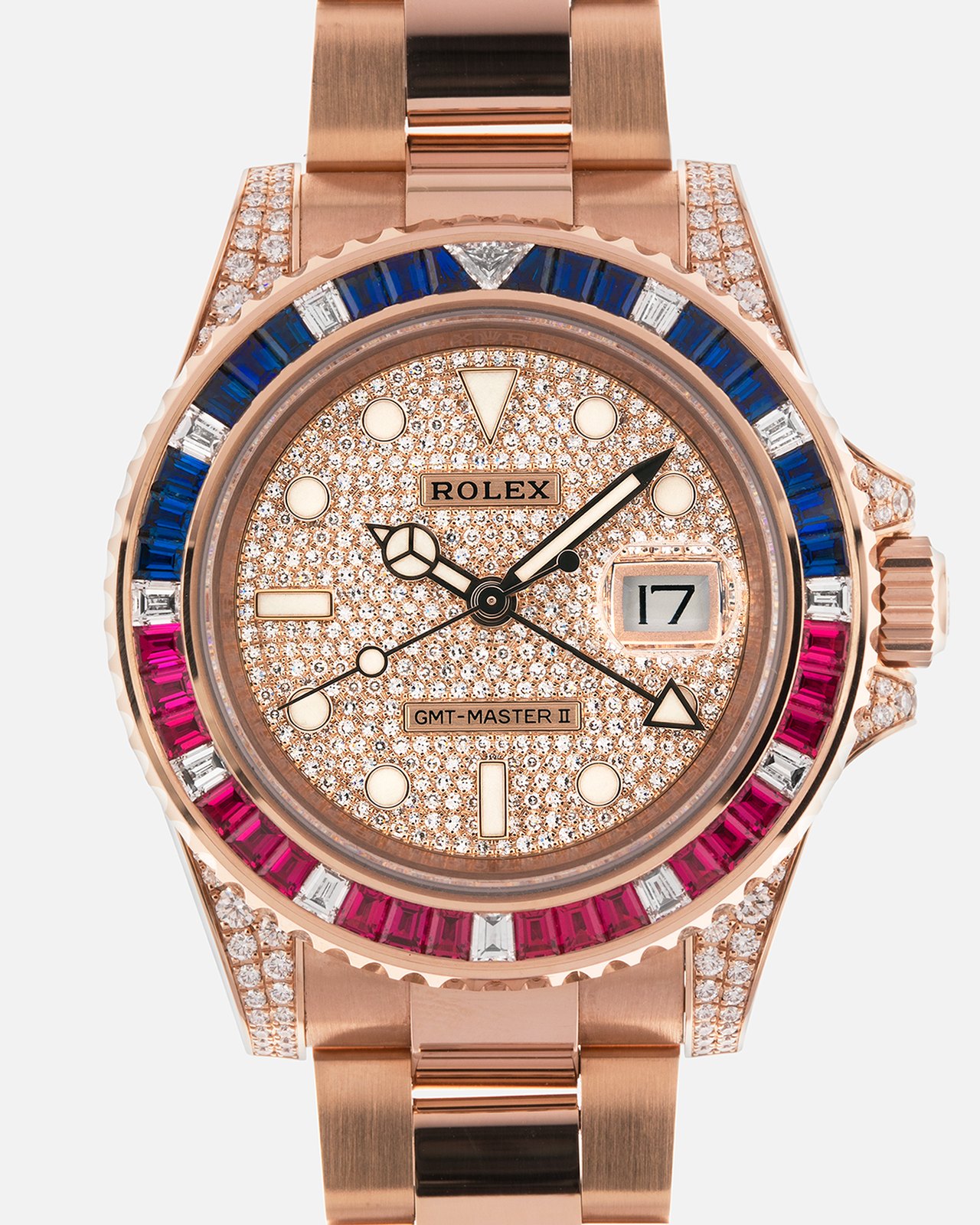
Rolex GMT Master II 126755SARU Pave Dial Rose Gold, 2020
- Maker / attribution
- Rolex (maker)
- Date
- 2020
- Historical period
- Contemporary Horology (2010 – Present)
- Country of origin
- Switzerland
- Object type
- Wristwatch
- Materials / technique
- rose gold
- Dimensions
- Case 40 mm
- Stock no.
- Product 7748217241687
- Credit line
- Dealer listing, S.Song Watches (product 7748217241687)
- Catalogue title (original)
- Rolex GMT Master II 126755SARU Pave Dial Rose Gold (English)
View the source record (dealer listing) ↗ (opens another website in a new tab)Suggest a correction
Record summary
Catalogued by S.Song Watches (dealer), Seattle (stock number Product 7748217241687), this is a wristwatch by Rolex, made in Switzerland, dated 2020. The Atlas places it in the Contemporary Horology period (2010 – Present) of its Wristwatches collection. Materials and techniques recorded by the source: rose gold. Recorded dimensions: Case 40 mm. The record is illustrated with 6 photographs.
Assembled from the source record's structured fields. Dates and attributions are given as the source states them; where a field is missing the Atlas leaves it blank rather than estimating.
Catalogue description
Dealer description — S.Song Watches
The Rolex GMT-Master has always been one of the brand's most recognisable sports watches. Originally developed in the 1950s as a tool watch for pilots, its defining feature was the ability to simultaneously display multiple time zones through a dedicated 24-hour hand and rotating bezel. Over the decades, however, Rolex has taken the GMT-Master far beyond its utilitarian beginnings, producing everything from simple stainless steel watches to some of the most extravagant gem-set sports watches ever made. Importantly, the SARU is not a recent creation. The combination can be traced back to 1979 and the extraordinarily rare Ref. 16758SARU, one of the earliest and most historically significant gem-set Rolex sports watches. The name SARU refers specifically to the sapphire and ruby-set bezel, recreating the GMT-Master's famous red and blue "Pepsi" colour combination using precious stones. Over subsequent generations, Rolex produced SARU GMTs in a number of configurations, including examples with conventional dials as well as far more elaborate pavé diamond dials and diamond-set bracelets. The Ref. 126755SARU seen here is the modern Everose gold evolution of that idea. Introduced in 2019, its 40mm case and Oyster bracelet are made entirely from 18-carat Everose gold, while the case itself is further set with brilliant-cut diamonds. Most importantly, the traditional ceramic bezel is replaced by baguette-cut blue sapphires and red rubies, separated by diamonds at the cardinal positions. It is an incredibly extravagant way of recreating one of the most recognisable bezel designs in watchmaking. This particular example takes things another step further with its factory pavé diamond dial. The dial is completely covered in brilliant-cut diamonds, interrupted by the applied luminous hour markers, Everose gold hands and date aperture at 3 o'clock. Against such an extravagant backdrop, I love that Rolex has retained all of the familiar GMT-Master elements. The Mercedes hour hand, arrow-tipped GMT hand, Cyclops date and rotating 24-hour bezel are all still there. Underneath everything, it remains unmistakably a GMT-Master II. There is something wonderfully ridiculous about a watch originally conceived as a professional pilot's instrument being executed like this. Yet the SARU is much more than Rolex simply adding gemstones to an existing watch. The sapphire, ruby and diamond-set GMT has existed in various forms for decades, making the SARU one of Rolex's most historically important and recognisable gem-set combinations. What began with the incredibly rare 16758SARU has survived through multiple generations of the GMT-Master, with each interpreting the same basic idea in a slightly different way. Inside is the automatic Rolex Calibre 3285, Rolex's modern-generation GMT movement. It allows the local hour hand to be adjusted independently and provides approximately 70 hours of power reserve, while retaining the practicality of 100 metres of water resistance. The 126755SARU is certainly not a subtle watch, nor is it supposed to be. With its Everose gold construction, pavé diamond dial and spectacular ruby, sapphire and diamond bezel, it is one of the most extravagant modern Rolex sports watches. More importantly, however, it continues a genuinely important chapter in Rolex's history. The SARU has gone from being an obscure and extraordinarily rare gem-set GMT of the late 1970s to one of the most recognisable jewelled Rolex configurations today, and in this pavé dial configuration, the 126755SARU is perhaps the ultimate modern expression of it.
Historical context
Contemporary Horology (2010 – Present)
Silicon components, connected watches, optical-lattice research clocks and a thriving independent scene.
Smartwatches became the world's best-selling watches, while mechanical watchmaking focuses on craft, innovation (silicon components, new escapements) and independent makers.
Read the period in the timelineMore wristwatches from this periodEarlier: Mechanical Renaissance
Atlas type guide
Military, pilot and travel watches
The wristwatch owes much of its adoption by men to warfare and aviation. Wristlets — small pocket watches soldered with lugs and worn on a strap — were used in colonial campaigns and became standard equipment in the First World War, with protective grilles over the crystal ('shrapnel guards'). Louis Cartier's Santos (1904), designed for the aviator Alberto Santos-Dumont, is often cited as an early purpose-made pilot's watch.
In the Second World War governments specified watches in detail: the German B-Uhr observation watches, the American A-11, and the British 'W.W.W.' (the 'Dirty Dozen' set of 1945). After the war, jet travel brought GMT and world-time watches, which show two or more time zones at once — Louis Cottier's world-time mechanism and the Rolex GMT-Master (1955) are examples.
What to look for
- Military markings on the case back: broad arrow, issue numbers, 'W.W.W.', 'A.T.P.'
- High-legibility black dials with luminous Arabic numerals; oversized crowns for gloved hands.
- 24-hour hands and rotating 24-hour bezels or city rings on GMT/world-time watches.
- Wire lugs on early wristlets converted from pocket watches.
Dating clues
- Wire-lug wristlets: c. 1900–1925.
- Military specifications of the Second World War: 1939–1945.
- GMT and world-time wristwatches: mainly after 1950.
General guidance written by the Atlas editors about this kind of object. It is not a statement about this particular piece; for that, rely on the source record above and on physical examination.
Related records

Movements & Components · c. 1970s
Rolex watch movement, c. 1970s
Antiquorum auction archive, Geneva

Pocket Watches · 1982
Fake Rolex watch, gold coloured metal, possibly made in Taiwan, 1982; part of a casual outfit, UK, 1982-84.
Victoria and Albert Museum, London

Wristwatches · c. 1920s
Rolex wristwatch, c. 1920s
Antiquorum auction archive, Geneva

Wristwatches · c. 1920s
Rolex wristwatch, ref. 6194, c. 1920s
Antiquorum auction archive, Geneva

Wristwatches · c. 2010s
Breguet Type XXI, ref. 3810, c. 2010s (Antiquorum Lot 381-24)
Antiquorum auction archive, Geneva

Wristwatches · c. 2010s
Breguet Type XXI, ref. 3810, c. 2010s (Antiquorum Lot 386-229)
Antiquorum auction archive, Geneva

Wristwatches · Sold in September 2010
Breitling Cosmonaute, ref. A 22322, Sold in September 2010
Antiquorum auction archive, Geneva

Wristwatches · c. 2010
Corum Bubble Chrono, ref. 396.150.20, c. 2010
Antiquorum auction archive, Geneva