
Wristwatches · Wristwatch
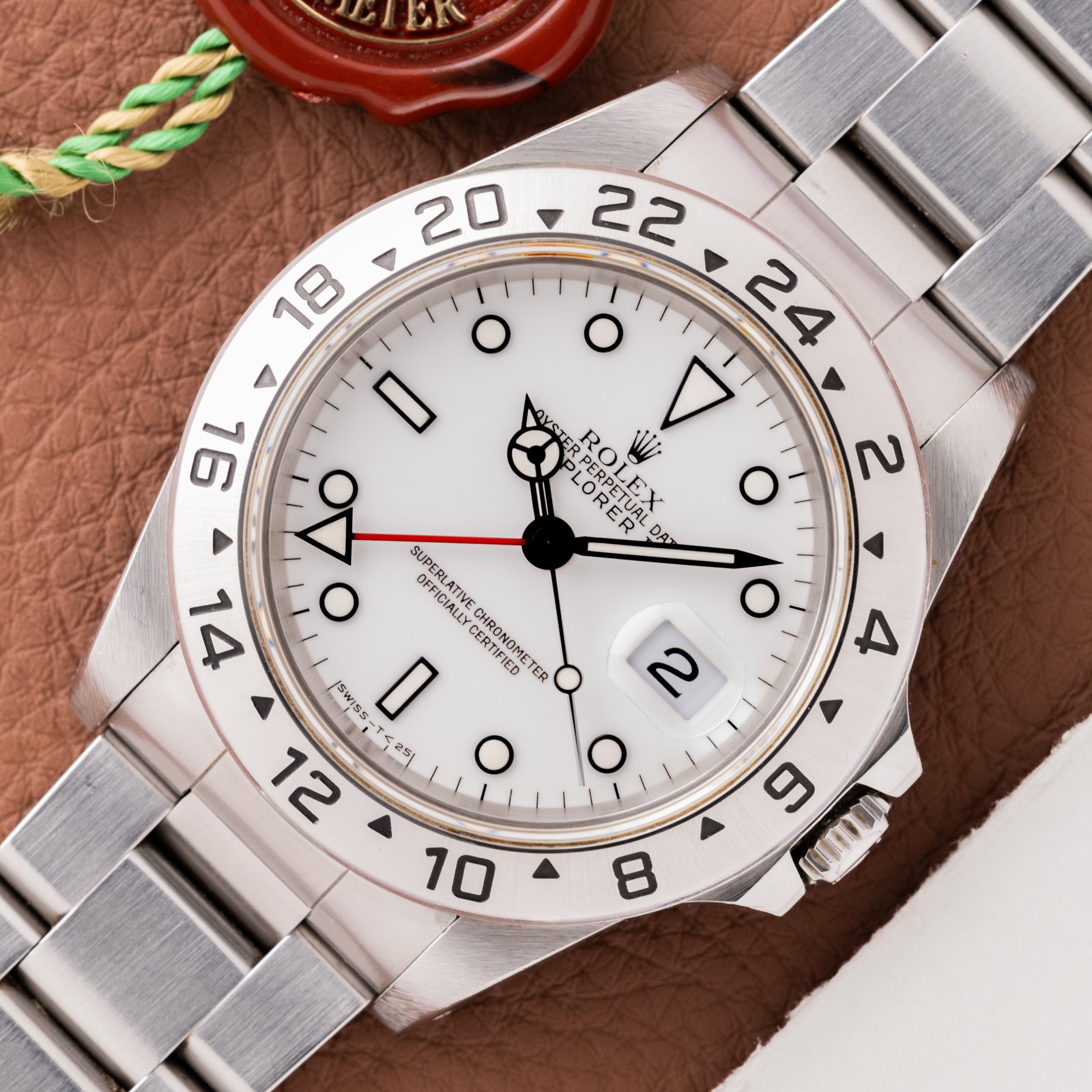
Rolex Explorer II Polar Tritium Dial (Ref. 16570), 1996
- Maker / attribution
- Rolex (maker)
- Date
- 1996
- Historical period
- Mechanical Renaissance (1990 – 2010)
- Country of origin
- Switzerland
- Object type
- Wristwatch
- Dimensions
- Case 40 mm
- Stock no.
- Product 8817209180343
- Credit line
- Dealer listing, Huntington Company (product 8817209180343)
- Catalogue title (original)
- 1996 Rolex Explorer II Polar Tritium Dial - Papers (Ref. 16570) (English)
View the source record (dealer listing) ↗ (opens another website in a new tab)Suggest a correction
Record summary
Catalogued by Huntington Company (dealer) (stock number Product 8817209180343), this is a wristwatch by Rolex, made in Switzerland, dated 1996. The Atlas places it in the Mechanical Renaissance period (1990 – 2010) of its Wristwatches collection. Recorded dimensions: Case 40 mm. The record is illustrated with 6 photographs.
Assembled from the source record's structured fields. Dates and attributions are given as the source states them; where a field is missing the Atlas leaves it blank rather than estimating.
Catalogue description
Dealer description — Huntington Company
History and Significance Introduced as a purpose-built tool watch for cave explorers, scientists, and adventurers working in environments where distinguishing day from night became difficult, the Explorer II has always favored function over flash. Fixed bezels replaced rotating ones. Large luminous markers prioritized legibility. Even the additional 24-hour hand existed solely to solve a practical problem rather than add visual complexity. The reference 16570 refined that philosophy into what many enthusiasts now consider the definitive Explorer II. Produced for more than two decades, it balanced the rugged charm of earlier references with modern reliability while retaining proportions that many collectors feel Rolex has never improved upon. At 40mm, it wears effortlessly, and the clean white Polar dial creates a personality entirely different from its black counterpart. For tritium enthusiasts, early 1996 examples occupy a particularly desirable place in the production run. They represent the final years before Rolex transitioned away from tritium luminous material, allowing these watches to develop the soft creamy patina collectors actively seek today. Combined with an untouched case and original accessories, they have become increasingly difficult to replace. Writer’s Thoughts We probably inspect more five-digit Rolex sports watches than anything else, and every once in a while one immediately separates itself from the rest. This Explorer II did exactly that. The unpolished case still has the sharp lines that define a truly honest Rolex, while the creamy tritium lume has aged exactly the way we'd hope to see on a mid-1990s watch. The dial remains beautifully preserved without the spotting or damage that can occasionally appear on Polar examples, allowing the warm lume to stand out even more. Reference 16570 is accompanied by its original papers and red tag, making it especially attractive for collectors looking for an untouched example. An original Rolex box can easily be added to complete the package, but the watch itself is already everything we'd want to see from a 1996 Explorer II. It has simply been preserved the right way. Our Promise Every watch is thoroughly vetted, carefully described with complete transparency, and guaranteed authentic. Each piece is offered in honest condition, ensuring collectors receive a timepiece that reflects both originality and integrity. Specifications Brand: Rolex Model: Explorer II Year: 1996 Case Material: Stainless Steel Case Size: 40mm Dial: Polar with tritium lume Movement: Automatic GMT Strap/Bracelet: Original Rolex Oyster bracelet Buckle/Clasp: Original Rolex Oyster clasp Contents: Original papers, red tag Condition Case: Unpolished case retaining crisp factory edges with light honest wear throughout. Dial: Original Polar dial in excellent condition with no visible signs of damage or deterioration. Hands: Original hands with attractive creamy tritium lume matching the dial. Crystal: Clean with light signs of careful use. Strap/Bracelet: Original Oyster bracelet showing normal signs of honest wear. Buckle/Clasp: Original Rolex Oyster clasp in excellent working condition.
Historical context
Mechanical Renaissance (1990 – 2010)
Mechanical watches return as cultural objects; independent watchmaking flourishes.
Mechanical watches returned as cultural and luxury objects. Complications, tourbillons and new materials proliferated; independent watchmakers such as George Daniels, F.P. Journe and Philippe Dufour revived artisanal watchmaking; collecting vintage watches became a major field.
Read the period in the timelineMore wristwatches from this periodEarlier: Quartz Revolution
Atlas type guide
Wristwatches
Bracelet watches were worn by women from the early nineteenth century — Breguet made one for Caroline Murat, Queen of Naples, in 1810–12 — but the wristwatch only became a man's instrument with military use and aviation in the early twentieth century. Between the World Wars it overtook the pocket watch; the 1920s and 1930s brought rectangular Art Deco cases, water-resistant cases and the first automatic winding systems.
After 1945 the wristwatch became a carrier of identity — dress watches, sports and dive watches, chronographs, calendars — produced by Swiss, American, Japanese, German, Soviet and Chinese industries. The quartz revolution after 1969 and the mechanical renaissance since the 1990s, including the rise of independent watchmakers, complete the story.
What to look for
- The reference number (between the lugs or inside the case back) and serial number, the starting point for dating.
- The calibre: its maker and number are often stamped under the dial or on the bridge.
- Originality of dial, hands and crown — refinished ('redial') dials are common.
- Case material marks: 18K/750, 14K/585, stainless steel, gold-filled, plated.
Dating clues
- Wire-lug cases: before c. 1925.
- Water-resistant screw-down cases: from 1926.
- Quartz movements: from 1969; sapphire crystals widespread after c. 1980.
General guidance written by the Atlas editors about this kind of object. It is not a statement about this particular piece; for that, rely on the source record above and on physical examination.
Related records

Movements & Components · c. 1970s
Rolex watch movement, c. 1970s
Antiquorum auction archive, Geneva

Pocket Watches · 1982
Fake Rolex watch, gold coloured metal, possibly made in Taiwan, 1982; part of a casual outfit, UK, 1982-84.
Victoria and Albert Museum, London

Wristwatches · c. 1920s
Rolex wristwatch, c. 1920s
Antiquorum auction archive, Geneva

Wristwatches · c. 1920s
Rolex wristwatch, ref. 6194, c. 1920s
Antiquorum auction archive, Geneva

Wristwatches · 2008
Wristwatch by Breitling?, 2008
Museum Rotterdam

Wristwatches · c. 1990s
Audemars Piguet Bamboo, c. 1990s
Antiquorum auction archive, Geneva

Wristwatches · c. 1990
Audemars Piguet Huitieme Perpetual Calendar, ref. 25696PT, c. 1990
Antiquorum auction archive, Geneva

Wristwatches · c. 1990
Breitling Chronomat, ref. b13050.1, c. 1990
Antiquorum auction archive, Geneva