
Wristwatches · Wristwatch
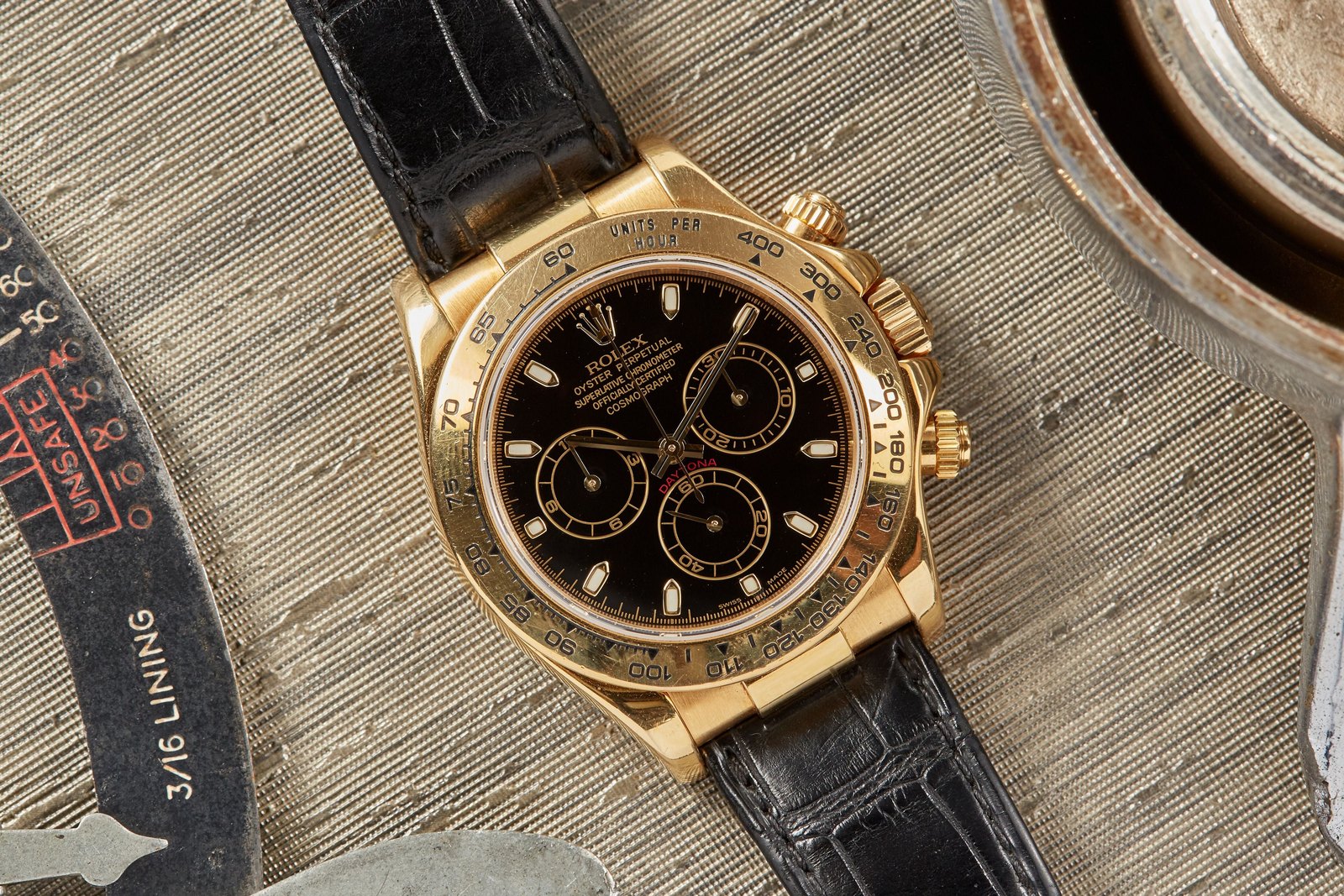
Rolex Daytona Chronograph, c. 2002
- Maker / attribution
- Rolex (maker)
- Date
- c. 2002
- Historical period
- Mechanical Renaissance (1990 – 2010)
- Country of origin
- Switzerland
- Object type
- Wristwatch
- Dimensions
- Case 39 mm
- Stock no.
- Product 3518719426647
- Credit line
- Dealer listing, Analog/Shift (product 3518719426647)
- Catalogue title (original)
- Rolex Daytona Chronograph (English)
View the source record (dealer listing) ↗ (opens another website in a new tab)Suggest a correction
Record summary
Catalogued by Analog/Shift (dealer), New York (stock number Product 3518719426647), this is a wristwatch by Rolex, made in Switzerland, dated c. 2002. The Atlas places it in the Mechanical Renaissance period (1990 – 2010) of its Wristwatches collection. Recorded dimensions: Case 39 mm. The record is illustrated with 6 photographs.
Assembled from the source record's structured fields. Dates and attributions are given as the source states them; where a field is missing the Atlas leaves it blank rather than estimating.
Catalogue description
Dealer description — Analog/Shift
Why We Love It Love 'em or hate 'em, the Rolex Daytona is the most sought after watch in the world. While vintage Daytonas aren't for every taste --and certainly not for every budget-- there are some more contemporary versions that, while still highly sought after, haven't completely exploded out of the reach of mere mortals. Yet. Powered by the manufacture Calibre 4130, this 39mm Daytona Reference 116518 is a recent and somewhat misunderstood model. Produced in solid 18K yellow gold, the 116518 carries the design language of the 'Zenith' Daytona that preceded it, and the same in-house automatic chronograph movement powering the current lineup. Setting the 116518 apart from other solid gold variants is the partial 'hooded lug' design of the lugs/strap setup - allowing for the fitment of a variety of strap options with a solid gold deployant clasp included. This particular example, a 'Y' Serial model dating from circa 2002, shows a strong case and flawless dial with just enough wear showing to allow for carefree use. Fitted with a genuine Rolex signed black leather strap and inclusive of a quality aftermarket rubber strap, it makes for a killer and versatile timepiece - particularly going into the warmer months. While the 'strap only' variants are somewhat controversial to Daytona purists, they offer a tremendous value proposition - we'd encourage you to look at them seriously! The Story The Daytona is Rolex's only chronograph in current production. Before the Cosmograph and Daytona models, Rolex had produced chronographs since the 1930s, setting the mold for what would ultimately become the single best-known chronograph in the world. These early watches, like many chronographs of the period, had monochromatic dials and a tachymeter ring printed on the outer edge of the dial. The design of the Cosmograph gradually changed, but the Oyster case remained at its heart. A change in dial configuration (mainly a shift from monochrome to the "panda" color schemes now closely associated with it) along with the removal of the tachymetric scale to the bezel made it a clear sportsman's watch. With the addition of the name Daytona in 1964 (taken from the 24 Hours of Daytona Race which Rolex started sponsoring in 1962), the motorsports association was cemented. The result of years of R&D, the movement used in the Reference 116520--the Calibre 4130--was the manufacture's first new in-house caliber in five decades. The Calibre 4130's construction--consisting of a vertical clutch, a larger balance wheel, and fewer screws--made it far more accurate (and more easily-serviced) than any of Rolex's previous self-winding chronograph calibres.
Historical context
Mechanical Renaissance (1990 – 2010)
Mechanical watches return as cultural objects; independent watchmaking flourishes.
Mechanical watches returned as cultural and luxury objects. Complications, tourbillons and new materials proliferated; independent watchmakers such as George Daniels, F.P. Journe and Philippe Dufour revived artisanal watchmaking; collecting vintage watches became a major field.
Read the period in the timelineMore wristwatches from this periodEarlier: Quartz Revolution
Atlas type guide
Chronographs and split-seconds watches
A chronograph is a watch with an additional seconds hand that can be started, stopped and returned to zero independently of the timekeeping. Louis Moinet built an early example in 1816 and Nicolas Rieussec a recording 'chronographe' in 1821; Adolphe Nicole's heart-shaped reset cam (patented 1862) made the modern return-to-zero possible. Split-seconds (rattrapante) chronographs add a second hand that can be stopped for intermediate times; flyback chronographs restart instantly.
Chronographs were essential tools for doctors (pulsometer scales), artillery (telemeter), engineers and sport. In wristwatches, Valjoux, Venus, Lemania and later the automatic chronographs of 1969 (Zenith El Primero, the Chronomatic Calibre 11 group and Seiko 6139) are milestones.
What to look for
- Push-pieces on the case band or a single button in the crown (monopusher).
- Subsidiary registers for minutes and hours; tachymeter, telemeter or pulsometer scales.
- Column wheel versus cam control visible in the movement.
- Calibre markings of specialist makers (Valjoux, Lemania, Venus, Landeron).
Dating clues
- Pocket chronographs with heart cam reset: after 1862.
- Wrist chronographs: from c. 1910; two-button designs from the 1930s.
- Automatic chronographs: from 1969.
General guidance written by the Atlas editors about this kind of object. It is not a statement about this particular piece; for that, rely on the source record above and on physical examination.
Read next:Flyback chronographChronograph
Related records

Movements & Components · c. 1970s
Rolex watch movement, c. 1970s
Antiquorum auction archive, Geneva

Pocket Watches · 1982
Fake Rolex watch, gold coloured metal, possibly made in Taiwan, 1982; part of a casual outfit, UK, 1982-84.
Victoria and Albert Museum, London

Wristwatches · c. 1920s
Rolex wristwatch, c. 1920s
Antiquorum auction archive, Geneva

Wristwatches · c. 1920s
Rolex wristwatch, ref. 6194, c. 1920s
Antiquorum auction archive, Geneva

Wristwatches · 2008
Wristwatch by Breitling?, 2008
Museum Rotterdam

Wristwatches · c. 1990s
Audemars Piguet Bamboo, c. 1990s
Antiquorum auction archive, Geneva

Wristwatches · c. 1990
Audemars Piguet Huitieme Perpetual Calendar, ref. 25696PT, c. 1990
Antiquorum auction archive, Geneva

Wristwatches · c. 1990
Breitling Chronomat, ref. b13050.1, c. 1990
Antiquorum auction archive, Geneva