
Wristwatches · Wristwatch
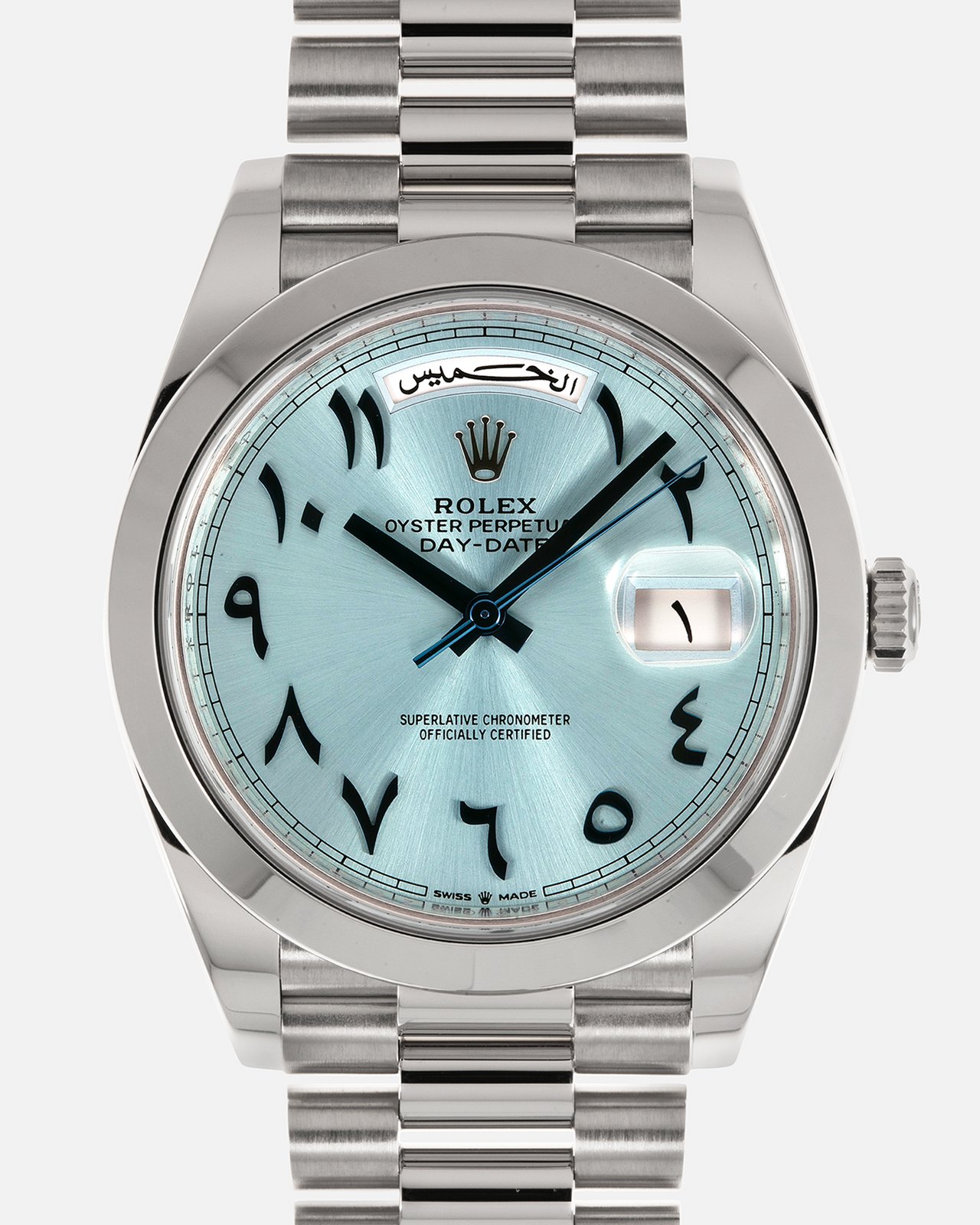
Rolex Day Date 40 228206 Arabic Platinum, 2020
- Maker / attribution
- Rolex (maker)
- Date
- 2020
- Historical period
- Contemporary Horology (2010 – Present)
- Country of origin
- Islamic world
- Object type
- Wristwatch
- Materials / technique
- platinum
- Dimensions
- Case 40 mm
- Stock no.
- Product 7148768624727
- Credit line
- Dealer listing, S.Song Watches (product 7148768624727)
- Catalogue title (original)
- Rolex Day Date 40 228206 Arabic Platinum (English)
View the source record (dealer listing) ↗ (opens another website in a new tab)Suggest a correction
Record summary
Catalogued by S.Song Watches (dealer), Seattle (stock number Product 7148768624727), this is a wristwatch by Rolex, made in Islamic world, dated 2020. The Atlas places it in the Contemporary Horology period (2010 – Present) of its Wristwatches collection. Materials and techniques recorded by the source: platinum. Recorded dimensions: Case 40 mm. The record is illustrated with 6 photographs.
Assembled from the source record's structured fields. Dates and attributions are given as the source states them; where a field is missing the Atlas leaves it blank rather than estimating.
Catalogue description
Dealer description — S.Song Watches
A legendary timepiece with iconic history, the Rolex Day-Date has earned the title of the "Watch of Prestige", and for good reason. First unveiled in 1956, it swiftly became the preferred choice for athletes, visionaries, and global leaders, leading to its enduring moniker 'the President.' This nickname persists even today, as the watch continues to serve as Rolex's flagship offering with its luxurious construction and timeless design. Constructed entirely of platinum, this Day-Date 40 Ref. 228206 that I have here features the iconic three-piece link "Presidential" bracelet, fitted onto a modern 40mm case with a sleek and smooth bezel. Introduced in 2016, this Ref. 228206 houses an elusive ice blue, sunburst dial (like on other platinum Rolex watches) adorned with an Eastern Arabic day wheel and hour markers. If you haven’t realized, this is a very special Rolex, and to emphasize how special this Arabic dial is, we need to journey back in time to the late 1960s when Rolex first began offering these unique Arabic dial configurations. Their rapid rise in popularity prompted Rolex to embark on extensive experimentation in the following decades, resulting in a diverse array of combinations involving dial colours, hour markers, and various metals for the case and bracelet. It is also worth mentioning that some of the most special examples that came out from this period include the Ref. 1803 'Alladin's Rose', which features a tappisserie guilloché dial, a unique feature not found on any other models, and the famous Ref. 1804 'Scheherazade' with an Arabic date wheel, hour markers, platinum case, and a factory-set diamond bezel, which was offered and sold in a recent 2021 auction. Today, there is a significant following for these Arabic dials among the most discerning Rolex collectors, spanning across vintage or modern examples. Powering it from within is Rolex’s in-house Cal. 3255, a self-winding, COSC-certified (Contrôle Officiel Suisse des Chronomètres) movement. Introduced by Rolex in 2015 to replace the Cal. 3155 used in its Day-Date range, this movement continues to be utilized to this day. In terms of power reserve, the Cal. 3255 can hold a charge for up to 70 hours on a full wind. In terms of aesthetics, I’d say that the Ref. 228206 may not immediately strike you as the flashiest Rolex, especially if that's what you're seeking. However, I believe it's precisely this understated quality that makes the Ref. 228206 a truly exceptional example of a Day-Date. With its substantial platinum case and rare ice blue ‘Arabic’ dial configuration, it offers a unique combination that flies under the radar, and yet, speaks volumes in its own right. I've previously expressed a similar sentiment in a listing for a platinum Daytona; platinum Rolex watches hold a special place in my mind. While I often highlight that white gold is the discreetly luxurious metal of choice, opting for platinum, if possible, adds an extra level of distinction. In my view, it effortlessly evades unwanted attention while exuding an understated sense of exclusivity. Moreover, each time you wear it, the weight of the platinum case and bracelet serves as a constant reminder that this is no ordinary contemporary Day-Date—it's truly something extraordinary. It is also worth noting that although the production of this Ref. 228206 isn't limited, this particular model is an off-catalogue piece, meaning that it is not advertised by Rolex and is only available to purchase upon request. It is extremely hard to be allocated a piece and this particular example was sold to the the Ministry of Presidential Affairs in the UAE. It is also worth noting that Rolex only sells these Arabic dialled 228206’s to select dealers in the Middle East. It is, without a doubt one of the most desirable modern Rolexes.
Historical context
Contemporary Horology (2010 – Present)
Silicon components, connected watches, optical-lattice research clocks and a thriving independent scene.
Smartwatches became the world's best-selling watches, while mechanical watchmaking focuses on craft, innovation (silicon components, new escapements) and independent makers.
Read the period in the timelineMore wristwatches from this periodEarlier: Mechanical Renaissance
Atlas type guide
Wristwatches
Bracelet watches were worn by women from the early nineteenth century — Breguet made one for Caroline Murat, Queen of Naples, in 1810–12 — but the wristwatch only became a man's instrument with military use and aviation in the early twentieth century. Between the World Wars it overtook the pocket watch; the 1920s and 1930s brought rectangular Art Deco cases, water-resistant cases and the first automatic winding systems.
After 1945 the wristwatch became a carrier of identity — dress watches, sports and dive watches, chronographs, calendars — produced by Swiss, American, Japanese, German, Soviet and Chinese industries. The quartz revolution after 1969 and the mechanical renaissance since the 1990s, including the rise of independent watchmakers, complete the story.
What to look for
- The reference number (between the lugs or inside the case back) and serial number, the starting point for dating.
- The calibre: its maker and number are often stamped under the dial or on the bridge.
- Originality of dial, hands and crown — refinished ('redial') dials are common.
- Case material marks: 18K/750, 14K/585, stainless steel, gold-filled, plated.
Dating clues
- Wire-lug cases: before c. 1925.
- Water-resistant screw-down cases: from 1926.
- Quartz movements: from 1969; sapphire crystals widespread after c. 1980.
General guidance written by the Atlas editors about this kind of object. It is not a statement about this particular piece; for that, rely on the source record above and on physical examination.
Related records

Movements & Components · c. 1970s
Rolex watch movement, c. 1970s
Antiquorum auction archive, Geneva

Pocket Watches · 1982
Fake Rolex watch, gold coloured metal, possibly made in Taiwan, 1982; part of a casual outfit, UK, 1982-84.
Victoria and Albert Museum, London

Wristwatches · c. 1920s
Rolex wristwatch, c. 1920s
Antiquorum auction archive, Geneva

Wristwatches · c. 1920s
Rolex wristwatch, ref. 6194, c. 1920s
Antiquorum auction archive, Geneva
Wristwatches · 2025
Cartier Santos De Cartier Arabic Middle East Limited Edition, 2025
Watches of Knightsbridge (dealer), London
Wristwatches · 2010
Wristwatch, 2010
Modemuseum Hasselt
Wristwatches · 2018 (Series 4 released in September 2018; '1977' in the source is the model number A1977)
Apple Watch Series 4 (GPS, 40 mm, model A1977), 2018
Vienna Museum of Science and Technology
Wristwatches · c. 2010s
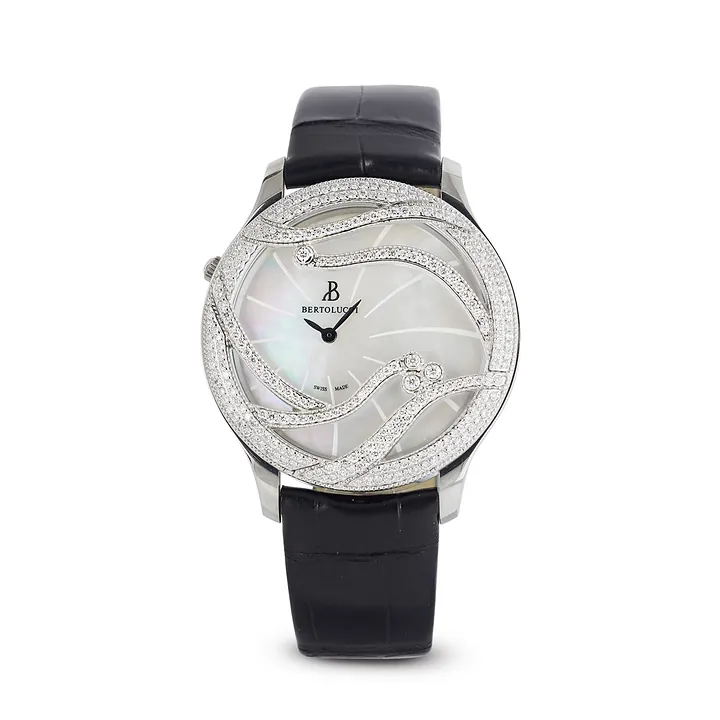
Bertolucci Stria III, ref. 11513.50.45.B88.6C1.501, c. 2010s
Antiquorum auction archive, Geneva