
Wristwatches · Wristwatch
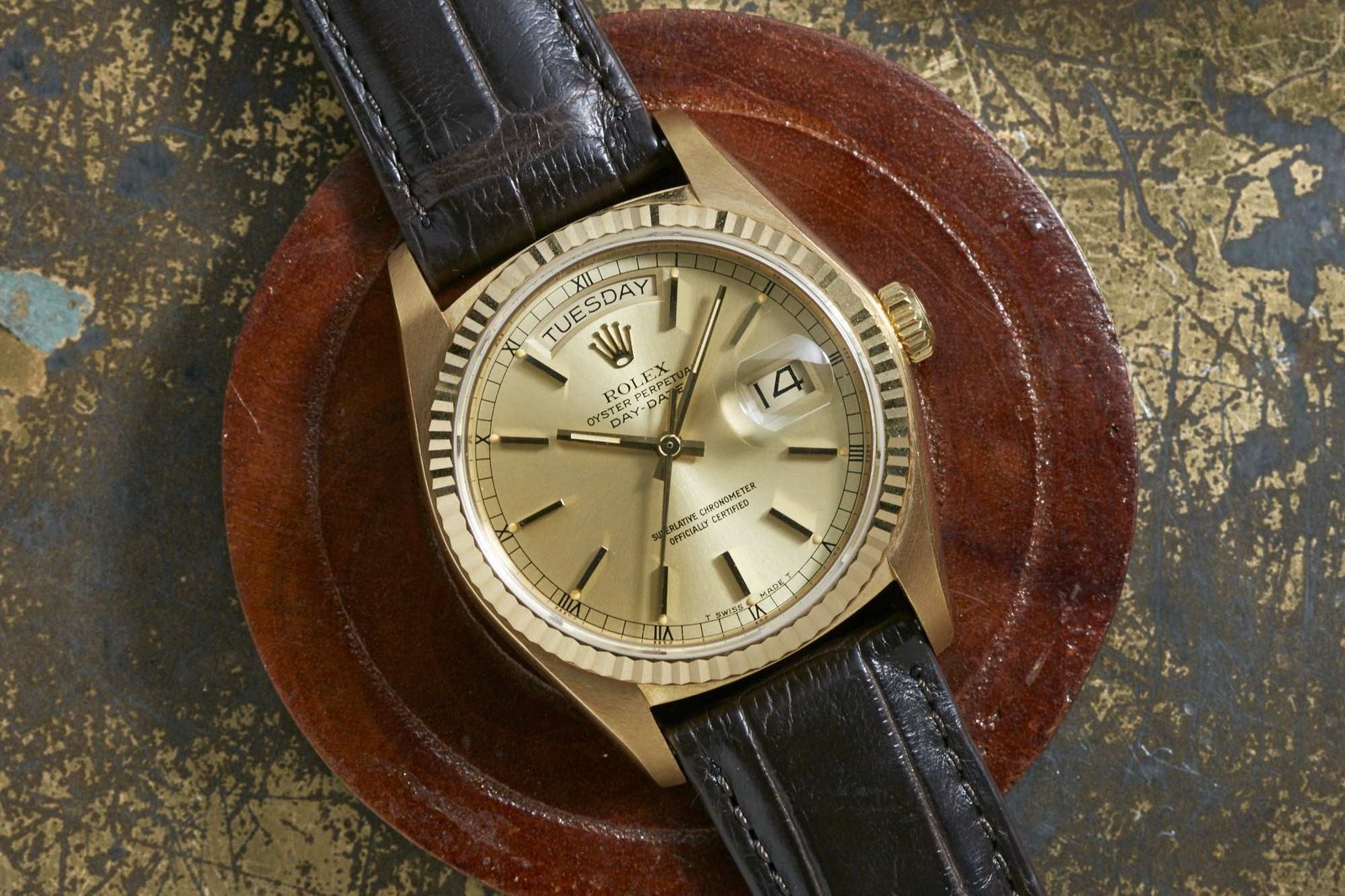
Rolex Day-Date, c. 1980
- Maker / attribution
- Rolex (maker)
- Date
- c. 1980
- Historical period
- Quartz Revolution (1969 – 1990)
- Country of origin
- Switzerland
- Object type
- Wristwatch
- Stock no.
- Product 6594221761
- Credit line
- Dealer listing, Analog/Shift (product 6594221761)
- Catalogue title (original)
- Rolex Day-Date (English)
View the source record (dealer listing) ↗ (opens another website in a new tab)Suggest a correction
Record summary
Catalogued by Analog/Shift (dealer), New York (stock number Product 6594221761), this is a wristwatch by Rolex, made in Switzerland, dated c. 1980. The Atlas places it in the Quartz Revolution period (1969 – 1990) of its Wristwatches collection. The record is illustrated with 6 photographs.
Assembled from the source record's structured fields. Dates and attributions are given as the source states them; where a field is missing the Atlas leaves it blank rather than estimating.
Catalogue description
Dealer description — Analog/Shift
Perhaps, given the relatively poor sales performance of complicated watches at the time, Rolex did not anticipate the Day-Date to become the best-seller that it is. Certainly, this first reference of Day-Date--the Reference 6511--suffered from some technical problems that saw its departure from Rolex's catalogs the following year. Due to the complexity of the automatic movement, with day and date discs, there was some concern that it would not keep accurate time. The stress on the mainspring, for example, was entirely focused on triggering a cam that would advance the day and date wheels at midnight. Since Rolex's modus operandi is--like Apple--not to innovate, but to refine, the Reference 6511 was discontinued and the movement was modified and improved throughout 1956. The resulting reference, the Reference 6611 of 1957, looked almost identical to its predecessor: an 18k gold or platinum case and a silver, white, or gold dial. But there were some slight modifications to the look, namely alpha style hands instead of the earlier dauphine, and--as an indication of what beats inside--"Superlative Chronometer Officially Certified" on the dial. That's because of their new movement, the Caliber 1055, which bears the distinction of being the first Rolex caliber ever to achieve chronometer certification. Additionally, it solved the cam issue found in the Reference 6511 by distributing the energy in the movement throughout the day instead of in the minutes immediately prior to midnight. And perhaps most excitingly of all, this was the first reference to be offered with the folded-clasp bracelet that would be bestowed to President Dwight D. Eisenhower and henceforth be dubbed: the President. Subtle changes occurred to the Day-Date throughout the 60s, both internally (the introduction of the Caliber 1555 in 1959 and the Caliber 1556 in 1965) and externally (the shift from radium to tritium in 1964). The introduction of the Caliber 1555 in 1959 marked the inauguration of the Reference 1800 series, which saw a veritable rainbow of dial colors. The Reference 1803 debuted in 1965 and ran until 1988, when Rolex introduced the 18000 series with the double quick-set Caliber 3155, which is found in Day-Dates to this day. In 1977, Rolex improved on the Reference 1803 Day-Date with the single quick-set date Caliber 3055. Prior to this innovative technology, the date could only be advanced by moving the hands forward many times until the correct date was displayed. But with the Caliber 3055, the date could be advanced simply by pulling the crown out to the first position and then turning it until the date window showed the correct date. Externally, the Day-Date also had a sapphire crystal, which gave the Day-Date increased water resistance, since it fit more tightly than the acrylic crystal that had been used previously. The first References of the Day-Date could only be guaranteed to a depth rating of 165 feet, but with the addition of the sapphire crystal, the depth rating was increased to 330 feet (though why anyone would dive with an 18k gold watch is beyond us...). Around this time, Rolex also introduced a new case reference number system. A fifth digit, signifying the material that the case was made of (whether stainless steel, gold-filled, platinum, or 14 or 18-karat gold), was added to the four-digit reference number. This particular watch bears the Reference number 18038, signifies that the case is made of 18k yellow gold. The Day-Date, with its dignified nickname, exemplifies class and success. Whether dressed-down on leather or on a hidden-clasp 18k gold President bracelet (which is also available for purchase), the Day-Date exudes a style and sophistication that cannot be suppressed. This particular example is in absolutely pristine condition showing virtually no signs of wear, and dates from approximately 1980. Coming complete with a period box and the original factory case back sticker still in place, makes it a brilliant and clean example that will make the wearer feel like the Leader of the Free World.
Historical context
Quartz Revolution (1969 – 1990)
Seiko's Astron begins mass quartz timekeeping; traditional industries contract sharply.
Quartz and digital watches transformed the market after 1969. Swiss employment collapsed, Japanese and Hong Kong production soared, and the Swatch (1983) helped the Swiss industry recover; mechanical watches survived as luxury goods.
Read the period in the timelineMore wristwatches from this periodEarlier: Modern Mechanical Horology
Atlas type guide
Calendar, moon-phase and perpetual calendar watches
Calendar complications range from a simple date to the perpetual calendar, which automatically allows for months of different lengths and leap years until 2100. Pocket watches with perpetual calendars were made in the eighteenth and nineteenth centuries; Patek Philippe made the first perpetual calendar wristwatch in 1925, and series production followed in 1941. The annual calendar (Patek Philippe, 1996) needs correction only once a year.
Moon-phase displays use a disc with two moons and 59 teeth advanced daily, approximating the 29.5-day lunation; more precise trains reduce the error to one day in over a century.
What to look for
- Apertures or subsidiary dials for day, date, month and leap year.
- Moon disc under a 'bosom' shaped aperture.
- Recessed correctors on the case band for setting the calendar.
Dating clues
- Triple-date wristwatches: popular c. 1940–1955.
- Perpetual calendar wristwatches: from 1925 (unique) and 1941 (series).
General guidance written by the Atlas editors about this kind of object. It is not a statement about this particular piece; for that, rely on the source record above and on physical examination.
Related records

Movements & Components · c. 1970s
Rolex watch movement, c. 1970s
Antiquorum auction archive, Geneva

Pocket Watches · 1982
Fake Rolex watch, gold coloured metal, possibly made in Taiwan, 1982; part of a casual outfit, UK, 1982-84.
Victoria and Albert Museum, London

Wristwatches · c. 1920s
Rolex wristwatch, c. 1920s
Antiquorum auction archive, Geneva

Wristwatches · c. 1920s
Rolex wristwatch, ref. 6194, c. 1920s
Antiquorum auction archive, Geneva

Wristwatches · 1970
Wristwatch by Heno, Switzerland, 1970
Museum Rotterdam

Wristwatches · 1960–1986
'Tri-Compax' calendar chronograph wristwatch in gold case, by Universal, Geneva, Switzerland, 1960–1986.
Science Museum Group, London

Wristwatches · 1969–1970
Beta 21 Quartz wristwatch movement, made in Switzerland, 1970.
Science Museum Group, London

Wristwatches · c. 1969
Omega Speedmaster Moonwatch, ref. 145022-69st, c. 1969
Antiquorum auction archive, Geneva