
Wristwatches · Wristwatch
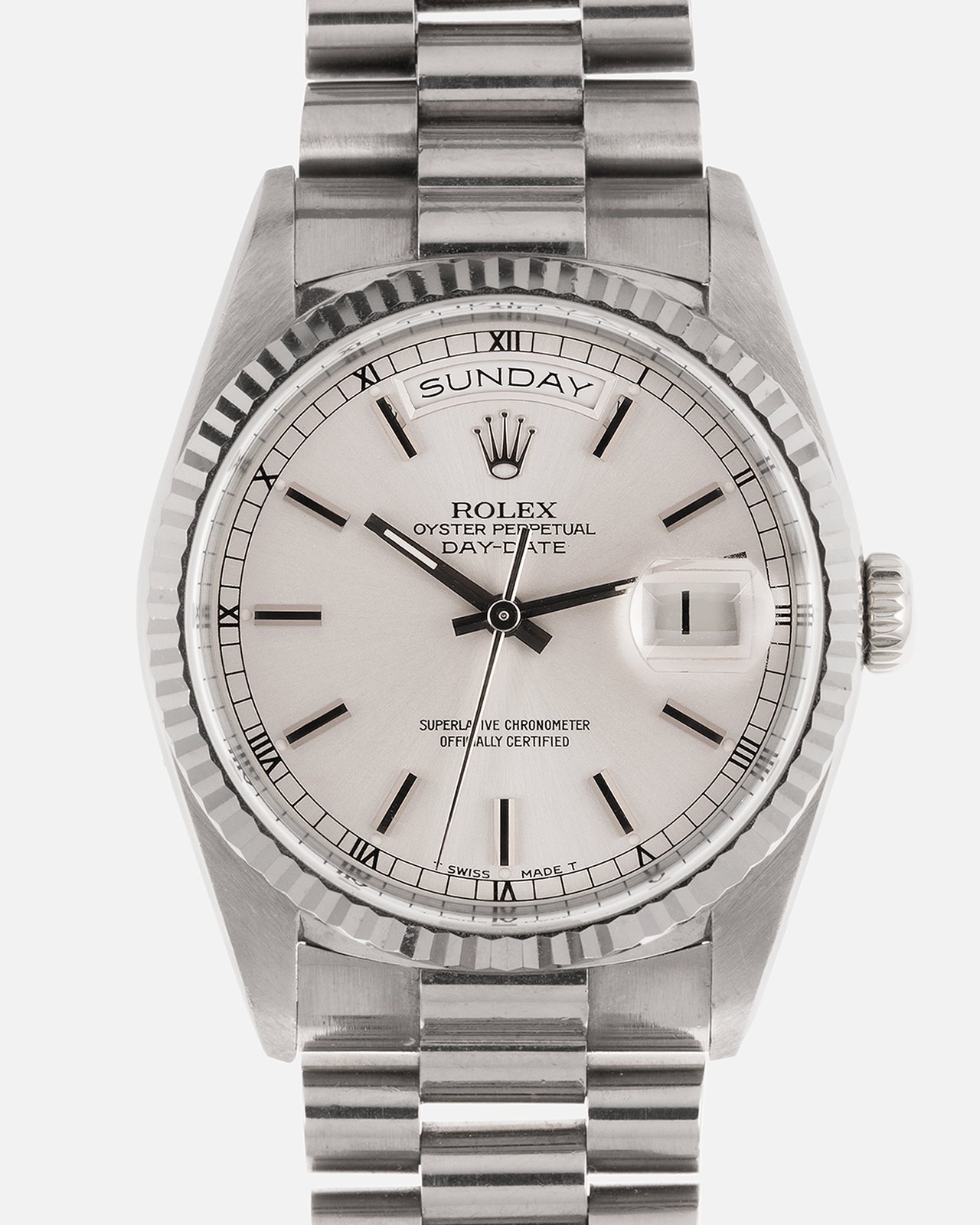
Rolex Day Date 18239 WG Silver Dial, 1994
- Maker / attribution
- Rolex (maker)
- Date
- 1994
- Historical period
- Mechanical Renaissance (1990 – 2010)
- Country of origin
- Switzerland
- Object type
- Wristwatch
- Materials / technique
- silver
- Dimensions
- Case 36 mm
- Stock no.
- Product 7853799047255
- Credit line
- Dealer listing, S.Song Watches (product 7853799047255)
- Catalogue title (original)
- Rolex Day Date 18239 WG Silver Dial (English)
View the source record (dealer listing) ↗ (opens another website in a new tab)Suggest a correction
Record summary
Catalogued by S.Song Watches (dealer), Seattle (stock number Product 7853799047255), this is a wristwatch by Rolex, made in Switzerland, dated 1994. The Atlas places it in the Mechanical Renaissance period (1990 – 2010) of its Wristwatches collection. Materials and techniques recorded by the source: silver. Recorded dimensions: Case 36 mm. The record is illustrated with 6 photographs.
Assembled from the source record's structured fields. Dates and attributions are given as the source states them; where a field is missing the Atlas leaves it blank rather than estimating.
Catalogue description
Dealer description — S.Song Watches
Since its introduction in 1956, the Rolex Day-Date has occupied a special position within the brand's collection. As the first self-winding, waterproof chronometer wristwatch to display both the day of the week written in full and the date, it represented an important development in Rolex's history. Produced exclusively in precious metals, the Day-Date quickly became associated with prominent figures in business, politics and entertainment, earning its familiar nickname, the President. Over the following decades, the Day-Date underwent numerous technical improvements while retaining much of its original design. Among the most significant developments was the introduction of the five-digit references in the late 1980s, which brought modern movement technology to the collection without fundamentally altering its classical proportions. Introduced in 1988, the reference 18239 replaced the earlier 1803X and incorporated the new calibre 3155. Its most important improvement was the introduction of the double quickset mechanism, allowing both the day and date to be adjusted independently through the crown. This was a considerable improvement over earlier Day-Date movements, which required the hands to be advanced to adjust the day. Here, we have a particularly attractive example of the reference 18239 in 18-carat white gold, featuring a silver sunburst dial with applied baton hour markers. While the Day-Date has been produced in countless dial configurations, including elaborate stone and diamond-set examples, I have always appreciated the simplicity of the more traditional variations. Measuring 36mm in diameter, the case features the familiar fluted bezel, originally developed as a functional component of the Oyster case before becoming one of Rolex's most recognisable design elements. The white gold construction gives the watch a relatively understated appearance compared to its yellow gold counterparts, while retaining the substantial weight and feel of a precious metal watch. The silver dial is particularly appealing, featuring a fine sunburst finish that subtly changes in appearance depending on the lighting. Applied white gold baton hour markers and matching hands complement the monochromatic appearance, while the day aperture at 12 o'clock and magnified date window at 3 o'clock provide the familiar Day-Date layout. The watch is fitted with the iconic President bracelet, featuring semi-circular three-piece links and a concealed clasp. First introduced alongside the Day-Date in 1956, the bracelet has become inseparable from the collection's identity and remains one of Rolex's most recognisable designs. It is also one of my personal favourite bracelet designs of all time, both in terms of design and comfort. Powering the reference 18239 is the automatic calibre 3155, featuring a balance frequency of 28,800 vibrations per hour, a free-sprung balance and approximately 48 hours of power reserve. The movement remained in production for several decades and is widely regarded as one of Rolex's most reliable automatic calendar calibres. What I find particularly appealing about this 18239 is its simplicity. The combination of white gold, a silver dial and the traditional 36mm case creates an almost entirely monochromatic appearance, allowing the proportions and finishing of the watch to speak for themselves. While more elaborate Day-Date configurations certainly have their appeal, there is something particularly satisfying and low-key about this one. Discretion is the quality here- from afar, it looks like any other steel watch, but if you know, you know.
Historical context
Mechanical Renaissance (1990 – 2010)
Mechanical watches return as cultural objects; independent watchmaking flourishes.
Mechanical watches returned as cultural and luxury objects. Complications, tourbillons and new materials proliferated; independent watchmakers such as George Daniels, F.P. Journe and Philippe Dufour revived artisanal watchmaking; collecting vintage watches became a major field.
Read the period in the timelineMore wristwatches from this periodEarlier: Quartz Revolution
Atlas type guide
Wristwatches
Bracelet watches were worn by women from the early nineteenth century — Breguet made one for Caroline Murat, Queen of Naples, in 1810–12 — but the wristwatch only became a man's instrument with military use and aviation in the early twentieth century. Between the World Wars it overtook the pocket watch; the 1920s and 1930s brought rectangular Art Deco cases, water-resistant cases and the first automatic winding systems.
After 1945 the wristwatch became a carrier of identity — dress watches, sports and dive watches, chronographs, calendars — produced by Swiss, American, Japanese, German, Soviet and Chinese industries. The quartz revolution after 1969 and the mechanical renaissance since the 1990s, including the rise of independent watchmakers, complete the story.
What to look for
- The reference number (between the lugs or inside the case back) and serial number, the starting point for dating.
- The calibre: its maker and number are often stamped under the dial or on the bridge.
- Originality of dial, hands and crown — refinished ('redial') dials are common.
- Case material marks: 18K/750, 14K/585, stainless steel, gold-filled, plated.
Dating clues
- Wire-lug cases: before c. 1925.
- Water-resistant screw-down cases: from 1926.
- Quartz movements: from 1969; sapphire crystals widespread after c. 1980.
General guidance written by the Atlas editors about this kind of object. It is not a statement about this particular piece; for that, rely on the source record above and on physical examination.
Related records

Movements & Components · c. 1970s
Rolex watch movement, c. 1970s
Antiquorum auction archive, Geneva

Pocket Watches · 1982
Fake Rolex watch, gold coloured metal, possibly made in Taiwan, 1982; part of a casual outfit, UK, 1982-84.
Victoria and Albert Museum, London

Wristwatches · c. 1920s
Rolex wristwatch, c. 1920s
Antiquorum auction archive, Geneva

Wristwatches · c. 1920s
Rolex wristwatch, ref. 6194, c. 1920s
Antiquorum auction archive, Geneva

Wristwatches · 2008
Wristwatch by Breitling?, 2008
Museum Rotterdam

Wristwatches · c. 1990s
Audemars Piguet Bamboo, c. 1990s
Antiquorum auction archive, Geneva

Wristwatches · c. 1990
Audemars Piguet Huitieme Perpetual Calendar, ref. 25696PT, c. 1990
Antiquorum auction archive, Geneva

Wristwatches · c. 1990
Breitling Chronomat, ref. b13050.1, c. 1990
Antiquorum auction archive, Geneva