
Wristwatches · Wristwatch
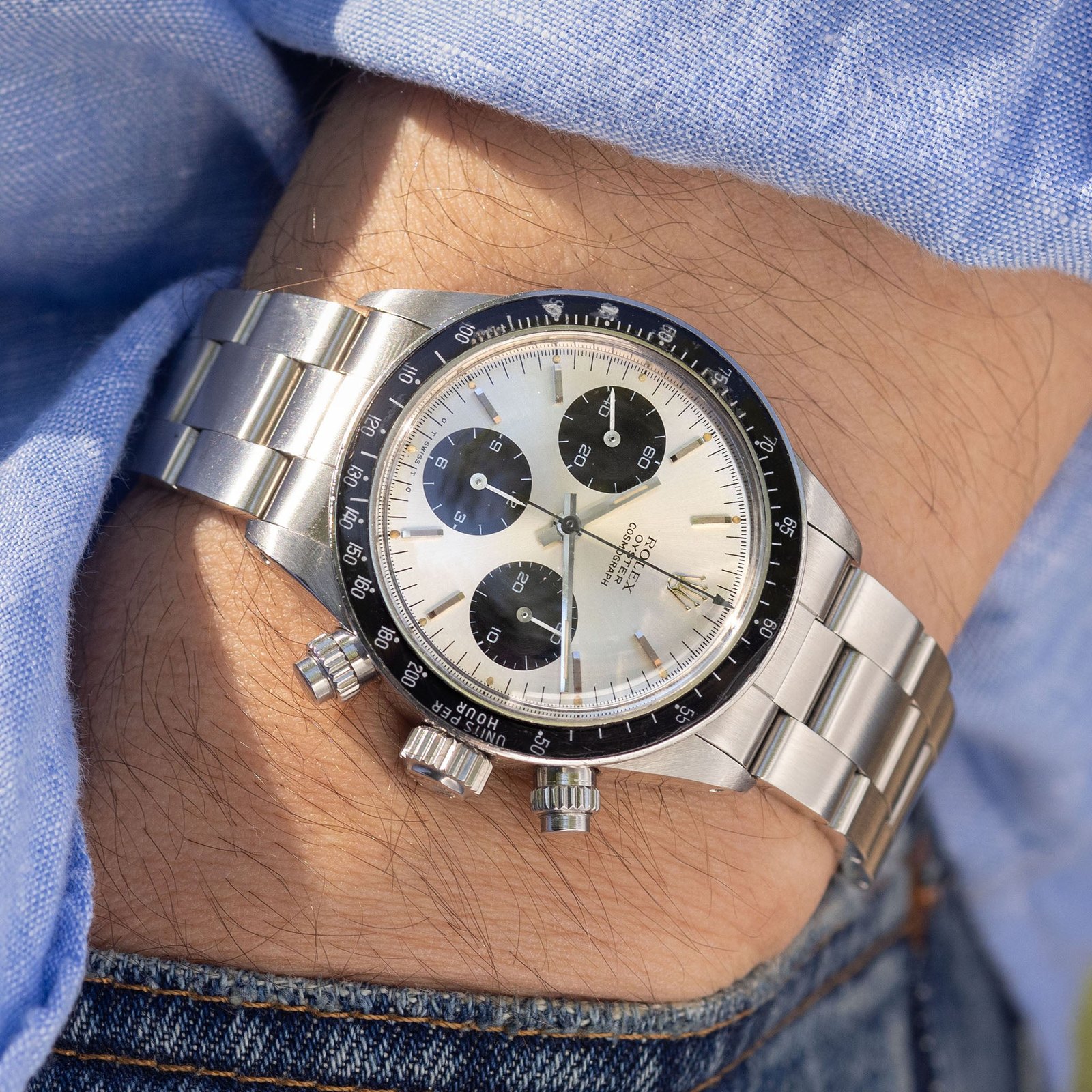
Rolex Cosmograph Daytona 6263 Silver Sigma Dial, 1973
- Maker / attribution
- Rolex (maker)
- Date
- 1973
- Historical period
- Quartz Revolution (1969 – 1990)
- Country of origin
- Switzerland
- Object type
- Wristwatch
- Materials / technique
- silver
- Dimensions
- Case 37 mm
- Stock no.
- W-3781
- Credit line
- Dealer listing, Bulang & Sons (W-3781)
- Catalogue title (original)
- Rolex Cosmograph Daytona 6263 Silver Sigma Dial (English)
View the source record (dealer listing) ↗ (opens another website in a new tab)Suggest a correction
Record summary
Catalogued by Bulang & Sons (dealer), Copenhagen (stock number W-3781), this is a wristwatch by Rolex, made in Switzerland, dated 1973. The Atlas places it in the Quartz Revolution period (1969 – 1990) of its Wristwatches collection. Materials and techniques recorded by the source: silver. Recorded dimensions: Case 37 mm. The record is illustrated with 6 photographs.
Assembled from the source record's structured fields. Dates and attributions are given as the source states them; where a field is missing the Atlas leaves it blank rather than estimating.
Catalogue description
Dealer description — Bulang & Sons
The Rolex Daytona was first introduced in 1963 as the “Cosmograph” reference 6239, designed specifically for professional racing drivers to measure speed and elapsed time. Around 1964–1965, the Daytona name began appearing on the dial, marking Rolex’s role as official timekeeper of the Daytona International Speedway. Its story is defined by three distinct eras — manual-wind, automatic Zenith-powered, and modern in-house references — evolving from a slow-selling tool watch into one of the most coveted luxury sports watches in the world. Produced from 1971 until approximately 1987, the Rolex Daytona reference 6263 is widely considered one of the defining hand-wound Daytona references. Characterised by its screw-down pushers, black acrylic tachymeter bezel and upgraded calibre 727 movement, the 6263 introduced improved water resistance and proudly carried the “Oyster” designation on the dial. Presented here is an early 1973 example featuring a particularly desirable and rare silver “Sigma” dial variation. Sigma dials are identified by the small Greek sigma symbols (σ T SWISS T σ) positioned at the bottom of the dial, signifying that the hands and hour markers are crafted from solid gold. Interestingly, Rolex omitted the “Daytona” signature from certain dials during this period — one of many small experiments carried out at a time when these chronographs were still relatively slow sellers. Hard to imagine today. Introduced in the early 1970s by APRIOR — an association of Swiss watch manufacturers — the Sigma signature was intended to highlight the intrinsic value of precious metals during the height of the quartz crisis, when traditional mechanical watchmaking faced increasing pressure from emerging quartz technology. On steel references such as the 6263, the Sigma designation confirms the use of 18k white gold hour markers rather than plated components, adding another layer of collectability and refinement to the watch. Today, Sigma dials are highly sought after by collectors, representing a short-lived and historically important period in Rolex production. The case on this example remains in excellent condition and retains its correct early Mk1 screw-down pushers — a detail collectors always look for on early 6263s. The early tachymeter bezel shows some light bubbling developed over decades of wear, yet remains in honest and sympathetic condition. The silver dial has developed a soft creamy patina over time, giving the watch a warmer overall appearance, while the sub-dials remain clean and sharply defined. The hour markers and lume on the hands have aged to a matching cream tone, beautifully enhancing the watch’s vintage character. This fine Daytona is fitted with a Rolex Oyster bracelet reference 78350, with end links stamped “571” and a clasp dated “D.” The watch and its hand-wound calibre 727 — based on the legendary Valjoux 72 — have been fully serviced by our watchmaker. One for the purist collector — and perhaps even more appealing for the dreamers who remember when Daytonas were simply tools for timing laps. Specifications: Rolex Cosmograph Daytona Reference 6263 Serial 360xxxx dating to 1973 37mm steel case with black bakelite tachymeter scale bezel Silver “Sigma ” Panda dial MK1 Screw down Pushers Cal. 727 movement Oyster bracelet reference 78350 with 551 end links Fully serviced by our watchmaker
Historical context
Quartz Revolution (1969 – 1990)
Seiko's Astron begins mass quartz timekeeping; traditional industries contract sharply.
Quartz and digital watches transformed the market after 1969. Swiss employment collapsed, Japanese and Hong Kong production soared, and the Swatch (1983) helped the Swiss industry recover; mechanical watches survived as luxury goods.
Read the period in the timelineMore wristwatches from this periodEarlier: Modern Mechanical Horology
Atlas type guide
Wristwatches
Bracelet watches were worn by women from the early nineteenth century — Breguet made one for Caroline Murat, Queen of Naples, in 1810–12 — but the wristwatch only became a man's instrument with military use and aviation in the early twentieth century. Between the World Wars it overtook the pocket watch; the 1920s and 1930s brought rectangular Art Deco cases, water-resistant cases and the first automatic winding systems.
After 1945 the wristwatch became a carrier of identity — dress watches, sports and dive watches, chronographs, calendars — produced by Swiss, American, Japanese, German, Soviet and Chinese industries. The quartz revolution after 1969 and the mechanical renaissance since the 1990s, including the rise of independent watchmakers, complete the story.
What to look for
- The reference number (between the lugs or inside the case back) and serial number, the starting point for dating.
- The calibre: its maker and number are often stamped under the dial or on the bridge.
- Originality of dial, hands and crown — refinished ('redial') dials are common.
- Case material marks: 18K/750, 14K/585, stainless steel, gold-filled, plated.
Dating clues
- Wire-lug cases: before c. 1925.
- Water-resistant screw-down cases: from 1926.
- Quartz movements: from 1969; sapphire crystals widespread after c. 1980.
General guidance written by the Atlas editors about this kind of object. It is not a statement about this particular piece; for that, rely on the source record above and on physical examination.
Related records

Movements & Components · c. 1970s
Rolex watch movement, c. 1970s
Antiquorum auction archive, Geneva

Pocket Watches · 1982
Fake Rolex watch, gold coloured metal, possibly made in Taiwan, 1982; part of a casual outfit, UK, 1982-84.
Victoria and Albert Museum, London

Wristwatches · c. 1920s
Rolex wristwatch, c. 1920s
Antiquorum auction archive, Geneva

Wristwatches · c. 1920s
Rolex wristwatch, ref. 6194, c. 1920s
Antiquorum auction archive, Geneva

Wristwatches · 1970
Wristwatch by Heno, Switzerland, 1970
Museum Rotterdam

Wristwatches · 1960–1986
'Tri-Compax' calendar chronograph wristwatch in gold case, by Universal, Geneva, Switzerland, 1960–1986.
Science Museum Group, London

Wristwatches · 1969–1970
Beta 21 Quartz wristwatch movement, made in Switzerland, 1970.
Science Museum Group, London

Wristwatches · c. 1969
Omega Speedmaster Moonwatch, ref. 145022-69st, c. 1969
Antiquorum auction archive, Geneva