
Wristwatches · Wristwatch
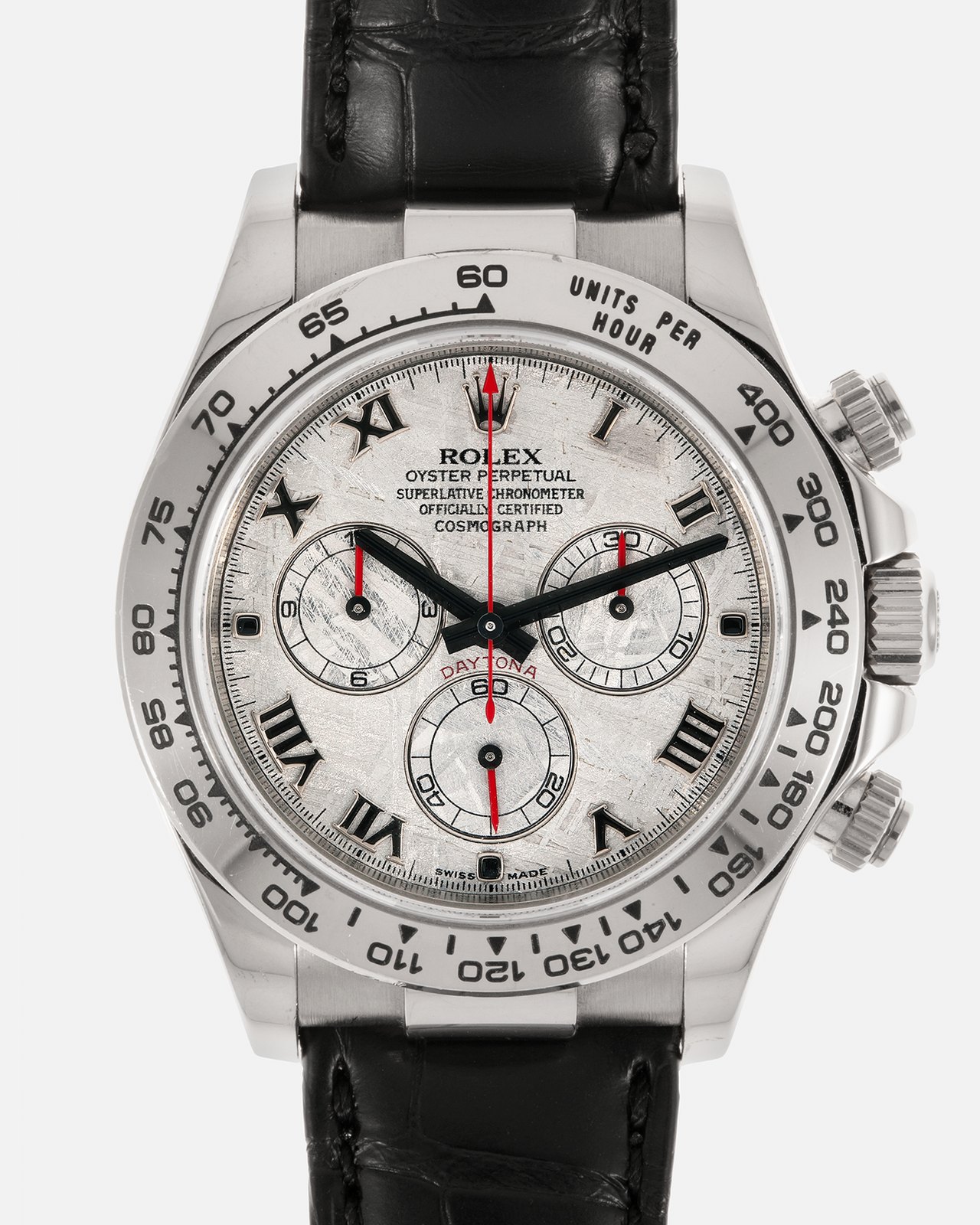
Rolex Cosmograph Daytona 116519 Meteorite White Gold, 2009
- Maker / attribution
- Rolex (maker)
- Date
- 2009
- Historical period
- Mechanical Renaissance (1990 – 2010)
- Country of origin
- Switzerland
- Object type
- Wristwatch
- Materials / technique
- white gold
- Dimensions
- Case 40 mm
- Stock no.
- Product 7320385814615
- Credit line
- Dealer listing, S.Song Watches (product 7320385814615)
- Catalogue title (original)
- Rolex Cosmograph Daytona 116519 Meteorite White Gold (English)
View the source record (dealer listing) ↗ (opens another website in a new tab)Suggest a correction
Record summary
Catalogued by S.Song Watches (dealer), Seattle (stock number Product 7320385814615), this is a wristwatch by Rolex, made in Switzerland, dated 2009. The Atlas places it in the Mechanical Renaissance period (1990 – 2010) of its Wristwatches collection. Materials and techniques recorded by the source: white gold. Recorded dimensions: Case 40 mm. The record is illustrated with 6 photographs.
Assembled from the source record's structured fields. Dates and attributions are given as the source states them; where a field is missing the Atlas leaves it blank rather than estimating.
Catalogue description
Dealer description — S.Song Watches
Known as one of the world's most desirable watches and perhaps the most widely-recognized chronograph model in the world of horology, the Rolex Cosmograph Daytona's design has remained ever-present in the world of motorsport and the watchmaking industry ever since its debut in 1963. With such a rich history spanning decades, the Rolex Cosmograph Daytona has evolved and seen many iterations and references throughout its lifetime, yet its lineage remains unmistakably clear today. The Daytona, like most of Rolex’s lineup, has largely existed as a no-fuss tool watch with usability and legibility paramount. That said, despite its reputation, Rolex do from time to time create highly unusual and crazy-looking watches that are so antithetical to the brand’s DNA that they somehow become cult icons. Models downright insane such as the Rainbow Daytona and Leopard Daytona were panned in the beginning as being ostentatious, but strangely grew on collectors over time, and now commands huge premiums as they realized it is often the models with unusual designs and material configurations that eventually become the most desirable. With that being said, this particular early Ref. 116519 Cosmograph Daytona fitted with an exotic and fascinating meteorite dial you see here today is one such example, as it introduces a playful and eye-catching element to its typically utilitarian design. For context, Rolex acquired a portion of the renowned Gibeon meteorite, discovered in 1836 by Captain J. E. Alexander along the banks of the Great Fish River in Namibia near the town of Gibeon. This meteorite, millions of years old, is thought to have fallen to Earth in prehistoric times, scattering across a broad area. On that note, I think it is also worth elaborating on the uniqueness of meteorites as a material for crafting special watch dials. Due to its otherworldly nature, Rolex subjected individual dial-like medallions of the meteorite to a special acid washing process, which helps bring out the naturally occurring crystalline pattern on the surface of the cross-section—scientifically known as the “Widmanstätten pattern”, or “Thomson structures”. Since the unique patterns on meteorite dials are entirely natural, they will vary slightly from one dial to another, ensuring that no two Rolex meteorite dials are ever exactly alike. The result, as shown in this example, is truly mesmerizing. During my time with it, I was consistently captivated by the beauty of the meteorite stone dial, often losing track of time as I admired it. The lustrous silvery effect on the dial beautifully complements the substantial white gold case. It's also worth noting that the meteorite dial features Roman numerals around the edge as hour markers, three individually recessed sub-dials, and touches of red on the sub-dial and seconds hand, along with the ‘Daytona’ text, adding necessary visual contrast to the Daytona’s otherwise monochromatic appearance. Powering this Ref. 116519 from within is the self-winding Rolex Cal. 4130 movement with 70 hours of power reserve. The Rolex Daytona has been and will always be the de facto flagship icon of Rolex, partly due to its rich history and association with famous individuals throughout history. Beyond the hype and heritage, it is simply a downright stunning watch. At 40mm x 11mm, it wears perfectly on the wrist and has a design language that sits amongst other legendary designs such as the 911 Porsche and Fender Stratocaster. This particular Ref. 116519 is made even more special by the tasteful pairing of a striking meteorite dial and a radiant white gold case. For me, white gold is the stealth wealth metal of choice, as most people will just think it is stainless steel. However, when you strap it on your wrist, the sheer weight of the white gold case will remind you every day exactly what it is.
Historical context
Mechanical Renaissance (1990 – 2010)
Mechanical watches return as cultural objects; independent watchmaking flourishes.
Mechanical watches returned as cultural and luxury objects. Complications, tourbillons and new materials proliferated; independent watchmakers such as George Daniels, F.P. Journe and Philippe Dufour revived artisanal watchmaking; collecting vintage watches became a major field.
Read the period in the timelineMore wristwatches from this periodEarlier: Quartz Revolution
Atlas type guide
Wristwatches
Bracelet watches were worn by women from the early nineteenth century — Breguet made one for Caroline Murat, Queen of Naples, in 1810–12 — but the wristwatch only became a man's instrument with military use and aviation in the early twentieth century. Between the World Wars it overtook the pocket watch; the 1920s and 1930s brought rectangular Art Deco cases, water-resistant cases and the first automatic winding systems.
After 1945 the wristwatch became a carrier of identity — dress watches, sports and dive watches, chronographs, calendars — produced by Swiss, American, Japanese, German, Soviet and Chinese industries. The quartz revolution after 1969 and the mechanical renaissance since the 1990s, including the rise of independent watchmakers, complete the story.
What to look for
- The reference number (between the lugs or inside the case back) and serial number, the starting point for dating.
- The calibre: its maker and number are often stamped under the dial or on the bridge.
- Originality of dial, hands and crown — refinished ('redial') dials are common.
- Case material marks: 18K/750, 14K/585, stainless steel, gold-filled, plated.
Dating clues
- Wire-lug cases: before c. 1925.
- Water-resistant screw-down cases: from 1926.
- Quartz movements: from 1969; sapphire crystals widespread after c. 1980.
General guidance written by the Atlas editors about this kind of object. It is not a statement about this particular piece; for that, rely on the source record above and on physical examination.
Related records

Movements & Components · c. 1970s
Rolex watch movement, c. 1970s
Antiquorum auction archive, Geneva

Pocket Watches · 1982
Fake Rolex watch, gold coloured metal, possibly made in Taiwan, 1982; part of a casual outfit, UK, 1982-84.
Victoria and Albert Museum, London

Wristwatches · c. 1920s
Rolex wristwatch, c. 1920s
Antiquorum auction archive, Geneva

Wristwatches · c. 1920s
Rolex wristwatch, ref. 6194, c. 1920s
Antiquorum auction archive, Geneva

Wristwatches · 2008
Wristwatch by Breitling?, 2008
Museum Rotterdam

Wristwatches · c. 1990s
Audemars Piguet Bamboo, c. 1990s
Antiquorum auction archive, Geneva

Wristwatches · c. 1990
Audemars Piguet Huitieme Perpetual Calendar, ref. 25696PT, c. 1990
Antiquorum auction archive, Geneva

Wristwatches · c. 1990
Breitling Chronomat, ref. b13050.1, c. 1990
Antiquorum auction archive, Geneva