
Wristwatches · Wristwatch
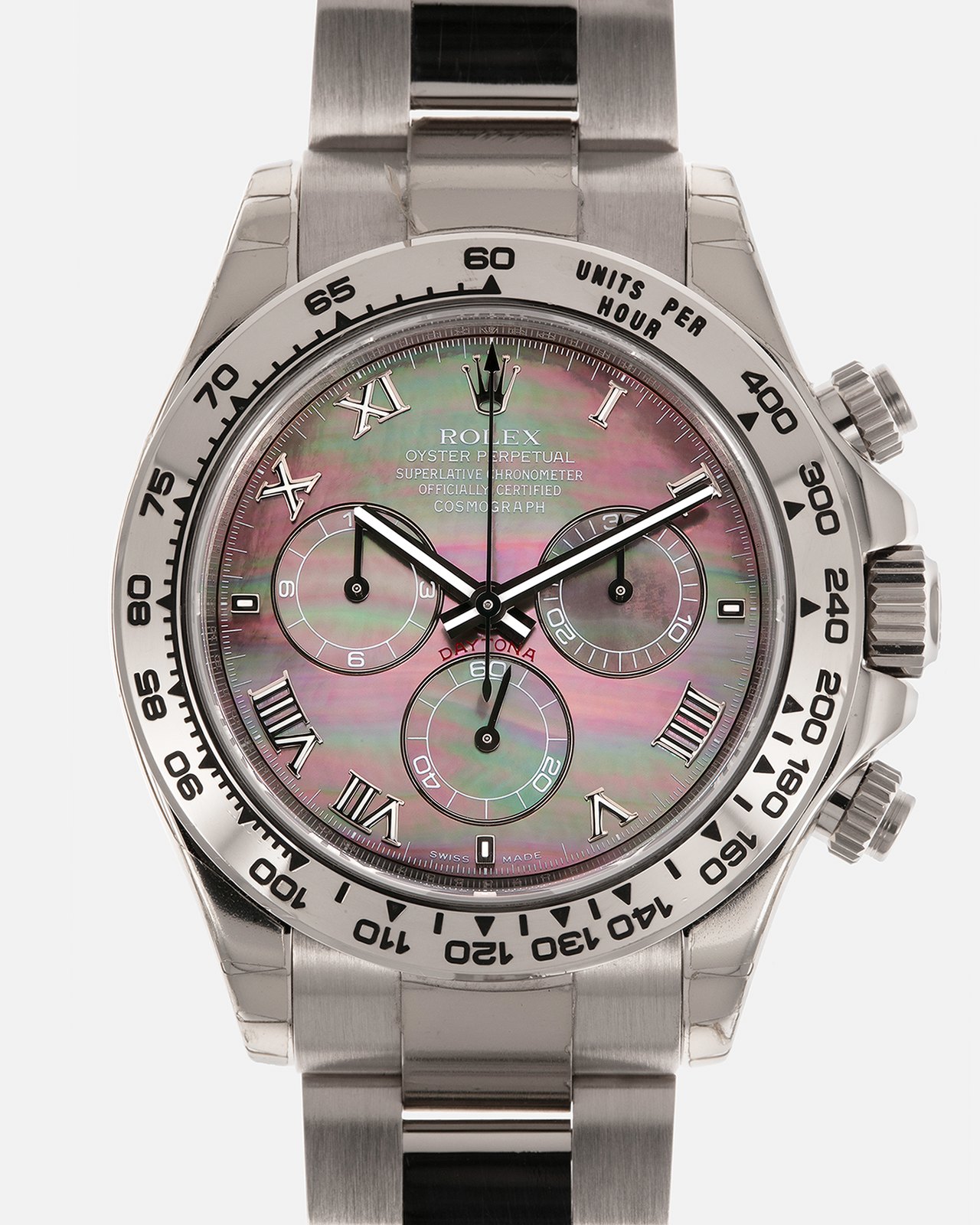
Rolex Cosmograph Daytona 116509 Black Tahitian Mother Of Pearl Stickered, 2007
- Maker / attribution
- Rolex (maker)
- Date
- 2007
- Historical period
- Mechanical Renaissance (1990 – 2010)
- Country of origin
- Switzerland
- Object type
- Wristwatch
- Dimensions
- Case 40 mm
- Stock no.
- Product 7551653118039
- Credit line
- Dealer listing, S.Song Watches (product 7551653118039)
- Catalogue title (original)
- Rolex Cosmograph Daytona 116509 Black Tahitian Mother Of Pearl Stickered (English)
View the source record (dealer listing) ↗ (opens another website in a new tab)Suggest a correction
Record summary
Catalogued by S.Song Watches (dealer), Seattle (stock number Product 7551653118039), this is a wristwatch by Rolex, made in Switzerland, dated 2007. The Atlas places it in the Mechanical Renaissance period (1990 – 2010) of its Wristwatches collection. Recorded dimensions: Case 40 mm. The record is illustrated with 6 photographs.
Assembled from the source record's structured fields. Dates and attributions are given as the source states them; where a field is missing the Atlas leaves it blank rather than estimating.
Catalogue description
Dealer description — S.Song Watches
I really don’t think I need to go too much into the Daytona, as pretty much everyone, watch enthusiast or not, knows or has at least heard about this watch. It has always been the case that the ultimate Rolex is, ironically, not a solid-gold President Day-Date, but the Cosmograph Daytona. With long waitlists and authorised dealers these days not even entertaining you unless you’ve bought another (or a few) Rolex before, the Daytona is without a doubt the most desirable and hardest to get Rolex on the market today. However, I believe it remains crucial to reiterate the Rolex Daytona's origin story briefly. In 1959, the Daytona International Speedway emerged as the swiftest racing track in the United States, and in 1962, it became renowned for hosting the esteemed “Rolex 24 At Daytona” endurance race. Recognizing the significance of this racing venue, Rolex was designated as the official timepiece/timekeeper of the Daytona International Speedway. In 1963, Rolex solidified its connection to the illustrious racetrack by christening its newly introduced racing chronograph as the Cosmograph Daytona. The Daytona, like most of Rolex’s lineup, has largely existed as a no-fuss tool watch with usability and legibility paramount. That said, despite its reputation, Rolex do from time to time create some highly unusual and crazy-looking watches that are so antithetical to the brand’s DNA that they somehow become cult icons. Models downright insane, such as the Rainbow Daytona and Leopard Daytona, were panned in the beginning as being ostentatious, but strangely grew on collectors over time, and now command huge premiums as they realised it is often the models with unusual designs and material configurations that eventually become the most desirable. With that being said, this particular early 116509 Cosmograph Daytona fitted with an exotic and visually fascinating black Tahitian mother-of-pearl dial you see here today is one such example, as it introduces a playful and eye-catching element to its typically utilitarian blueprint. For context, the black Tahitian mother-of-pearl used on this dial originates from the Pinctada Margaritifera , the black-lipped oyster native to the warm lagoons of French Polynesia, especially around Tahiti. Unlike standard white mother-of-pearl, this variety forms naturally dark layers of nacre (the inner shell), producing the unmistakable iridescence collectors prize—tones that can shift between shades of deep blue, peacock green, aubergine, and even soft pistachio depending on the angle of light. Its colour isn’t “black” in the literal sense; it’s the result of conchiolin-rich layers absorbing and scattering light as they accumulate over time. Because every oyster grows its nacre differently, each slice of black Tahitian mother-of-pearl carries its own distinct pattern, depth, and play of colour, ensuring that no two dials ever look quite the same. The result is a visual spectacle. In person, the dial pulls you in immediately. I found myself repeatedly pausing just to watch the colours shift across its surface. Its iridescence plays beautifully against the weight and sheen of the white-gold case. This example also carries Roman numerals around the periphery, three neatly recessed sub-dials, and a contrasting red ‘DAYTONA’ script above the 6:00 sub-dial that gives the dial a well-judged pop of colour. Powering this 116509 from within is the robust self-winding Rolex Cal. 4130 movement with 70 hours of power reserve. The Rolex Daytona has been and will always be the de facto flagship icon of Rolex, partly due to its rich history and association with famous individuals throughout history. Beyond the hype and heritage, it is simply a downright stunning watch. At 40mm x 12.4mm, it wears perfectly on the wrist and has a timeless design language that sits amongst other legendary icons such as the 911 Porsche and Fender Stratocaster. This particular 116509 is made even more special by the tasteful pairing of a striking mother-of-pearl dial and a radiant white gold case. For me, white gold will always be the stealth wealth metal of choice, as most people will just think it is stainless steel. However, when you strap it on your wrist, the sheer heft of the white gold case will remind you every day exactly the kind of watch it is.
Historical context
Mechanical Renaissance (1990 – 2010)
Mechanical watches return as cultural objects; independent watchmaking flourishes.
Mechanical watches returned as cultural and luxury objects. Complications, tourbillons and new materials proliferated; independent watchmakers such as George Daniels, F.P. Journe and Philippe Dufour revived artisanal watchmaking; collecting vintage watches became a major field.
Read the period in the timelineMore wristwatches from this periodEarlier: Quartz Revolution
Atlas type guide
Wristwatches
Bracelet watches were worn by women from the early nineteenth century — Breguet made one for Caroline Murat, Queen of Naples, in 1810–12 — but the wristwatch only became a man's instrument with military use and aviation in the early twentieth century. Between the World Wars it overtook the pocket watch; the 1920s and 1930s brought rectangular Art Deco cases, water-resistant cases and the first automatic winding systems.
After 1945 the wristwatch became a carrier of identity — dress watches, sports and dive watches, chronographs, calendars — produced by Swiss, American, Japanese, German, Soviet and Chinese industries. The quartz revolution after 1969 and the mechanical renaissance since the 1990s, including the rise of independent watchmakers, complete the story.
What to look for
- The reference number (between the lugs or inside the case back) and serial number, the starting point for dating.
- The calibre: its maker and number are often stamped under the dial or on the bridge.
- Originality of dial, hands and crown — refinished ('redial') dials are common.
- Case material marks: 18K/750, 14K/585, stainless steel, gold-filled, plated.
Dating clues
- Wire-lug cases: before c. 1925.
- Water-resistant screw-down cases: from 1926.
- Quartz movements: from 1969; sapphire crystals widespread after c. 1980.
General guidance written by the Atlas editors about this kind of object. It is not a statement about this particular piece; for that, rely on the source record above and on physical examination.
Related records

Movements & Components · c. 1970s
Rolex watch movement, c. 1970s
Antiquorum auction archive, Geneva

Pocket Watches · 1982
Fake Rolex watch, gold coloured metal, possibly made in Taiwan, 1982; part of a casual outfit, UK, 1982-84.
Victoria and Albert Museum, London

Wristwatches · c. 1920s
Rolex wristwatch, c. 1920s
Antiquorum auction archive, Geneva

Wristwatches · c. 1920s
Rolex wristwatch, ref. 6194, c. 1920s
Antiquorum auction archive, Geneva

Wristwatches · 2008
Wristwatch by Breitling?, 2008
Museum Rotterdam

Wristwatches · c. 1990s
Audemars Piguet Bamboo, c. 1990s
Antiquorum auction archive, Geneva

Wristwatches · c. 1990
Audemars Piguet Huitieme Perpetual Calendar, ref. 25696PT, c. 1990
Antiquorum auction archive, Geneva

Wristwatches · c. 1990
Breitling Chronomat, ref. b13050.1, c. 1990
Antiquorum auction archive, Geneva