
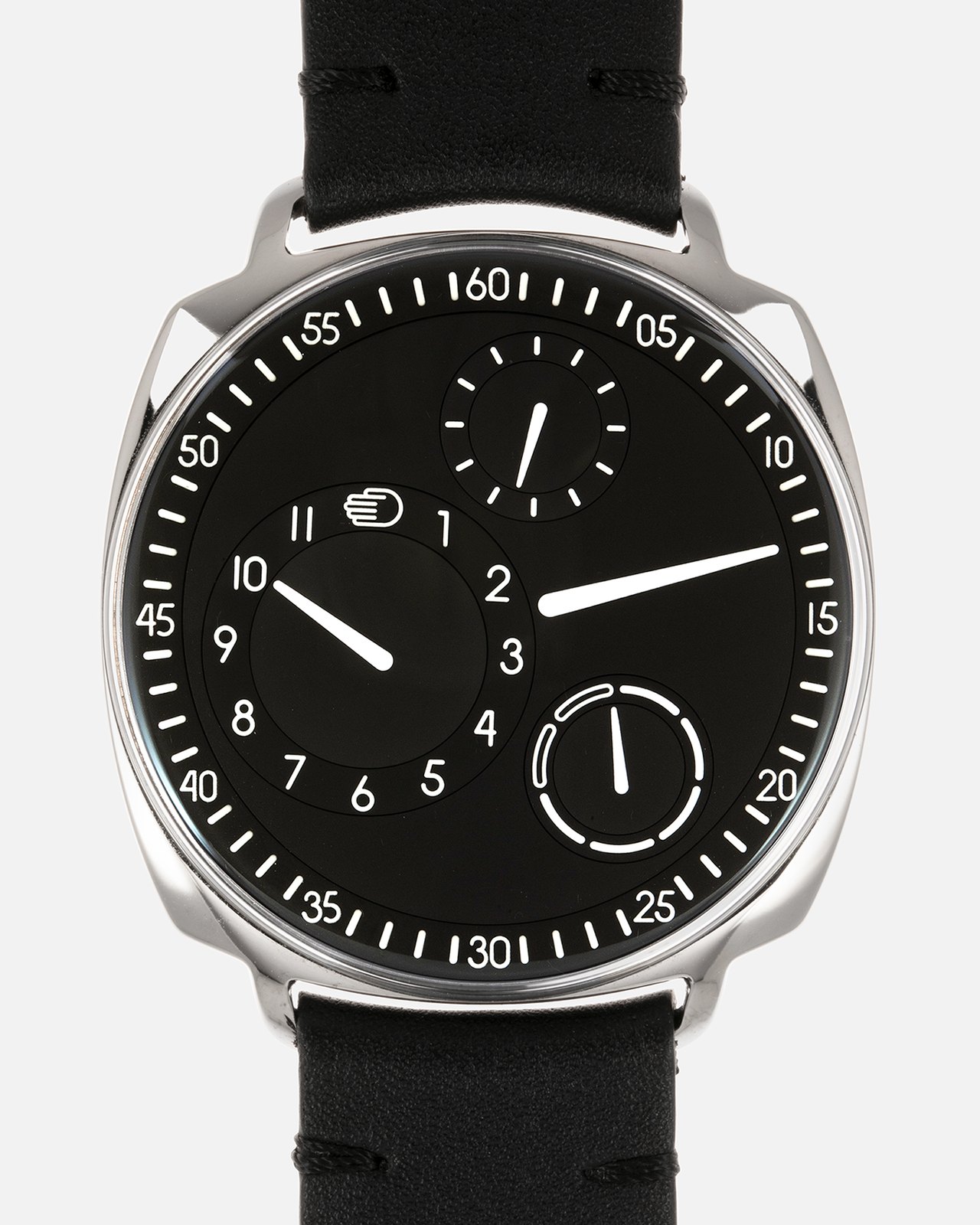
Wristwatches · Wristwatch
Ressence Type 1 Squared, 2022
- Maker / attribution
- Ressence (maker)
- Date
- 2022
- Historical period
- Contemporary Horology (2010 – Present)
- Country of origin
- Unrecorded in source
- Object type
- Wristwatch
- Dimensions
- Case 41 mm
- Stock no.
- Product 6884358160471
- Credit line
- Dealer listing, S.Song Watches (product 6884358160471)
- Catalogue title (original)
- Ressence Type 1 Squared (English)
View the source record (dealer listing) ↗ (opens another website in a new tab)Suggest a correction
Record summary
Catalogued by S.Song Watches (dealer), Seattle (stock number Product 6884358160471), this is a wristwatch by Ressence, dated 2022. The Atlas places it in the Contemporary Horology period (2010 – Present) of its Wristwatches collection. Recorded dimensions: Case 41 mm. The record is illustrated with 6 photographs.
Assembled from the source record's structured fields. Dates and attributions are given as the source states them; where a field is missing the Atlas leaves it blank rather than estimating.
Catalogue description
Dealer description — S.Song Watches
I once heard from collectors that your first time handling a Ressence timepiece can actually be quite a polarising experience, and I can personally attest to that. When I first held a Ressence Type 3 several years ago, I vividly recall experiencing a blend of bewilderment, enthusiasm, and awe. This was due to the Type 3's unprecedented design that diverged from conventional watchmaking. In fact, I even momentarily pondered at some point during that first encounter whether this mechanical work of art was actually a collaborative design with Apple given its remarkably minimal and intuitive interface, but I digress. In case you're not familiar with Ressence, they are an acclaimed design studio based out of Antwerp, Belgium, known for their highly sought-after watch designs that boast an incredibly futuristic and visually captivating aesthetic. Led by industrial designer Benoît Mintiens, Ressence reimagined the conventional way in which a mechanical timepiece would typically operate and function. You might wonder how they achieved this. Well, prepare to abandon any preconceived notions you have about conventional watch dial configurations as we delve further into the fascinating features that make the Ressence Type 1², the watch we're highlighting today, truly captivating. Let's begin with the 41mm x 11.5mm case of the Type 1², which is crafted entirely from high-polished grade 5 titanium, resulting in a lightweight construction that contributes to its overall comfort when worn. The case has an interesting multi-faceted appearance, it features a combination of curves and angular surfaces that adds a sense of dimensional depth and finesse to the watch. This design choice not only enhances its aesthetic appeal but also contributes to its versatility. In fact, the Type 1² is among the slimmest and most versatile. Additionally, the lug design also bears a slight resemblance to the wired lugs seen on the Panerai Radiomir, but this is not the case here (no pun intended). These short lugs are thoughtfully designed to complement rather than disrupt the already complex and intricate geometry of the case. Moving onto the Type 1²’s super clean and crisp regulator-style dial layout, you can see that the indications are neatly and orderly isolated, creating a visually satisfying display. While the Type 1²’s may appear seemingly avant-garde to some, it is actually quite simple to read and understand. Alongside the minute scale on the outer periphery and the hour indicator (referring to the sub-dial specifically with the Ressence 'hand' logo), there are two additional sub-dials for a running-seconds and a day indication which uses two hollowed-out batons to signify the weekend. Together, these indications can be conveniently operated via a flip-out lever that cleverly folds back into the caseback when not in use. To set the watch, all that is required for the user to do is to just pop out the lever and literally turn it like a key. As you engage the lever to set the time, you'll notice that the individual sub-dials rotate in a planetary/orbital fashion, creating an engaging and intriguing visual experience. Powering this planetary/orbital display is a self-winding, ETA-based Cal. 2894/2 that has been extensively customized with an in-house patented Ressence Orbital Convex System (ROCS) 1 Module. Due to the demanding torque required by the Type 1²’s planetary display, it only holds a modest but solid power reserve of 36 hours at 28,800 vph. The Type 1²'s dial layout is not only visually captivating but also reflects Ressence's design philosophy and their commitment to pushing the boundaries of independent watchmaking. Whether it's the elegant simplicity or the incorporation of cutting-edge technical innovation into a Ressence design, there's a distinct charm to the timepieces they make, such as this Type 1². It serves as a testament to Ressence's adventurous design ethos and their unwavering belief in their vision. In terms of ‘wild card’ watch designs, the Type 1² undoubtedly ranks high on my list. Personally, I wholeheartedly welcome and embrace this approach, as it adds an exciting dimension to the vast world of independent watchmaking.
Historical context
Contemporary Horology (2010 – Present)
Silicon components, connected watches, optical-lattice research clocks and a thriving independent scene.
Smartwatches became the world's best-selling watches, while mechanical watchmaking focuses on craft, innovation (silicon components, new escapements) and independent makers.
Read the period in the timelineMore wristwatches from this periodEarlier: Mechanical Renaissance
Atlas type guide
Wristwatches
Bracelet watches were worn by women from the early nineteenth century — Breguet made one for Caroline Murat, Queen of Naples, in 1810–12 — but the wristwatch only became a man's instrument with military use and aviation in the early twentieth century. Between the World Wars it overtook the pocket watch; the 1920s and 1930s brought rectangular Art Deco cases, water-resistant cases and the first automatic winding systems.
After 1945 the wristwatch became a carrier of identity — dress watches, sports and dive watches, chronographs, calendars — produced by Swiss, American, Japanese, German, Soviet and Chinese industries. The quartz revolution after 1969 and the mechanical renaissance since the 1990s, including the rise of independent watchmakers, complete the story.
What to look for
- The reference number (between the lugs or inside the case back) and serial number, the starting point for dating.
- The calibre: its maker and number are often stamped under the dial or on the bridge.
- Originality of dial, hands and crown — refinished ('redial') dials are common.
- Case material marks: 18K/750, 14K/585, stainless steel, gold-filled, plated.
Dating clues
- Wire-lug cases: before c. 1925.
- Water-resistant screw-down cases: from 1926.
- Quartz movements: from 1969; sapphire crystals widespread after c. 1980.
General guidance written by the Atlas editors about this kind of object. It is not a statement about this particular piece; for that, rely on the source record above and on physical examination.
Related records
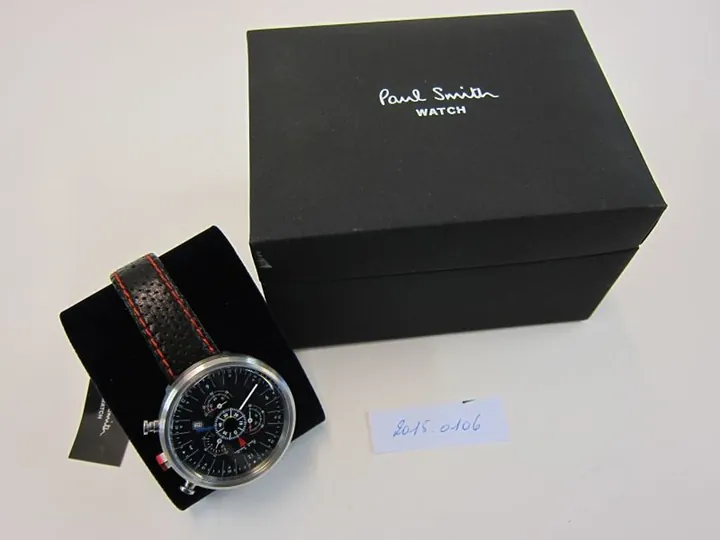
Wristwatches · 2010
Wristwatch, 2010
Modemuseum Hasselt
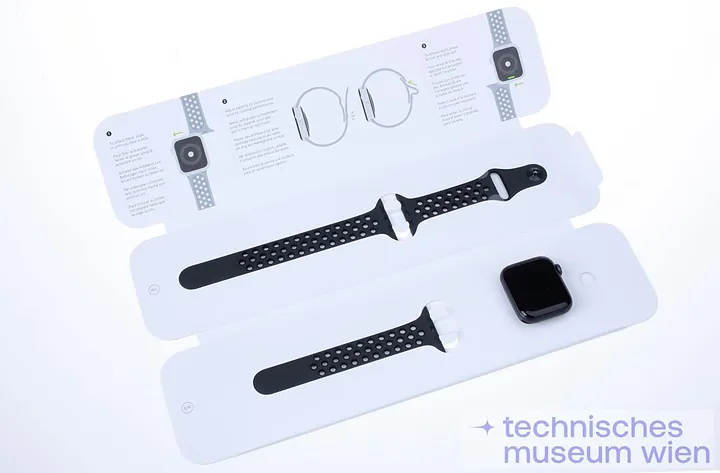
Wristwatches · 2018 (Series 4 released in September 2018; '1977' in the source is the model number A1977)
Apple Watch Series 4 (GPS, 40 mm, model A1977), 2018
Vienna Museum of Science and Technology
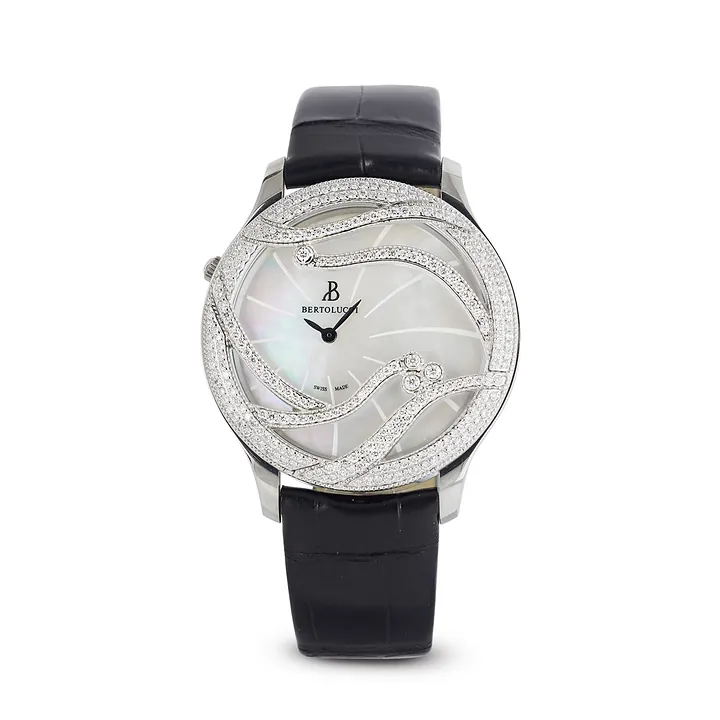
Wristwatches · c. 2010s
Bertolucci Stria III, ref. 11513.50.45.B88.6C1.501, c. 2010s
Antiquorum auction archive, Geneva
Wristwatches · c. 2010s
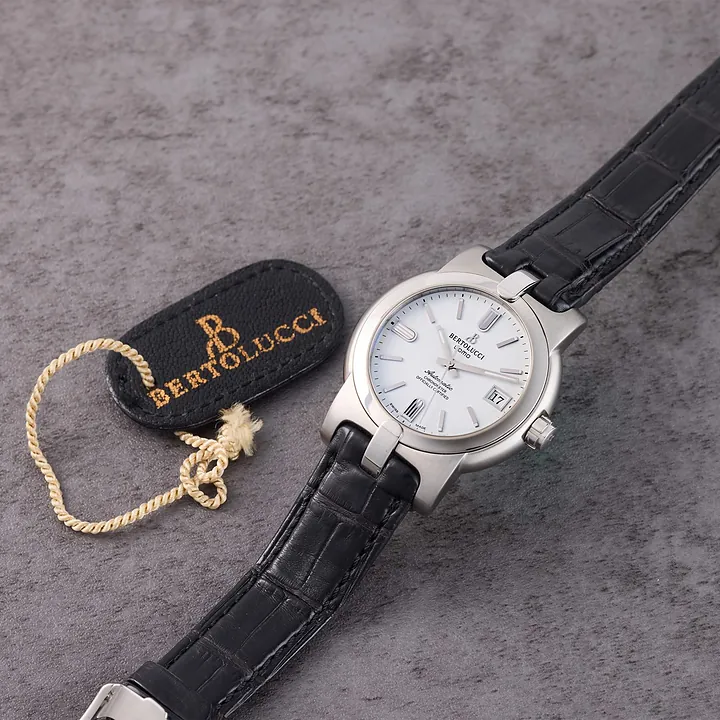
Bertolucci Uoma, ref. 824.51.41.10B, c. 2010s
Antiquorum auction archive, Geneva

Wristwatches · c. 2010s
Breguet Type XXI, ref. 3810, c. 2010s (Antiquorum Lot 381-24)
Antiquorum auction archive, Geneva

Wristwatches · c. 2010s
Breguet Type XXI, ref. 3810, c. 2010s (Antiquorum Lot 386-229)
Antiquorum auction archive, Geneva

Wristwatches · Sold in September 2010
Breitling Cosmonaute, ref. A 22322, Sold in September 2010
Antiquorum auction archive, Geneva
Wristwatches · c. 2010s
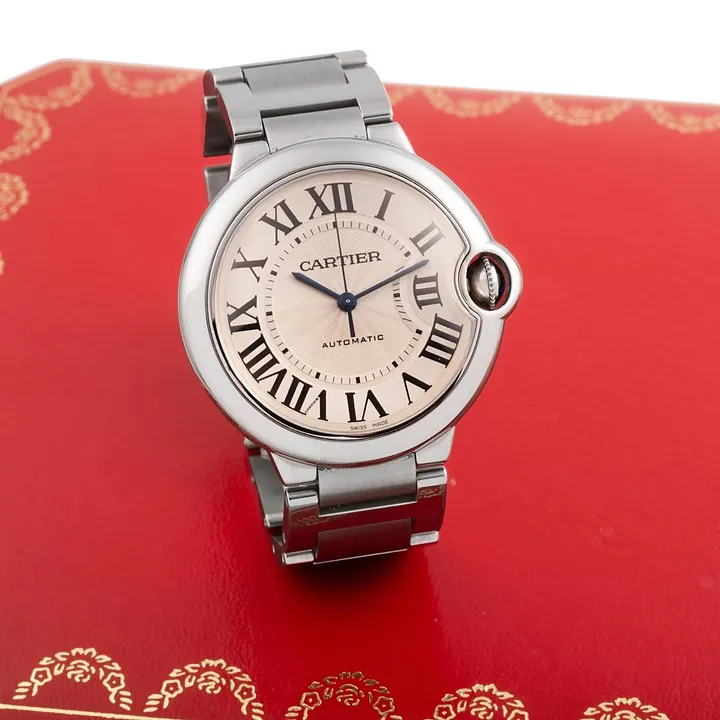
Cartier Ballon Bleu, ref. 3284, c. 2010s
Antiquorum auction archive, Geneva