
Pocket Watches · Pocket watch
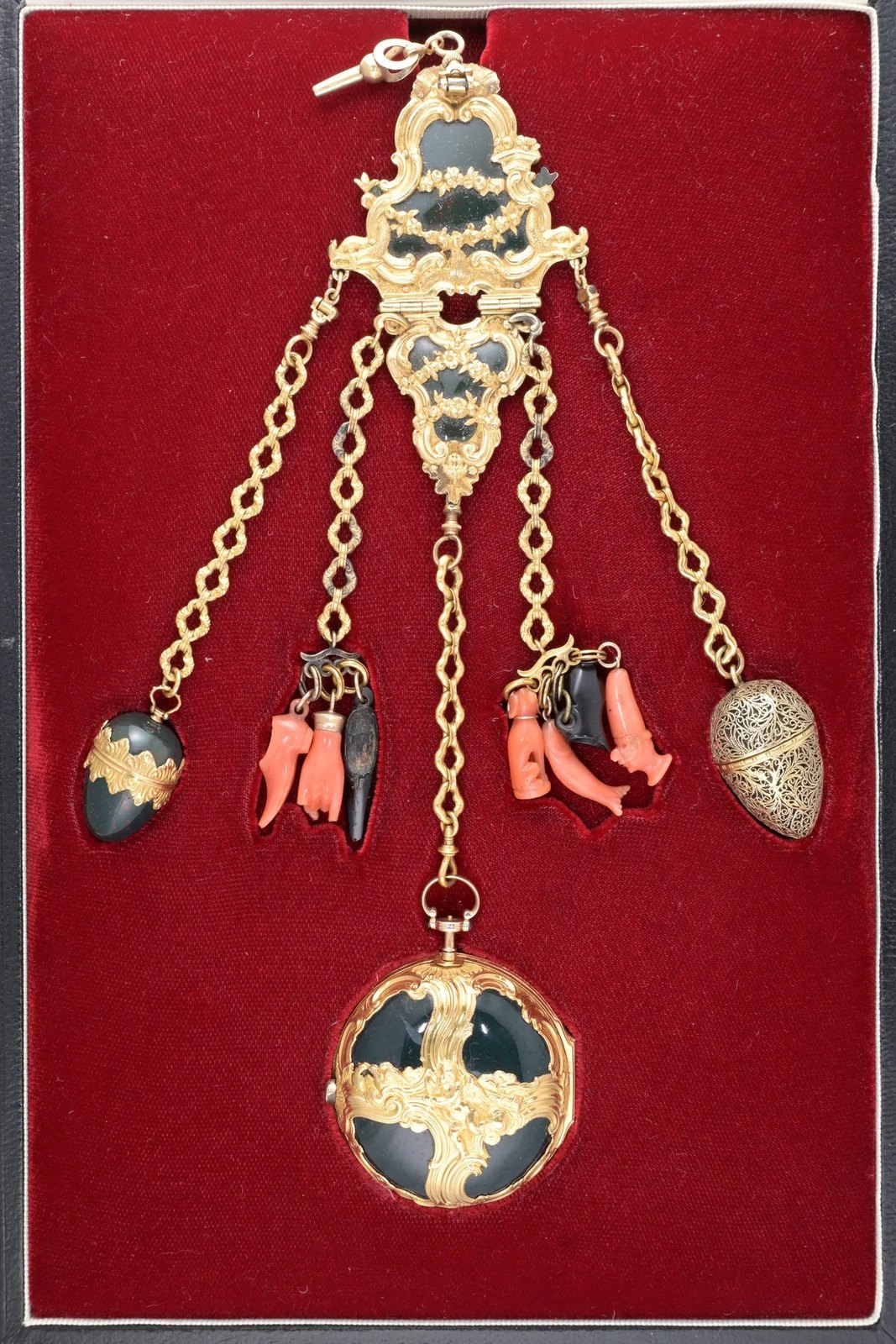
Rare Gold and Bloodstone Chatelaine Watch, circa 1750
- Maker / attribution
- Unrecorded in source
- Date
- c. 1750
- Historical period
- Precision & Scientific Horology (1750 – 1850)
- Country of origin
- Unrecorded in source
- Object type
- Pocket watch
- Materials / technique
- gold
- Stock no.
- A10920
- Credit line
- Dealer listing, Pieces of Time (A10920)
- Catalogue title (original)
- Rare Gold and Bloodstone Chatelaine Watch (English)
View the source record (dealer listing) ↗ (opens another website in a new tab)Suggest a correction
Record summary
Catalogued by Pieces of Time (dealer), London (stock number A10920), this is a pocket watch, dated c. 1750. The Atlas places it in the Precision & Scientific Horology period (1750 – 1850) of its Pocket Watches collection. Materials and techniques recorded by the source: gold. The record is illustrated with 6 photographs.
Assembled from the source record's structured fields. Dates and attributions are given as the source states them; where a field is missing the Atlas leaves it blank rather than estimating.
Catalogue description
Dealer description — Pieces of Time
A mid 18 th Century English verge in a fine 22 carat gold mounted bloodstone consular case and matching chatelaine. Full plate fire gilt movement with square baluster pillars. Pierced and engraved masked cock, pierced and engraved foot and plate for the silver regulator disc. Fusee and chain with worm and wheel barrel setup between the plates. Plain three arm gilt balance, blue steel spiral hairspring. Wound through the white enamel dial, Roman and Arabic numerals, blue steel beetle and poker hands. Polished bloodstone consular case with gold mounts. A single piece of bloodstone forms the back of the case secured to the hinged gold bezels by a gold repousse frame chased and engraved with a representation of a cherub and doves. The front bezel set with four separate pieces of bloodstone. Gold pendant and bow. Fine matching chatelaine, the gilt clip faced with a thin piece of bloodstone secured under a gold repousse frame. Similarly decorated cartouche attached to the clip by a hinge. Five matching chains are supported by the clip of alternating cast links and gold rings. The watch hangs from the centre chain on a small hinged gold clip with threaded safety collar. The outer chains both have egg shaped accessories of differing design. The smaller of these is constructed in a similar fashion to the watch with two bloodstone shells mounted on a hinged gold middle. The other is formed from fine gold filigree work joined by a screw thread and has a gilt lining painted black. The two inner chains have five well carved pieces of coral in the form of a hand, a shoe, a dog, a fish and head of a jester. Two other small black carvings, possibly jet, are in the form of a shoe and a jug. Additionally, and most unusually, the gold watch key is attached to the top of the chatelaine by a hinge and swivel hinged gilt clip with threaded safety collar. Recent red velvet lined black morocco fitted display box.
Historical context
Precision & Scientific Horology (1750 – 1850)
Harrison solves longitude; Mudge invents the lever; Breguet's Paris workshop defines the modern watch.
From 1750 to 1850 the watch became a precision instrument. Mudge's lever escapement, the cylinder escapement, Lépine's thin bar calibre, Breguet's innovations (overcoil, tourbillon, perpétuelle) and the pocket chronometer of Arnold and Earnshaw all date from this period, while verge watches remained common in cheaper production.
Read the period in the timelineMore pocket watches from this periodEarlier: Early Modern Horology
Atlas type guide
Pocket watches
The pocket watch was the dominant personal timekeeper from the late seventeenth century until the First World War. Its development tracks the history of the escapement: verge watches with fusees until the late eighteenth century; Thomas Mudge's lever escapement (c. 1755) and the cylinder escapement popularised by George Graham and later by Swiss makers; and the Swiss and English lever watches of the nineteenth century. Lépine's bar-bridge calibre and keyless winding made watches thinner and easier to use.
Industrialisation transformed the trade: American factories such as Waltham (from 1850) and Elgin produced interchangeable parts by machine, and Swiss makers responded with their own mechanisation after the 1876 Philadelphia Exhibition. By 1900 a reliable watch was affordable to millions; the finest makers continued to produce complications and precision watches.
What to look for
- The escapement: verge (crown wheel), cylinder, duplex, English or Swiss lever.
- Key winding (a square arbor in dial or back) or keyless crown winding.
- Signatures and serial numbers on the movement, dial and inside case back.
- Hallmarks, case maker's marks and gold or silver standards stamped in the case.
- Dial material: enamel, silver, gold, later printed metal.
Dating clues
- Verge watches dominate before c. 1800; cylinder watches c. 1770–1900; lever watches after c. 1820.
- Keyless winding: increasingly common after c. 1860.
- Manufacturer serial number lists exist for Waltham, Elgin, Longines, Omega, Patek Philippe and others.
General guidance written by the Atlas editors about this kind of object. It is not a statement about this particular piece; for that, rely on the source record above and on physical examination.
Related records
Pocket Watches · 1800–1899
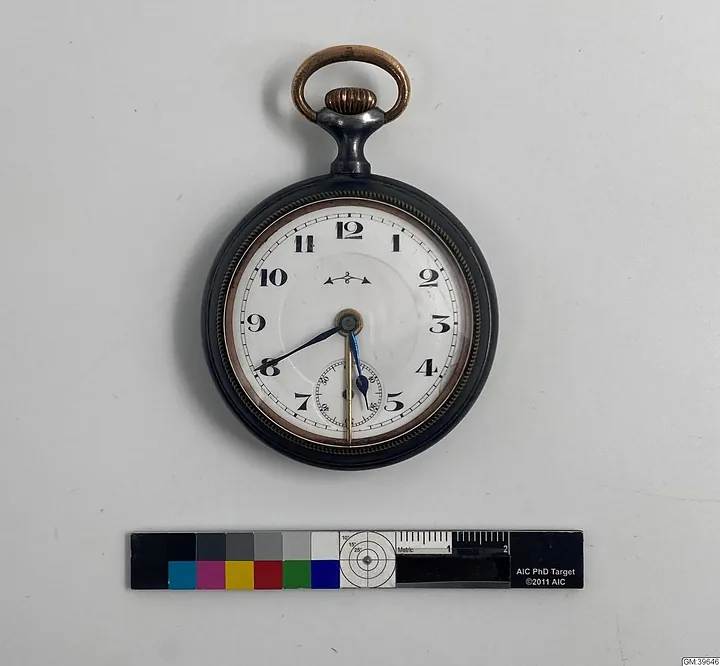
Alarm pocket watch by Eterna w, Gothenburg, 1800–1899
Museum of Gothenburg
Pocket Watches · 1820
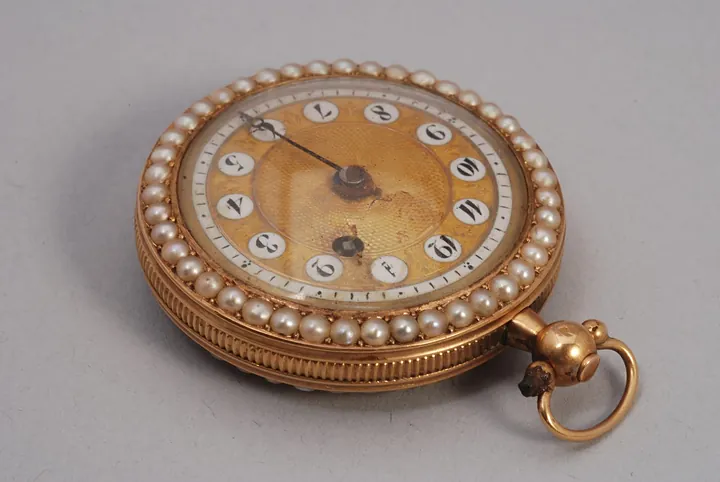
Pocket watch by Chevalier & Cochet, 1820
Museum Rotterdam
Pocket Watches · c. 1740–60
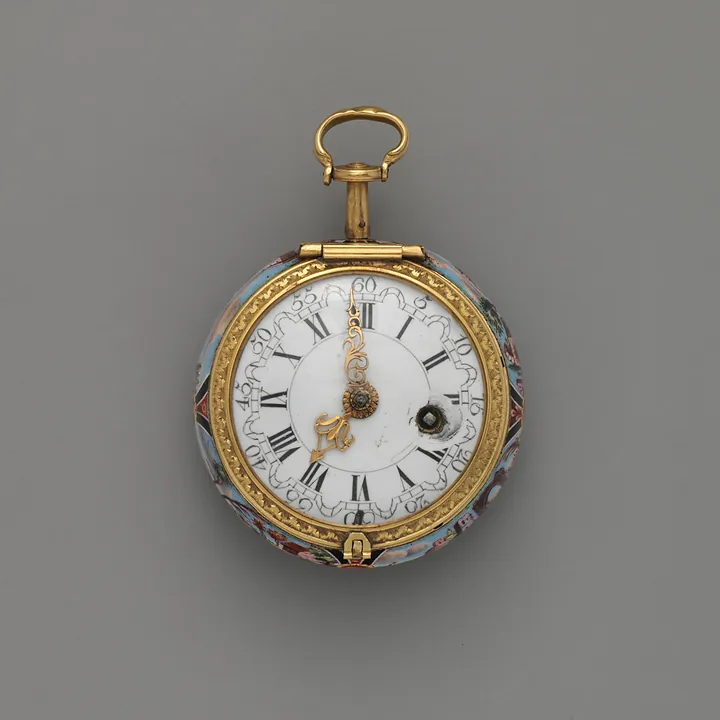
Watch by Charles Cabrier II, England, c. 1740–60 (The Met 17.190.1458)
The Metropolitan Museum of Art, New York
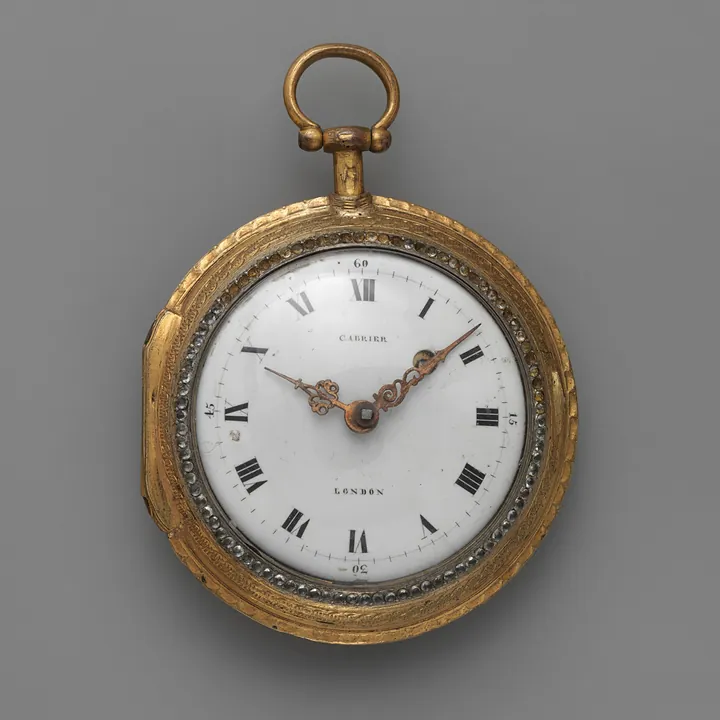
Pocket Watches · c. 1740–60
Watch by Charles Cabrier II, England, c. 1740–60 (The Met 17.190.1461)
The Metropolitan Museum of Art, New York
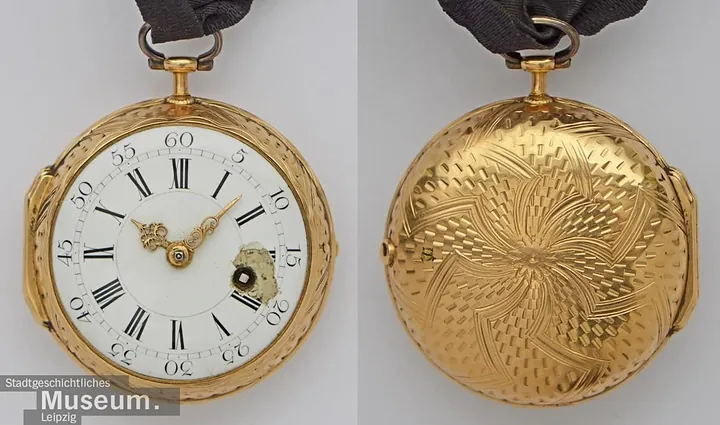
Pocket Watches · 1745–1755
Pocket watch by Jean Baptiste Baillon, France, 1745–1755
Museum of City History Leipzig
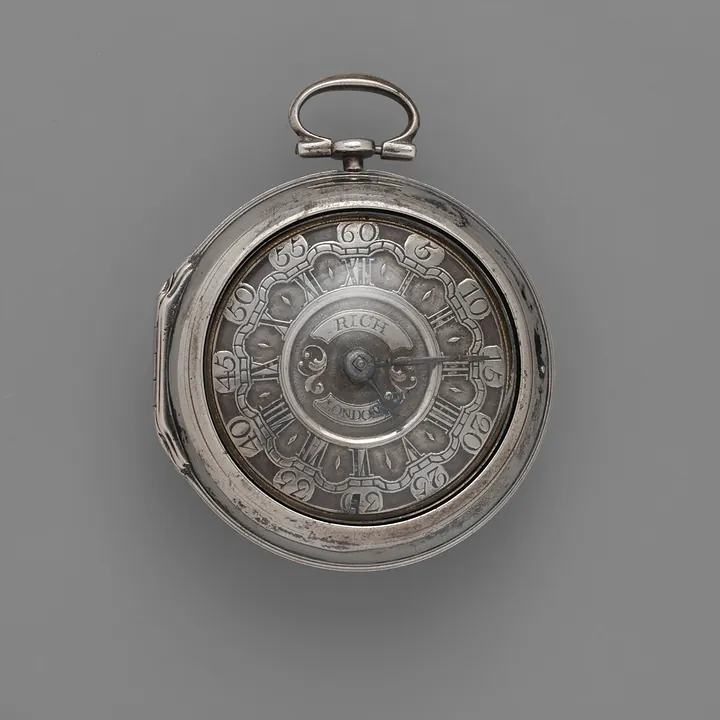
Pocket Watches · c. 1751–52
Watch by John Rich, England, c. 1751–52
The Metropolitan Museum of Art, New York
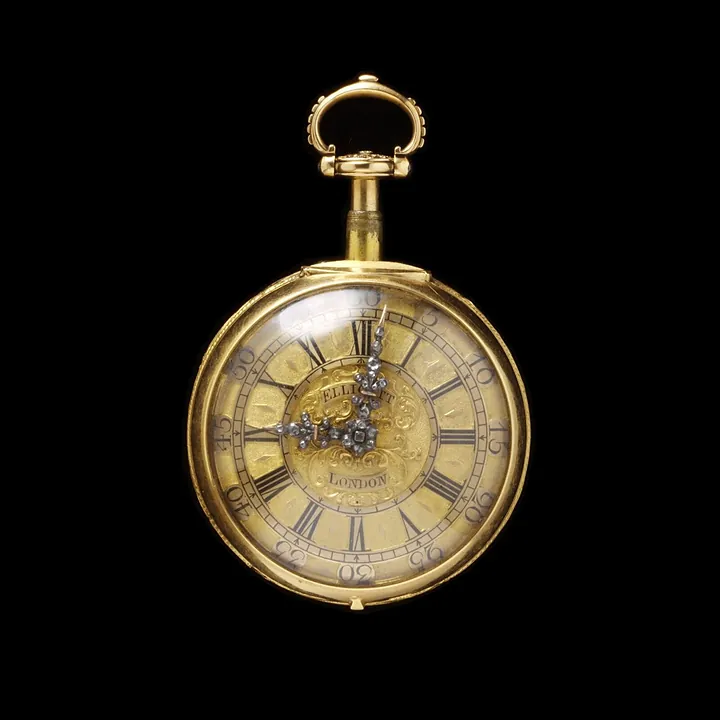
Pocket Watches · c. 1753
Gold watch, signed 'Jno. Ellicott, London, 3719', the inner case pierced and engraved, with a casemaker's mark 'JB', London, about 1753
Victoria and Albert Museum, London
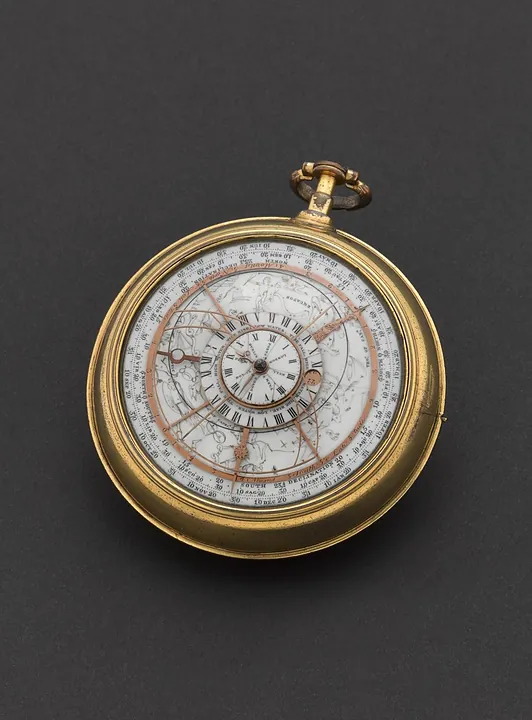
Pocket Watches · 1750–1810
Astronomical watch by George Margetts No.3043 in pair case, 1750–1810
Science Museum Group, London