
Wristwatches · Wristwatch
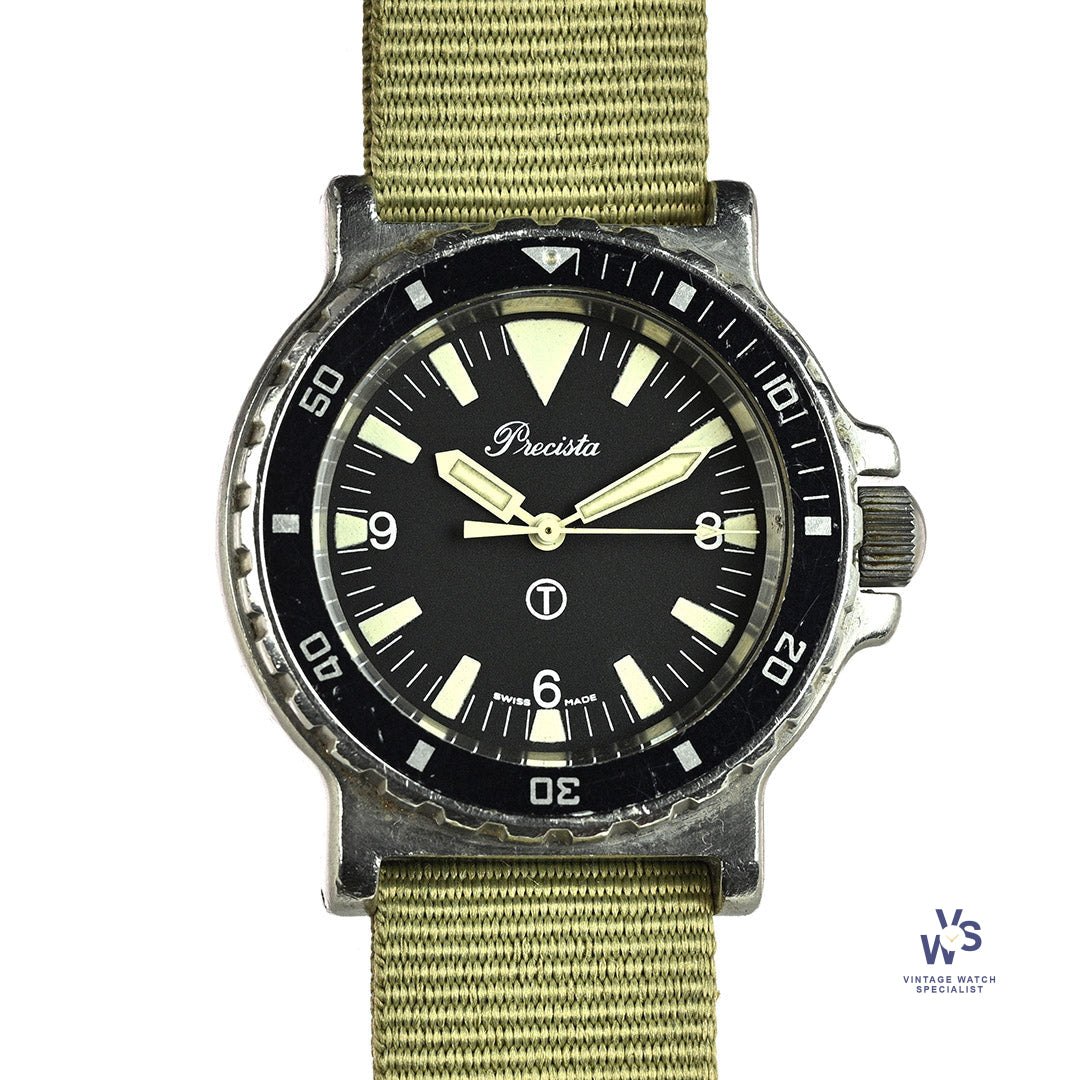
Precista Royal Navy Divers Watch, 'Big Triangle' Dial, Military Engravings, Tritium Lume, circa 1988
- Maker / attribution
- Precista (maker)
- Date
- c. 1988
- Historical period
- Quartz Revolution (1969 – 1990)
- Country of origin
- Unrecorded in source
- Object type
- Wristwatch
- Stock no.
- vws4197
- Credit line
- Dealer listing, Vintage Watch Specialist (vws4197)
- Catalogue title (original)
- Precista Royal Navy Divers Watch - 'Big Triangle' Dial - Military Engravings - Tritium Lume - c.1988 (English)
View the source record (dealer listing) ↗ (opens another website in a new tab)Suggest a correction
Record summary
Catalogued by Vintage Watch Specialist (dealer), United Kingdom (stock number vws4197), this is a wristwatch by Precista, dated c. 1988. The Atlas places it in the Quartz Revolution period (1969 – 1990) of its Wristwatches collection. The record is illustrated with 6 photographs.
Assembled from the source record's structured fields. Dates and attributions are given as the source states them; where a field is missing the Atlas leaves it blank rather than estimating.
Catalogue description
Dealer description — Vintage Watch Specialist
A 1988 MOD-issued Precista diver with tritium dial, rotating bezel and classic military NATO strap - original military 6645 engravings and attractive lume Precista is closely linked to British military timekeeping, particularly from the 1970s onwards when watches bearing the name were supplied to the Ministry of Defence. Produced by manufacturers such as Hamilton and later CWC, these watches were built to strict military specifications, prioritising durability, legibility and reliability. Issued across various branches of the armed forces, Precista watches are now valued for their utilitarian design and authentic connection to British military history. What's on Offer A proper military-issued Precista diver from the late 1980s, built to exacting Ministry of Defence specifications and designed with pure function in mind. The black dial is clean and highly legible, with bold luminous markers and hands that still deliver excellent visibility in low light, anchored by the circled “T” denoting tritium lume. The unidirectional rotating bezel frames the dial with purpose, showing honest wear that speaks to its tool-watch roots. The asymmetric case, complete with integrated crown guards, reinforces its rugged, utilitarian design. On the reverse, the military engravings remain clearly visible, including NATO stock numbers and issue markings—key details that root the watch firmly in its service history. Powered by a reliable ETA quartz movement for precision and durability, it’s fitted to an army green NATO-style textile strap, perfectly in keeping with its military origins. A genuine British military diver—honest, purposeful, and increasingly collectible.
Historical context
Quartz Revolution (1969 – 1990)
Seiko's Astron begins mass quartz timekeeping; traditional industries contract sharply.
Quartz and digital watches transformed the market after 1969. Swiss employment collapsed, Japanese and Hong Kong production soared, and the Swatch (1983) helped the Swiss industry recover; mechanical watches survived as luxury goods.
Read the period in the timelineMore wristwatches from this periodEarlier: Modern Mechanical Horology
Atlas type guide
Dive and water-resistant watches
Keeping water and dust out of a wristwatch was a long-standing challenge. Rolex's screw-down Oyster case (1926) and Omega's Marine (1932) were landmarks; in the early 1950s Blancpain's Fifty Fathoms and Rolex's Submariner defined the professional dive watch with rotating bezels for timing dives, luminous dials and high water resistance. The ISO 6425 standard (1982) later codified what a 'diver's watch' must do.
Dive watches became icons of post-war design and exploration, and their evolution — helium escape valves, ceramic bezels, saturation-diving depth ratings — records the history of underwater work.
What to look for
- Unidirectional or bidirectional rotating bezel with minute markings.
- Screw-down crown and case back; depth rating printed on the dial.
- Luminous hands and markers (radium before c. 1960, tritium c. 1960–1998, then Super-LumiNova).
- Reference numbers on the case between the lugs or inside the back.
Dating clues
- Screw-down Oyster cases: from 1926.
- Professional dive watches: from 1953.
- Tritium 'T' marks on dials: c. 1960–1998.
General guidance written by the Atlas editors about this kind of object. It is not a statement about this particular piece; for that, rely on the source record above and on physical examination.
Related records
Wristwatches · 1982
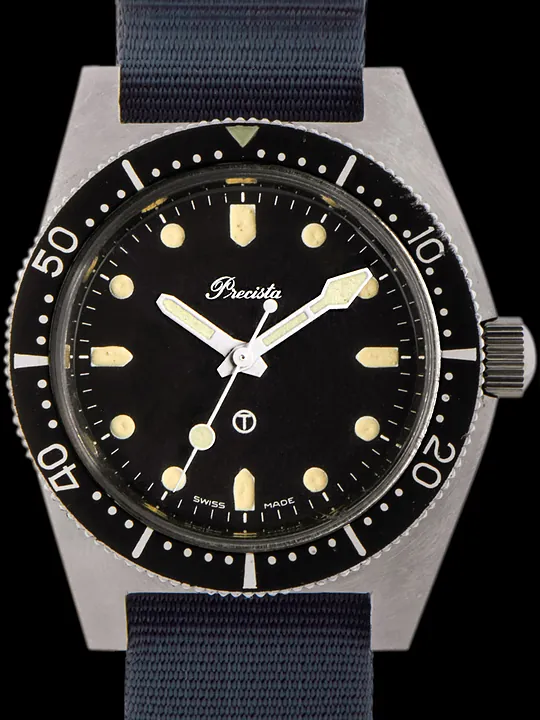
Precista Royal Navy Issue Diver "Snake Head" 0552/923-7697, 1982
Craft & Tailored (dealer), Los Angeles
Wristwatches · 1982
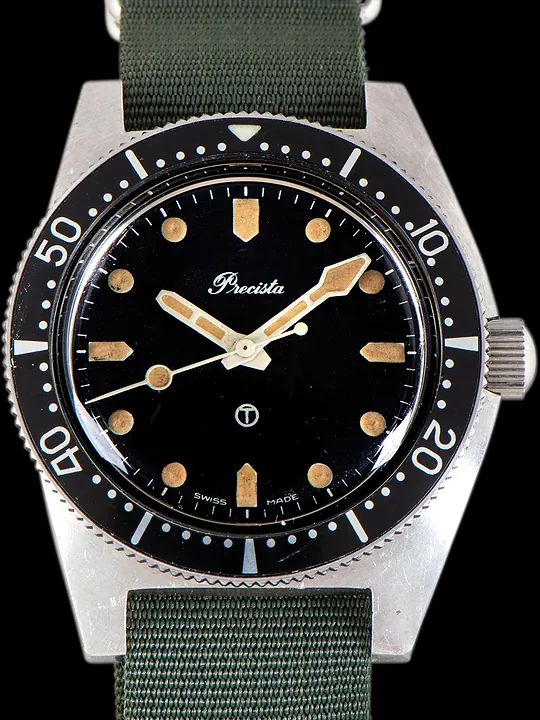
Precista Royal Navy Issue Diver "Snake Head" 0552/923-7697, 1982
Craft & Tailored (dealer), Los Angeles
Wristwatches · 1990s
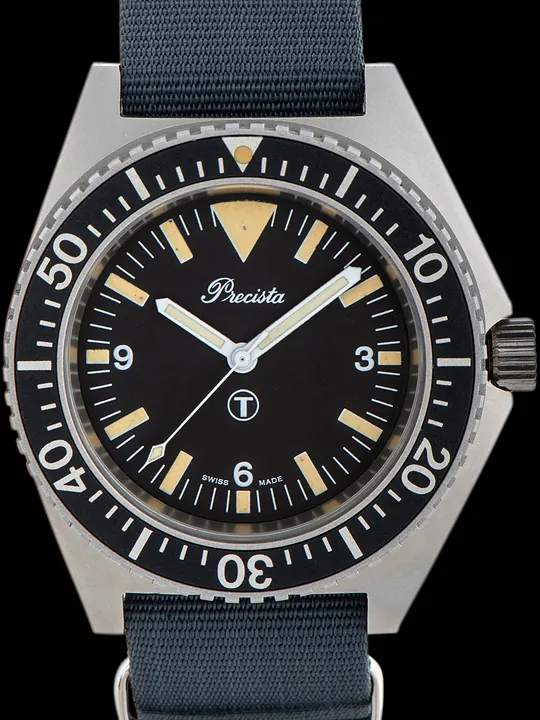
Precista Royal Navy Diver (6645-99-757-3314) “Sterile Case Back”, 1990s
Craft & Tailored (dealer), Los Angeles
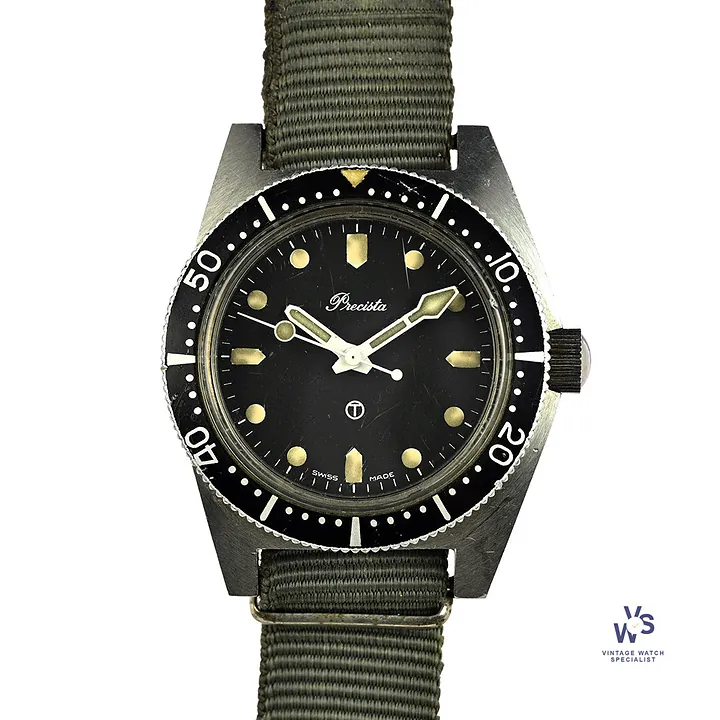
Wristwatches · c. 1982
Royal Navy Issued Precista Dive Watch with 0552 Case Back Markings, 'Snakehead' Minute Hand, circa 1982
Vintage Watch Specialist (dealer), United Kingdom

Wristwatches · 1970
Wristwatch by Heno, Switzerland, 1970
Museum Rotterdam
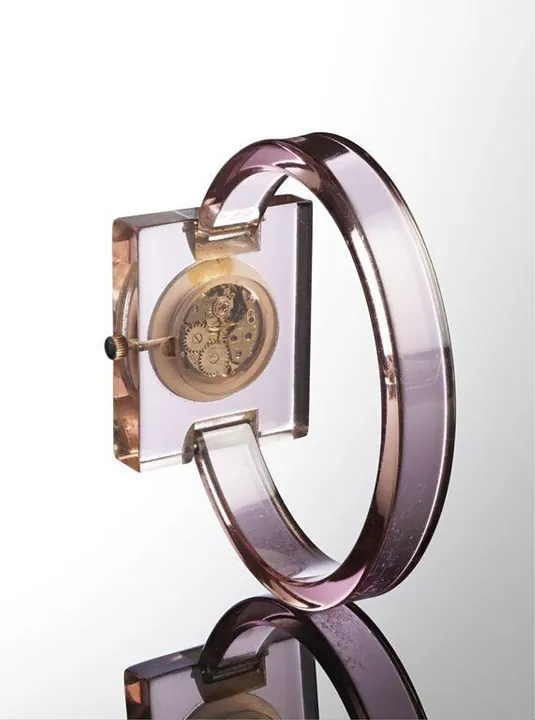
Wristwatches · 1970s
Wristwatch, plastic, by Gucci; Italy, 1970s.
Victoria and Albert Museum, London
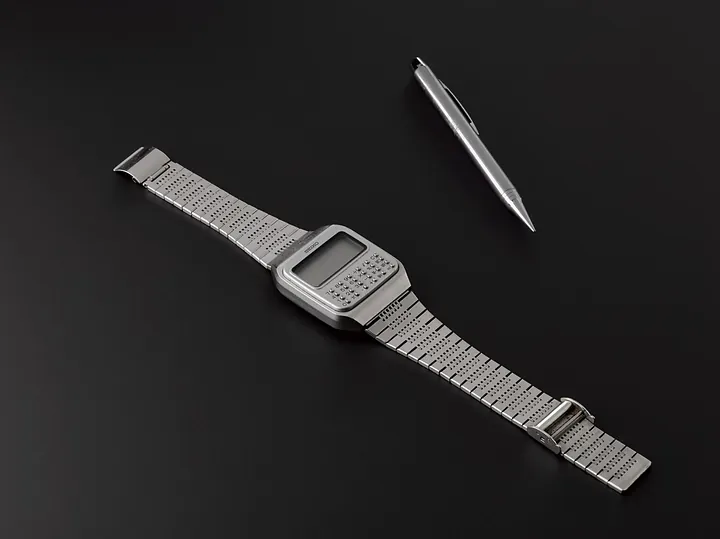
Wristwatches · 1978
Calculator wristwatch by Suwa Seikosha Co. Limited, Japan, 1978
Science Museum Group, London
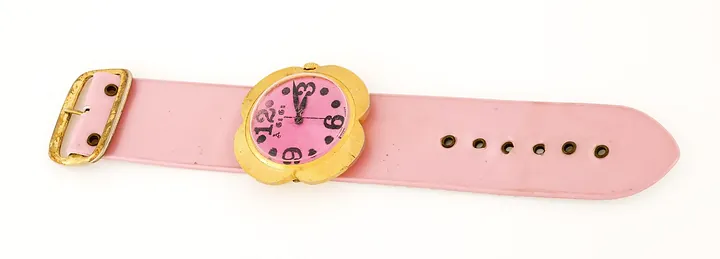
Wristwatches · 1980
Wristwatch, 1980 (no. 71413)
Museum Rotterdam