
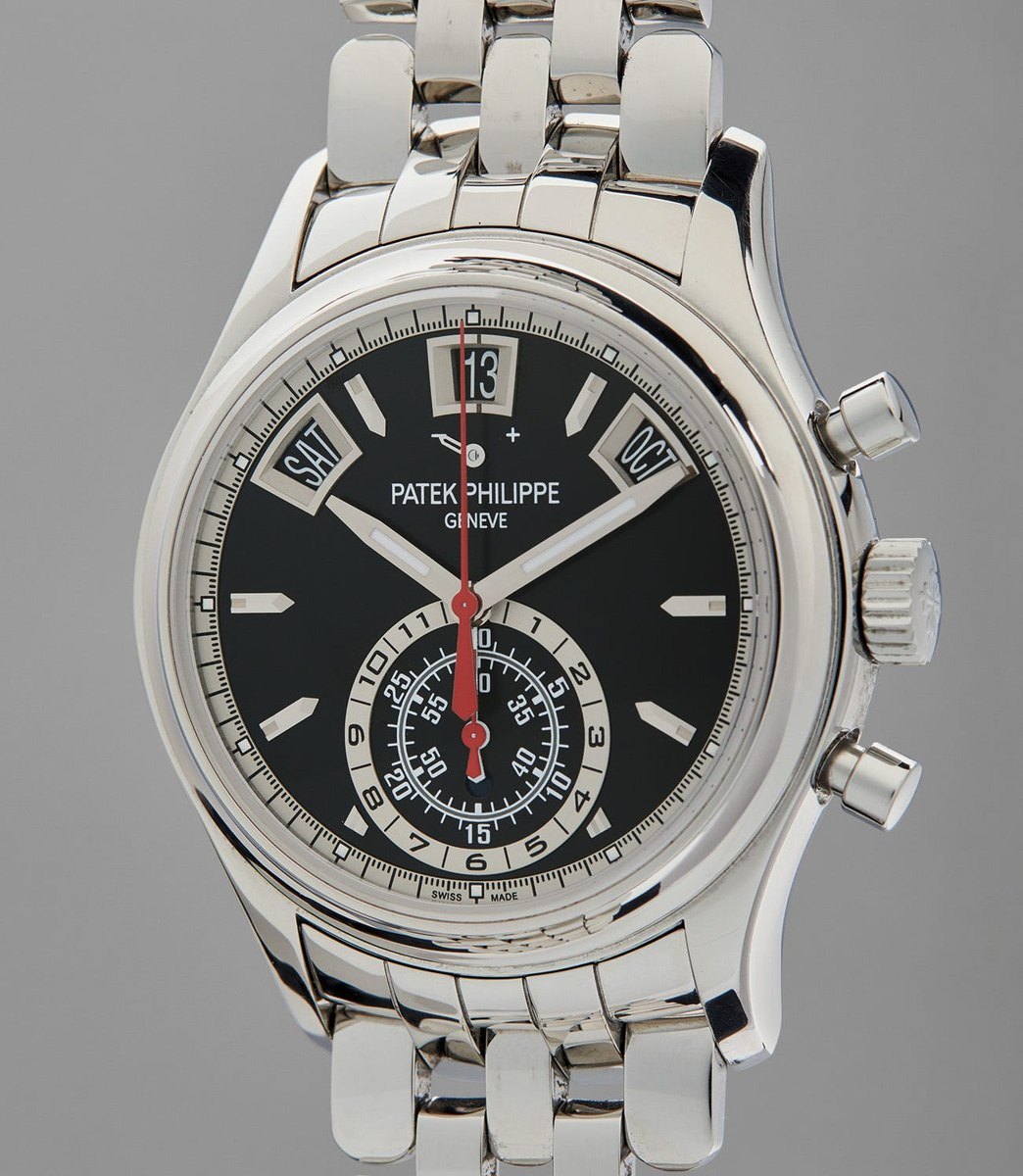
Wristwatches · Annual calendar flyback chronograph wristwatch
Patek Philippe Ref. 59601A-010 Annual Calendar Flyback Chronograph Wristwatch
- Maker / attribution
- Patek Philippe (source attribution)
- Date
- c. 2018
- Historical period
- Contemporary Horology (2010 – Present)
- Country of origin
- Switzerland
- Object type
- Annual calendar flyback chronograph wristwatch
- Dimensions
- 40.5mm Diameter
- Holding institution
- Phillips
- Accession / object no.
- 133
- Credit line
- Phillips
- Catalogue title (original)
- Patek Philippe Racing Pulse (English)
View the source record ↗ (opens another website in a new tab)Suggest a correction
Record summary
Held and catalogued by Phillips (object number 133), this is an annual calendar flyback chronograph wristwatch attributed to Patek Philippe, made in Switzerland, dated c. 2018. The Atlas places it in the Contemporary Horology period (2010 – Present) of its Wristwatches collection. Recorded dimensions: 40.5mm Diameter. The record is illustrated with 1 photograph.
Assembled from the source record's structured fields. Dates and attributions are given as the source states them; where a field is missing the Atlas leaves it blank rather than estimating.
Catalogue description
Original object description
Produced around 2018, the Patek Philippe reference 59601A-010 is a stainless steel wristwatch incorporating an annual calendar and a flyback chronograph. Its 40.5 mm case features round pump pushers, a grooved winding crown, and an integrated steel multi-link bracelet. The black dial exhibits three curved windows across the upper register for the day, date, and month, an up-and-down power reserve gauge beneath 12 o'clock, and a dual-scale monocounter at 6 o'clock tracking both chronograph minutes and hours. Driving these functions is the 40-jewel automatic calibre 28-250 IRM QA 24H.
Original object description
The reference 59601A-010 is built with a 40.5 mm stainless steel case fitted with pump-style pushers and a fluted crown, paired with a matching multi-row stainless steel bracelet fastened by a double folding deployant clasp. Although unpictured in available lot photography, an auxiliary leather strap is recorded in the catalogue description.
Original object description
Set against the black dial, three apertures positioned along an upper arc between 10 and 2 o'clock present the day, date, and month. A power reserve indicator is situated directly beneath the 12 o'clock index. Chronograph tracking utilizes a central bright red seconds hand in coordination with a 6 o'clock monocounter, which displays elapsed time up to 30 minutes and 12 hours on two concentric scales.
Original object description
Operating via automatic calibre 28-250 IRM QA 24H with 40 jewels, the mechanism combines annual calendar gearing with a flyback chronograph complication and is stamped with movement number 7’100’074. The movement and the caseback are not depicted in the listing's photographic documentation.
Inscriptions & marks
7’100’074
Historical context
Contemporary Horology (2010 – Present)
Silicon components, connected watches, optical-lattice research clocks and a thriving independent scene.
Smartwatches became the world's best-selling watches, while mechanical watchmaking focuses on craft, innovation (silicon components, new escapements) and independent makers.
Read the period in the timelineMore wristwatches from this periodEarlier: Mechanical Renaissance
Atlas type guide
Chronographs and split-seconds watches
A chronograph is a watch with an additional seconds hand that can be started, stopped and returned to zero independently of the timekeeping. Louis Moinet built an early example in 1816 and Nicolas Rieussec a recording 'chronographe' in 1821; Adolphe Nicole's heart-shaped reset cam (patented 1862) made the modern return-to-zero possible. Split-seconds (rattrapante) chronographs add a second hand that can be stopped for intermediate times; flyback chronographs restart instantly.
Chronographs were essential tools for doctors (pulsometer scales), artillery (telemeter), engineers and sport. In wristwatches, Valjoux, Venus, Lemania and later the automatic chronographs of 1969 (Zenith El Primero, the Chronomatic Calibre 11 group and Seiko 6139) are milestones.
What to look for
- Push-pieces on the case band or a single button in the crown (monopusher).
- Subsidiary registers for minutes and hours; tachymeter, telemeter or pulsometer scales.
- Column wheel versus cam control visible in the movement.
- Calibre markings of specialist makers (Valjoux, Lemania, Venus, Landeron).
Dating clues
- Pocket chronographs with heart cam reset: after 1862.
- Wrist chronographs: from c. 1910; two-button designs from the 1930s.
- Automatic chronographs: from 1969.
General guidance written by the Atlas editors about this kind of object. It is not a statement about this particular piece; for that, rely on the source record above and on physical examination.
Read next:Chronograph
Related records

Clocks · 1965–1975
Quartz master clock QM 1, with movement by Patek Phillippe, Switzerland, 1965–1975. Supplied by English Clock Systems.
Science Museum Group, London

Instruments · 1965–1984
Chronometer by Patek Philippe and Kelvin Hughes, England, 1965–1984
Science Museum Group, London

Pocket Watches · c. 1895
Patek Philippe pocket watch, c. 1895
Antiquorum auction archive, Geneva

Pocket Watches · c. 1900
Patek Philippe Chronometro Gondolo, c. 1900
Antiquorum auction archive, Geneva

Wristwatches · c. 2010s
Breguet Type XXI, ref. 3810, c. 2010s (Antiquorum Lot 381-24)
Antiquorum auction archive, Geneva

Wristwatches · c. 2010s
Breguet Type XXI, ref. 3810, c. 2010s (Antiquorum Lot 386-229)
Antiquorum auction archive, Geneva

Wristwatches · Sold in September 2010
Breitling Cosmonaute, ref. A 22322, Sold in September 2010
Antiquorum auction archive, Geneva

Wristwatches · c. 2010
Corum Bubble Chrono, ref. 396.150.20, c. 2010
Antiquorum auction archive, Geneva