
Wristwatches · Wristwatch
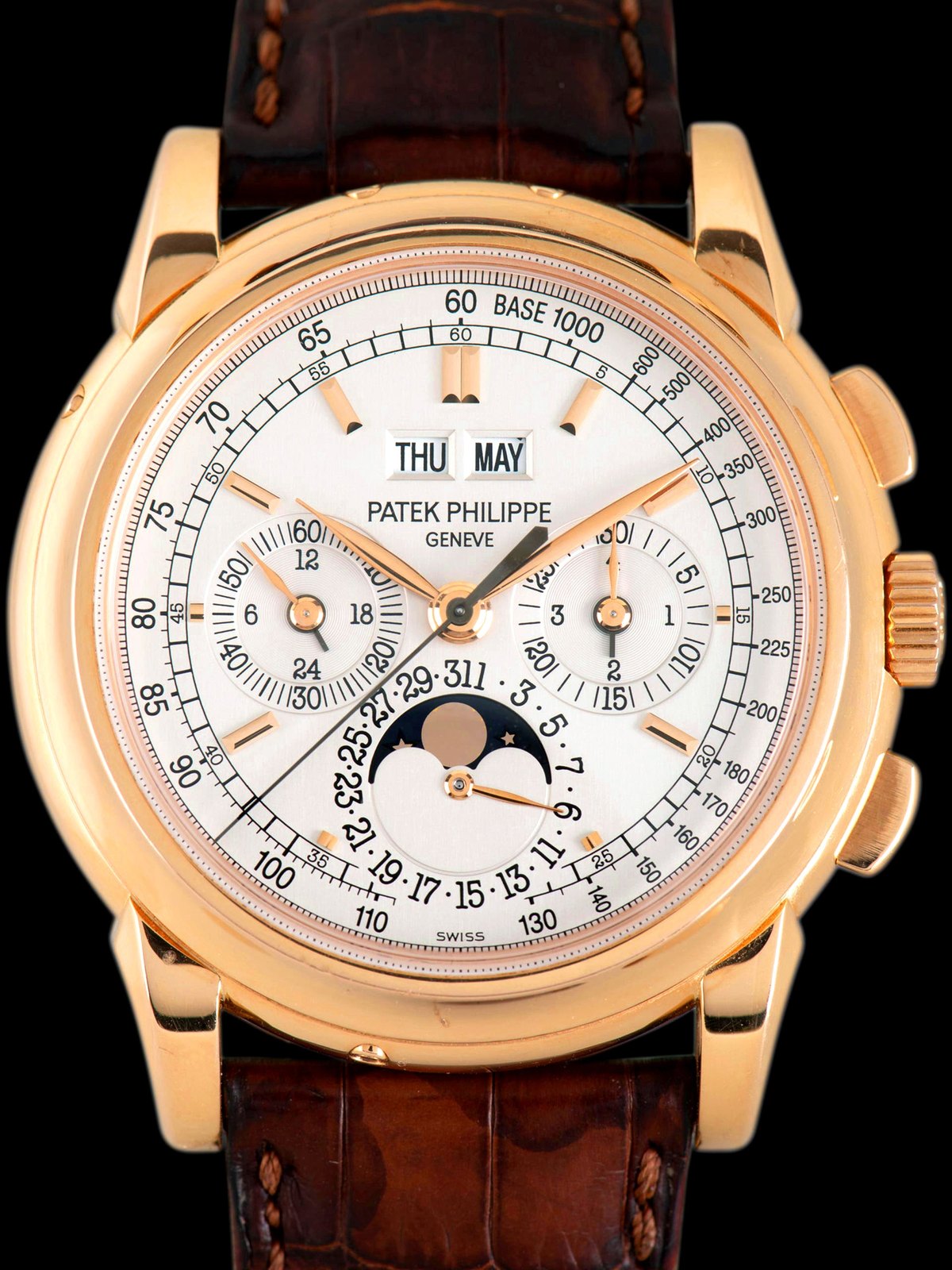
Patek Philippe Perpetual Calendar Moonphase Chronograph (Ref. 5970R) 18K RG, 2000s
- Maker / attribution
- Patek Philippe (maker)
- Date
- 2000s
- Historical period
- Mechanical Renaissance (1990 – 2010)
- Country of origin
- Switzerland
- Object type
- Wristwatch
- Dimensions
- Case 40 mm
- Stock no.
- PP5970R
- Credit line
- Dealer listing, Craft & Tailored (PP5970R)
- Catalogue title (original)
- 2000s Patek Philippe Perpetual Calendar Moonphase Chronograph (Ref. 5970R) 18K RG W/ Box (English)
View the source record (dealer listing) ↗ (opens another website in a new tab)Suggest a correction
Record summary
Catalogued by Craft & Tailored (dealer), Los Angeles (stock number PP5970R), this is a wristwatch by Patek Philippe, made in Switzerland, dated 2000s. The Atlas places it in the Mechanical Renaissance period (1990 – 2010) of its Wristwatches collection. Recorded dimensions: Case 40 mm. The record is illustrated with 6 photographs.
Assembled from the source record's structured fields. Dates and attributions are given as the source states them; where a field is missing the Atlas leaves it blank rather than estimating.
Catalogue description
Dealer description — Craft & Tailored
'You never actually own a Patek Philippe. You merely look after it for the next generation.’ — Patek Philippe started this now ubiquitous marketing campaign in 1966 and never looked back, though they already had an outstanding legacy since the watchmaker was founded in the year 1839. Patek built its reputation on several foundational pillars: tradition, innovation, and excellence, all of which are paramount in every timepiece they make, both old and new. The Grand Complications series is the best from the best, being Patek Philippe's premier offering at any one time. While other wild creations are made alongside, such as the Grandmaster Chime, these generally extravagant models are essentially unobtainable horological feats of art. Whereas the Grand Complications series is that of wearable watchmaking excellence in its purest form. Dating all the way back to 1941 with the now iconic reference 1518, Patek Philippe unveiled the first perpetual calendar moonphase chronograph to the world. Today the 1518 is celebrated as one of the most coveted watches of all time, commonly fetching millions of dollars at auction every year. The ref. 1518 ceased production in 1954, and the next reference, the 2499 was produced from 1950 - 1985 and utilized the same Valjoux cal. 13 movement as its predecessor. The third execution of the Grand Complications line from Patek Philippe, the reference 3970, carries the historical transition from a Valjoux-based caliber movement to a Lemania-based caliber with the caliber 2310. The Lemania cal. 2310 is widely regarded as one of the greatest movements ever created, and was the same movement that NASA brought into space with the Omega Speedmaster, though heavily modified in the hands of Patek Philippe to incorporate the perpetual calendar as well as elevate the finishing to the horological house’s standards. The ref. 3970 reigned from 1986-2004. The fourth installment of the Patek Philippe Grand Complications Perpetual Calendar Chronograph is the reference 5970, which is already celebrated as a modern classic and is regarded extremely highly amongst the world's most influential collectors. Building off and improving upon the base created by the ref. 3970, the ref. 5970 introduces both more traditional and updated elements that create the reference's distinct feel. With a 40mm case size, the largest in the Grand Complications’ history at the time of production, the ref. 5970 truly feels like a modern interpretation of its predecessors, especially with the square pushers that call back to the original design of the ref. 1518 from 1941. It is estimated 2800 pieces were produced in the 6 years the ref. 5970 was produced, from 2004-2010. Of the 2800 it is believed the rose and white gold models are the most common, with an estimated production of 1,000 pieces each produced from 2004-2008. Yellow gold models were only produced in 2008 and are said to be the rarest variants, with a very low estimated production of a mere 300 pieces. The platinum models were the last to be produced, are the second-rarest, and the only variant to feature a black dial, these were produced from 2009-2010 with an estimated production of about 500 pieces. The reference 5970 was replaced with the reference 5270 in 2011, which employed an in-house Patek Philippe movement. This transition makes the ref. 5970 very likely the last Grand Complications reference made with a modified non-in-house movement, and the end of an era for watchmaking history. Stock # PP5970R Brand Patek Philippe Style Perpetual Calendar Moonphase Chronograph Model 5970R Serial 30XXXXX Size Men's Material 18K Rose Gold Dial Silver Millimeters 40 Strap Patek Philippe Brown Crocodile Leather Strap 18K RG Deployant Buckle CASE & BRACELET The intricately designed and beautifully executed 18K rose gold case is in exceptional condition, retaining the original geometry and dimensions with minimal evidence of previous polishing and very minor signs of use present. The square pushers are original as is the winding crown adorned with the Patek Philippe cross. The setting pushers around the case all remain original and in excellent condition as well. Both of the sapphire crystals are blemish free and in clean overall condition. The watch comes supplied on its original Patek Philippe brown crocodile leather strap with the original 18K rose gold Patek Philippe deployant clasp. The inside of the deployant clasp is adorned with an engraving that reads "To my father and my teacher, Love Todd". DIAL & HANDS The original silver dial with rose gold markers is flawless, the hands are all original and flawless as well. Though the dial displays many functions, it is composed beautifully to be both easy to read and attractive to the eye. The day and month windows are located above the Patek Philippe text. The 3 o'clock sub-register is both a 30-minute totalizer which is tracked by the rose gold hands, while the small blued hand tracks the leap year. The 6 o'clock sub-register houses the moonphase along with the date function. The 9'clock sub-register tracks the running seconds with the rose gold hands and the small blued hand tracks 24hr time. ACCESSORIES The watch comes with its original inner and outer Patek Philippe boxes, the inner box is missing its pillow insert. The watch DOES NOT include any paperwork or documents. The watch is keeping time and running perfectly.
Historical context
Mechanical Renaissance (1990 – 2010)
Mechanical watches return as cultural objects; independent watchmaking flourishes.
Mechanical watches returned as cultural and luxury objects. Complications, tourbillons and new materials proliferated; independent watchmakers such as George Daniels, F.P. Journe and Philippe Dufour revived artisanal watchmaking; collecting vintage watches became a major field.
Read the period in the timelineMore wristwatches from this periodEarlier: Quartz Revolution
Atlas type guide
Chronographs and split-seconds watches
A chronograph is a watch with an additional seconds hand that can be started, stopped and returned to zero independently of the timekeeping. Louis Moinet built an early example in 1816 and Nicolas Rieussec a recording 'chronographe' in 1821; Adolphe Nicole's heart-shaped reset cam (patented 1862) made the modern return-to-zero possible. Split-seconds (rattrapante) chronographs add a second hand that can be stopped for intermediate times; flyback chronographs restart instantly.
Chronographs were essential tools for doctors (pulsometer scales), artillery (telemeter), engineers and sport. In wristwatches, Valjoux, Venus, Lemania and later the automatic chronographs of 1969 (Zenith El Primero, the Chronomatic Calibre 11 group and Seiko 6139) are milestones.
What to look for
- Push-pieces on the case band or a single button in the crown (monopusher).
- Subsidiary registers for minutes and hours; tachymeter, telemeter or pulsometer scales.
- Column wheel versus cam control visible in the movement.
- Calibre markings of specialist makers (Valjoux, Lemania, Venus, Landeron).
Dating clues
- Pocket chronographs with heart cam reset: after 1862.
- Wrist chronographs: from c. 1910; two-button designs from the 1930s.
- Automatic chronographs: from 1969.
General guidance written by the Atlas editors about this kind of object. It is not a statement about this particular piece; for that, rely on the source record above and on physical examination.
Read next:Flyback chronographChronograph
Related records
Clocks · 1965–1975
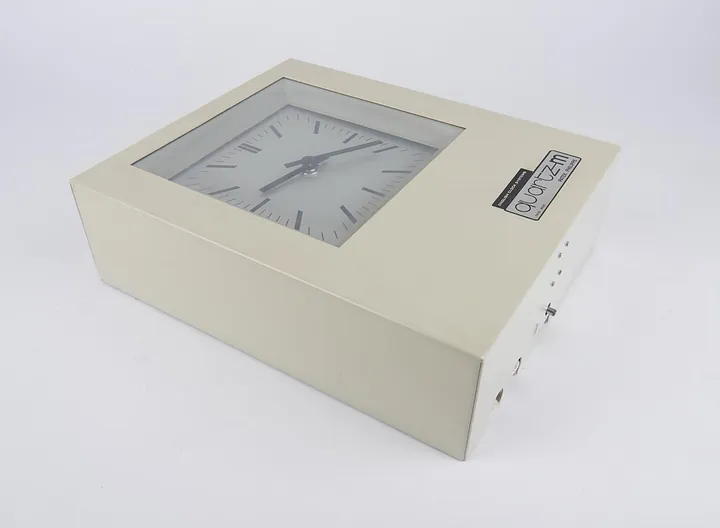
Quartz master clock QM 1, with movement by Patek Phillippe, Switzerland, 1965–1975. Supplied by English Clock Systems.
Science Museum Group, London
Instruments · 1965–1984
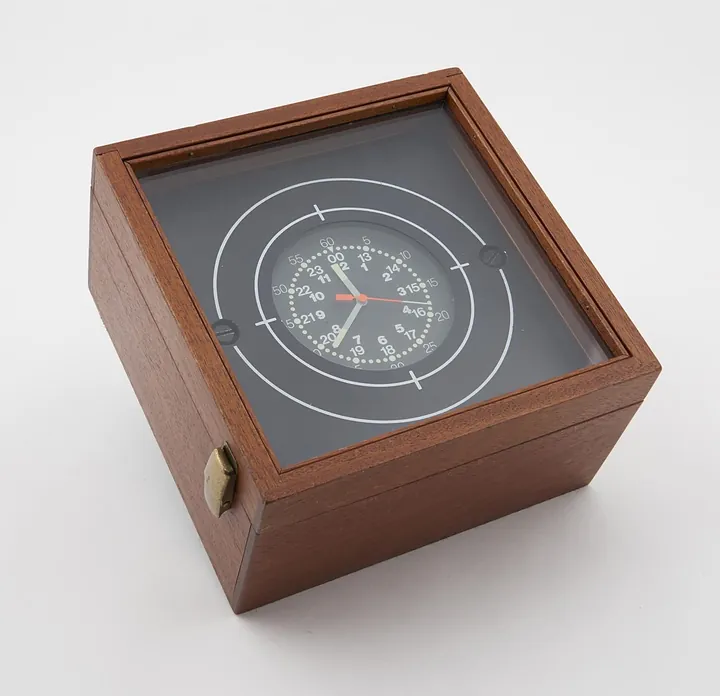
Chronometer by Patek Philippe and Kelvin Hughes, England, 1965–1984
Science Museum Group, London
Pocket Watches · c. 1895
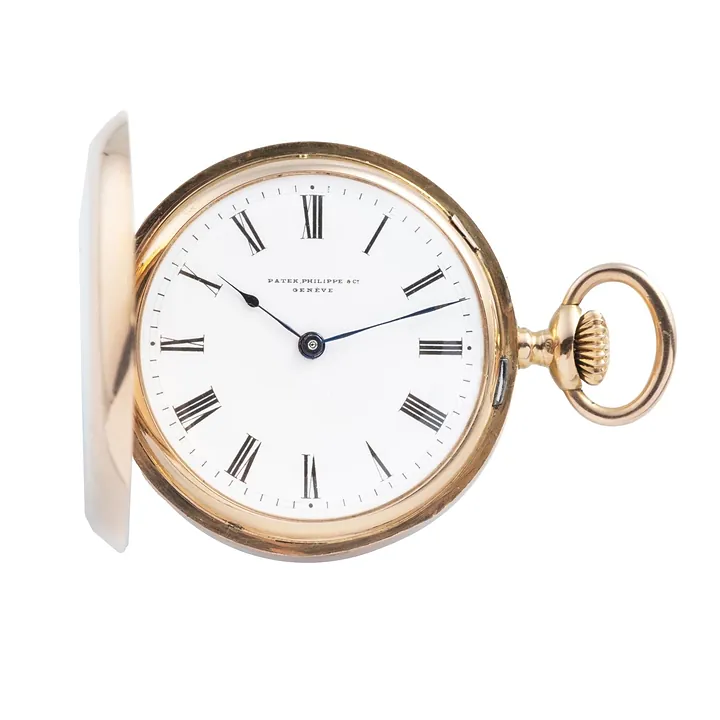
Patek Philippe pocket watch, c. 1895
Antiquorum auction archive, Geneva

Pocket Watches · c. 1900
Patek Philippe Chronometro Gondolo, c. 1900
Antiquorum auction archive, Geneva

Wristwatches · 2008
Wristwatch by Breitling?, 2008
Museum Rotterdam

Wristwatches · c. 1990s
Audemars Piguet Bamboo, c. 1990s
Antiquorum auction archive, Geneva

Wristwatches · c. 1990
Audemars Piguet Huitieme Perpetual Calendar, ref. 25696PT, c. 1990
Antiquorum auction archive, Geneva

Wristwatches · c. 1990
Breitling Chronomat, ref. b13050.1, c. 1990
Antiquorum auction archive, Geneva