
Wristwatches · Wristwatch
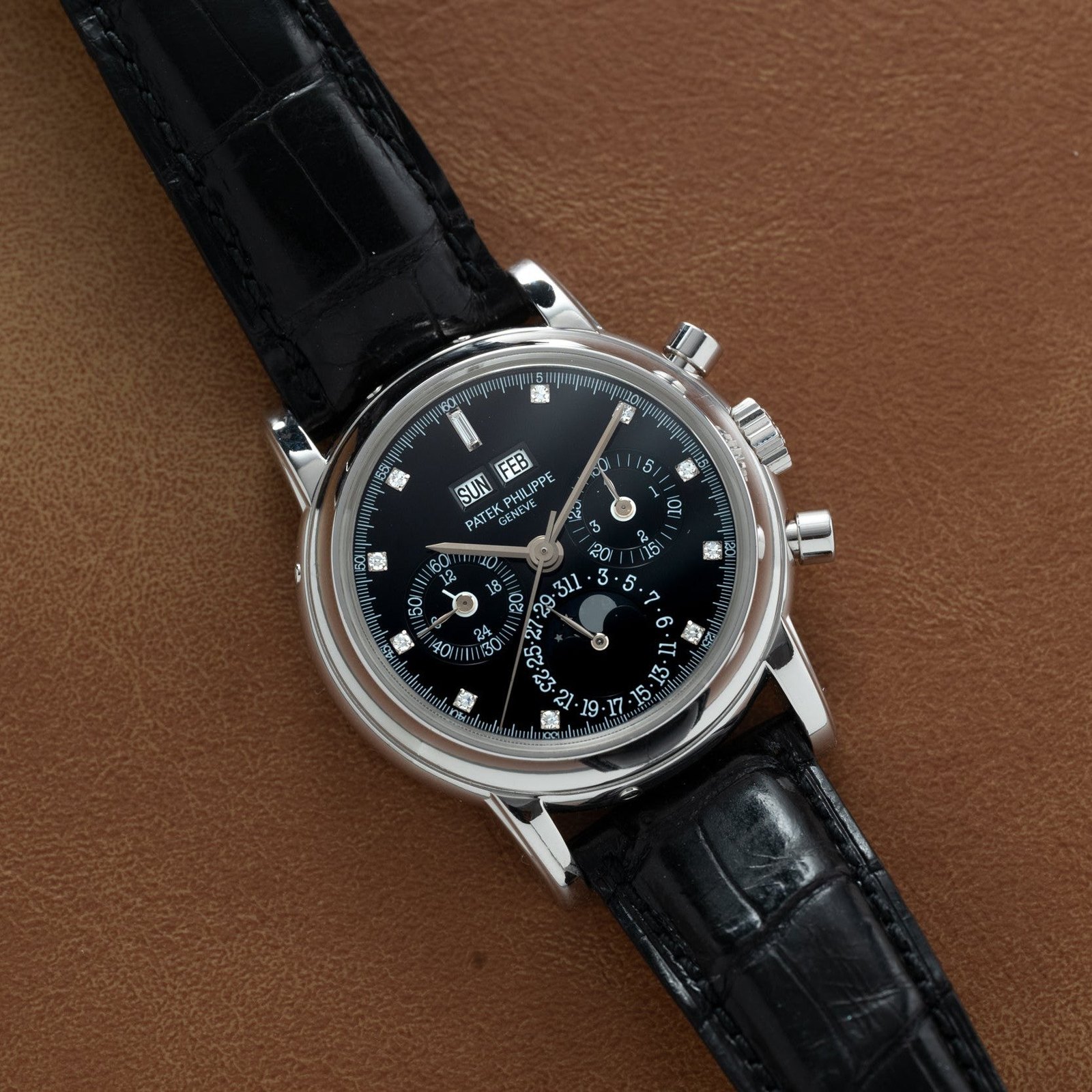
Patek Philippe Perpetual Calendar Moonphase Chronograph, 2000s
- Maker / attribution
- Patek Philippe (maker)
- Date
- 2000s
- Historical period
- Mechanical Renaissance (1990 – 2010)
- Country of origin
- Switzerland
- Object type
- Wristwatch
- Dimensions
- Case 36 mm
- Stock no.
- 40930356
- Credit line
- Dealer listing, Analog/Shift (40930356)
- Catalogue title (original)
- Patek Philippe Perpetual Calendar Moonphase Chronograph (English)
View the source record (dealer listing) ↗ (opens another website in a new tab)Suggest a correction
Record summary
Catalogued by Analog/Shift (dealer), New York (stock number 40930356), this is a wristwatch by Patek Philippe, made in Switzerland, dated 2000s. The Atlas places it in the Mechanical Renaissance period (1990 – 2010) of its Wristwatches collection. Recorded dimensions: Case 36 mm. The record is illustrated with 6 photographs.
Assembled from the source record's structured fields. Dates and attributions are given as the source states them; where a field is missing the Atlas leaves it blank rather than estimating.
Catalogue description
Dealer description — Analog/Shift
Patek Philippe has sat high atop the horological mountain for going on two centuries, having earned near-universal acclaim for their proficiencies in designing, engineering, and manufacturing some of the most exquisite timepieces the world has ever seen. But while Patek is world-renowned for its superb in-house movements, it should be noted that up until fairly recently, even its complicated chronographs used sourced Swiss movements from the likes of Lemania, and before that, Valjoux. Naturally, these were superbly finished versions of base ébauches , but this is old-school watchmaking in a nutshell — a maison such as Patek would source the parts from the very best manufacturers as a starting point, and improve, modify and finish from there. In the 1980s and 1990s, the best chronograph bases in the industry came from Lemania. Widely considered amongst collectors as one of the maison’s greatest designs, the Reference 3970 — such the one we have here — is a 36mm perpetual calendar chronograph dating to the 2000s. Preceded chronologically by the Ref. 2499 and succeeded by the Ref. 5970, it’s powered by the Calibre CH 27-70 Q manually-wound movement — Patek’s modified version of the Lemania Calibre 2310. Hand-finished and beautiful, this movement formed the basis for not only the 3970, but also the Calibre .321 used in the earliest Omega Speedmatsers. What is this notable movement powering? Namely, a mechanism with an incredible amount of information, conveyed in an elegant form that only a maison such as Patek Philippe could design: On its gloss-black dial you'll find applied diamond indices; dual day and month displays beneath the 12 o’clock index; a combined 30-minute totalizer and leap year indicator at 3 o’clock; a combined date wheel and moon phase indicator at 6 o’clock; and a combined running seconds and 12-hour totalizer at 9 o’clock — oh, and it also tells the time! This particular example, a Reference 3970JP, features a tidy platinum case equipped with round chronograph pushers, a signed crown, an exhibition caseback and its characteristic sculpted lugs — o oh la la. Despite being housed in a rare precious metal and featuring diamond indices set on the dial, this piece is incredibly stealthy on its signed black alligator leather strap and matching platinum deployant buckle. Indeed, only collectors with a deep scholarship of the maison's horological prowess will understand how truly special this piece is. Beautifully sized and featuring one of the most notable chronograph movements in history, we’ll be damned if this 3970 isn’t one of the most exquisite complicated watches from Patek that we’ve ever had the pleasure to offer. We're certain you'll agree!
Historical context
Mechanical Renaissance (1990 – 2010)
Mechanical watches return as cultural objects; independent watchmaking flourishes.
Mechanical watches returned as cultural and luxury objects. Complications, tourbillons and new materials proliferated; independent watchmakers such as George Daniels, F.P. Journe and Philippe Dufour revived artisanal watchmaking; collecting vintage watches became a major field.
Read the period in the timelineMore wristwatches from this periodEarlier: Quartz Revolution
Atlas type guide
Chronographs and split-seconds watches
A chronograph is a watch with an additional seconds hand that can be started, stopped and returned to zero independently of the timekeeping. Louis Moinet built an early example in 1816 and Nicolas Rieussec a recording 'chronographe' in 1821; Adolphe Nicole's heart-shaped reset cam (patented 1862) made the modern return-to-zero possible. Split-seconds (rattrapante) chronographs add a second hand that can be stopped for intermediate times; flyback chronographs restart instantly.
Chronographs were essential tools for doctors (pulsometer scales), artillery (telemeter), engineers and sport. In wristwatches, Valjoux, Venus, Lemania and later the automatic chronographs of 1969 (Zenith El Primero, the Chronomatic Calibre 11 group and Seiko 6139) are milestones.
What to look for
- Push-pieces on the case band or a single button in the crown (monopusher).
- Subsidiary registers for minutes and hours; tachymeter, telemeter or pulsometer scales.
- Column wheel versus cam control visible in the movement.
- Calibre markings of specialist makers (Valjoux, Lemania, Venus, Landeron).
Dating clues
- Pocket chronographs with heart cam reset: after 1862.
- Wrist chronographs: from c. 1910; two-button designs from the 1930s.
- Automatic chronographs: from 1969.
General guidance written by the Atlas editors about this kind of object. It is not a statement about this particular piece; for that, rely on the source record above and on physical examination.
Read next:Flyback chronographChronograph
Related records

Clocks · 1965–1975
Quartz master clock QM 1, with movement by Patek Phillippe, Switzerland, 1965–1975. Supplied by English Clock Systems.
Science Museum Group, London

Instruments · 1965–1984
Chronometer by Patek Philippe and Kelvin Hughes, England, 1965–1984
Science Museum Group, London

Pocket Watches · c. 1895
Patek Philippe pocket watch, c. 1895
Antiquorum auction archive, Geneva

Pocket Watches · c. 1900
Patek Philippe Chronometro Gondolo, c. 1900
Antiquorum auction archive, Geneva

Wristwatches · 2008
Wristwatch by Breitling?, 2008
Museum Rotterdam

Wristwatches · c. 1990s
Audemars Piguet Bamboo, c. 1990s
Antiquorum auction archive, Geneva

Wristwatches · c. 1990
Audemars Piguet Huitieme Perpetual Calendar, ref. 25696PT, c. 1990
Antiquorum auction archive, Geneva

Wristwatches · c. 1990
Breitling Chronomat, ref. b13050.1, c. 1990
Antiquorum auction archive, Geneva