
Wristwatches · Wristwatch
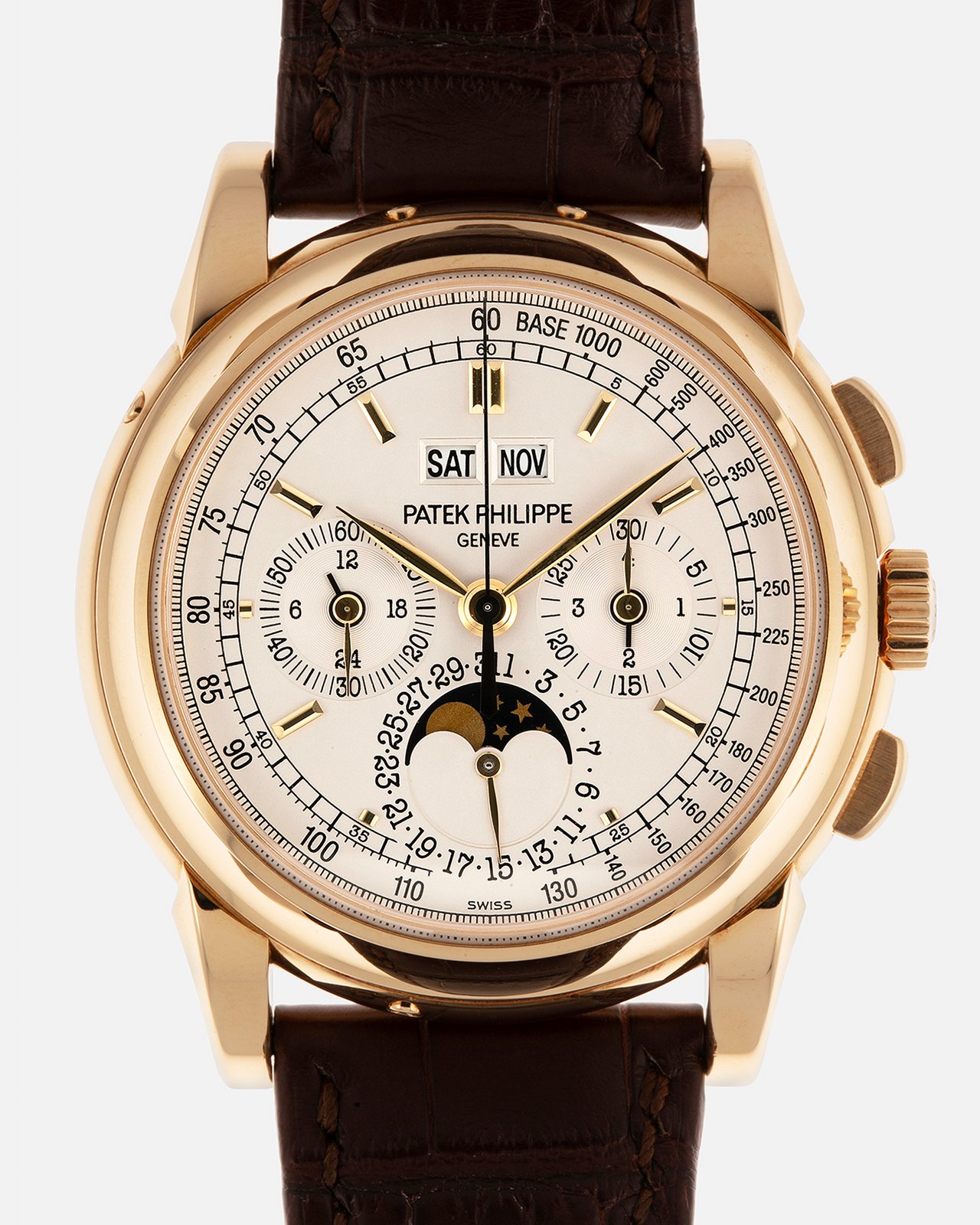
Patek Philippe Perpetual Calendar Chronograph 5970J, 2008
- Maker / attribution
- Patek Philippe (maker)
- Date
- 2008
- Historical period
- Mechanical Renaissance (1990 – 2010)
- Country of origin
- Switzerland
- Object type
- Wristwatch
- Dimensions
- Case 40 mm
- Stock no.
- Product 7561621241943
- Credit line
- Dealer listing, S.Song Watches (product 7561621241943)
- Catalogue title (original)
- Patek Philippe Perpetual Calendar Chronograph 5970J (English)
View the source record (dealer listing) ↗ (opens another website in a new tab)Suggest a correction
Record summary
Catalogued by S.Song Watches (dealer), Seattle (stock number Product 7561621241943), this is a wristwatch by Patek Philippe, made in Switzerland, dated 2008. The Atlas places it in the Mechanical Renaissance period (1990 – 2010) of its Wristwatches collection. Recorded dimensions: Case 40 mm. The record is illustrated with 6 photographs.
Assembled from the source record's structured fields. Dates and attributions are given as the source states them; where a field is missing the Atlas leaves it blank rather than estimating.
Catalogue description
Dealer description — S.Song Watches
There are times when an item becomes so synonymous with an individual or a brand that it becomes an integral part of their identity; An association formed that is so inseparable that doing without it would diminish the character of the brand or person. So, for Patek Philippe? Perpetual calendar chronographs. Not much has been left unsaid about this legendary flagship family of watches, and rightly so. Deemed by many not only as the quintessential Patek but also as some of the best watches of all time, they have become graceful lessons in restraint and practicality, in execution and in tradition. The first-ever perpetual calendar chronograph by Patek Philippe was in 1941 with the reference 1518, and since then, they have only released four more iterations (1518, 2499, 3970, 5970, 5270), with the one you see here today being the 5970. For some context, the 5970 was introduced in 2004 as the successor to the 3970 and continued to use the same Lemania-based Cal. 27-70 Q. It represented a transitional period before Patek Philippe’s move to a fully in-house movement with the subsequent 5270. The yellow gold example offered here is perhaps the most classic configuration of the reference, embodying the traditional aesthetic codes Patek is so well known for, while incorporating subtle modern touches and technical refinements that have made the 5970 so well regarded among collectors. Starting with its 40mm x 13.5mm case, the 5970 is proportionally excellent, especially when viewed in the context of its mid-2000s release, a period when 40mm was still considered unconventional by Patek standards. Despite its substantial presence as a grand complication and the complexity housed within the case, it remains remarkably wearable. The thickness, lug design, and overall flow of the case all work in harmony, aided by a subtly concave bezel and downward-turning lugs that help the watch sit low on the wrist and visually temper its mass. The profile really works, and it doesn’t look bulky or oversized at all, coming from someone with a smaller wrist. Moving on to the dial, as a grand complication, its numerous indications are harmoniously arranged: a twin day–month display at 12:00, a moonphase display and date at 6:00, a leap-year indicator integrated within the 30-minute chronograph counter at 3:00, and a 24-hour indicator set within the running seconds sub-dial at 9:00. While we’re on the topic of dial layouts, I do think a lot of complicated watches often live or die by their ability to balance a large number of elements, and the 5970 is a strong example of how Patek managed to get that visual balance right. According to Thierry Stern, Patek was adamant on preserving this delicate sense of balance and simplicity, reportedly exploring as many as 20 dial iterations before arriving at the final design, which helps explain its clarity and composure despite the complication load. Usually, this is where many perpetual chronographs begin to feel congested, yet the 5970 remains clear, symmetrical, and calm. Even with its larger dial, Patek managed to fill the available space without tipping into clutter, while the enlarged 6:00 sub-dial, slightly overlapping the minute track and tachymeter, introduces a sense of breathability that keeps the dial visually composed. The additional space also allows greater emphasis to be subtly placed on the beautifully frosted moonphase display. As for its movement, when discussing the 5970, you’ll often hear it being referred to as the “last of the Lemanias,” since it was Patek Philippe’s final perpetual calendar chronograph to employ a Lemania-based calibre before the brand transitioned to an in-house movement. That said, the Lemania 2310 derived Cal. CH 27-70 Q powering the watch is an exceptional manual-winding movement. The 5970 adds a perpetual calendar module and sees the movement meticulously reworked and finished to Patek’s standards. Each component receives expert hand-bevelling and polishing, including the brand’s signature capped column wheel. Produced from 2004 to 2011 in roughly 2,800 examples across all metals, the 5970 had the shortest production run of any Patek perpetual calendar chronograph. It is a modern watch with a neo-vintage feel and notably the first designed under Thierry Stern’s presidency. As the final perpetual calendar chronograph to employ a Lemania-based movement, it captures a pivotal moment in Patek Philippe’s evolution from third-party to in-house movement production. Among the variants, yellow gold is the rarest, with an estimated 100–300 examples made between 2008 and 2009. Don’t get me wrong—while I do admire the 5270, which carries its own merits as a worthy successor, the 5970 remains an emblematic predecessor, a reminder of Patek’s enduring ability to create watches that are both technically sophisticated and timeless in their appeal.
Historical context
Mechanical Renaissance (1990 – 2010)
Mechanical watches return as cultural objects; independent watchmaking flourishes.
Mechanical watches returned as cultural and luxury objects. Complications, tourbillons and new materials proliferated; independent watchmakers such as George Daniels, F.P. Journe and Philippe Dufour revived artisanal watchmaking; collecting vintage watches became a major field.
Read the period in the timelineMore wristwatches from this periodEarlier: Quartz Revolution
Atlas type guide
Chronographs and split-seconds watches
A chronograph is a watch with an additional seconds hand that can be started, stopped and returned to zero independently of the timekeeping. Louis Moinet built an early example in 1816 and Nicolas Rieussec a recording 'chronographe' in 1821; Adolphe Nicole's heart-shaped reset cam (patented 1862) made the modern return-to-zero possible. Split-seconds (rattrapante) chronographs add a second hand that can be stopped for intermediate times; flyback chronographs restart instantly.
Chronographs were essential tools for doctors (pulsometer scales), artillery (telemeter), engineers and sport. In wristwatches, Valjoux, Venus, Lemania and later the automatic chronographs of 1969 (Zenith El Primero, the Chronomatic Calibre 11 group and Seiko 6139) are milestones.
What to look for
- Push-pieces on the case band or a single button in the crown (monopusher).
- Subsidiary registers for minutes and hours; tachymeter, telemeter or pulsometer scales.
- Column wheel versus cam control visible in the movement.
- Calibre markings of specialist makers (Valjoux, Lemania, Venus, Landeron).
Dating clues
- Pocket chronographs with heart cam reset: after 1862.
- Wrist chronographs: from c. 1910; two-button designs from the 1930s.
- Automatic chronographs: from 1969.
General guidance written by the Atlas editors about this kind of object. It is not a statement about this particular piece; for that, rely on the source record above and on physical examination.
Read next:Flyback chronographChronograph
Related records

Clocks · 1965–1975
Quartz master clock QM 1, with movement by Patek Phillippe, Switzerland, 1965–1975. Supplied by English Clock Systems.
Science Museum Group, London

Instruments · 1965–1984
Chronometer by Patek Philippe and Kelvin Hughes, England, 1965–1984
Science Museum Group, London

Pocket Watches · c. 1895
Patek Philippe pocket watch, c. 1895
Antiquorum auction archive, Geneva

Pocket Watches · c. 1900
Patek Philippe Chronometro Gondolo, c. 1900
Antiquorum auction archive, Geneva

Wristwatches · 2008
Wristwatch by Breitling?, 2008
Museum Rotterdam

Wristwatches · c. 1990s
Audemars Piguet Bamboo, c. 1990s
Antiquorum auction archive, Geneva

Wristwatches · c. 1990
Audemars Piguet Huitieme Perpetual Calendar, ref. 25696PT, c. 1990
Antiquorum auction archive, Geneva

Wristwatches · c. 1990
Breitling Chronomat, ref. b13050.1, c. 1990
Antiquorum auction archive, Geneva