
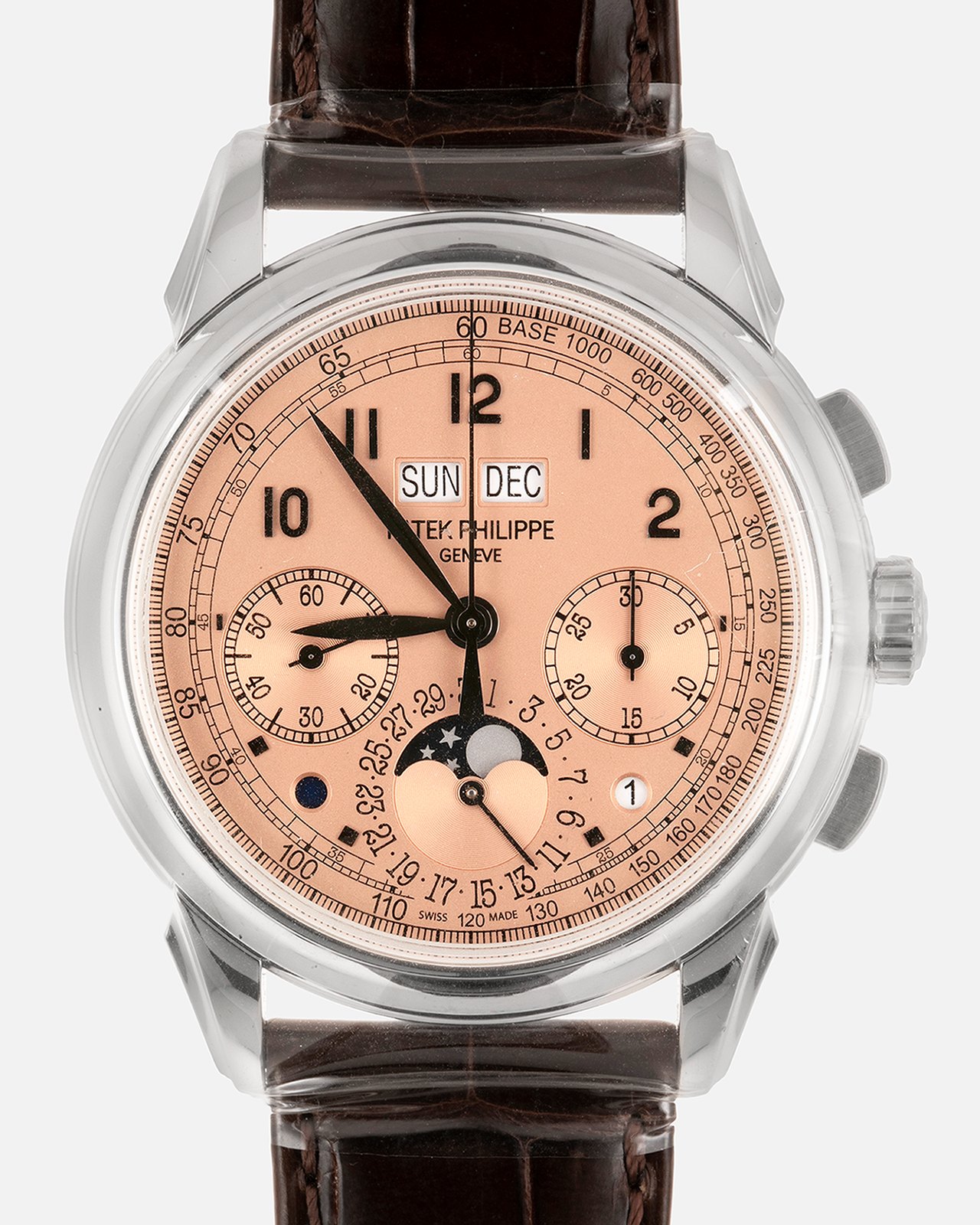
Wristwatches · Wristwatch
Patek Philippe Perpetual Calendar Chronograph 5270P Salmon, 2021
- Maker / attribution
- Patek Philippe (maker)
- Date
- 2021
- Historical period
- Contemporary Horology (2010 – Present)
- Country of origin
- Switzerland
- Object type
- Wristwatch
- Dimensions
- Case 41 mm
- Stock no.
- Product 6880088752215
- Credit line
- Dealer listing, S.Song Watches (product 6880088752215)
- Catalogue title (original)
- Patek Philippe Perpetual Calendar Chronograph 5270P Salmon (English)
View the source record (dealer listing) ↗ (opens another website in a new tab)Suggest a correction
Record summary
Catalogued by S.Song Watches (dealer), Seattle (stock number Product 6880088752215), this is a wristwatch by Patek Philippe, made in Switzerland, dated 2021. The Atlas places it in the Contemporary Horology period (2010 – Present) of its Wristwatches collection. Recorded dimensions: Case 41 mm. The record is illustrated with 6 photographs.
Assembled from the source record's structured fields. Dates and attributions are given as the source states them; where a field is missing the Atlas leaves it blank rather than estimating.
Catalogue description
Dealer description — S.Song Watches
There are times, an item becomes so synonymous with an individual or a brand that it becomes an integral part of their identity; An association formed that is so inseparable that doing without it, would diminish the character of the brand or person. So, for Patek Philippe? Perpetual calendar chronographs. Not much has been left unsaid about this legendary flagship family of watches, and rightly so. Deemed by many not only as the quintessential Patek but also as some of the best watches of all time, they have become graceful lessons in restraint and practicality, in balance and in tradition. The first-ever produced perpetual calendar chronograph by Patek Philippe was in 1941 with the reference 1518 and since then they have only released four more iterations, with the one you see here today, the 5270, the most recent. It goes to show that this reference is taken very seriously, with only five versions (1518, 2499, 3970, 5970, 5270) in nearly 80 years. Offered here today is an example of a Ref. 5270 that is not often seen in the wild, and perhaps one of my favorite iterations of this particular reference – the Patek Philippe Perpetual Calendar Chronograph Ref. 5270 in platinum and a salmon dial. First introduced at Baselworld 2018, the world already knew this watch was going to be a special one. With an unusual combination of a platinum 41mm x 12.4mm case and a gorgeous salmon-colored dial, the Ref. 5270P was the first ever Ref. 5270 to be offered in platinum and was destined to be a fan favorite, for sure. There is something to be said about this platinum and salmon dial combination though, because when we talk about case design and dial aesthetics, not many watches do it quite like this Ref. 5270P. The radiant 41mm platinum case is strong and hefty, coupled with a stunning matte salmon dial (Patek calls this the golden opaline dial – a salmon dial for all intents) that exudes warmth and restrained elegance as well as leaf (feuille) hands and hour markers in blackened gold. The beautifully shaped flared lugs here are generously stepped out from the case and dramatically fluted to accommodate better fitting on any wrist. I was actually pleasantly surprised at how well it hugged my wrist. The profile really works and it doesn’t look bulky or oversized at all, coming from someone with a smaller wrist. Of course, this being a contemporary platinum Patek Philippe also means that you will find a white Wesselton diamond, beautifully set in between the lugs at 6 o ‘clock. With this being a grand complication, its numerous indications on the dial are harmoniously arranged – a twin day-month indication at 12, a moon phase cum calendar at 6, a leap year indicator at 4:30, a day-night display aperture at 7:30, a seconds sub-dial at 9, and a 30-minute chronograph counter at 3. Looking into the business end of the Ref. 5270P, this is where Patek Philippe made headlines when this watch was first released in 2011. The hand-winding Cal. 29-535 PS Q was the first perpetual calendar chronograph made entirely in-house, replacing the Nouvelle Lemania-based Cal. 27-70 Q used in the older Ref. 5970 and Ref. 3970. Although the Cal. 27-70 Q was an exquisite, top-tier movement, we live in an age where the term ‘in-house’ has become a selling point for manufacturers and a priority for customers. In terms of tradition, this is as pure as it gets. Housed inside the Ref. 5270P is a classic column-wheel chronograph, using a lateral clutch engagement so you can see the watch functioning in all of its glory. While there are known drawbacks to a lateral clutch as opposed to a more modern vertical one, Patek opted for the former due to the fact that simply stated, they are architecturally and aesthetically more beautiful. It isn’t always the case that watchmaking is all about technicality, especially in Haute Horlogerie. Instead, it is the subtle alternations between the balance of beauty and functionality that truly defines a great movement. Furthermore, the Cal. 29-525 PS Q features a strong 65-hour power reserve. To be able to see the wheels engage and disengage in the Ref. 5270 really is a beautiful thing and provides a much more immersive experience for the wearer. After all, why have an exhibition case back if there’s nothing to see? It is important to note, that Patek being Patek, they combatted a lot of the downsides of a lateral clutch movement such as hand quivering and backlash through a series of ingenious inventions. This includes a patented tooth profile for the chronograph wheels to reduce wear and prevent tooth tip collisions (which causes hand jumps), a column wheel cap that is actually functional, allowing a more precise adjustment for the clutch lever, and a slotted minute counter cam that prevents the second-hand quivering when reset. Above the base caliber, sits a newly developed perpetual calendar module, and at a thickness of 1.65mm, it ensures the watch remains discreet and slim, relative to the level of complications. As expected, the Cal. 29-535 PS Q is finished impeccably, albeit understatedly. There is nothing superfluous, no flourishes or engravings and that is the way I like it. With expertly finished polished chamfers on all edges and satin-finished flanks, it is aligned with Patek Philippe’s pursuit of sophistication and understatement. The Patek Phillipe Perpetual Calendar Chronograph Ref. 5270P “Salmon” is as good as it gets, and it is not difficult to see why. It has been an absolute pleasure to be able to handle, and now offer this beautiful piece of wearable art on the site.
Historical context
Contemporary Horology (2010 – Present)
Silicon components, connected watches, optical-lattice research clocks and a thriving independent scene.
Smartwatches became the world's best-selling watches, while mechanical watchmaking focuses on craft, innovation (silicon components, new escapements) and independent makers.
Read the period in the timelineMore wristwatches from this periodEarlier: Mechanical Renaissance
Atlas type guide
Chronographs and split-seconds watches
A chronograph is a watch with an additional seconds hand that can be started, stopped and returned to zero independently of the timekeeping. Louis Moinet built an early example in 1816 and Nicolas Rieussec a recording 'chronographe' in 1821; Adolphe Nicole's heart-shaped reset cam (patented 1862) made the modern return-to-zero possible. Split-seconds (rattrapante) chronographs add a second hand that can be stopped for intermediate times; flyback chronographs restart instantly.
Chronographs were essential tools for doctors (pulsometer scales), artillery (telemeter), engineers and sport. In wristwatches, Valjoux, Venus, Lemania and later the automatic chronographs of 1969 (Zenith El Primero, the Chronomatic Calibre 11 group and Seiko 6139) are milestones.
What to look for
- Push-pieces on the case band or a single button in the crown (monopusher).
- Subsidiary registers for minutes and hours; tachymeter, telemeter or pulsometer scales.
- Column wheel versus cam control visible in the movement.
- Calibre markings of specialist makers (Valjoux, Lemania, Venus, Landeron).
Dating clues
- Pocket chronographs with heart cam reset: after 1862.
- Wrist chronographs: from c. 1910; two-button designs from the 1930s.
- Automatic chronographs: from 1969.
General guidance written by the Atlas editors about this kind of object. It is not a statement about this particular piece; for that, rely on the source record above and on physical examination.
Read next:Flyback chronographChronograph
Related records
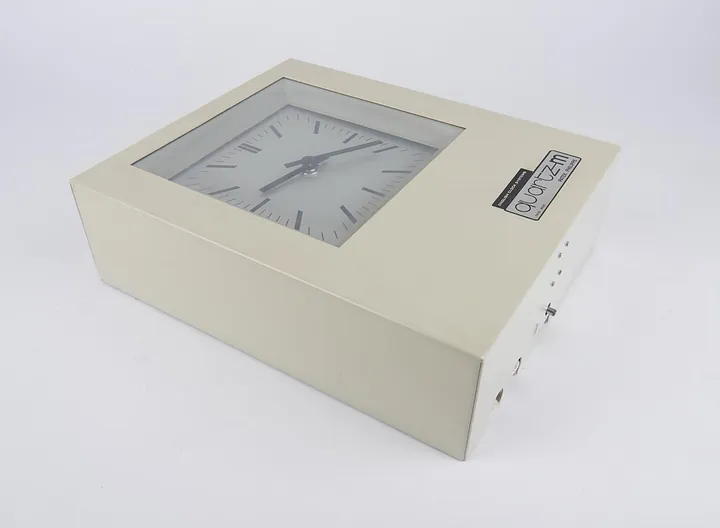
Clocks · 1965–1975
Quartz master clock QM 1, with movement by Patek Phillippe, Switzerland, 1965–1975. Supplied by English Clock Systems.
Science Museum Group, London
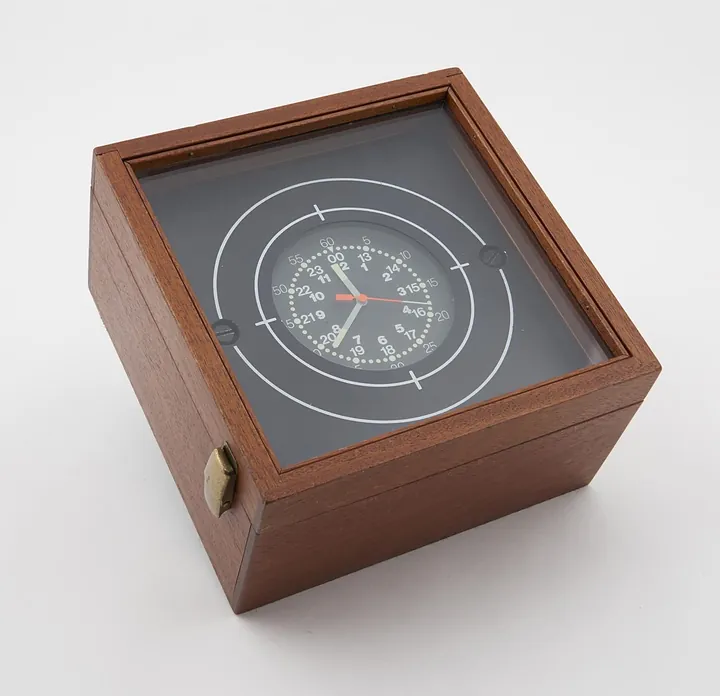
Instruments · 1965–1984
Chronometer by Patek Philippe and Kelvin Hughes, England, 1965–1984
Science Museum Group, London
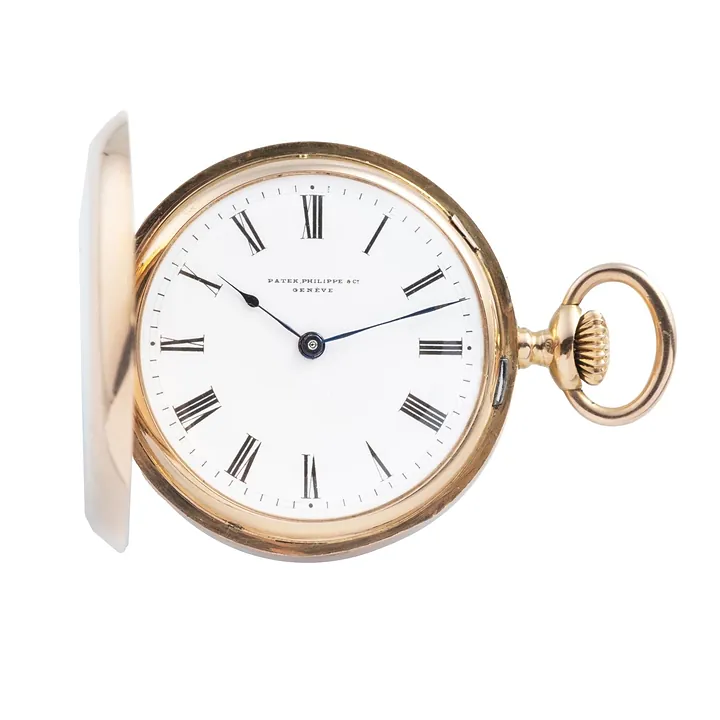
Pocket Watches · c. 1895
Patek Philippe pocket watch, c. 1895
Antiquorum auction archive, Geneva

Pocket Watches · c. 1900
Patek Philippe Chronometro Gondolo, c. 1900
Antiquorum auction archive, Geneva

Wristwatches · c. 2010s
Breguet Type XXI, ref. 3810, c. 2010s (Antiquorum Lot 381-24)
Antiquorum auction archive, Geneva

Wristwatches · c. 2010s
Breguet Type XXI, ref. 3810, c. 2010s (Antiquorum Lot 386-229)
Antiquorum auction archive, Geneva

Wristwatches · Sold in September 2010
Breitling Cosmonaute, ref. A 22322, Sold in September 2010
Antiquorum auction archive, Geneva

Wristwatches · c. 2010
Corum Bubble Chrono, ref. 396.150.20, c. 2010
Antiquorum auction archive, Geneva