
Wristwatches · Wristwatch
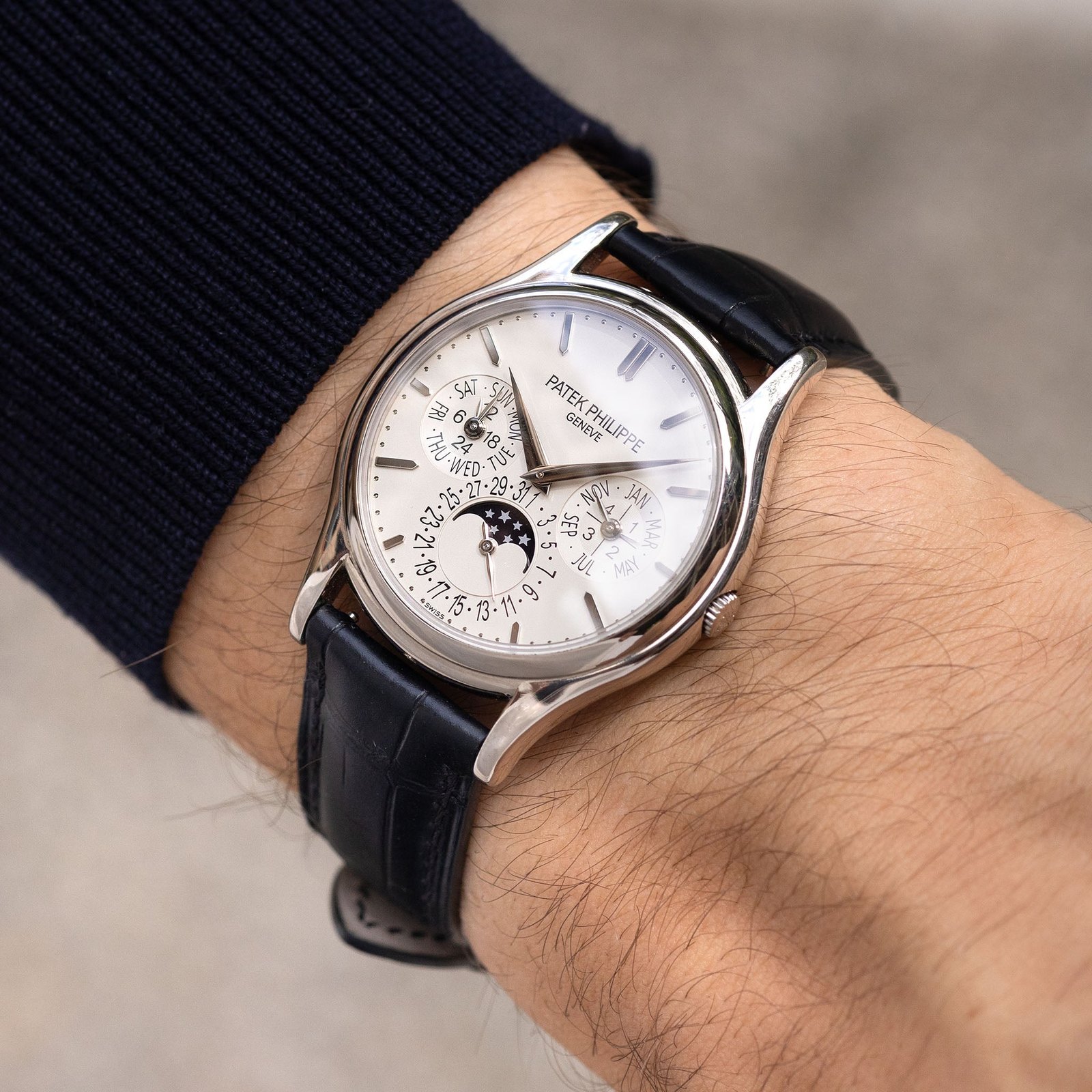
Patek Philippe Perpetual Calendar 5140G in 18k White Gold Opaline dial with Box and Extract of Archives, 2014
- Maker / attribution
- Patek Philippe (maker)
- Date
- 2014
- Historical period
- Contemporary Horology (2010 – Present)
- Country of origin
- Switzerland
- Object type
- Wristwatch
- Materials / technique
- 18k white gold
- Dimensions
- Case 37 mm
- Stock no.
- W-3834
- Credit line
- Dealer listing, Bulang & Sons (W-3834)
- Catalogue title (original)
- Patek Philippe Perpetual Calendar 5140G in 18k White Gold Opaline dial with Box and Extract of Archives (English)
View the source record (dealer listing) ↗ (opens another website in a new tab)Suggest a correction
Record summary
Catalogued by Bulang & Sons (dealer), Copenhagen (stock number W-3834), this is a wristwatch by Patek Philippe, made in Switzerland, dated 2014. The Atlas places it in the Contemporary Horology period (2010 – Present) of its Wristwatches collection. Materials and techniques recorded by the source: 18k white gold. Recorded dimensions: Case 37 mm. The record is illustrated with 6 photographs.
Assembled from the source record's structured fields. Dates and attributions are given as the source states them; where a field is missing the Atlas leaves it blank rather than estimating.
Catalogue description
Dealer description — Bulang & Sons
We have always been big fans of perpetual calendars, and few brands are as closely associated with the complication as Patek Philippe. Not only did the manufacture play a pivotal role in the development of the perpetual calendar wristwatch, it also helped establish the market for complicated wristwatches as we know it today. Presented here is a lovely reference 5140G in 18k white gold, featuring an elegant and perfectly proportioned 37 mm case. The reference 5140 succeeded the legendary 3940, a model widely regarded as one of the most important creations of Patek Philippe's modern era. Together with the reference 3970, the 3940 helped redefine complicated watchmaking in the late twentieth century and is often considered one of the first highly complicated wristwatches to be produced in series. After an impressive production run spanning nearly two decades, the 3940 was replaced in 2006 by the reference 5140, which retained the celebrated ultra-thin self-winding calibre 240Q, powered by a beautifully engineered micro-rotor. The elegant white-gold case features the four correctors required to adjust the perpetual calendar functions and remains in excellent condition, with the gold hallmarks still clearly visible. The watch is fitted with its beautiful snap-on sapphire display case back, offering a wonderful view of the exquisite calibre 240Q movement. Our watchmaker has fully checked and regulated the movement to ensure it performs exactly as it should. The opaline dial is both refined and highly legible, featuring a dotted minute track and three perfectly balanced sub-dials displaying the perpetual calendar indications. These include the date, day, month, leap-year cycle, 24-hour indication, and moon-phase display, all presented in English. The dial's clean layout and understated elegance are hallmarks of what many collectors consider one of Patek Philippe's finest perpetual calendar designs. Completing the watch is its original Patek Philippe leather strap, fitted with an 18k white-gold Patek Philippe folding clasp.Further more the original 18 k white gold second closed case back is also included in the sale as well the original wooden Patek Philippe box with its battery driven watch winder. Accompanied by a Patek Philippe Extract from the Archives confirming that the watch was originally sold in 2014. For collectors looking to enter the world of Patek Philippe “Grand Complications,” this piece represents an exceptional opportunity. It combines elegant proportions, everyday wearability, and the timeless appeal of one of the brand’s most respected modern perpetual calendar designs. Understated yet highly sophisticated, it remains an enduring classic within the Patek Philippe collection.For further details or to discuss availability, feel free to get in touch. Specifications: Patek Philippe Perpetual Calendar reference 5140G 37mm 18k white gold case with display case back Perpetual calendar with three sub-dial layout with moon phase, English language Automatic movement Cal. 240Q with 18k gold micro-rotor Accompanied by it’s original 2nd solid 18k white gold case back Original Patek Philippe wood presentation box with battery driven watch winder, cardboard outer-box. Case no 468xxxx / movement no 579xxxx dating to 2014 Patek Philippe leather strap with original Patek Philippe 18k white gold folding clasp Extract of Archives stating a sale in 2014 Fully checked by our watchmaker
Historical context
Contemporary Horology (2010 – Present)
Silicon components, connected watches, optical-lattice research clocks and a thriving independent scene.
Smartwatches became the world's best-selling watches, while mechanical watchmaking focuses on craft, innovation (silicon components, new escapements) and independent makers.
Read the period in the timelineMore wristwatches from this periodEarlier: Mechanical Renaissance
Atlas type guide
Calendar, moon-phase and perpetual calendar watches
Calendar complications range from a simple date to the perpetual calendar, which automatically allows for months of different lengths and leap years until 2100. Pocket watches with perpetual calendars were made in the eighteenth and nineteenth centuries; Patek Philippe made the first perpetual calendar wristwatch in 1925, and series production followed in 1941. The annual calendar (Patek Philippe, 1996) needs correction only once a year.
Moon-phase displays use a disc with two moons and 59 teeth advanced daily, approximating the 29.5-day lunation; more precise trains reduce the error to one day in over a century.
What to look for
- Apertures or subsidiary dials for day, date, month and leap year.
- Moon disc under a 'bosom' shaped aperture.
- Recessed correctors on the case band for setting the calendar.
Dating clues
- Triple-date wristwatches: popular c. 1940–1955.
- Perpetual calendar wristwatches: from 1925 (unique) and 1941 (series).
General guidance written by the Atlas editors about this kind of object. It is not a statement about this particular piece; for that, rely on the source record above and on physical examination.
Related records

Clocks · 1965–1975
Quartz master clock QM 1, with movement by Patek Phillippe, Switzerland, 1965–1975. Supplied by English Clock Systems.
Science Museum Group, London

Instruments · 1965–1984
Chronometer by Patek Philippe and Kelvin Hughes, England, 1965–1984
Science Museum Group, London

Pocket Watches · c. 1895
Patek Philippe pocket watch, c. 1895
Antiquorum auction archive, Geneva

Pocket Watches · c. 1900
Patek Philippe Chronometro Gondolo, c. 1900
Antiquorum auction archive, Geneva

Wristwatches · c. 2010s
Breguet Type XXI, ref. 3810, c. 2010s (Antiquorum Lot 381-24)
Antiquorum auction archive, Geneva

Wristwatches · c. 2010s
Breguet Type XXI, ref. 3810, c. 2010s (Antiquorum Lot 386-229)
Antiquorum auction archive, Geneva

Wristwatches · Sold in September 2010
Breitling Cosmonaute, ref. A 22322, Sold in September 2010
Antiquorum auction archive, Geneva

Wristwatches · c. 2010
Corum Bubble Chrono, ref. 396.150.20, c. 2010
Antiquorum auction archive, Geneva