
Wristwatches · Wristwatch
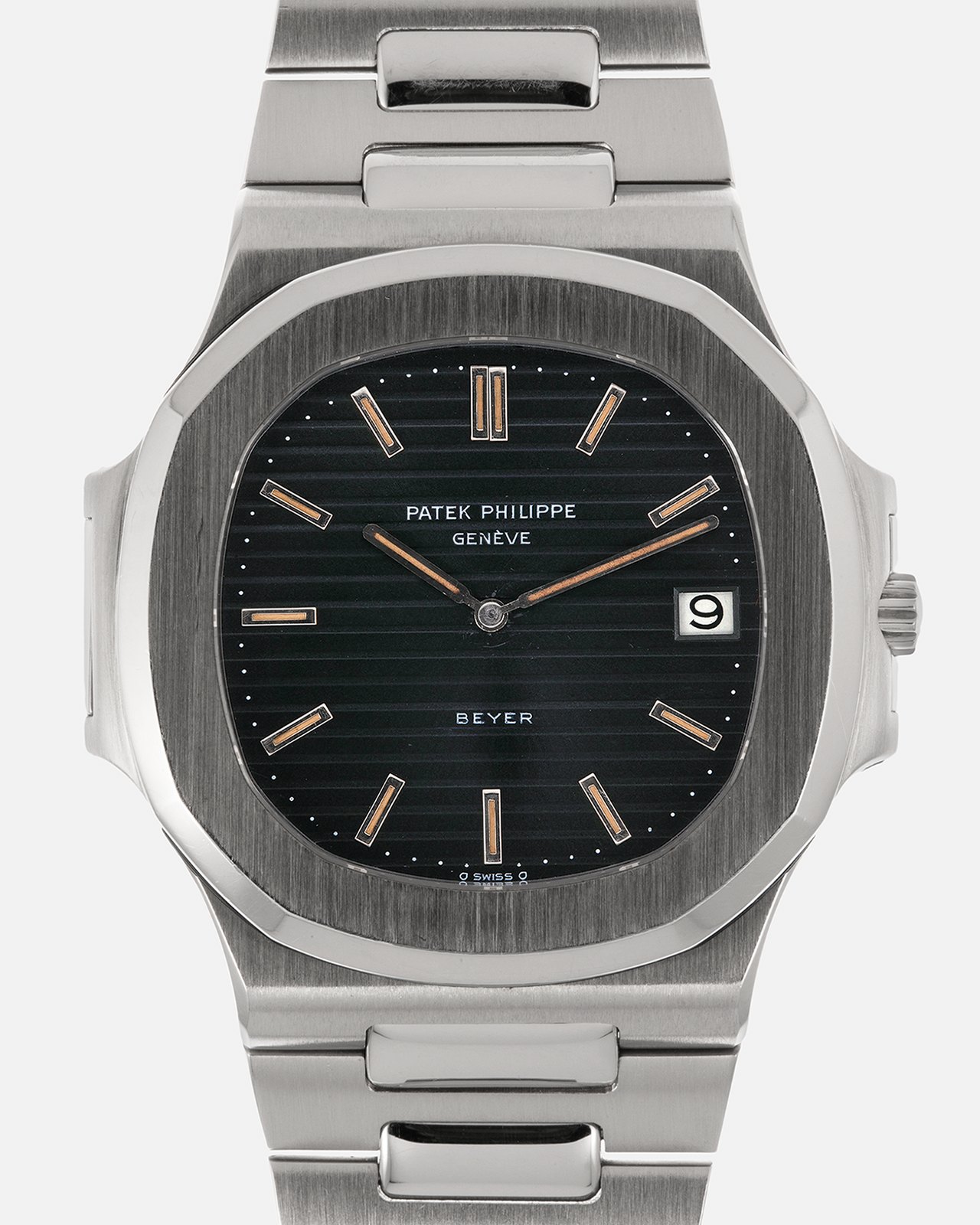
Patek Philippe Nautilus 3700/11 Jumbo Beyer, 1983
- Maker / attribution
- Patek Philippe (maker)
- Date
- 1983
- Historical period
- Quartz Revolution (1969 – 1990)
- Country of origin
- Switzerland
- Object type
- Wristwatch
- Dimensions
- Case 14 mm
- Stock no.
- Product 7497406578775
- Credit line
- Dealer listing, S.Song Watches (product 7497406578775)
- Catalogue title (original)
- Patek Philippe Nautilus 3700/11 Jumbo Beyer (English)
View the source record (dealer listing) ↗ (opens another website in a new tab)Suggest a correction
Record summary
Catalogued by S.Song Watches (dealer), Seattle (stock number Product 7497406578775), this is a wristwatch by Patek Philippe, made in Switzerland, dated 1983. The Atlas places it in the Quartz Revolution period (1969 – 1990) of its Wristwatches collection. Recorded dimensions: Case 14 mm. The record is illustrated with 6 photographs.
Assembled from the source record's structured fields. Dates and attributions are given as the source states them; where a field is missing the Atlas leaves it blank rather than estimating.
Catalogue description
Dealer description — S.Song Watches
Released in 1976, the Patek Philippe Nautilus marked the brand’s bold entry into the luxury sports watch category, conceived as Patek’s direct response to Audemars Piguet’s paradigm-shifting Royal Oak. Designed by Gerald Genta—the very same visionary behind the Royal Oak—the Nautilus drew inspiration from maritime vessel portholes, featuring a round octagonal bezel with distinctive hinges on both sides of the case. The debut of the Nautilus was a turning point for the brand due to the landscape of the luxury watch market at the time, which hosted a period of emphasis on horological innovation and creativity that birthed many now iconic designs we see today (Submariner, Daytona, Speedmaster, etc). In other words, watches introduced during that time were getting more and more precise, reliable, and efficient. The timely arrival of the Nautilus was initially met with immense scepticism and was deemed an uncharacteristic departure from Patek’s classic and conservative DNA, but it eventually went on to establish itself as one of the most sought-after luxury sports watches, a reputation that continues to strengthen even to this day, with examples achieving remarkable results at major auctions worldwide. Offered here today is an example of the reference that laid down the foundation for the Nautilus lineage as we know it: the Patek Philippe Nautilus 3700. Produced from 1976 to 1990 in various metals and configurations, the 3700 established the core identity of the model and set the stage for everything that followed. Among its iterations, the stainless steel version is the most desirable, with production ending sometime around 1987, several years earlier than its other precious metal counterparts. This here is a 3700/11A, with the “A” denoting Acier (French for steel). According to its extract from the archives, it was manufactured in 1983, placing it within the mid-to-late production years of the original Nautilus 3700. This particular specimen, however, is double-stamped “Beyer”, marking it as an exceptionally rare and historically significant example that unites the purity of the original Nautilus blueprint with the prestige of Beyer Chronometrie, Patek Philippe’s longest-standing retail partner since 1842. Introduced around 1982, the 3700/11 marked the final evolution of the original Nautilus. While it remained visually similar in appearance to the earlier 3700/1, it featured a more tapered bracelet design. The “11A” designation in its reference indicates that it is fitted with Patek Philippe’s later integrated bracelet, produced by Ateliers Réunis, whose version tapers more noticeably to 14mm at the clasp (versus a wider 16mm width on the 3700/1), with tighter link articulation and more defined finishing. This update followed the brand’s move to bring bracelet production under its own roof after Gay Frères, its long-time supplier, stopped supplying the brand with bracelets sometime around 1982. Also worth noting is that production of the 3700/11 was noticeably lower, with approximately 1,300 pieces made between 1982 and 1990, compared to around 3,500 pieces of the earlier 3700/1 produced from 1976 to 1982. Combined with its ‘Beyer’ double stamp, this adds an extra layer of rarity and distinction for collectors seeking one of the most complete and refined expressions of the early Nautilus era. As far as aesthetics and technical specifications go, the 3700/11 retains the same 42mm “Jumbo” monobloc case, meaning the movement can only be accessed from the dial side—an engineering hallmark that contributes to its overall thinness and rigidity. As with most of Genta’s designs, the Nautilus features a horizontally embossed dial that interacts beautifully with light, shifting between deep blue and slate tones for a captivating visual effect. At 3:00, a discreet date window is positioned, while at 6:00, you’ll find a “σ SWISS σ” signature, with the flanking Greek sigma symbols denoting solid gold in the hour markers and hands. Powering the watch from within is the ultra-thin Cal. 28-255C, a Patek-modified version of Jaeger-LeCoultre’s Cal. 920, widely regarded as one of the thinnest full-rotor self-winding movements in the world. The same movement was also famously used in the Audemars Piguet Royal Oak 5402 and the Vacheron Constantin 222. In terms of power reserve, the Cal. 28-255 SC can hold a charge of up to 38 hours on a full wind. Nearly fifty years on, the Nautilus continues to define Patek Philippe’s legacy in modern watchmaking. This now-iconic sports watch remains as coveted as ever, with its popularity showing no signs of slowing down. With its impeccable provenance and rare Beyer double-stamped dial, this 3700/11A represents one of the most important and desirable specimens of the reference to surface in recent years, and we’re absolutely thrilled to be able to offer one here on the site today.
Historical context
Quartz Revolution (1969 – 1990)
Seiko's Astron begins mass quartz timekeeping; traditional industries contract sharply.
Quartz and digital watches transformed the market after 1969. Swiss employment collapsed, Japanese and Hong Kong production soared, and the Swatch (1983) helped the Swiss industry recover; mechanical watches survived as luxury goods.
Read the period in the timelineMore wristwatches from this periodEarlier: Modern Mechanical Horology
Atlas type guide
Wristwatches
Bracelet watches were worn by women from the early nineteenth century — Breguet made one for Caroline Murat, Queen of Naples, in 1810–12 — but the wristwatch only became a man's instrument with military use and aviation in the early twentieth century. Between the World Wars it overtook the pocket watch; the 1920s and 1930s brought rectangular Art Deco cases, water-resistant cases and the first automatic winding systems.
After 1945 the wristwatch became a carrier of identity — dress watches, sports and dive watches, chronographs, calendars — produced by Swiss, American, Japanese, German, Soviet and Chinese industries. The quartz revolution after 1969 and the mechanical renaissance since the 1990s, including the rise of independent watchmakers, complete the story.
What to look for
- The reference number (between the lugs or inside the case back) and serial number, the starting point for dating.
- The calibre: its maker and number are often stamped under the dial or on the bridge.
- Originality of dial, hands and crown — refinished ('redial') dials are common.
- Case material marks: 18K/750, 14K/585, stainless steel, gold-filled, plated.
Dating clues
- Wire-lug cases: before c. 1925.
- Water-resistant screw-down cases: from 1926.
- Quartz movements: from 1969; sapphire crystals widespread after c. 1980.
General guidance written by the Atlas editors about this kind of object. It is not a statement about this particular piece; for that, rely on the source record above and on physical examination.
Related records

Clocks · 1965–1975
Quartz master clock QM 1, with movement by Patek Phillippe, Switzerland, 1965–1975. Supplied by English Clock Systems.
Science Museum Group, London

Instruments · 1965–1984
Chronometer by Patek Philippe and Kelvin Hughes, England, 1965–1984
Science Museum Group, London

Pocket Watches · c. 1895
Patek Philippe pocket watch, c. 1895
Antiquorum auction archive, Geneva

Pocket Watches · c. 1900
Patek Philippe Chronometro Gondolo, c. 1900
Antiquorum auction archive, Geneva

Wristwatches · 1970
Wristwatch by Heno, Switzerland, 1970
Museum Rotterdam

Wristwatches · 1960–1986
'Tri-Compax' calendar chronograph wristwatch in gold case, by Universal, Geneva, Switzerland, 1960–1986.
Science Museum Group, London

Wristwatches · 1969–1970
Beta 21 Quartz wristwatch movement, made in Switzerland, 1970.
Science Museum Group, London

Wristwatches · c. 1969
Omega Speedmaster Moonwatch, ref. 145022-69st, c. 1969
Antiquorum auction archive, Geneva