
Wristwatches · Wristwatch
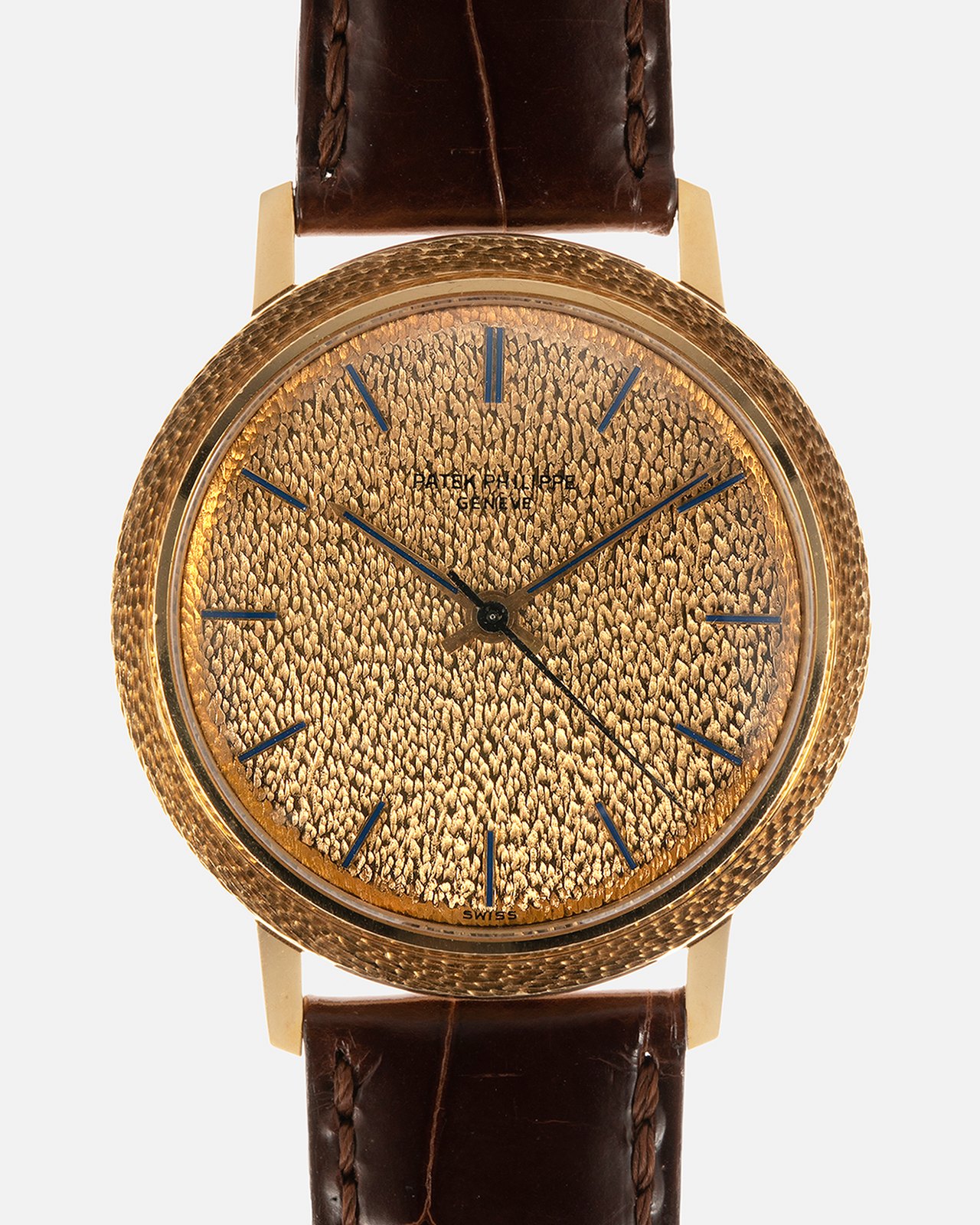
Patek Philippe Calatrava ‘Back Wind’ 3569J Hammered Dial/Case, 1970
- Maker / attribution
- Patek Philippe (maker)
- Date
- 1970
- Historical period
- Quartz Revolution (1969 – 1990)
- Country of origin
- Switzerland
- Object type
- Wristwatch
- Dimensions
- Case 36 mm
- Stock no.
- Product 7468707971159
- Credit line
- Dealer listing, S.Song Watches (product 7468707971159)
- Catalogue title (original)
- Patek Philippe Calatrava ‘Back Wind’ 3569J Hammered Dial/Case (English)
View the source record (dealer listing) ↗ (opens another website in a new tab)Suggest a correction
Record summary
Catalogued by S.Song Watches (dealer), Seattle (stock number Product 7468707971159), this is a wristwatch by Patek Philippe, made in Switzerland, dated 1970. The Atlas places it in the Quartz Revolution period (1969 – 1990) of its Wristwatches collection. Recorded dimensions: Case 36 mm. The record is illustrated with 6 photographs.
Assembled from the source record's structured fields. Dates and attributions are given as the source states them; where a field is missing the Atlas leaves it blank rather than estimating.
Catalogue description
Dealer description — S.Song Watches
One of the bedrocks of the Patek Philippe collection is its classic dress watch—the Calatrava. A necessary foundation piece for any haute horlogerie brand, the dress watch archetype is a must and with the Calatrava, Patek Philippe continues to build on its rich tradition to this day. For a bit of historical context, we go back to the ’30s when Charles and Henri Stern purchased the Patek Philippe brand. To revamp the manufacture, the first model they produced is, of course, the Calatrava. The reference 96 came in 1932, at a time when wristwatches were beginning to take over pocket watches, and it was a move that cemented their status as one of the eminent watch brands of the world. To this day, the Stern family still owns Patek Philippe, and you can tell that the Calatrava is still very important. Offered here today is an exceptionally beautiful example of a Calatrava ‘Back Wind’ 3569J. It is presented in a sleek 36mm x 8.3mm and intricately hammered 18-carat yellow gold case, which exudes a certain old-world charm, warmth and texture, all in equal measure. Housed within is a stunningly radiant gold dial finished with the same artisanal touch. The dial is further adorned with understated baton hour markers filled with blue enamel, complemented by a set of matching thin gold hands with the same blue enamel inlays gracefully positioned at its center.. As a fan of vintage Patek Philippe, I have to say that the craftsmanship on this example is truly among the most intricate and beautiful I have seen and handled. From my understanding, the 3569 was produced between 1969 and 1989 in several metals and variants, spanning the quartz crisis. There was nothing quite like it at the time. From afar, it may appear to be just a regular gold dress watch, but it reveals its true character only upon closer inspection. The hammered texture of both the case and dial lends the 3569 a distinct artistic and ornate quality that feels entirely its own, something rarely seen in modern dress watches. There is also something about it and the way it shimmers under certain lighting conditions that gives off an impression of quiet lavishness. It speaks volumes about the level of detail Patek invested into what is, on the surface, a simple dress watch. As the saying goes, God is in the details, and I find that especially true when it comes to vintage Patek Philippe, like this example. As mentioned earlier, the 3569 was produced during the onset of the quartz crisis: a period when much of the Swiss watch industry shifted focus toward quartz-powered timepieces, prized for their accuracy and low maintenance. While many brands pivoted in that direction, Patek Philippe remained committed to its mechanical roots and heritage. True to its spirit of innovation and quiet defiance (much like the legendary 3940 and 3970), Patek developed a new movement to continue offering mechanical watches to its clientele. That movement was the Cal. 350, a clever automatic movement notable for its back-wind system and use of a peripheral rotor—one of the earliest serially produced examples of its kind. This unconventional construction enabled a slimmer case profile and allowed for a crownless, symmetrical front appearance. This was perfectly in line with the elegant dress watch aesthetic codes of Patek’s Calatrava lineage. Yet despite its technical novelty, the design had one critical flaw: the crownless case design meant the winding mechanism was integrated directly onto the caseback, which unfortunately created an entry point for moisture to seep in from prolonged contact with the wrist. This vulnerability compromised the movement’s long-term reliability, and by around 1985, the design was quietly retired. Nevertheless, it was a bold and ambitious attempt, especially given the industry climate at the time, and it speaks to the kind of risk-taking that is sometimes necessary to remain at the forefront of fine watchmaking. That being said, not every experiment yields lasting success, but when a watch looks this gorgeous in the process, it’s hard not to admire and applaud the effort. Perhaps one of the most daringly innovative and experimental Calatravas ever made, the 3569 is an absolute joy to behold and wear. During my time with it, I often caught myself simply admiring the case and dial, completely captivated by its beauty and, ironically, forgetting the time altogether. Visually, it has the presence of a charismatic old gentleman from a bygone era of refined taste and distinction. With its near-perfect proportions, graceful design, and exceptional craftsmanship, the 3569 is a remarkable dress watch for the collector who appreciates traditional elegance, but with a touch of artisanal flair.
Historical context
Quartz Revolution (1969 – 1990)
Seiko's Astron begins mass quartz timekeeping; traditional industries contract sharply.
Quartz and digital watches transformed the market after 1969. Swiss employment collapsed, Japanese and Hong Kong production soared, and the Swatch (1983) helped the Swiss industry recover; mechanical watches survived as luxury goods.
Read the period in the timelineMore wristwatches from this periodEarlier: Modern Mechanical Horology
Atlas type guide
Wristwatches
Bracelet watches were worn by women from the early nineteenth century — Breguet made one for Caroline Murat, Queen of Naples, in 1810–12 — but the wristwatch only became a man's instrument with military use and aviation in the early twentieth century. Between the World Wars it overtook the pocket watch; the 1920s and 1930s brought rectangular Art Deco cases, water-resistant cases and the first automatic winding systems.
After 1945 the wristwatch became a carrier of identity — dress watches, sports and dive watches, chronographs, calendars — produced by Swiss, American, Japanese, German, Soviet and Chinese industries. The quartz revolution after 1969 and the mechanical renaissance since the 1990s, including the rise of independent watchmakers, complete the story.
What to look for
- The reference number (between the lugs or inside the case back) and serial number, the starting point for dating.
- The calibre: its maker and number are often stamped under the dial or on the bridge.
- Originality of dial, hands and crown — refinished ('redial') dials are common.
- Case material marks: 18K/750, 14K/585, stainless steel, gold-filled, plated.
Dating clues
- Wire-lug cases: before c. 1925.
- Water-resistant screw-down cases: from 1926.
- Quartz movements: from 1969; sapphire crystals widespread after c. 1980.
General guidance written by the Atlas editors about this kind of object. It is not a statement about this particular piece; for that, rely on the source record above and on physical examination.
Related records

Clocks · 1965–1975
Quartz master clock QM 1, with movement by Patek Phillippe, Switzerland, 1965–1975. Supplied by English Clock Systems.
Science Museum Group, London

Instruments · 1965–1984
Chronometer by Patek Philippe and Kelvin Hughes, England, 1965–1984
Science Museum Group, London

Pocket Watches · c. 1895
Patek Philippe pocket watch, c. 1895
Antiquorum auction archive, Geneva

Pocket Watches · c. 1900
Patek Philippe Chronometro Gondolo, c. 1900
Antiquorum auction archive, Geneva

Wristwatches · 1970
Wristwatch by Heno, Switzerland, 1970
Museum Rotterdam

Wristwatches · 1960–1986
'Tri-Compax' calendar chronograph wristwatch in gold case, by Universal, Geneva, Switzerland, 1960–1986.
Science Museum Group, London

Wristwatches · 1969–1970
Beta 21 Quartz wristwatch movement, made in Switzerland, 1970.
Science Museum Group, London

Wristwatches · c. 1969
Omega Speedmaster Moonwatch, ref. 145022-69st, c. 1969
Antiquorum auction archive, Geneva