
Wristwatches · Wristwatch
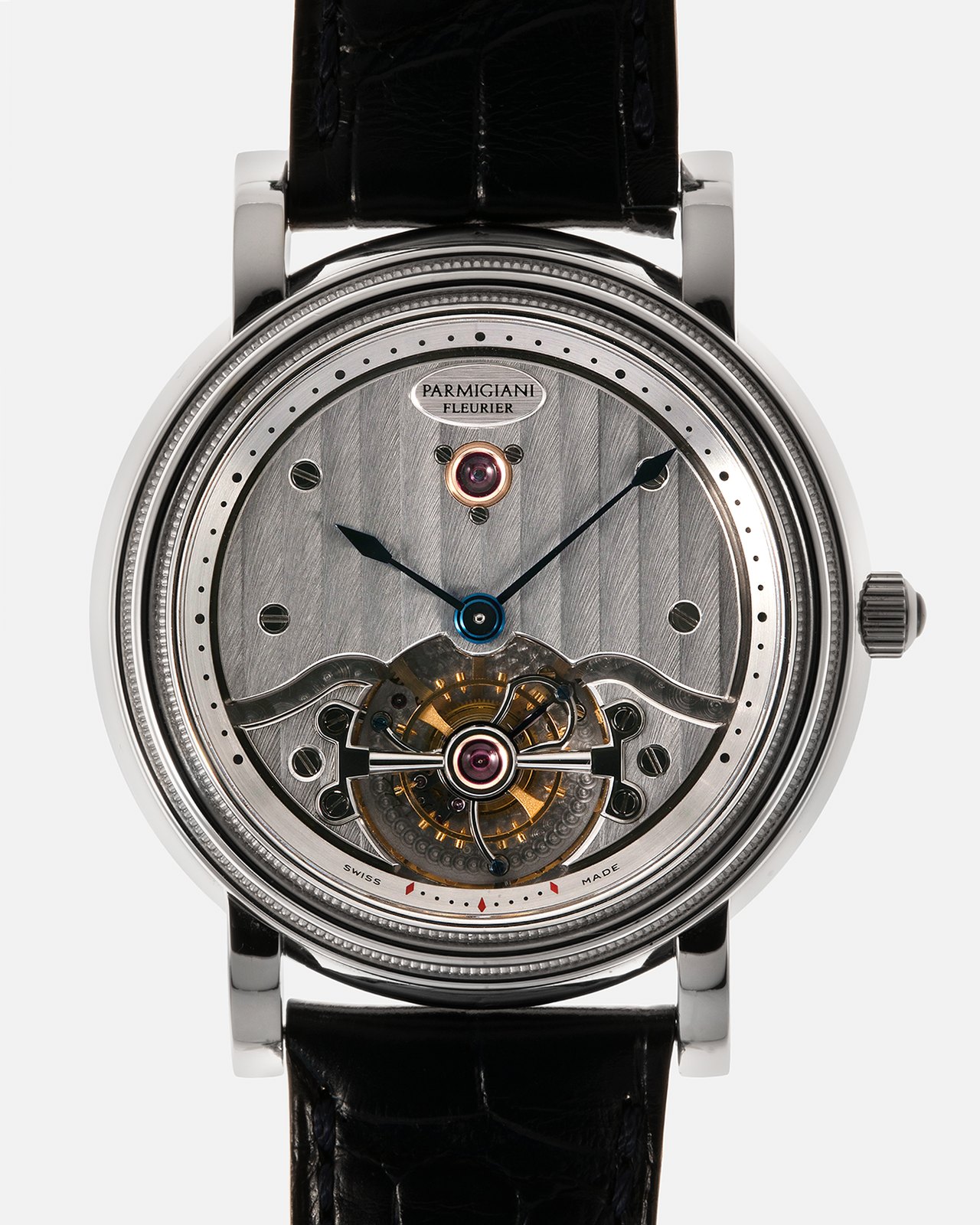
Parmigiani Fleurier Toric Tourbillon 2840 Platinum, 2001
- Maker / attribution
- Parmigiani Fleurier (maker)
- Date
- 2001
- Historical period
- Mechanical Renaissance (1990 – 2010)
- Country of origin
- Switzerland
- Object type
- Wristwatch
- Materials / technique
- platinum
- Dimensions
- Case 40 mm
- Stock no.
- Product 7382619226199
- Credit line
- Dealer listing, S.Song Watches (product 7382619226199)
- Catalogue title (original)
- Parmigiani Fleurier Toric Tourbillon 2840 Platinum (English)
View the source record (dealer listing) ↗ (opens another website in a new tab)Suggest a correction
Record summary
Catalogued by S.Song Watches (dealer), Seattle (stock number Product 7382619226199), this is a wristwatch by Parmigiani Fleurier, made in Switzerland, dated 2001. The Atlas places it in the Mechanical Renaissance period (1990 – 2010) of its Wristwatches collection. Materials and techniques recorded by the source: platinum. Recorded dimensions: Case 40 mm. The record is illustrated with 6 photographs.
Assembled from the source record's structured fields. Dates and attributions are given as the source states them; where a field is missing the Atlas leaves it blank rather than estimating.
Catalogue description
Dealer description — S.Song Watches
Parmigiani Fleurier is an independent brand that can be described as a manufacturer that goes beyond surface appearances. Often only talked about within enthusiast circles, the brand has garnered a reputation as somewhat of an underdog in the realm of independent watchmaking. Before its eventual establishment in 1996, Michel Parmigiani, operated a small Mesure et Art du Temps (restoration workshop) in Couvet, Switzerland, where he was renowned for his expertise in the art of timepiece restoration. As time went on, Michel began crafting unique watches for clients, and the Parmigiani restoration workshop became a training ground for some of the most accomplished and highly regarded independent watchmakers who have since made their mark in the industry. Most notably, Kari Voutilainen, Stepan Sarpaneva and Raúl Pagès. Today, Parmigiani Fleurier has garnered recognition as one of the most extensively vertically integrated watch manufacturers globally. Its facilities have assumed a crucial role within the Swiss watch industry's supply chain due to its extensive involvement in the production of various essential components for watch manufacturing/production, including balance springs and movements, etc. Additionally, the brand's expertise extends to the restoration of historically significant clocks and timepieces from around the world. These are a few of Michel Parmigiani’s many achievements which have contributed to his recognition as one of the pioneers of the industry, earning him the moniker of one of the "fathers" of independent watchmaking. Offered here today is a first-generation Toric Tourbillon Ref. 2840 in platinum. First introduced around 2000, the Ref. 2840 also marks Parmigiani Fleurier’s debut tourbillon. In the context of haute horlogerie , they are often regarded as an unspoken rite of passage and a benchmark for many watchmakers in demonstrating their technical prowess and capabilities. Established in 1996, Parmigiani Fleurier is a relatively young brand, so the fact that they were able to release a complication of such caliber in merely four years after its founding is an impressive feat, undoubtedly speaking volumes to the manufacture’s watchmaking and technical mastery. From a design perspective, the Ref. 2840 hails from the Toric collection, which, as the name suggests, draws inspiration from the geometry of a torus. This is particularly evident in the Ref. 2840's case, which is crafted in line with the Golden Ratio. The design features stepped, fluted bezels and two pairs of finely scalloped lugs that curve downward just ever so slightly. When viewed from a distance, the case exudes a lavish and ornamental flair, evoking the aesthetic of Greek Doric columns—an architectural element from ancient Greece that represents one of the five orders of classical architecture. Powering the Ref. 2840 from within its 40mm platinum 950 case is the 20-jewelled, manual-winding Cal. PF280, featuring a tourbillon regulator and an impressive 72-hour power reserve. Visible through the exhibition sapphire caseback, you can see that the Cal. PF280 is adorned with exquisite Côtes de Genève decoration, as well as a myriad of beautifully executed hand-finishing techniques. Interestingly, the Cal. PF280 also bears a visual resemblance to the Girard Perregaux Three Bridges ébauche. You see, during the manufacture’s early years, Parmigiani Fleurier actually utilized high-quality ébauches, which were then modified, assembled, and finished in-house. For those unaware, the Girard-Perregaux ébauche was originally designed for pocket watches and has a decorated history dating back to the 19th century. According to scholarly sources, the movement was initially fitted with 3 nickel bridges to power a tourbillon chronometer pocket watch made by Constant Girard in 1860, which went on to win top honors at the 1867 and 1889 Paris World Exhibitions (a.k.a the “Exposition Universelle”) as well as the prestigious Neuchâtel Observatory Prize in 1911—one of the most esteemed competitions for timepiece accuracy. Moving on to its dial, it’s important to note that the dial is open-worked, revealing the reverse side of the Cal. PF280 movement, also beautifully embellished with Côtes de Genève and encircled by a black-dotted rehaut along the dial’s periphery. Visually, the dial adopts a clean minimalist approach that allows the stunning tourbillon cage at 6:00 to take centerstage. Positioned at 12:00, an oval ring proudly displays the Parmigiani Fleurier brand signature. Completing the dial is a set of thermally blued, javelin-style hands, which add a touch of elegance and provide a lovely contrast to the overall aesthetic. What can I say? The Toric Tourbillon is undeniably an extraordinary and charming timepiece. The seamless fusion of traditional elements with modern touches and subtle nuances here is a testament to the creative brilliance of Michel Parmigiani, resulting in a sophisticated design that truly comes to life when viewed and handled in person. Ultimately, the Toric Tourbillon presents an overall aesthetic that is truly unparalleled, particularly within its era. Personally, as an admirer of tourbillon complications, this piece unquestionably earns a place among my personal favorites, alongside icons like the Daniel Roth 2187 Tourbillon, the Breguet Ref. 3357, and others.
Historical context
Mechanical Renaissance (1990 – 2010)
Mechanical watches return as cultural objects; independent watchmaking flourishes.
Mechanical watches returned as cultural and luxury objects. Complications, tourbillons and new materials proliferated; independent watchmakers such as George Daniels, F.P. Journe and Philippe Dufour revived artisanal watchmaking; collecting vintage watches became a major field.
Read the period in the timelineMore wristwatches from this periodEarlier: Quartz Revolution
Atlas type guide
Wristwatches
Bracelet watches were worn by women from the early nineteenth century — Breguet made one for Caroline Murat, Queen of Naples, in 1810–12 — but the wristwatch only became a man's instrument with military use and aviation in the early twentieth century. Between the World Wars it overtook the pocket watch; the 1920s and 1930s brought rectangular Art Deco cases, water-resistant cases and the first automatic winding systems.
After 1945 the wristwatch became a carrier of identity — dress watches, sports and dive watches, chronographs, calendars — produced by Swiss, American, Japanese, German, Soviet and Chinese industries. The quartz revolution after 1969 and the mechanical renaissance since the 1990s, including the rise of independent watchmakers, complete the story.
What to look for
- The reference number (between the lugs or inside the case back) and serial number, the starting point for dating.
- The calibre: its maker and number are often stamped under the dial or on the bridge.
- Originality of dial, hands and crown — refinished ('redial') dials are common.
- Case material marks: 18K/750, 14K/585, stainless steel, gold-filled, plated.
Dating clues
- Wire-lug cases: before c. 1925.
- Water-resistant screw-down cases: from 1926.
- Quartz movements: from 1969; sapphire crystals widespread after c. 1980.
General guidance written by the Atlas editors about this kind of object. It is not a statement about this particular piece; for that, rely on the source record above and on physical examination.
Related records
Wristwatches · c. 2000s
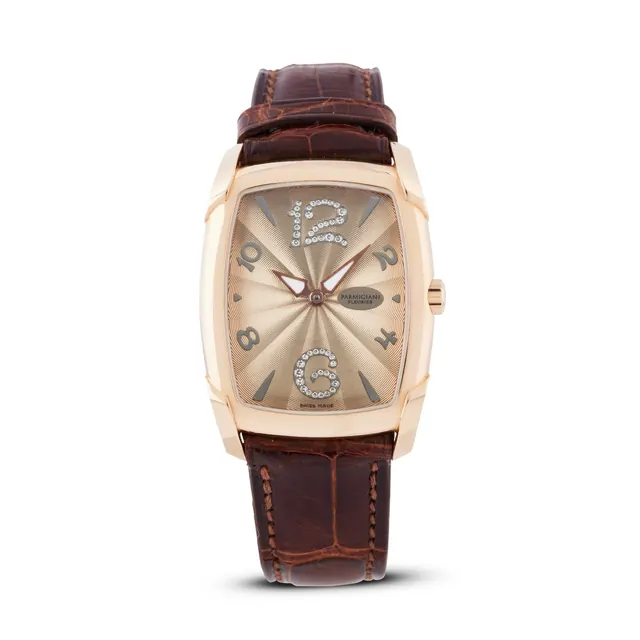
Parmigiani Fleurier wristwatch, Kalpa, circa 2000s
Antiquorum auction archive, Geneva
Wristwatches · c. 2010s
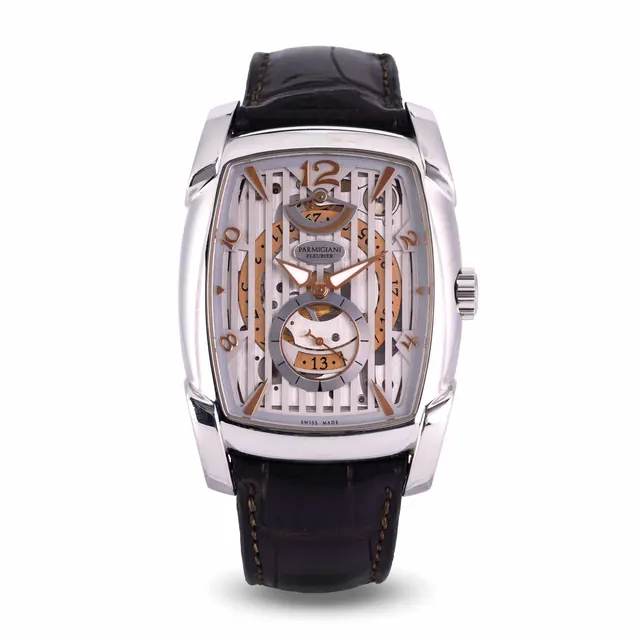
Parmigiani Fleurier wristwatch, Kalpa Xl Hebdomadaire, circa 2010s
Antiquorum auction archive, Geneva
Wristwatches · 2025
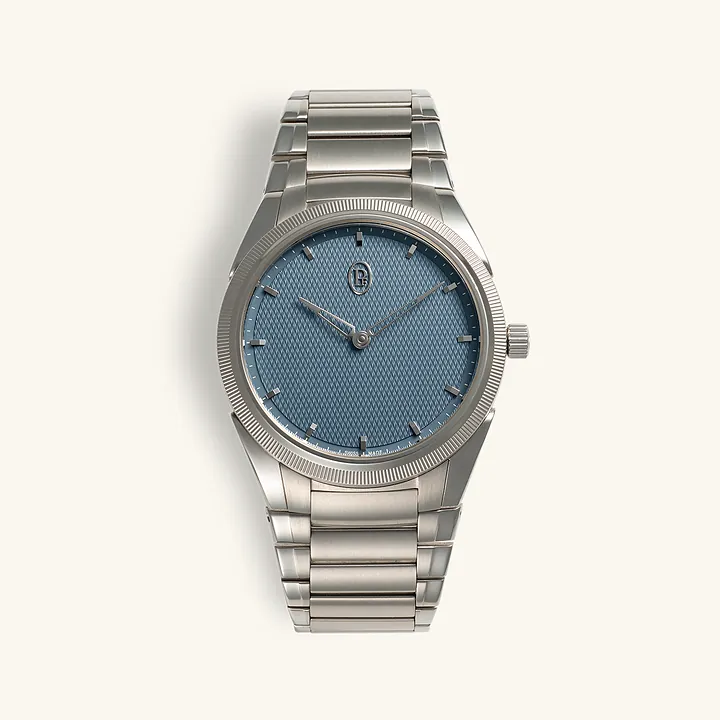
Parmigiani Fleurier Tonda PF 36mm Stone Blue, 2025
Watches of Knightsbridge (dealer), London
Wristwatches · 2023
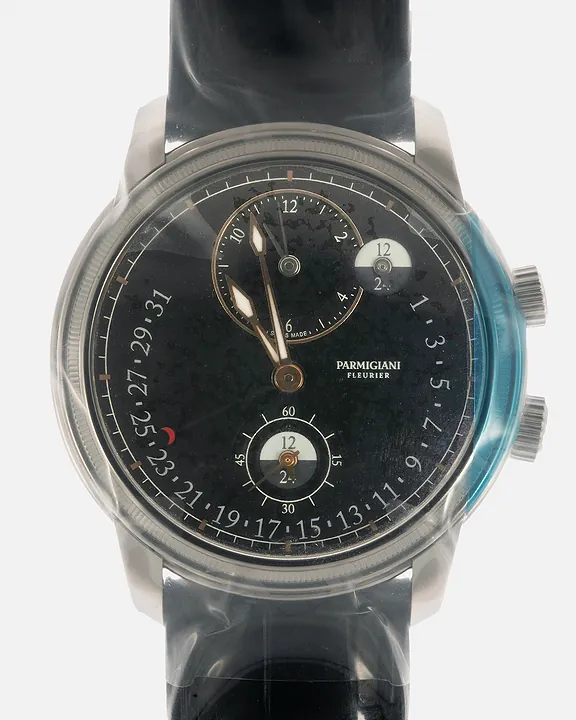
Parmigiani Fleurier Toric Hemisphères Rétrograde Steel Sealed, 2023
S.Song Watches (dealer), Seattle

Wristwatches · 2008
Wristwatch by Breitling?, 2008
Museum Rotterdam

Wristwatches · c. 1990s
Audemars Piguet Bamboo, c. 1990s
Antiquorum auction archive, Geneva

Wristwatches · c. 1990
Audemars Piguet Huitieme Perpetual Calendar, ref. 25696PT, c. 1990
Antiquorum auction archive, Geneva

Wristwatches · c. 1990
Breitling Chronomat, ref. b13050.1, c. 1990
Antiquorum auction archive, Geneva