
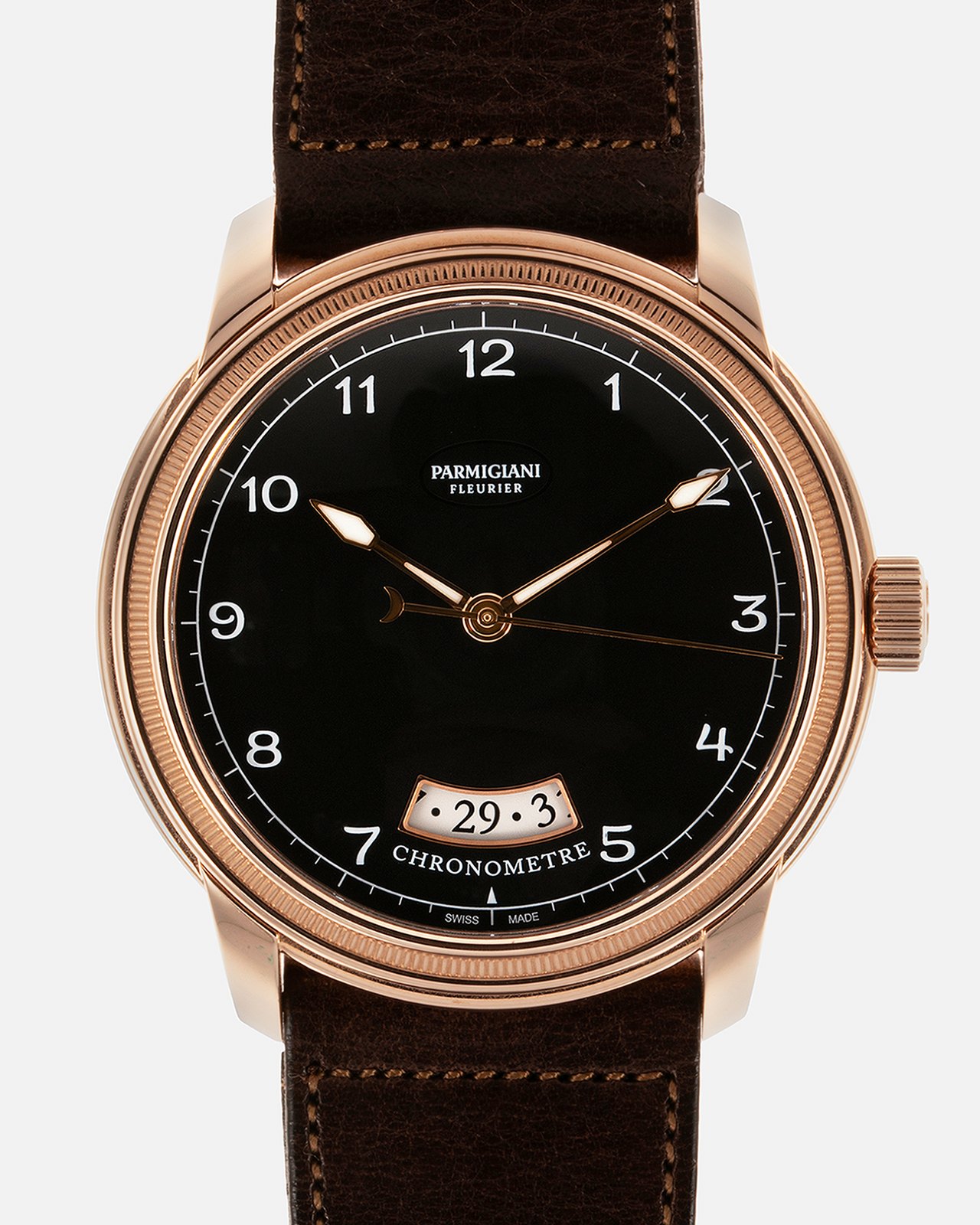
Wristwatches · Wristwatch
Parmigiani Fleurier Toric Chronometre, 2017
- Maker / attribution
- Parmigiani Fleurier (maker)
- Date
- 2017
- Historical period
- Contemporary Horology (2010 – Present)
- Country of origin
- Switzerland
- Object type
- Wristwatch
- Dimensions
- Case 40.8 mm
- Stock no.
- Product 6890329014359
- Credit line
- Dealer listing, S.Song Watches (product 6890329014359)
- Catalogue title (original)
- Parmigiani Fleurier Toric Chronometre (English)
View the source record (dealer listing) ↗ (opens another website in a new tab)Suggest a correction
Record summary
Catalogued by S.Song Watches (dealer), Seattle (stock number Product 6890329014359), this is a wristwatch by Parmigiani Fleurier, made in Switzerland, dated 2017. The Atlas places it in the Contemporary Horology period (2010 – Present) of its Wristwatches collection. Recorded dimensions: Case 40.8 mm. The record is illustrated with 6 photographs.
Assembled from the source record's structured fields. Dates and attributions are given as the source states them; where a field is missing the Atlas leaves it blank rather than estimating.
Catalogue description
Dealer description — S.Song Watches
Parmigiani Fleurier is an independent brand that can be described as a manufacturer that goes beyond surface appearances. Often only talked about within enthusiast circles, the brand has garnered a reputation as somewhat of an underdog in the realm of independent watchmaking. Before its eventual establishment in 1996, Michel Parmigiani, operated a small Mesure et Art du Temps (restoration workshop) in Couvet, Switzerland, where he was renowned for his expertise in the art of timepiece restoration. As time went on, Michel began crafting unique watches for clients, and the Parmigiani restoration workshop became a training ground for some of the most accomplished and highly regarded independent watchmakers who have since made their mark in the industry. Most notably, Kari Voutilainen, Stepan Sarpaneva and Raúl Pagès. Today, Parmigiani Fleurier has garnered recognition as one of the most extensively vertically integrated watch manufacturers globally. Its facilities have assumed a crucial role within the Swiss watch industry's supply chain due to its extensive involvement in the production of various essential components for watch manufacturing/production, including balance springs and movements components. Additionally, the brand's expertise still extends to the restoration of historically significant clocks and timepieces from around the world. These are a few of Michel Parmigiani’s many achievements which have contributed to his recognition as one of the pioneers of the industry, earning him the moniker as one of the "fathers" of independent watchmaking. What we have on offer today is quite an intriguing and unique reference that hails from the Parmigiani Fleurier Toric Collection. It is also a reference that, for some reason, you don’t typically see too often - the Toric Chronometre in 18-carat rose gold. Beginning with the case design, the Toric Chronometre delights with its contemporary dimensions of 40.8mm x 9.5mm, reminiscent of the revered Toric Memory Time. While the case may appear unassuming at first, a closer examination reveals a wealth of intricate details and subtleties. Constructed from 18-carat rose gold, the case features a stepped bezel that exudes a vintage charm reminiscent of the art deco era. When observed from a distance, the case emanates an ornamental allure, drawing inspiration from the architectural grandeur of Greek Doric columns - a testament to the classical orders of ancient Greece. The lugs, soldered with a graceful inward curve, ensure a comfortable fit on wrists of all sizes, adding to its overall wearability. Moving on to its dial, the Toric Chronometre showcases a mesmerizing deep black dial, creating a nice visual contrast against the case's colour tone. The dial is also adorned with contrasting numerals as hour markers, boasting an art nouveau-inspired font. At the heart of the dial, you'll find a striking set of javelin hands in rose gold, accompanied by a lunette counterweight for the seconds-hand. Finally, positioned at the 6 o'clock position, a window aperture gracefully presents the date indication, elegantly framed in gold to match the case. At the core of the Toric Chronometre lies the in-house, 11 ½ ligne, COSC-certified Cal. PF331. When admiring the watch through its exhibition caseback, one can catch a glimpse of the twin mainspring barrels peeking out from under the bridge. The Cal. PF331 also exhibits exquisite Côtes de Genève decoration and is meticulously finished to an exceptionally high standard by Parmigiani Fleurier. A noteworthy feature of the movement is its 22-carat gold rotor, elegantly embellished with a guilloché grain d’orge (barleycorn) pattern and the PF signature at its centre. The Cal. PF331 also features a power reserve of 55 hours and runs at 28,800 vph. Parmigiani Fleurier, true to its reputation, is a watch manufacturer that delves deeper than mere surface appearances. The words of Michel Parmigiani himself echo the brand's ethos, as he recalls his father telling him, "If you learn to look, art will reveal itself." This profound perspective drives the craftsmanship behind each creation. While the Toric Chronometre may initially seem like a conventional three-handed watch with a date function, I’d go as far as to say that it surprises and exceeds expectations in more ways than one. Just like the hidden depths of art that reveal themselves to those with a discerning eye, the Toric Chronometre beckons for a closer look.
Historical context
Contemporary Horology (2010 – Present)
Silicon components, connected watches, optical-lattice research clocks and a thriving independent scene.
Smartwatches became the world's best-selling watches, while mechanical watchmaking focuses on craft, innovation (silicon components, new escapements) and independent makers.
Read the period in the timelineMore wristwatches from this periodEarlier: Mechanical Renaissance
Atlas type guide
Wristwatches
Bracelet watches were worn by women from the early nineteenth century — Breguet made one for Caroline Murat, Queen of Naples, in 1810–12 — but the wristwatch only became a man's instrument with military use and aviation in the early twentieth century. Between the World Wars it overtook the pocket watch; the 1920s and 1930s brought rectangular Art Deco cases, water-resistant cases and the first automatic winding systems.
After 1945 the wristwatch became a carrier of identity — dress watches, sports and dive watches, chronographs, calendars — produced by Swiss, American, Japanese, German, Soviet and Chinese industries. The quartz revolution after 1969 and the mechanical renaissance since the 1990s, including the rise of independent watchmakers, complete the story.
What to look for
- The reference number (between the lugs or inside the case back) and serial number, the starting point for dating.
- The calibre: its maker and number are often stamped under the dial or on the bridge.
- Originality of dial, hands and crown — refinished ('redial') dials are common.
- Case material marks: 18K/750, 14K/585, stainless steel, gold-filled, plated.
Dating clues
- Wire-lug cases: before c. 1925.
- Water-resistant screw-down cases: from 1926.
- Quartz movements: from 1969; sapphire crystals widespread after c. 1980.
General guidance written by the Atlas editors about this kind of object. It is not a statement about this particular piece; for that, rely on the source record above and on physical examination.
Related records
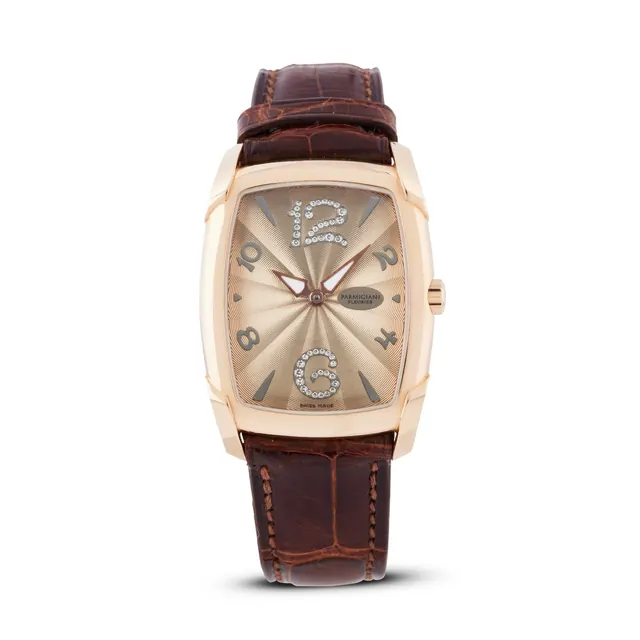
Wristwatches · c. 2000s
Parmigiani Fleurier wristwatch, Kalpa, circa 2000s
Antiquorum auction archive, Geneva
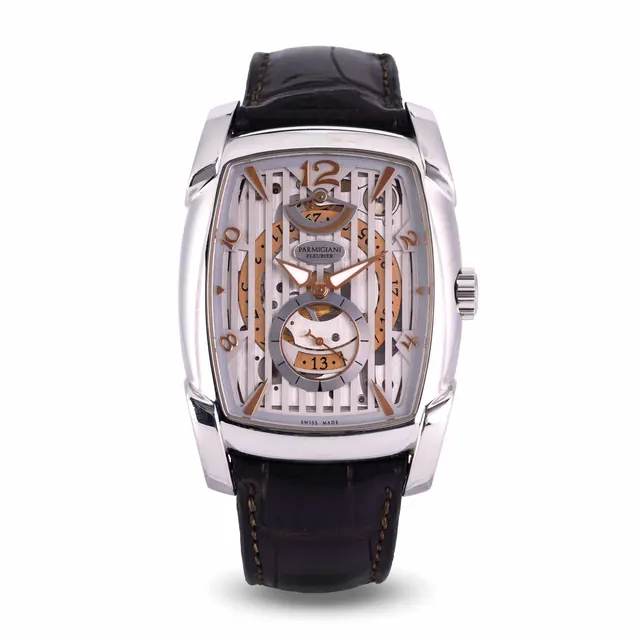
Wristwatches · c. 2010s
Parmigiani Fleurier wristwatch, Kalpa Xl Hebdomadaire, circa 2010s
Antiquorum auction archive, Geneva
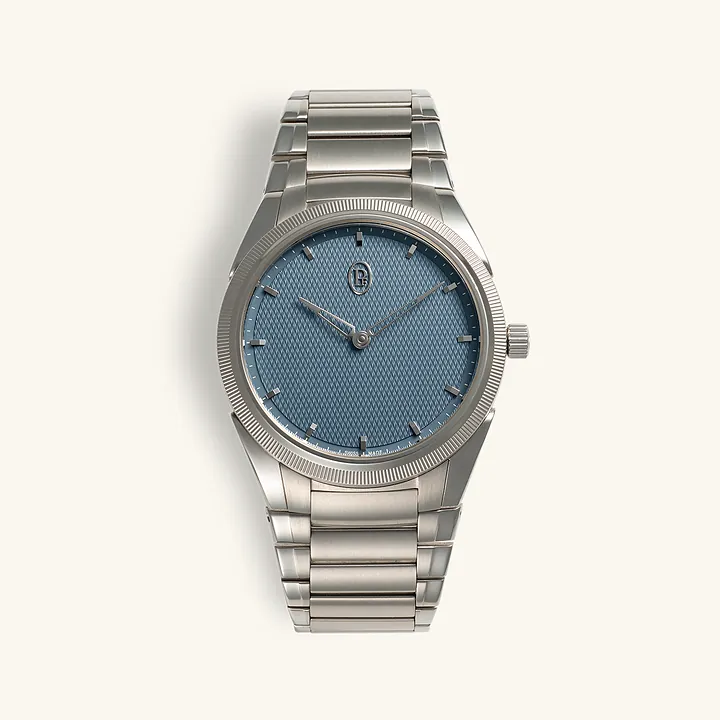
Wristwatches · 2025
Parmigiani Fleurier Tonda PF 36mm Stone Blue, 2025
Watches of Knightsbridge (dealer), London
Wristwatches · 2023
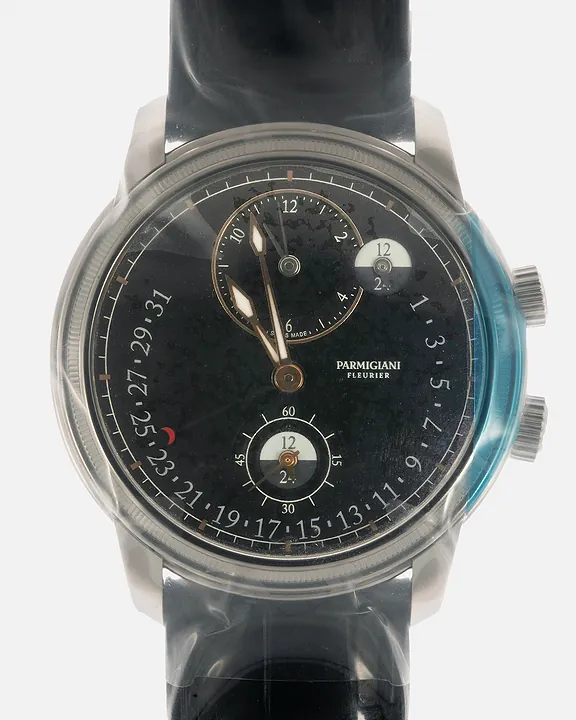
Parmigiani Fleurier Toric Hemisphères Rétrograde Steel Sealed, 2023
S.Song Watches (dealer), Seattle

Wristwatches · c. 2010s
Breguet Type XXI, ref. 3810, c. 2010s (Antiquorum Lot 381-24)
Antiquorum auction archive, Geneva

Wristwatches · c. 2010s
Breguet Type XXI, ref. 3810, c. 2010s (Antiquorum Lot 386-229)
Antiquorum auction archive, Geneva

Wristwatches · Sold in September 2010
Breitling Cosmonaute, ref. A 22322, Sold in September 2010
Antiquorum auction archive, Geneva

Wristwatches · c. 2010
Corum Bubble Chrono, ref. 396.150.20, c. 2010
Antiquorum auction archive, Geneva