
Pocket Watches · Pocket watch
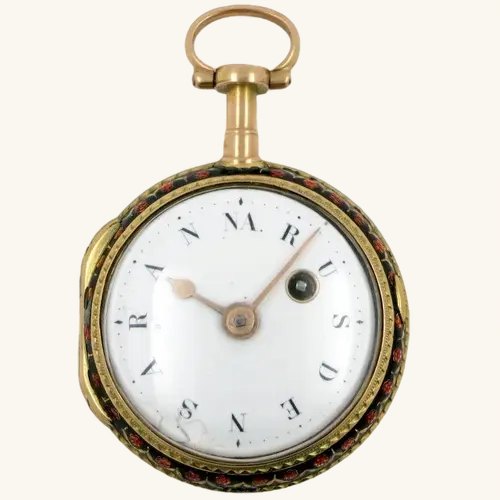
Paris verge in a gold and enamel case, c. 1790
- Maker / attribution
- Unrecorded in source
- Date
- c. 1790
- Historical period
- Precision & Scientific Horology (1750 – 1850)
- Country of origin
- France
- Object type
- Pocket watch
- Materials / technique
- gold, enamel
- Dealer
- WatchMuseum.org shop
- Stock no.
- Product 5998
- Credit line
- Dealer listing, WatchMuseum.org shop (product 5998)
- Catalogue title (original)
- Paris verge in a gold and enamel case (English)
View the source record (dealer listing) ↗ (opens another website in a new tab)Suggest a correction
Record summary
Catalogued by WatchMuseum.org shop (stock number Product 5998), this is a pocket watch, made in France, dated c. 1790. The Atlas places it in the Precision & Scientific Horology period (1750 – 1850) of its Pocket Watches collection. Materials and techniques recorded by the source: gold, enamel. The record is illustrated with 6 photographs.
Assembled from the source record's structured fields. Dates and attributions are given as the source states them; where a field is missing the Atlas leaves it blank rather than estimating.
Catalogue description
Dealer description — WatchMuseum.org shop
Step into a captivating journey through time with the “Paris verge in a gold and enamel case – C1790,” an exquisite pocket watch that elegantly bridges the past and present. This remarkable timepiece is more than just a watch; it is a historical artifact that whispers tales of its storied past, intricately linked to Saranna Rusden, a significant figure in the Australian women’s rights movement. Crafted by the renowned Parisian watchmakers Marchand Fils, the watch features a gilt verge movement adorned with intricate engravings and a silvered regulator disk, all held together by four round pillars. Despite its venerable age, the movement remains in good condition, though it runs slightly fast, gaining a couple of minutes each hour. The white enamel dial, uniquely personalized with the name “Saranna Rusden” in place of traditional hour markers, tells its own story of time’s passage, with a small filled-in chip at the center, repairs along the edge between 6 and 8, and a delicate hairline crack extending from the edge at 9. Delicate gold hands gracefully sweep across the dial, marking the hours with timeless elegance. Encasing this historical marvel is a magnificent gold case, resplendent with vibrant orange and black fish scale enamel decoration on the bezel and back, a testament to the artistry of its era. Although the case bears no discernible maker’s or gold marks, the worn serial number inside the movement hints at its rich lineage. This pocket watch is not just a keeper of time but a keeper of stories, a tangible connection to a bygone era and the indelible impact of a pioneering spirit. This exquisite pocket watch holds a piece of history, connecting it to an influential figure in the Australian women’s rights movement. Encased in gold and enamel, it features a Parisian verge movement crafted by Marchand Fils. The gilt verge movement showcases intricate engravings and a silvered regulator disk, held together by four round pillars. Despite its age, the movement is in good condition and operates slightly fast, gaining a couple of minutes per hour. The white enamel dial is adorned with the name “Saranna Rusden” instead of traditional hour markers. It bears signs of wear, including a small filled-in chip at the center, repairs along the edge between 6 and 8, and a hairline crack from the edge at 9. Delicate gold hands elegantly point the time. Encased within the pocket watch is a magnificent gold case adorned with vivid orange and black fish scale enamel decoration on the bezel and back. Although there are no discernible maker’s or gold marks, the movement’s worn serial number is present inside the back casing. The case has been tested as high carat gold, approximately 15 ct. It remains in good condition, with only minor wear to the catch button. The enamel on the case exhibits some damage at the back, near the neck, and around the catch spring stud. A scratch-free crystal adds to the watch’s overall appeal. The hinge functions well, while the steel movement catch is missing a small lever that allows for the smooth release of the movement from the case. As a result, the catch can only be disengaged using a pin, with great care taken to protect the dial from any harm. Marchand Fils, a renowned Parisian watchmaker during the late 18th century, crafted the movement of this timepiece. It is worth noting that the dial bears the name “Saranna Rusden,” which suggests that it was either added later or the watch itself was produced after Saranna’s birth in 1810. While there is limited information available about Marchand Fils, their legacy lives on through this exceptional pocket watch. The historical significance of this timepiece lies in its connection to Saranna Rusden, an important figure in the Australian women’s rights movement. Saranna, born in England in 1810, immigrated to Australia in 1834 and married Helenus Scott in the following year. Helenus, a settler and son of renowned Scottish physician Dr. Helenus Scott, was an influential figure himself. Saranna’s daughter, Rose Scott, who was born in 1847 and passed away in 1925, became a notable women’s rights activist. A champion for women’s rights and suffrage, Rose founded the Women’s Political Education League in 1902 and played a pivotal role in advocating for equality in New South Wales at the turn of the 20th century. Creator: Marchand Fils Place of Origin: Paris Date of Manufacture: c1790 Gold & enamel case, 31.6 mm. Verge escapement Condition: Good
Historical context
Precision & Scientific Horology (1750 – 1850)
Harrison solves longitude; Mudge invents the lever; Breguet's Paris workshop defines the modern watch.
From 1750 to 1850 the watch became a precision instrument. Mudge's lever escapement, the cylinder escapement, Lépine's thin bar calibre, Breguet's innovations (overcoil, tourbillon, perpétuelle) and the pocket chronometer of Arnold and Earnshaw all date from this period, while verge watches remained common in cheaper production.
Read the period in the timelineMore pocket watches from this periodEarlier: Early Modern Horology
Atlas type guide
Verge and pair-cased watches
After Christiaan Huygens and Robert Hooke applied the balance spring around 1675, the verge watch became a reasonably reliable timekeeper and the minute hand became standard. Through the eighteenth century the typical English watch was a pair-cased verge: a fusee movement with a pierced, engraved balance cock, housed in an inner case and a separate protective outer case, often of repoussé gold, shagreen, tortoiseshell or enamel.
French watches of the same period were thicker 'oignons', later replaced by elegant thinner watches following Jean-Antoine Lépine's bar-bridge calibre of c. 1770. Dutch, Swiss and German makers supplied international markets, and verge watches were made until the mid-nineteenth century as cheaper alternatives to the cylinder and lever.
What to look for
- The pierced balance cock on the backplate: winged (continental) or with a foot (English); its style dates the watch.
- Fusee and chain visible through the movement; key winding through the dial (early) or case back.
- Hallmarks inside English silver or gold cases, which give a date letter.
- Maker's name and serial number engraved on the backplate; watch papers inside outer cases.
- Enamel dials (after c. 1720) versus earlier champlevé metal dials.
Dating clues
- Champlevé dials: c. 1680–1730; white enamel dials thereafter.
- English case hallmarks give the year of assay to within a year.
- Verge watches persisted in cheap production until c. 1850.
General guidance written by the Atlas editors about this kind of object. It is not a statement about this particular piece; for that, rely on the source record above and on physical examination.
Related records
Pocket Watches · 1745–1755
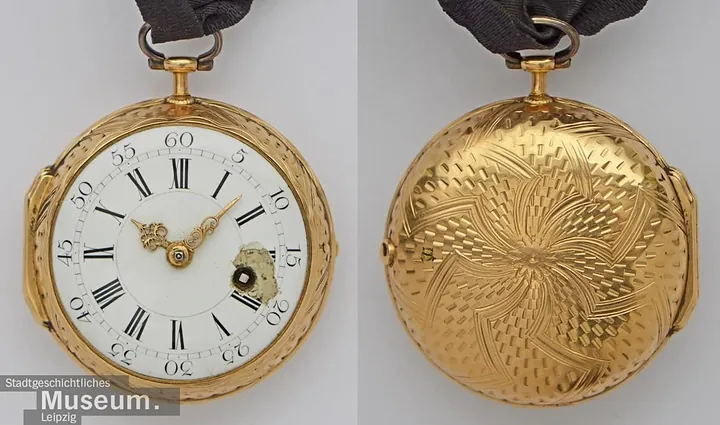
Pocket watch by Jean Baptiste Baillon, France, 1745–1755
Museum of City History Leipzig
Pocket Watches · c. 1750
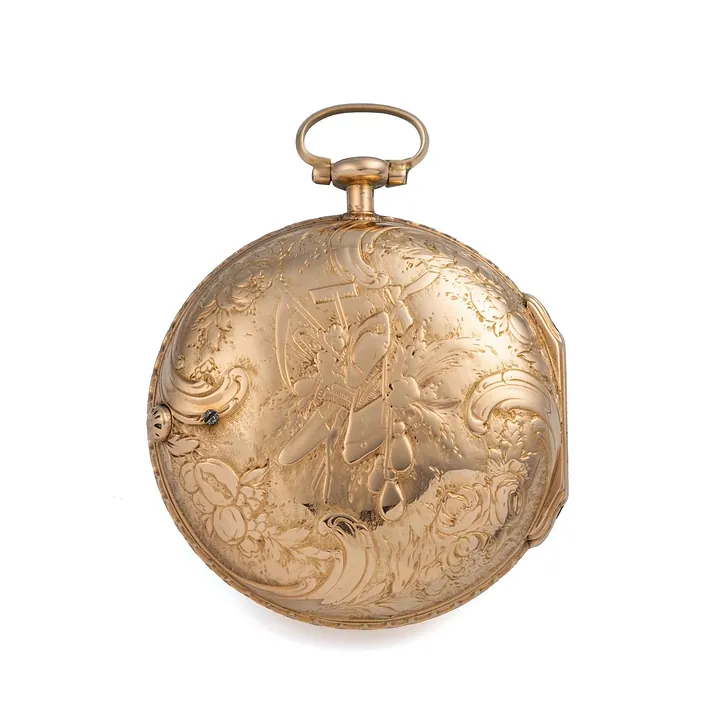
Baillon À Paris pocket watch, c. 1750
Antiquorum auction archive, Geneva
Pocket Watches · 1750–1780
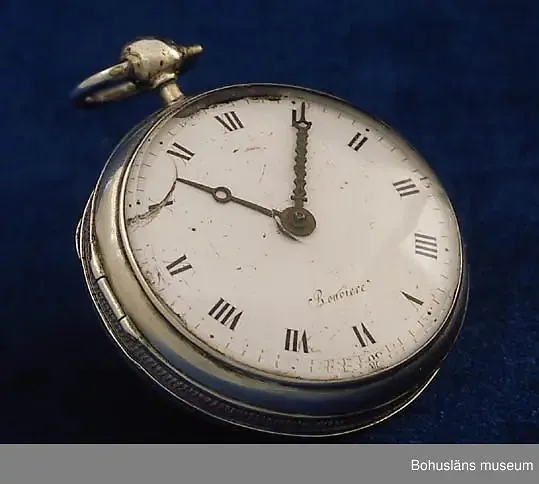
Pocket watch by BONBIERE, France, 1750–1780
Bohuslän Museum
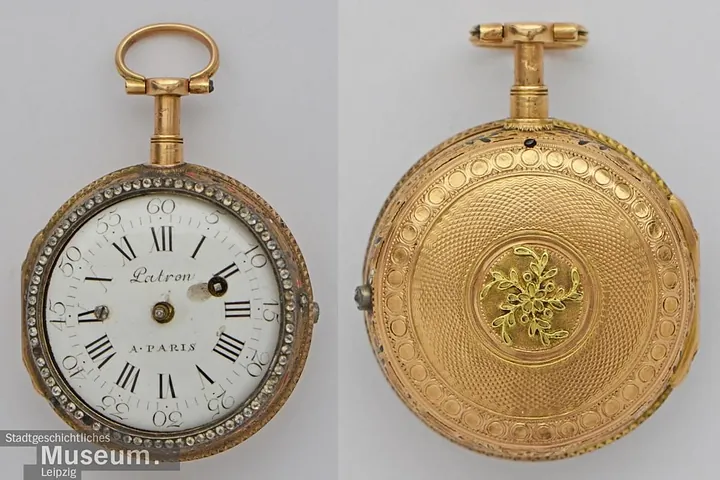
Pocket Watches · 1750
Pocket watch by Patron, France, 1750
Museum of City History Leipzig
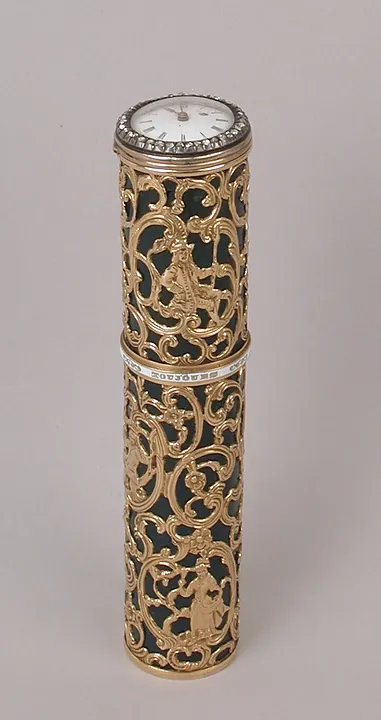
Pocket Watches · second half 18th century
Watch probably by by an imitator of Abraham-Louis Bréguet, France, second half 18th century
The Metropolitan Museum of Art, New York
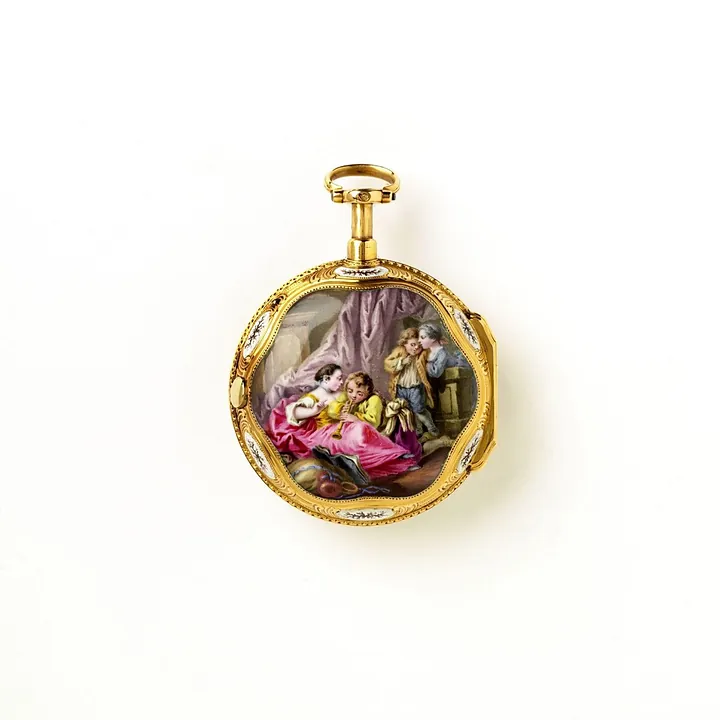
Pocket Watches · 1760–1761
Enamelled gold, quarter repeating watch, Paris, 1760-62, Romilly
Victoria and Albert Museum, London
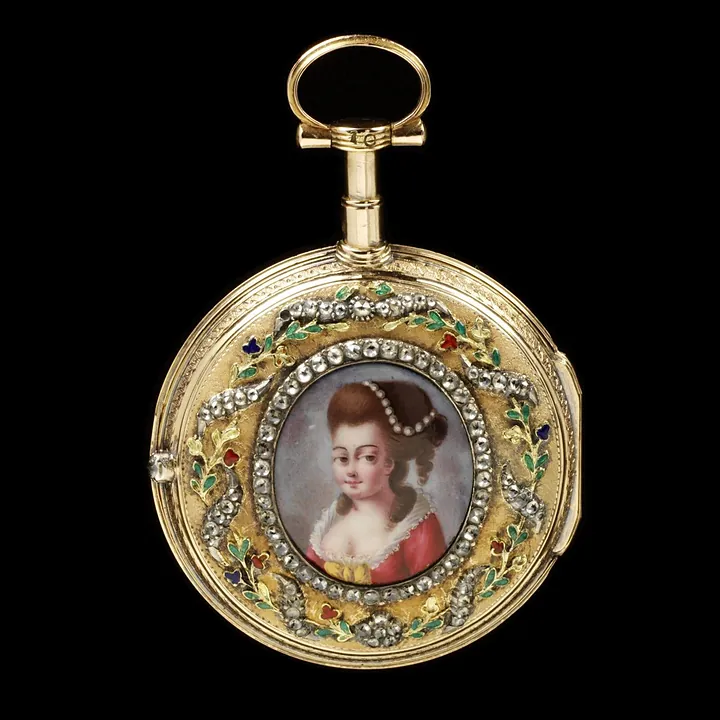
Pocket Watches · 1770-5
Enamelled copper gilt watch set with pastes, signed 'Vauchez A Paris'; made in France or Switzerland, 1770-5
Victoria and Albert Museum, London
Pocket Watches · 1770–1780
Pocket watch by Lepine, France, 1770–1780
Museum of City History Leipzig