
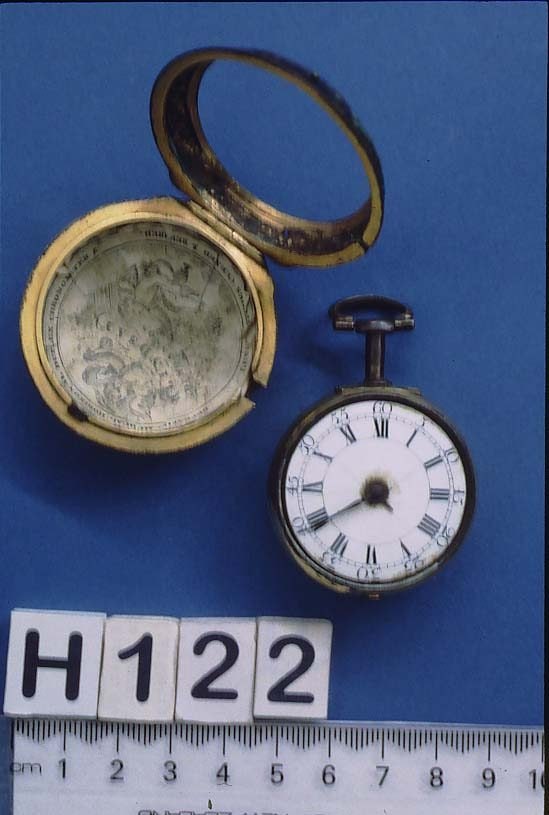
Pocket Watches · Pair case verge pocket watch
Pair case verge pocket watch by John Ruxton
- Maker / attribution
- John Ruxton (source attribution)
- Date
- c. 1780
- Historical period
- Precision & Scientific Horology (1750 – 1850)
- Country of origin
- Ireland
- Object type
- Pair case verge pocket watch
- Dimensions
- 65mm x 55mm x 18mm
- Holding institution
- Auckland Museum
- Accession / object no.
- 1954.26.1
- Credit line
- Auckland Museum
- Catalogue title (original)
- Pair case silver-gilt and shagreen verge pocket watch (English)
View the source record ↗ (opens another website in a new tab)Suggest a correction
Record summary
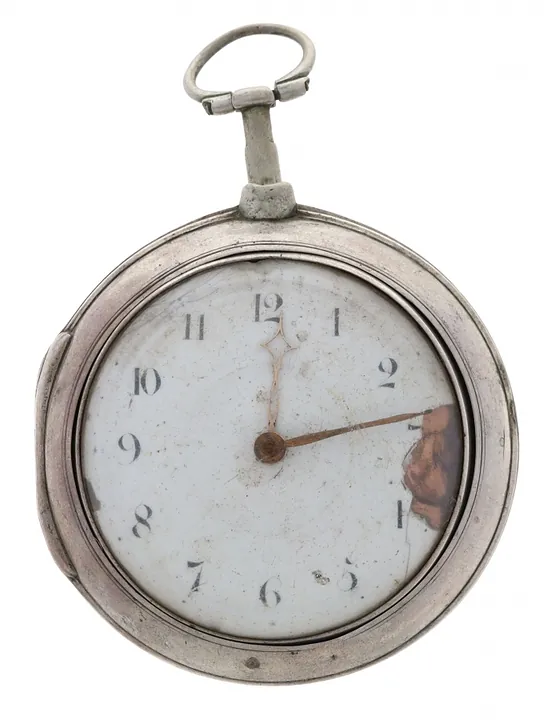
Held and catalogued by Auckland Museum (object number 1954.26.1), this is a pair case verge pocket watch attributed to John Ruxton, made in Ireland, dated c. 1780. The Atlas places it in the Precision & Scientific Horology period (1750 – 1850) of its Pocket Watches collection. Recorded dimensions: 65mm x 55mm x 18mm. The record is illustrated with 1 photograph.
Assembled from the source record's structured fields. Dates and attributions are given as the source states them; where a field is missing the Atlas leaves it blank rather than estimating.
Catalogue description
Original object description
Preserved in the Auckland War Memorial Museum Tāmaki Paenga Hira under registration 1954.26.1, this pair-case verge pocket watch is attributed to the Dublin horologist John Ruxton and dated to approximately 1780. It features an inner case of silver-gilt and an outer protective shell faced in stingray skin (shagreen), which encloses a decorative watch paper within. The white enamel dial is configured with standard hour designations ringed by an outer five-minute track in Arabic figures; the crystal and one hand are currently absent. Internally, the verge mechanism is constructed with shaped square pillars, a pierced balance cock and foot, and a worm-gear regulator for the mainspring, with number 87 stamped upon the rear plate. Marking the inner case are faint hallmarks alongside the engraved name "Lindsay Duncannon". The timepiece entered the museum's holdings as a gift from Mr. A. T. Pycroft in 1954.
Inscriptions & marks
87
Historical context
Precision & Scientific Horology (1750 – 1850)
Harrison solves longitude; Mudge invents the lever; Breguet's Paris workshop defines the modern watch.
From 1750 to 1850 the watch became a precision instrument. Mudge's lever escapement, the cylinder escapement, Lépine's thin bar calibre, Breguet's innovations (overcoil, tourbillon, perpétuelle) and the pocket chronometer of Arnold and Earnshaw all date from this period, while verge watches remained common in cheaper production.
Read the period in the timelineMore pocket watches from this periodEarlier: Early Modern Horology
Atlas type guide
Verge and pair-cased watches
After Christiaan Huygens and Robert Hooke applied the balance spring around 1675, the verge watch became a reasonably reliable timekeeper and the minute hand became standard. Through the eighteenth century the typical English watch was a pair-cased verge: a fusee movement with a pierced, engraved balance cock, housed in an inner case and a separate protective outer case, often of repoussé gold, shagreen, tortoiseshell or enamel.
French watches of the same period were thicker 'oignons', later replaced by elegant thinner watches following Jean-Antoine Lépine's bar-bridge calibre of c. 1770. Dutch, Swiss and German makers supplied international markets, and verge watches were made until the mid-nineteenth century as cheaper alternatives to the cylinder and lever.
What to look for
- The pierced balance cock on the backplate: winged (continental) or with a foot (English); its style dates the watch.
- Fusee and chain visible through the movement; key winding through the dial (early) or case back.
- Hallmarks inside English silver or gold cases, which give a date letter.
- Maker's name and serial number engraved on the backplate; watch papers inside outer cases.
- Enamel dials (after c. 1720) versus earlier champlevé metal dials.
Dating clues
- Champlevé dials: c. 1680–1730; white enamel dials thereafter.
- English case hallmarks give the year of assay to within a year.
- Verge watches persisted in cheap production until c. 1850.
General guidance written by the Atlas editors about this kind of object. It is not a statement about this particular piece; for that, rely on the source record above and on physical examination.
Related records
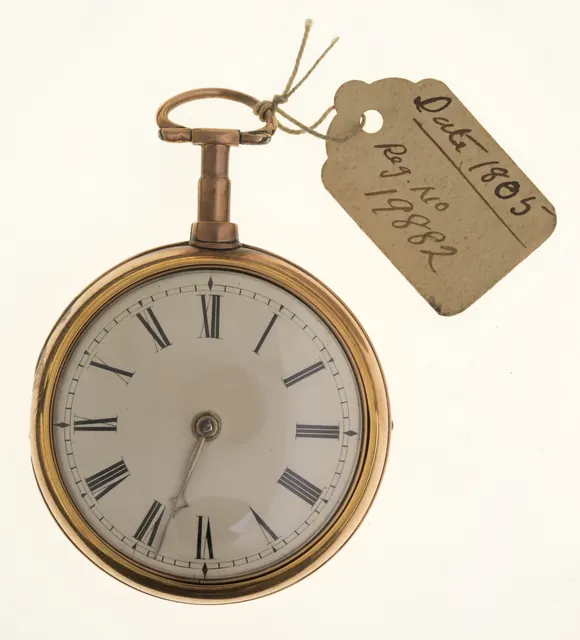
Pocket Watches · 1805
Pocket Watch - Isaac Barrington, Dublin, 1805
Museums Victoria, Melbourne
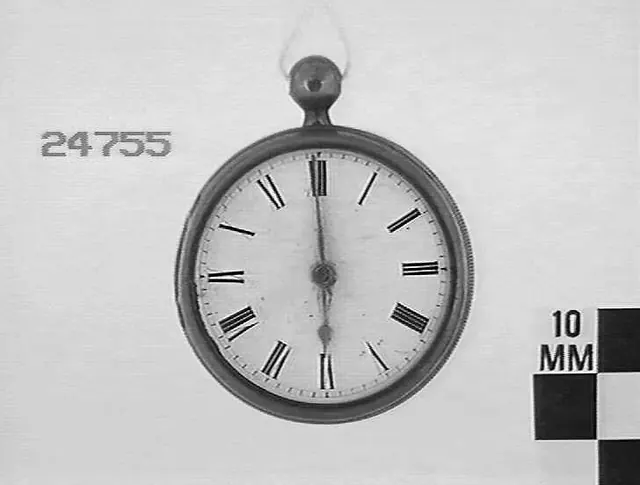
Pocket Watches · c. 1846
Pocket Watch - Dalrymple, Dublin, c. 1846
Museums Victoria, Melbourne
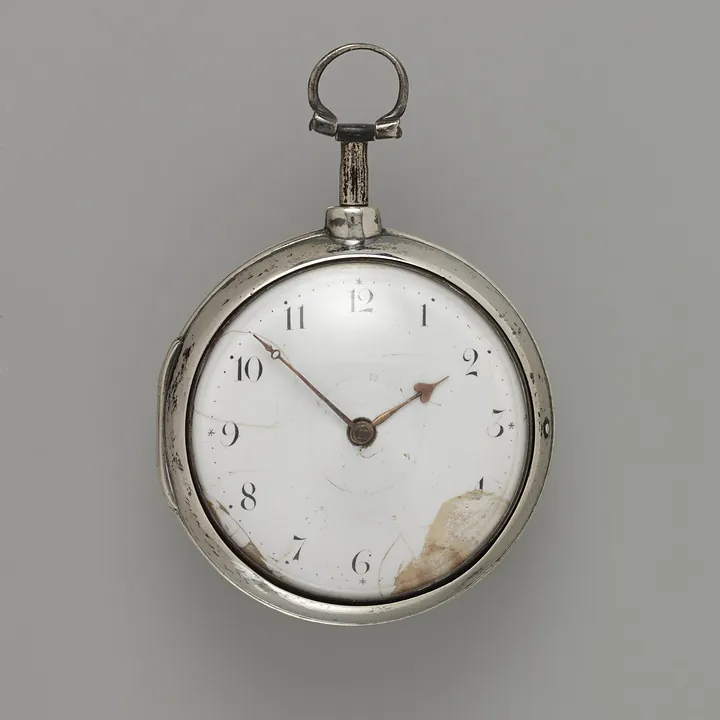
Pocket Watches · 1809
Watch by Charles Wilson, Ireland, 1809
The Metropolitan Museum of Art, New York
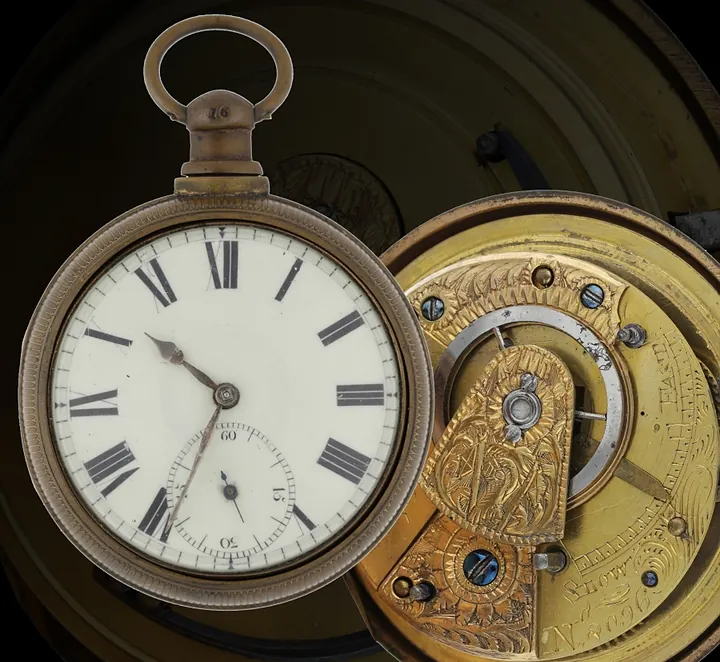
Pocket Watches · early 19th century
Irish early 19th century gilt metal pair cased verge pocket watch by P. Rielly, Dublin
Gardiner Houlgate (auction house), Corsham
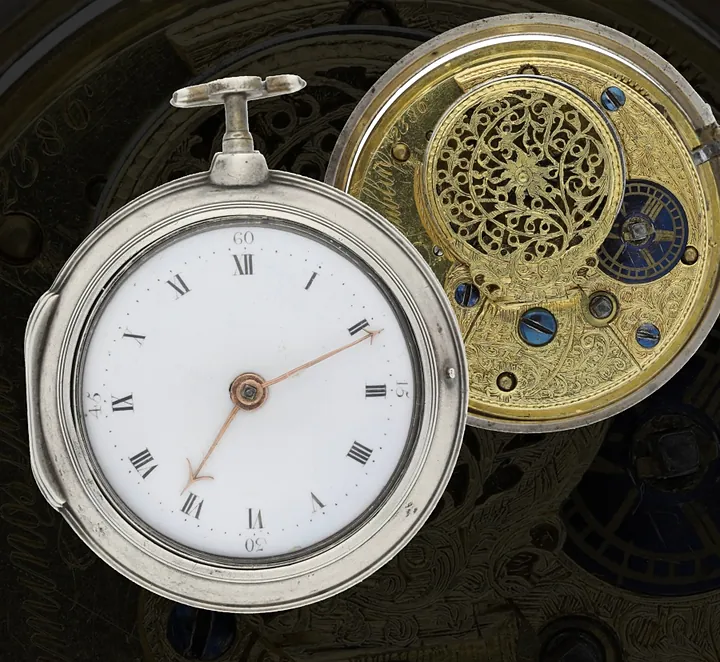
Pocket Watches · 1795 (hallmarked Birmingham)
Late 18th century Irish silver pair cased verge pocket watch by G. Cummings, Dublin, hallmarked Birmingham 1795
Gardiner Houlgate (auction house), Corsham
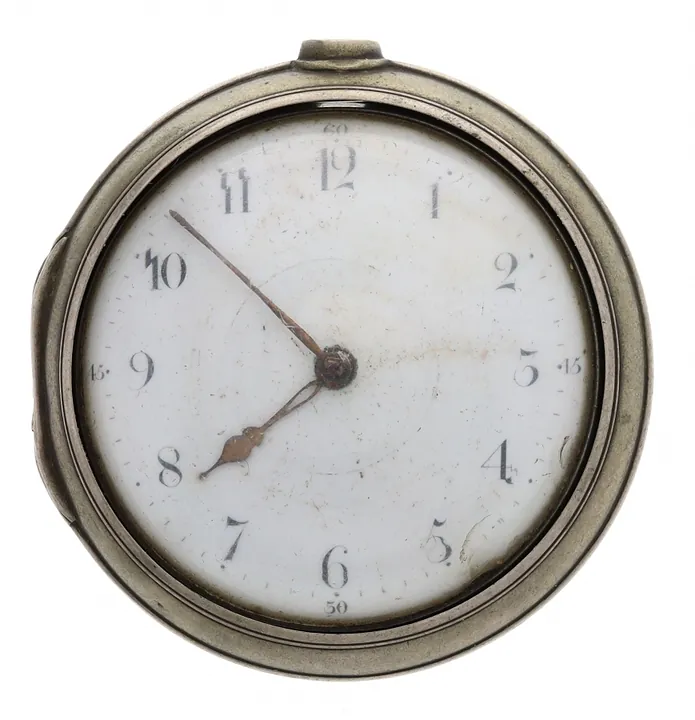
Pocket Watches · 1804 (hallmarked Dublin)
Early 19th century Irish silver verge pair cased pocket watch by Howard, Dublin, hallmarked Dublin 1804
Gardiner Houlgate (auction house), Corsham
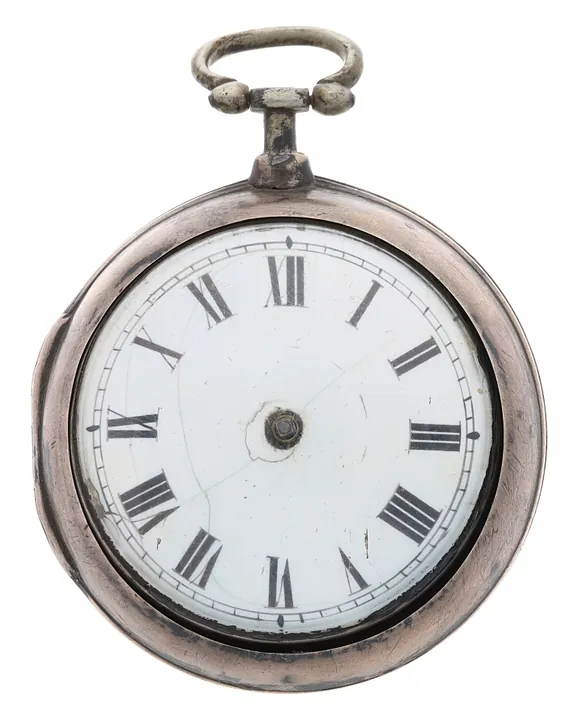
Pocket Watches · 1796 (hallmarked London)
George III Irish silver verge pair cased pocket watch by Robert Clench, Dublin, hallmarked London 1796
Gardiner Houlgate (auction house), Corsham
Pocket Watches · 1795 (hallmarked London)
George III Irish silver verge pair cased pocket watch by William Barr, Dublin, hallmarked London 1795
Gardiner Houlgate (auction house), Corsham