
Pocket Watches · Alarm watch
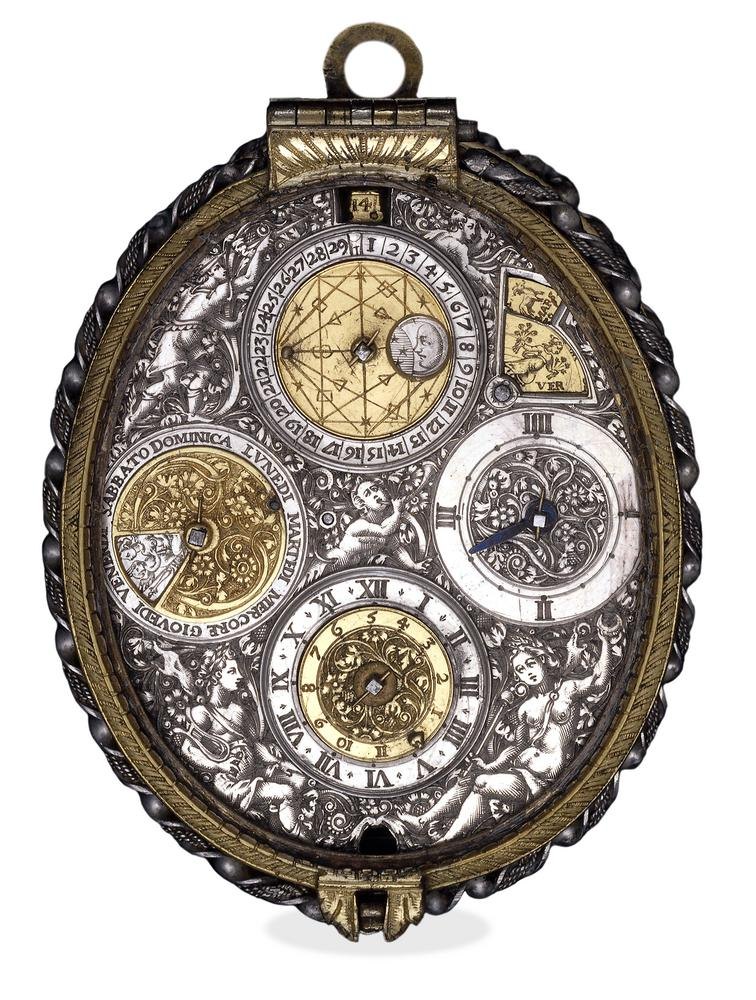
Oval silver and gilt-brass cased verge clock-watch with hour-striking, alarm and calendar
- Maker / attribution
- Jean Vallier (Made by)
- Date
- 1625–1635
- Historical period
- Early Modern Horology (1600 – 1750)
- Country of origin
- France
- Place
- Lyon
- Object type
- Alarm watch
- Materials / technique
- brass, gold, silver
- Dimensions
- Length: 78.70 millimetres (case) Thickness: 34.30 millimetres Width: 62 millimetres
- Holding institution
- British Museum
- Accession / object no.
- 1888,1201.177
- Credit line
- British Museum, London
- Catalogue title (original)
- Oval silver and gilt-brass cased verge clock-watch with hour-striking, alarm and calendar (English)
View the source record ↗ (opens another website in a new tab)Suggest a correction
Record summary
Held and catalogued by British Museum (object number 1888,1201.177), this is an alarm watch by Jean Vallier, made in Lyon, France, dated 1625–1635. The Atlas places it in the Early Modern Horology period (1600 – 1750) of its Pocket Watches collection. Materials and techniques recorded by the source: brass, gold, silver. Recorded dimensions: Length: 78.70 millimetres (case) Thickness: 34.30 millimetres Width: 62 millimetres. The record is illustrated with 6 photographs.
Assembled from the source record's structured fields. Dates and attributions are given as the source states them; where a field is missing the Atlas leaves it blank rather than estimating.
Catalogue description
Description — British Museum
Alarm watch. Strike and alarum disc. Oval case. Train count: Going: Fusee great wheel 64 Second wheel 50, 6 Contrate wheel 44, 5 Escape wheel 17, 5 Striking: Great wheel 54 (barrel ratch 14) Second (pin) wheel 40, … 8 Third (locking/warning) 34, 5 Fourth wheel 28, 5 Fifth wheel 24, 5 Sixth, roller, 6 Alarm: Great wheel 32 (barrel ratchet 11) Second wheel 20, 6 Contrate wheel 20, 6 Crown wheel 9, 6 Under-dial work.
Curator's comments — British Museum
This watch is very similar to one in the Musuem of London collection by Gaultier Ferlite (Object ID A14092), part of the Cheapside Hoard. Whilst they are hinged at opposite ends to each other, both the dial and mechanism layout are almost identical. Baillie, Watches 1929, plate XI, pp.67,95. Bassermann-Jordan, The Book of Old Clocks & Watches, 4th ed. 1964, fig.91a/b p.121. For a comparison see Tardy, LA PENDULE FRANCAIS, Vol.I P.88. Here a watch signed Pierre Louteau has a dial clearly decorated by the same engraver. Text from 'Watches', by David Thompson, London, 2008, p. 34-35. Jean Vallier CLOCK-WATCH WITH CALENDAR AND ALARM LYON, c. 1630 SIGNED: 'Jean Vallier à Lyon By the early seventeenth century, watchmaking in France had reached a high level of sophistication and the quality of engraved decoration on French cases was perhaps better than anywhere else in Europe. At that time one of the more important centres of watchmaking was Lyon, a city with a history in the craft stretching back well into the sixteenth century, and Jean Vallier was one of its most celebrated makers. He became a master watchmaker in 1602 and died in 1649. Of the surviving watches that bear his name, this is the finest, made around 1630 and intended for a customer of considerable wealth, for such a watch would have been a Rolls-Royce of its day. The case alone is a work of art, intricately engraved on the back with depictions of Apollo and the nine Muses. The band is pierced and engraved around the sides with foliate scrolls and has most unusual rope-twist top and bottom rims. It is a great pity that at some time in the watch's history someone saw fit to remove the front solid-silver cover, which would, without doubt, have been engraved with similar beautiful classical designs. It is likely that somewhere there is an oval pendant that contains a finely engraved silver plaque, for it is hard to believe that anyone could melt down such superb artistry. The calendar dial is of the highest quality, with beautiful engraved detail around the various indications. It carries depictions of Diana holding a crescent moon (for the moon) and Apollo with his lyre (for the sun). At the top a small rectangular aperture shows the date above a subsidiary dial indicating the age and phase of the moon. To the left, another dial shows the days of the week, with each day's ruling deity appearing in a sector. On the right an engraved silver chapter ring indicates the quarters. The bottom dial is for the hours, with an alarm-setting disc at its centre. Two sectors in the upper right-hand area show the seasons and the months, with the number of days in each. Interestingly the dial inscriptions are in Italian, showing that the watch was made for a customer from that country. The movement contains an array of wheels, pinions and levers for the separate gear trains which provide the timekeeping, hour-striking and alarm functions. All the finely pierced and engraved components on the back plate are original except for the plain brass balance, which has been replaced in more recent times. It must be asked who made the case and dial; it is unlikely to have been Jean Vallier the watchmaker. The Rijksmuseum in Amsterdam holds a very similar watch which contains a movement signed 'Pierre Louteau'. The case and dial of the Louteau watch are clearly associated with this example by Vallier. Was Louteau, or perhaps Vallier, responsible for both examples? Equally it could have been a top-class silversmith-engraver who supplied both watchmakers 'with cases. In any event, the results are stunning.
Inscriptions & marks
signature; movement back-plate; Jean Vallier à Lyon
Provenance
Bequeathed by:, Octavius Morgan; Acquired 1888
Historical context
Early Modern Horology (1600 – 1750)
Huygens' pendulum and balance spring transform accuracy; English makers develop the anchor and deadbeat escapements.
The balance spring (c. 1675) improved watches dramatically and introduced the minute hand. English pair-cased verge watches with pierced balance cocks and French oignons were typical; enamel painting at Blois and Geneva, and the repeating watch (1680s), made watches objects of great refinement.
Read the period in the timelineMore pocket watches from this periodEarlier: Renaissance Horology
Atlas type guide
Early spring-driven watches
Portable spring-driven timepieces appeared in southern Germany, France and Italy in the early sixteenth century; Peter Henlein of Nuremberg is traditionally credited, although the historical record is complex. These early watches were worn as pendants or carried, had iron or brass movements with a verge escapement and a foliot or small balance, and used a stackfreed or fusee to equalise spring force. They indicated hours only and were notoriously inaccurate.
From the later sixteenth century watches were made in Blois, Paris, Geneva, London and Augsburg in oval, octagonal, cruciform, skull and other 'form' cases of rock crystal, gilt brass, silver and enamel. They were jewellery and status objects as much as timekeepers.
What to look for
- A single hour hand and often a touch-pin hour ring for feeling the time.
- Stackfreed (a cam and spring) instead of a fusee on German watches.
- Pierced and engraved cocks over the balance, fine gut fusee lines.
- Rock-crystal, enamelled or engraved form cases.
Dating clues
- Drum-shaped German watches: c. 1530–1580.
- Oval and form watches: c. 1580–1650.
- Before c. 1675 there is no balance spring; watches can vary by many minutes a day.
General guidance written by the Atlas editors about this kind of object. It is not a statement about this particular piece; for that, rely on the source record above and on physical examination.
Read next:FoliotThe Melanchthon watch
Related records
Pocket Watches · 1600–1615
Watch by Jean Vallier, France, 1600–1615
Musée du Louvre, Paris
Pocket Watches · 1600–1650
Watch by Jean Vallier, France, 1600–1650
Musée du Louvre, Paris
Pocket Watches · 1600–1650
Watch by Jean Vallier, France, 1600–1650
Musée du Louvre, Paris
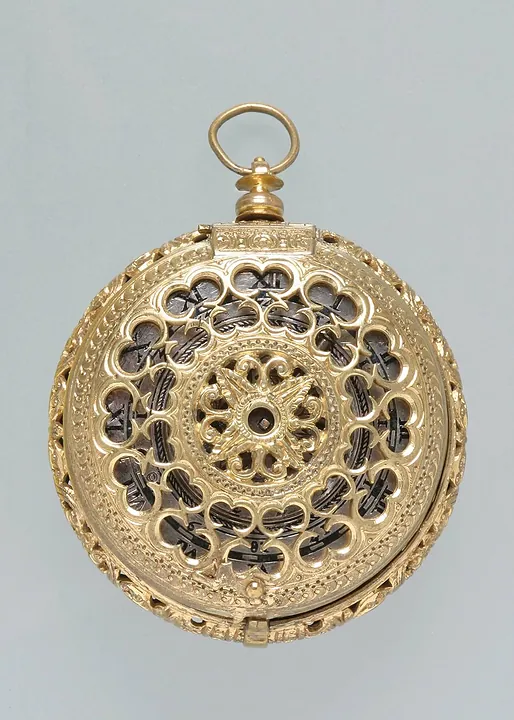
Pocket Watches · c. 1600
Pocket watch by Hans Reinboldt, France, c. 1600
German Clock Museum
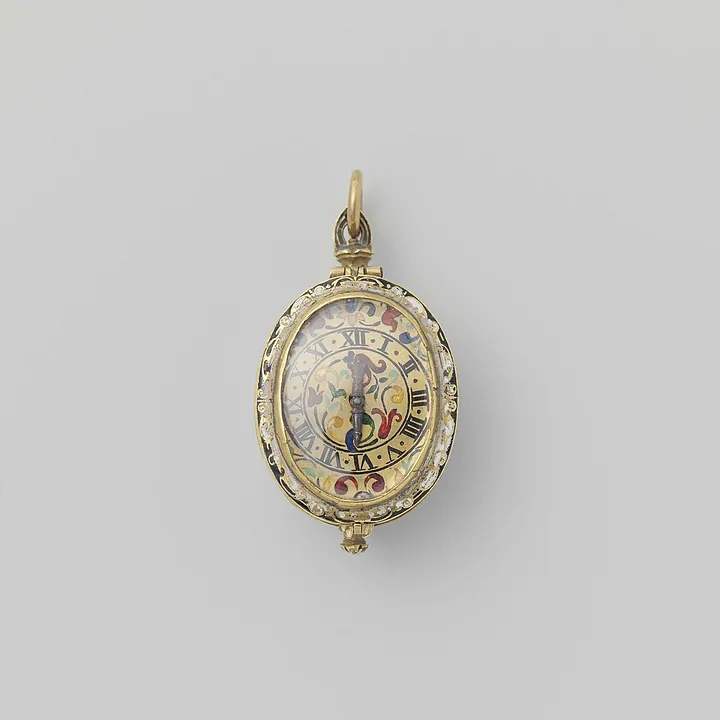
Pocket Watches · 1600
Pocket watch, France, 1600
Rijksmuseum
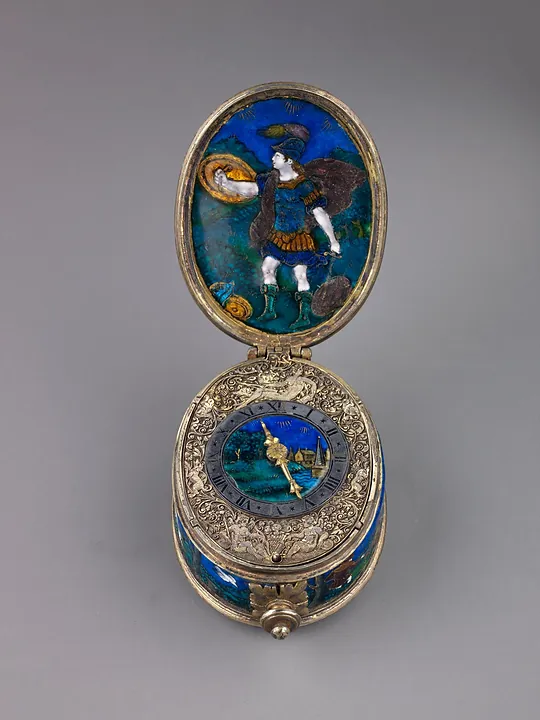
Pocket Watches · first quarter of 17th century
Watch by Suzanne de Court, France, first quarter of 17th century
The Metropolitan Museum of Art, New York
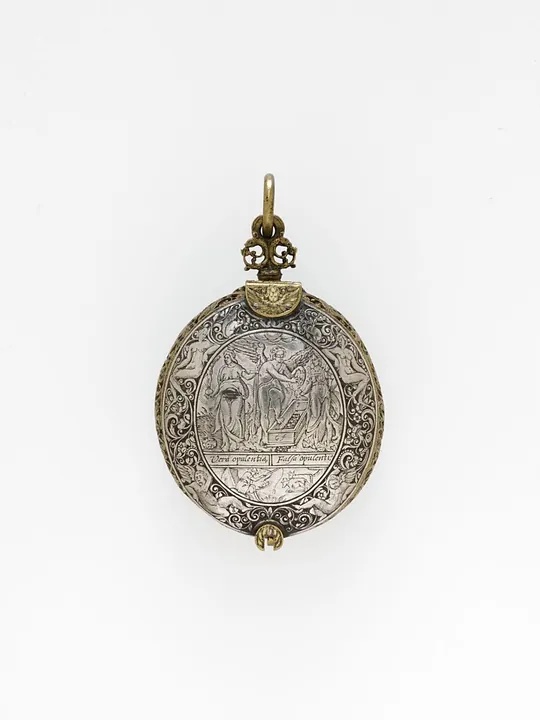
Pocket Watches · early 17th century
Watch of engraved and pierced silver and gilt brass, signed 'Noel Hubert A Rouen', France, early 17th century
Victoria and Albert Museum, London
Pocket Watches · 1601–1700
Pocket watch by D Margotin, France, 1601–1700
Science Museum Group, London